
It’s 7:45 p.m. You’re at the pre-interview dinner or the resident–faculty mixer at a national conference. Your feet hurt, your tie is too tight, and you’re holding a sweating plastic cup of bad white wine. Someone whispers, “That’s the program director,” and suddenly the person you’re chatting with steps aside and you find yourself face-to-face with the exact human who can shape your career.
You panic. You say the first thing that comes to mind.
And three years later, the residents still tell the story.
I’ve watched more careers get quietly dinged by 30 seconds of sloppy small-talk than by an entire application. Not because people are evil or vengeful, but because medicine is a small village and program directors are human. They remember moments, not PDFs.
Let’s walk through the small-talk mistakes that do not just embarrass you for a night—but echo through rank meetings, hiring decisions, and future letters.
1. Treating “Informal” As “Unfiltered”
The biggest lie in academic medicine: “This is just an informal social event, relax.”
Whenever you hear that, translate it to: “You are being evaluated without the protection of structure. Any weirdness will be used as a tiebreaker later.”
The mistake
You believe:
- “It’s after hours, everyone’s relaxed.”
- “We’re at a bar, so normal social rules apply.”
- “If the chief resident is swearing, it’s fine if I do too.”
Wrong. The social setting is casual. The memory is not.
I’ve seen all of these happen in a single recruitment season:
- An applicant complaining about their home program’s leadership by name, at a happy hour, standing two feet from a faculty member who trained there.
- A student making a raunchy joke about nurses within earshot of the PD, thinking “everyone’s loosening up.”
- An intern at a conference bragging to a PD about “beating” duty hours and “getting away with it.”
None of those people were explicitly “blacklisted.” But they were absolutely discussed in rank and hiring conversations.
How to avoid it
Use this rule:
If you would not say it in a semi-formal noon conference with faculty present, do not say it at the reception.
Quick filters for “keep it in your head” topics:
- Complaints about:
- Your home program
- Individual attendings
- Nurses, techs, patients, admin
- Anything about:
- Breaking rules (duty hours, moonlighting, documentation games)
- Sex, politics, religion (unless they bring it up in a clearly safe way, and even then tread lightly)
- Making fun of other specialties or programs
You’re allowed to relax. You’re not allowed to forget that everyone here is in your industry for life.
2. Trying to Be Clever Instead of Clear
People get nervous and start “performing.” They try to be funny, memorable, edgy.
That instinct will bury you.
The mistake
A few greatest hits I’ve heard:
- “I’m not really into scut work, I like more ‘pure medicine’.” (To a PD who started as a bedside nurse.)
- “Yeah, I’m trying to avoid ending up in community programs.” (Said at a reception hosted by a high-quality community program.)
- “Honestly, I just want a place where people aren’t so obsessed with research.” (To a PD with an R01 whose identity is, yes, research.)
These are not career-ending lines. But they’re “sticky”. They lodge in memory. And in medicine, if people can summarize you in one unflattering sentence—“that’s the one who trashed community programs”—it follows you.
How to avoid it
Don’t try to be impressive. Try to be:
- Straightforward
- Interested
- Not obnoxious
If you hear yourself about to make a big sweeping statement about:
- What “matters” in residency
- What’s “beneath” you
- What’s “a waste of time”
Stop. Switch to curiosity instead:
- “How do residents get involved in research here?”
- “What kind of patients do you see most?”
- “What do your grads usually go on to do?”
You can have strong preferences. But don’t package them as insults to entire ways of practicing medicine.
3. Confusing Being “Real” With Oversharing
There’s a fad right now where applicants are told, “Just be authentic, be yourself.”
Fine. Except some people interpret that as “tell your PD your full unfiltered life story in 90 seconds over meatballs.”
The mistake
I’ve seen these drop like grenades into perfectly normal small-talk:
- “Honestly, I chose this specialty because internal medicine seemed too boring.”
- “My last relationship ended because my partner could not handle my hours, so I’m just not doing relationships during residency.”
- “I had a really rough time with depression last year; my Step 2 prep was… honestly a train wreck.”
None of those topics are shameful. But they are not small-talk with a gatekeeper.
What happens in the PD’s head:
- “Will they trash us later the way they talk about their last program or partner?”
- “Are they going to overshare with everyone?”
- “Is this going to become a professionalism or boundaries issue?”
Program directors must worry about risk. You do not want to be mentally tagged as “might be drama.”
How to avoid it
You can be “real” without being raw.
Safe small-talk lanes with PDs:
- Where you grew up, went to school
- What you like about the specialty
- Professional interests (teaching, QI, global health, research)
- Non-controversial hobbies (running, baking, music, sports)
If the conversation starts drifting to:
- Your mental health history
- Your divorce or breakup
- Financial disaster
- Interpersonal conflict at prior institutions
Pull it back. You’re not in therapy. You’re talking to someone who may later have to defend ranking or hiring you in front of a committee.
4. Negging Programs and Colleagues to “Signal Standards”
This one is common among high-achievers trying to show they have “high standards” or are “competitive.”
So they start casually negging everything.
The mistake
Variants I’ve heard:
- “Some of the places I interviewed at… honestly felt kind of low-tier.”
- “I don’t really want to work somewhere where the residents need their hands held.”
- “That other program I saw seemed really malignant, I’m hoping this place is less like that.”
To program leadership, this sounds like:
- “I will talk about you like this too when you’re not in the room.”
- “I think my value comes from putting other people down.”
- “If anything goes wrong here, I’ll be the loudest complainer.”
Remember: programs talk. PDs text each other. Chiefs gossip at conferences. That dismissive comment you made about “low-tier” programs? It might be about one of their best friends’ programs. Or their spouse’s job. Or the place they trained.
How to avoid it
You can show standards without trashing others.
Bad:
“I don’t want to end up somewhere that’s not academic enough.”
Better:
“I’m really energized by being around people who are involved in teaching and scholarship, so I’m looking for that in a program.”
Bad:
“Some residents I met elsewhere seemed kind of unmotivated.”
Better:
“I work best in groups where people push each other and care about getting better; that’s something I really value.”
You want PDs to think: “They’re serious, but not arrogant.” Not: “They think they’re above everyone.”
5. Treating Program Directors Like Your Peers—or Like Celebrities
Both ends of this spectrum are a mess.
One group acts like the PD is just another resident at the bar. The other behaves like they just met Beyoncé.
Both are off.
The “too casual” mistake
Examples I’ve seen:
- Slapping a PD on the back.
- Calling them by first name without permission, while everyone else uses “Dr. X.”
- Teasing them about sports, politics, or age in a way that would be fine with peers, not with someone deciding your fate.
Program directors are often friendly. Many genuinely want you to feel at ease. That does not mean there is no hierarchy.
The “star-struck” mistake
Other side:
- Monologuing about their papers or podcast for five minutes.
- Over-flattering: “Your program is literally my dream, I’ve been following you for years, I quote your talks all the time.”
- Hovering around them all night instead of circulating. Looking desperate.
PDs are used to being “a big deal” in small circles. You don’t get extra credit for feeding that.
You just look like you have no boundaries or self-confidence.
How to avoid it
Aim for: respectful, not worshipful. Warm, not buddy-buddy.
- Start with “Dr. [Last Name]” until told otherwise.
- Keep compliments specific and short:
- “I appreciated your talk on X—especially your point about Y.”
- Share the air. Talk to others at the table, not just the PD.
- If you’re at a bar or dinner, remember: this is still work for them.
If you feel yourself gushing, stop. Ask them a simple, professional question and listen.
6. Alcohol and the Illusion of Safety
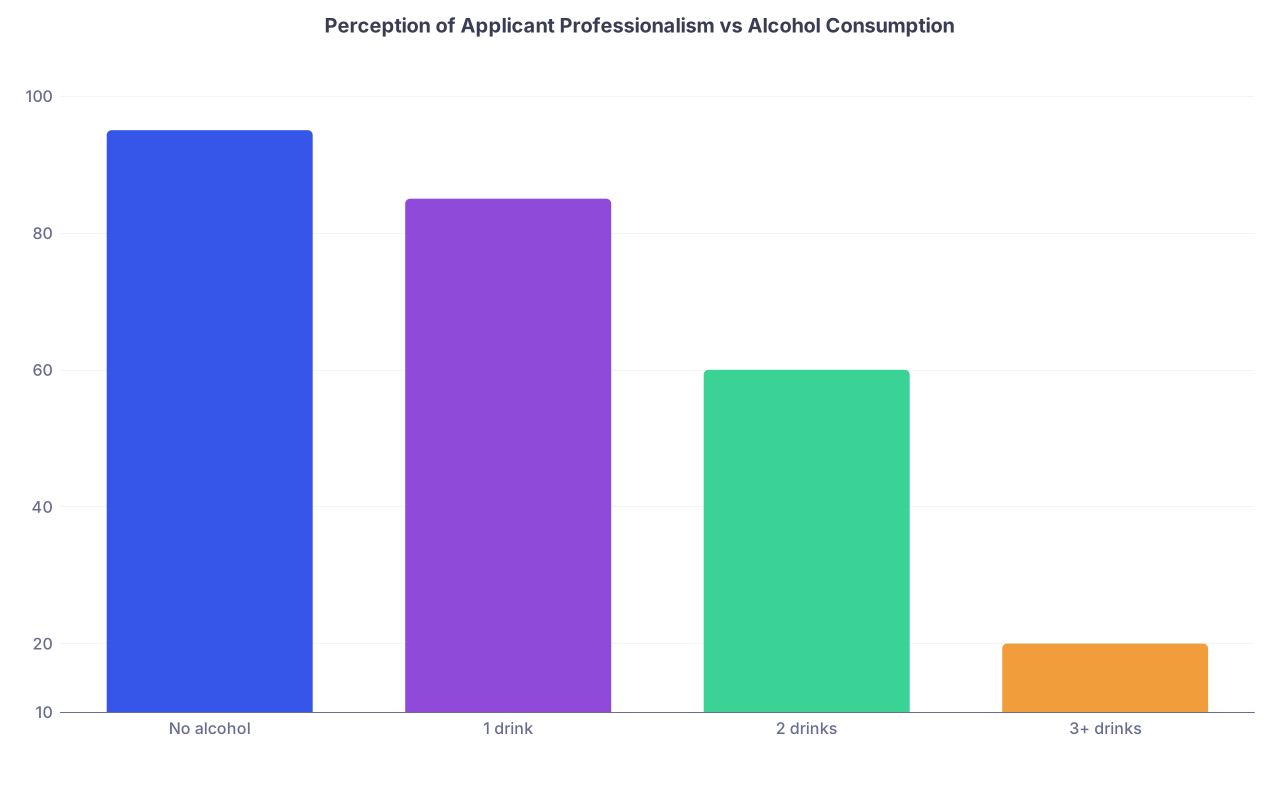
If there’s an open bar, assume it’s a test you can quietly fail.
| Category | Value |
|---|---|
| No alcohol | 95 |
| 1 drink | 85 |
| 2 drinks | 60 |
| 3+ drinks | 20 |
Those numbers aren’t from a specific study; they’re how PDs’ internal dials often work. The more you drink, the more ways you give them to doubt your judgment.
The mistake
The classics:
- Getting visibly tipsy and louder as the night goes on.
- Telling a “funny” drunk story from med school that actually reveals:
- Poor judgment
- Unprofessional behavior
- Possible legal issues
- Holding a drink in every photo that lands on people’s phones and shared group chats.
You might think you’re in control. But all it takes is one slurred word, one too-hard laugh at an off-color joke, one over-share. That’s what people remember.
How to avoid it
- Hard cap yourself at:
- 0–1 drink if you’re a student or applicant.
- Keep a non-alcoholic drink in your hand between alcohol if you even go there.
- If you don’t drink at all, you owe no one an explanation. “I’m good with water, thanks,” is enough.
Do not let FOMO or social pressure make you gamble with the one thing you actually control in this process: how put-together you seem.
7. Misreading Group Dynamics and Confidentiality
People assume: “If a resident tells me something negative about the program, PDs must hate them. I’ll score points by co-signing or adding my own take.”
Disastrous.
The mistake
You’re at a table with residents. One says, “Yeah, the ICU months can be rough. Lots of hours.”
You chime in:
“Honestly, I think programs that push duty hours like that are unethical. My friend’s program is militant about hours. If I see anything sketchy, I’ll report it.”
Then the PD sits down.
You have just:
- Called them potentially unethical.
- Marked yourself as someone who may escalate before understanding context.
- Put their current residents who were venting in an awkward spot.
Or worse: you start quoting residents’ comments verbatim to PDs to show how “in the loop” you are.
Residents notice. That story will circle back. You will be remembered as untrustworthy.
How to avoid it
- Treat any negative resident commentary as confidential venting, not ammunition.
- If you have a concern, frame it neutrally:
- “Some residents mentioned ICU months are intense. How does the program support people during those stretches?”
- Do not become the person who gleefully repeats internal gripes to leadership.
Programs are actively looking for people who will raise concerns maturely. Not people who carry gossip up the chain like trophies.
8. Trying to “Stand Out” With Controversial Takes
Some applicants think being memorable requires being provocative.
It does. Just not in the way you want.
The mistake
These are the “hot takes” I’ve heard that tanked the vibe instantly:
- “Telemedicine is overblown; in-person is the only real medicine.”
- “I don’t think diversity initiatives actually improve care; they’re more PR than substance.”
- “Honestly, I think residents these days are too soft about work–life balance.”
Even if someone quietly agrees with you, this is not the right stage. You are not interviewing to be a pundit. You’re interviewing to be a safe, collegial colleague.
What PDs hear:
- “This person might undermine institutional priorities.”
- “They could be a liability with patients or staff if they say something like this in clinic.”
- “Do I want to be explaining their comments in a dean’s office someday?”
How to avoid it
You’re allowed to have opinions. You don’t need to air all of them in a 10-minute small-talk window.
Safer patterns:
- Ask questions instead of planting flags.
- “How has your program adapted to telemedicine, and how do you see it evolving?”
- Use “I’m curious about…” instead of “I think X is dumb.”
- If a topic is obviously loaded (DEI, unionization, politics), default to listening.
If you’re itching to “stand out,” do it by:
- Asking insightful, specific questions.
- Showing you understand the specialty’s real challenges.
- Being the one applicant who’s not trying too hard.
9. Forgetting That People Talk—For Years
Here’s the part applicants consistently underestimate: the longevity of stories.

| Step | Description |
|---|---|
| Step 1 | Awkward Comment at Mixer |
| Step 2 | Resident Mentions it to Co-resident |
| Step 3 | Story Reaches Chief Residents |
| Step 4 | PD Hears Summary Version |
| Step 5 | Name Mentioned in Rank Meeting |
| Step 6 | Story Retold Next Season as Cautionary Tale |
I know programs that still reference a bad comment from seven years ago when teaching their own residents “how not to act on interview day.”
Not because they’re petty. Because storytelling is how culture transmits norms.
The mistake
You assume:
- “They’ll forget by next week.”
- “There are so many applicants; my moment won’t matter.”
- “As long as my scores are good, I’m safe.”
Reality:
- People have scary-good memory for social weirdness.
- Names stick to stories, especially if they’re novel or cringey.
- On the margin, small-talk is exactly what tips decisions.
How to avoid it
You cannot control every impression. But you can avoid giving them a story.
Don’t be the main character.
If someone had to describe you later, aim for:
- “Seemed solid, nice, interested in ICU.”
- “Quiet but professional, liked QI.”
- “Friendly, asked good questions about mentorship.”
That sounds boring. That’s the point. Boring is safe. Safe gets ranked, hired, trusted.
You want to be memorable later for your actual work and how you conduct yourself as a resident or fellow. Not for the weird comment at the poster session.
10. A Quick Reference: What To Say vs. What To Avoid
| Situation | Safer Approach | Risky Approach |
|---|---|---|
| Asked about other programs | “I’ve seen a range of setups; I’m figuring out where I fit best.” | “Some places felt pretty low-tier or malignant.” |
| Talking about residents’ workload | “I know ICU blocks can be intense; how do you support folks?” | “Any program that pushes duty hours is basically abusive.” |
| Discussing your interests | “I’m especially interested in [X area] and teaching.” | “I don’t want to do scut like some programs make interns do.” |
| Receiving alcohol | “No, thank you, I’m good with water.” | Accepting multiple drinks and telling wild stories. |
| Asked why this specialty | “I like the mix of [specific reasons] and continuity with patients.” | “I didn’t want to do surgery or deal with surgeons.” |
FAQs
1. If I already made a small-talk mistake with a PD, should I try to “fix” it later?
If it was minor awkwardness, let it die. Do not send a long apologetic email that reminds them of something they’d half-forgotten. If it was clearly bad—overtly inappropriate, potentially offensive—you can send a brief, direct note along the lines of: “I realized on reflection that my comment about X could have come across poorly. That wasn’t my intent, and I’m sorry if it did.” Then stop. Over-fixing often draws more attention than the original misstep.
2. Is it fake to avoid being “fully myself” in these interactions?
No. It’s professional. You already do this with patients, attendings, even family at times. You’re not being asked to become someone else; you’re being asked to show the version of yourself that’s appropriate for a high-stakes professional setting. Think of it as “clinic-you,” not “group-chat-you.”
3. What if the PD is the one making edgy jokes or oversharing—am I supposed to match that?
Do not mirror unprofessional behavior to “fit in.” Smile politely, keep your responses neutral, and gently redirect to safer topics when you can. You will not be penalized for being slightly more formal than the most relaxed person in the room. You can be penalized for echoing their worst instincts.
4. How do I practice small-talk so I don’t panic in the moment?
You rehearse it the same way you rehearse answers for formal interviews. Grab a classmate or resident and run 10-minute “mixer drills” where they play PD and you have to keep a normal conversation going: background, interests, a couple of questions, graceful exit. It feels silly. Do it anyway. Better to stumble over your words in a fake coffee shop than in front of the person who controls your spot.
Key points:
- Informal settings are still part of your evaluation; “relaxed” does not mean “unfiltered.”
- Avoid being the main character—no hot takes, no gossip, no oversharing, minimal alcohol.
- People remember small-talk missteps for years; aim for “solid and professional,” not “unforgettable for the wrong reason.”