
You finish a two-week subspecialty elective. The feedback form says “Pleasure to work with you.” The attending says, “Keep in touch.” You walk out of the hospital… and you both disappear from each other’s lives.
That “keep in touch” could have been a letter writer. A mentor. A research collaborator. Maybe even the person who calls a PD for you one day. Instead, nothing.
Let’s fix that.
You are going to build a repeatable, step-by-step system to convert rotations into lasting mentorships. Not “hope they like me.” A system. Something you can run on every rotation, with every potential mentor, for the rest of your career.
Step 1: Clarify What You Actually Want From Mentorship
Before you start “networking,” get brutally clear on what you need. Otherwise you will collect vague contacts and no real mentors.
Here is the reality: different mentors serve different purposes. Stop trying to find one magical “career mentor” who does everything.
Break it down into roles:
- Door opener – makes calls, sends emails, connects you to people
- Skill builder – teaches you how to think, work up patients, do procedures
- Navigator – tells you which paths are dumb, which are smart, and why
- Sponsor – puts their name on the line for you (letters, phone calls)
- Research guide – gets you publications, shows you how to run projects
Decide your top 1–2 needs for the next 12–18 months, not your whole life.
Example:
- M3 with average scores, curious about IM vs EM
→ Needs: Navigator + Door opener - M4 applying to ortho with research gaps
→ Needs: Research guide + Sponsor
Write this down. Literally.
- “For this year, I need: ______ and ______.”
Why? Because on each rotation, you will look at attendings and ask: Could this person fill one of these roles for me? If yes, they go into your “mentor pipeline.” If no, you stop forcing it.
Step 2: Treat Each Rotation as a Mentorship Hunt (Quietly)
You are not just “doing the rotation.” You are running a structured search.

| Step | Description |
|---|---|
| Step 1 | Start Rotation |
| Step 2 | Identify 2 to 3 Attendings |
| Step 3 | Perform at High Level |
| Step 4 | Request Career Conversation |
| Step 5 | Send Follow Up Email |
| Step 6 | Maintain 90 Day Contact |
Here is the system for weeks 1–2 of any rotation:
2.1 In Week 1, Scan for Potential Mentors
You are looking for three things:
- They actually enjoy teaching (you will see this fast).
- They are respected in the department (residents talk about it).
- You have some overlap with their field or path.
Ask residents directly:
- “Who here is really good with students?”
- “If you were me and wanted letters / advice, who would you try to work with?”
Write down 2–3 names per rotation max. More than that and you dilute your effort.
2.2 Align Yourself to Their Orbit
Once you know who your “targets” are, you quietly orient your work:
- Volunteer to pre-round on their patients.
- Ask chiefs/residents if you can present new admits to them.
- Offer to help with tasks they care about (consult notes, follow-up calls, etc.).
Phrase it simply:
- “If it works for the team, I would like to follow more of Dr Smith’s patients this week. I learn a lot from their teaching style.”
You are not being a kiss-up. You are concentrating exposure, which is how people form actual impressions instead of vague “yeah, I kind of remember them.”
Step 3: Make Yourself Unforgettable (For the Right Reasons)
Mentorship does not start with coffee. It starts with competence.
3.1 Basic Professionalism (You’d Be Surprised…)
Baseline behaviors that are non-negotiable if you want someone to stake their name on you:
- Show up early. Earlier than the residents.
- Know your patients cold. Labs, imaging, overnight issues, meds. No excuses.
- Close the loop. If you say you will do something, it is done and reported back.
I have watched attendings cross people off their mental “I will write for them” list in one day because they were late twice or sloppy once. People remember reliability more than brilliance.
3.2 One Signature Strength Per Rotation
You want each attending to remember you with one specific phrase.
Examples:
- “That is the student who always read about the patient’s condition and came back with a concise update.”
- “That is the student who took ownership of following up imaging and calling families.”
- “That is the student who was always prepared with a differential, not just a list of labs.”
Pick one thing. Drive it hard.
Suggestions:
The Follow-Up Machine
- Always know results before rounds and bring them up proactively.
- If you order something on a patient, you follow it and communicate.
The Reading and Teaching Student
- For 1 patient per day, read a short article or guideline and summarize 2–3 bullet points on rounds only when relevant.
- Short. No speeches. Example: “I looked up the latest HF guideline; the new threshold for SGLT2 is…”
The Communication Anchor
- Volunteer to talk to families (with supervision).
- Summarize complex plans in plain language; ask for feedback: “Did I explain that clearly?”
The specific strength matters less than consistency. People trust patterns, not one-off heroics.
Step 4: Ask for a Career Conversation Before You Leave
Most students blow this part. They leave mentorship to chance. That is lazy.
You will systematically convert “good rotation” into “first mentor conversation” before the block ends.
4.1 When to Ask
- Aim for the second-to-last day of your time on that service.
- So if it is a 4-week rotation, ask at the end of week 3 or early week 4.
- Do not wait until the last day. Life happens, cases run late, things fall apart.
4.2 How to Ask Without Sounding Awkward
Script you can literally use:
“Dr Smith, I have really appreciated working with you this rotation. Your feedback has been very helpful. I am trying to be more intentional about finding mentors early. Would you have 15–20 minutes sometime in the next week for a quick conversation about career paths in [specialty] and how someone at my stage should be thinking about it?”
Key points:
- You are not asking, “Will you be my mentor?” Too heavy, too early.
- You are asking for one conversation. Low pressure, easy to say yes to.
- You frame it as you trying to learn, not asking for favors.
If they say yes, you now have an opening. If they say no or deflect repeatedly, that is data. Do not chase.
4.3 Have a 3-Question Career Conversation
When you sit down (or do it at a quiet time between cases), go in with a structured 3-question agenda.
Examples:
- “Given where I am now (M3 / early resident), what would you be focusing on over the next 6–12 months if you were me?”
- “Looking back, what were the 1–2 decisions during your training that had the biggest impact on your career?”
- “For someone considering [specialty / academic vs community / research], what mistakes do you see people make early?”
Then one closing:
- “If, after this rotation, I have questions or want occasional advice as I progress, would it be alright if I reached out by email a few times a year?”
If they say yes to that last question, you have just created permission for ongoing contact. That is the seed of mentorship.
Step 5: Send a High-Quality Follow-Up Within 48 Hours
You are going to systematize the follow-up. No vague “Thanks for everything!” emails.
5.1 Structure Your Thank-You Email
Within 24–48 hours of the rotation ending:
Subject line options:
- “Thank you and quick update – [Your Name], [Rotation/Service]”
- “Appreciation and next steps – [Your Name]”
Email template:
Dear Dr Smith,
Thank you again for the opportunity to work with you on the [service/rotation] this month. I learned a great deal from your approach to [specific thing – e.g., evaluating undifferentiated abdominal pain / teaching on rounds / handling complex family discussions].
I especially appreciated your feedback on [1 specific behavior] and have already started applying it by [how you are using it].
As we discussed, over the next [6–12] months I will be focusing on [1–2 concrete goals: e.g., exploring internal medicine vs EM, building research experience in nephrology, strengthening my clinical reasoning].
If you are comfortable with it, I would be grateful to keep you updated a few times a year and occasionally ask for your advice as I progress.
Thank you again for your time and teaching.
Best regards,
[Full Name]
[School / PGY level]
[Phone]
[Email]
Specific. Respectful. Clear that this is not a one-off.
Step 6: Install a 90-Day Mentorship Maintenance System
Mentors are lost not at week 1, but after month 3, when no one hears from you and you hope they “still remember you” at LOR time.
You will not rely on memory. You will build a simple tracking and follow-up system.
6.1 Simple Mentor Tracking Sheet
Use a spreadsheet or note app. Columns:
| Column | Example Entry |
|---|---|
| Name | Dr Jane Smith |
| Specialty/Role | Academic Hospitalist / IM |
| Institution | University Hospital |
| How You Met | M3 IM rotation, July 2026 |
| Last Contact Date | 2026-07-28 |
| Next Contact Deadline | 2026-10-28 |
| Topic/Notes | Discussed IM vs EM, suggested research |
You update this every time you:
- Finish a rotation with a potential mentor
- Send or receive an email
- Have a meeting
6.2 The 90-Day Touch Rule
Default rule: Never go >90 days without some kind of touch with an active mentor.
Types of “touch” that do not feel needy:
- Short email update (3–5 sentences) on progress related to what they advised.
- Sharing a relevant article or guideline and one sentence on why it made you think of them.
- Quick question that is genuinely thoughtful, not “what should I do with my life?”
Example 90-day email:
Dear Dr Smith,
I wanted to send a brief update since we worked together on the wards in July. I took your advice about getting exposure to both academic and community [specialty], and I just finished a community elective where I saw [1 specific learning point].
Your point about [repeat 1 key piece of advice they gave] has been very helpful in thinking about [decision you are facing].
Next, I will be starting [upcoming rotation or project]. If you have any thoughts on how a student at my level can make the most of it, I would be glad to hear them, but no rush at all.
Best regards,
[Name]
You are not asking for anything heavy. You are keeping the relationship alive.
Step 7: Convert Good Mentors Into Sponsors (When The Time Is Right)
Mentorship is advice. Sponsorship is action.
At some point, you will need letters, calls, introductions. The worst time to ask is when they have not heard from you in a year. The best time: after a series of good contacts and clear growth.
7.1 When to Ask for a Letter or Support
Clues they are sponsor material:
- They give you specific, frequent feedback without being asked.
- They bring up opportunities without you prompting (“There is a project you might like…”).
- They reference you in front of others positively (“Our student here did a great job on…”).
If these boxes are checked and you have known them for at least a few months (ideally more):
You can ask directly but respectfully:
“Dr Smith, I am putting together my residency application for internal medicine this fall. You have seen my work on the wards and we have kept in touch since then. Would you feel comfortable writing a strong letter of recommendation on my behalf?”
That “strong letter” phrase gives them an easy out if they are not enthusiastic. If they hesitate or waffle: thank them and ask someone else. Do not push.
7.2 Give Them Materials and Make it Easy
Once they agree:
Send a “letter packet” by email:
- Updated CV.
- Short paragraph on your career goals.
- 3–4 bullet points reminding them of specific things you did with them.
- Deadlines and submission instructions in one place.
And yes, do this even for mentors you think “know you well.” People are busy. They appreciate structure.
Step 8: Build a Portfolio of 5–8 Real Mentors Over Training
You do not need 20 mentors. You need a small, intentional group.
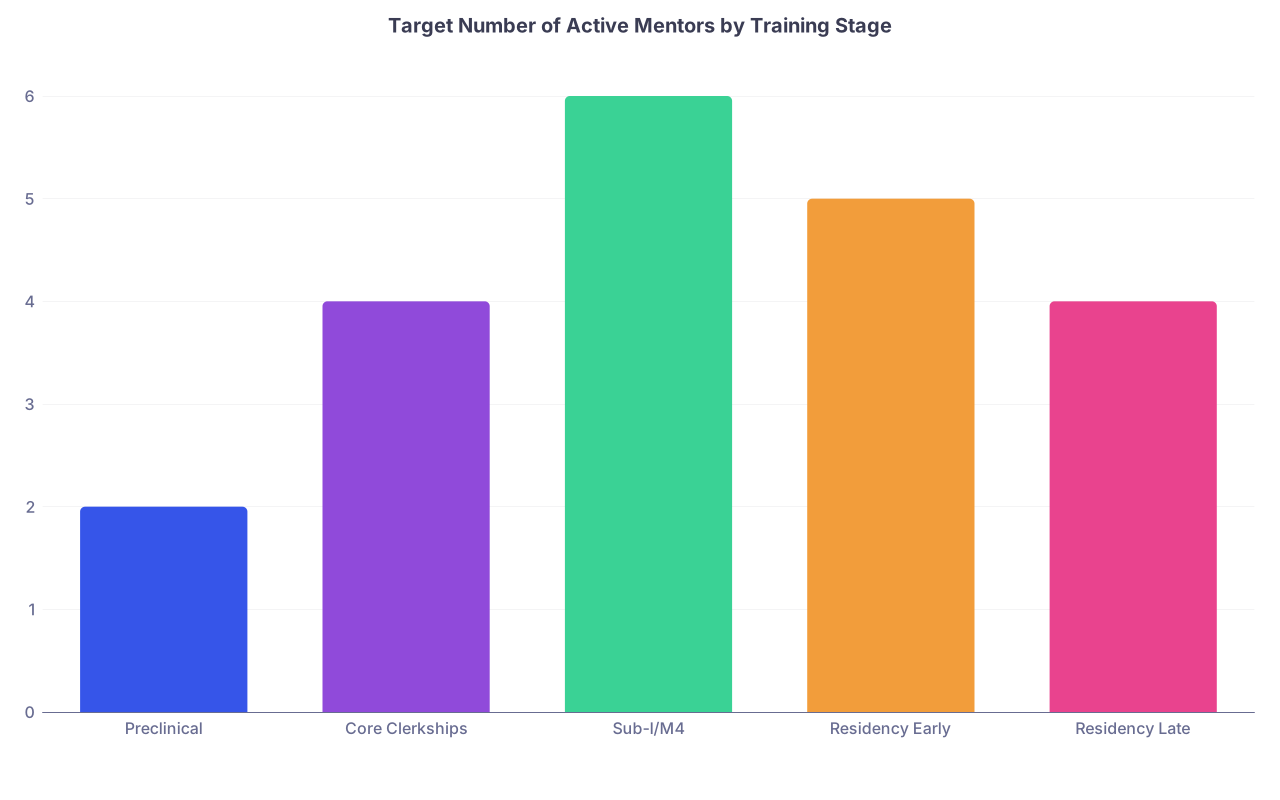
Target numbers by stage:
| Category | Value |
|---|---|
| Preclinical | 2 |
| Core Clerkships | 4 |
| Sub-I/M4 | 6 |
| Residency Early | 5 |
| Residency Late | 4 |
How this might look:
- M1–M2: 1–2 basic science / clinician advisors
- M3: 3–4 clinical mentors from core rotations
- M4: 5–7 total, with 2–3 strong letter writers
- Residency: 4–6 total, with 1–2 in your specific niche (e.g., transplant nephrology)
Distribute by function:
- 1–2 navigators
- 1–2 research / academic guides
- 1–2 potential sponsors
- 1 “truth teller” (the one who will tell you when you are being dumb)
You will lose some as people move, change jobs, or just do not click long-term. That is fine. This is a living portfolio, not a sacred circle.
Step 9: Handle Common Awkward Situations
You will run into friction. That does not mean the system is broken; it means you are interacting with humans.
9.1 They Say “Sure, Let’s Talk” But Never Reply to Schedule
This happens constantly. Do not take it personally.
Protocol:
- Wait 7–10 days.
- Send one short follow-up:
- “Just following up on my prior email in case it got buried. Totally understand if now is not a good time.”
- If no response after that, archive them as “low probability mentor” and move on.
Do not chase. If it takes two emails just to get one 15-minute chat, this will not become a reliable mentorship.
9.2 They Are Great Clinically but Terrible at Follow-Up
You may have attendings who are phenomenal teachers on the wards but never check their email.
Use in-person micro-mentorship:
- Ask 1 career question per week while on service.
- Get feedback on your performance explicitly: “What is one thing I should change or double down on?”
- Do not expect long-term contact. Use them for intense, short bursts of learning.
You do not have to force every good teacher into being a long-term mentor.
9.3 You Outgrow a Mentor
At some point, someone who was perfect for M3 you will be misaligned with as a fellow or junior attending. Maybe your interests diverge. Maybe their style stops fitting you.
You do not “break up.” You just shift gears.
- Reduce contact frequency.
- Still send major updates (match, graduation, job changes).
- Respect what they contributed and keep the door open without forcing new asks.
Step 10: Make This Automatic, Not Heroic
The difference between students who actually build a network and those who do not is not charm or genius. It is systems.
Here is a lean version you can actually run while exhausted:
10.1 A Simple Quarterly Routine
Once per quarter (set a calendar repeat):
- Open your mentor tracking sheet.
- For each active mentor:
- If >90 days since contact → send short update.
- Add new potential mentors from recent rotations.
- Decide 1 person to ask for a deeper conversation over the next month.
This takes 30–45 minutes. You can do it on a Sunday afternoon while half-distracted.
10.2 A Rotation-End Checklist
For every rotation:
- Identify 1–2 potential mentors.
- Ask at least 1 attending for a 15–20 minute career conversation.
- Have that conversation before the rotation ends.
- Send a structured thank-you email within 48 hours.
- Add them to your tracking sheet with a 90-day follow-up date.
Print this. Tape it to your desk or laptop.
How This Looks Over a Few Years
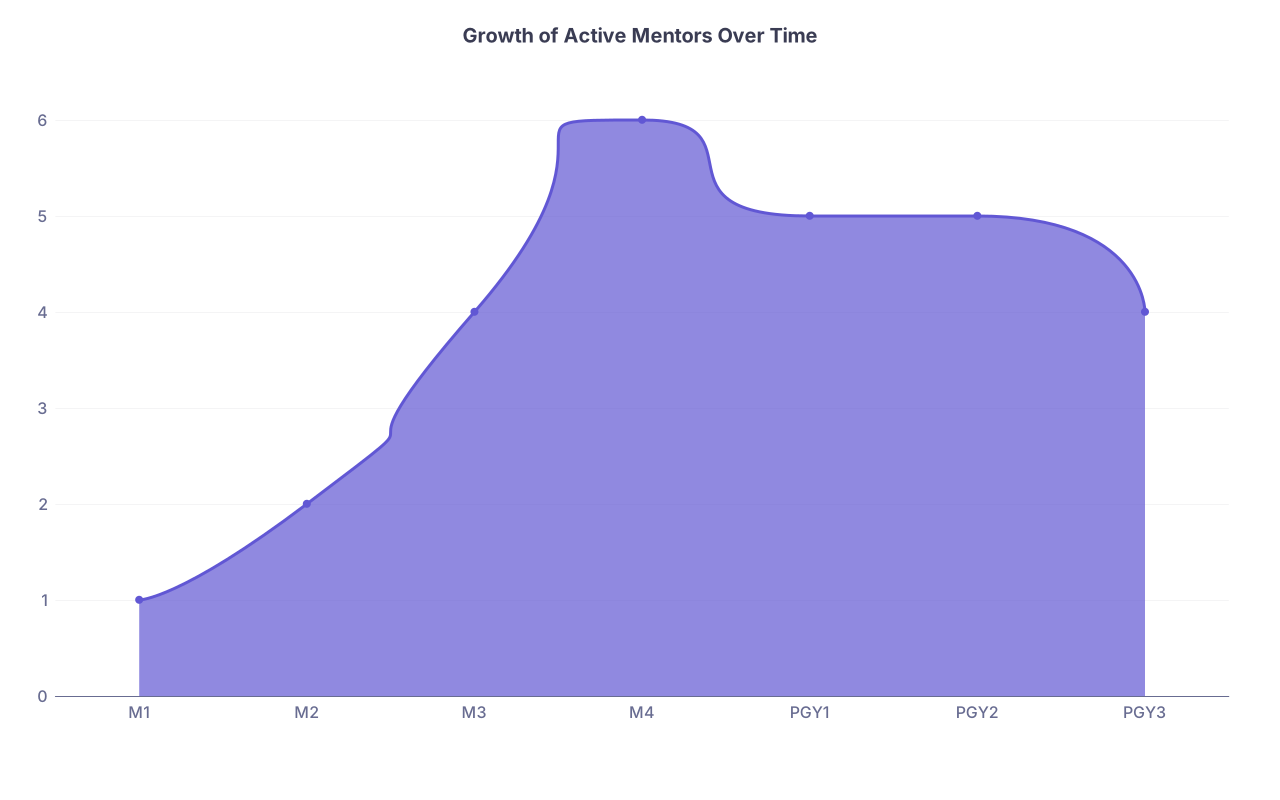
To give you a realistic picture, here is the progression I have seen with students who run this system deliberately.
| Category | Value |
|---|---|
| M1 | 1 |
| M2 | 2 |
| M3 | 4 |
| M4 | 6 |
| PGY1 | 5 |
| PGY2 | 5 |
| PGY3 | 4 |
By the time they hit residency:
- They are not scrambling for letters. They are choosing among strong options.
- PDs already know their name through back-channel calls.
- They have a clear idea of where they fit (academic vs community, niche interests).
- When they need to pivot (fellowship choice, job decision), they have people to call who actually understand their trajectory.
This is not magic. It is consistent, systematized effort across rotations.
FAQs
1. What if I am introverted or feel like I am “using” people by doing this?
You are not asking for handouts. You are offering effort, reliability, and curiosity in exchange for guidance. That is exactly how medicine has functioned for decades. Introverts do very well with this system because it is structured and does not rely on “working the room” or fake small talk. You are asking for focused, specific conversations, not constant socializing.
2. How many mentors should come from my own institution versus outside?
Early in training, most should be at your home institution, because they see your day-to-day work and can sponsor you locally. As you progress (late residency, fellowship), add a few external mentors in your subfield through conferences, collaborative projects, and introductions. A solid target: 70–80% internal, 20–30% external once you are aiming for fellowship or faculty positions.
3. What if a rotation went badly – can I still try to salvage mentorship from it?
If the rotation was truly bad (documented issues, conflict, remediation), do not force mentorship from that group. Focus on other rotations. If it was just “not stellar” but you improved, you can still ask one attending you did click with for a career conversation, but be realistic: they may not be ideal sponsors. Your energy is better spent making the next rotation a clean slate and executing this system from day one.
Key Takeaways:
- Do not leave mentorship to chance. Use each rotation as a deliberate search for 1–2 potential mentors.
- Convert positive clinical impressions into structured career conversations before the block ends, then maintain 90-day contact.
- Build a small, intentional portfolio of 5–8 mentors over your training, and let a few of them evolve into true sponsors who will put their names behind you.