Why Networking Matters So Much in a Transitional Year Residency
Transitional year residency is unique: one year, broad exposure, and residents rotating through multiple departments rather than settling into a single specialty program. That structure makes networking in medicine especially critical during a TY program.
In a categorical residency, you have several years to build relationships within one department. In a transitional year residency, you have 12 months to:
- Solidify mentorship medicine relationships
- Build a reputation across multiple specialties
- Position yourself for your advanced residency and future career
- Learn the unwritten rules of medicine from people further along the path
Your clinical performance matters, but your network often determines what doors open next: strong letters of recommendation, advocacy during selection meetings, research collaborations, job leads, and early career guidance.
In this guide, we’ll walk step-by-step through how to build and leverage medical networking during your transitional year—on rotations, at conferences, in professional societies, and online—while balancing schedule demands and avoiding common pitfalls.
Core Principles of Effective Medical Networking in a TY Program
Before focusing on specific strategies, it helps to understand what high-quality networking in medicine actually looks like—especially within the compressed timeline of a TY year.
1. Think “relationships,” not “transactions”
Many residents feel awkward about “networking” because it sounds like using people. In medicine, the most effective networking is relationship-based:
- You show up consistently and reliably
- You offer value (hard work on the team, teaching juniors, sharing resources)
- You stay curious about the other person’s work, path, and interests
A useful mindset: “Can we be helpful to each other over time?” instead of “What can I get from this person today?”
2. Your reputation is your strongest networking tool
In a transitional year residency, you move frequently between services. Attending physicians talk. Program directors talk. Chiefs talk. Your daily behavior becomes part of your “brand”:
- Reliable, responsive, and prepared
- Calm under pressure
- Teachable and open to feedback
- Respectful to all staff (nurses, techs, clerks, housekeeping)
When future opportunities arise—research, fellowships, jobs—the first question is often: “What’s this resident like to work with?” Networking amplifies a good reputation; it can’t cover for a consistently poor one.
3. Targeted, not random, networking
You have limited time and energy during a TY program. You don’t need to meet “everyone.” Instead, be intentional:
- Clarify your likely advanced specialty (e.g., radiology, anesthesia, dermatology, PM&R, neurology)
- Identify clinical and academic leaders in that area at your institution
- Find residents and fellows already on the path you want
- Connect with people who share specific interests (global health, QI, med ed, informatics, policy, etc.)
Aim for a small, high-quality network of people who know you well enough to vouch for you.
4. Follow-through is what turns contact into connection
You will meet many people during the year. What differentiates successful medical networking is what you do after the first interaction:
- A short thank-you email after a meaningful conversation
- Sending an article or resource that relates to what you discussed
- Scheduling a brief follow-up (e.g., “Would you have 20 minutes to talk about research opportunities?”)
- Periodically updating mentors on your progress and career steps
One well-maintained connection is more valuable than ten forgotten introductions.
Networking on Rotations: Where TY Residents Have a Built-In Advantage
Your biggest networking asset in a transitional year residency is your rotational variety. You’ll work with attendings, fellows, and seniors in multiple specialties, often including your target advanced field. Each rotation is a chance to deepen your network—if you approach it intentionally.

1. Prepare for each rotation with a networking lens
Before starting a new block:
Scan the schedule:
Identify key faculty you’ll be working with. Ask seniors which attendings are strong teachers or well-connected in your field of interest.Set networking goals:
Example goals for a 4-week rotation:- Have at least 2 substantive teaching/mentorship conversations with attendings
- Identify 1 potential project (QI, research, education)
- Get specific performance feedback before the final week
Clarify your narrative:
Have a 2–3 sentence, non-awkward explanation of your path:“I’m a transitional year resident planning to go into anesthesia. I’m using this year to build a strong internal medicine foundation and to explore perioperative medicine.”
This gives attendings context for how to help you.
2. Network through excellent clinical work
On busy services, your work is your introduction. To stand out as a TY resident:
Arrive early, know your patients cold
Anticipate plan questions, lab trends, and likely issues.Communicate clearly and efficiently
Especially on rounds and in sign-out. Being concise and accurate builds trust quickly.Volunteer strategically
Take on manageable extra tasks (e.g., draft a patient education handout, lead a mini-case discussion, help with a QI data pull).
Attending physicians are more likely to mentor or sponsor a resident who reliably makes the team’s life easier and demonstrates genuine curiosity.
3. Initiate professional conversations without feeling awkward
Many residents hesitate to “bother” faculty. Most educators appreciate interested residents—if you approach respectfully.
Some simple scripts you can adapt:
Early in the rotation
“Dr. Lee, I’m a transitional year resident planning to go into PM&R. I’d love to get the most out of this rotation—particularly around neuro exam skills. Is there anything specific you recommend I focus on?”
Mid-rotation check-in
“Do you have any feedback on how I can be more helpful to the team or what I should work on during the rest of the month?”
Career-focused ask (toward the end)
“I’ve really appreciated your teaching this month. Would you be open to a brief meeting sometime to discuss my career plans and any advice you might have for someone interested in neurorehab?”
This shows respect, self-awareness, and initiative—key traits attendings want to support.
4. Identify mentors, sponsors, and “near-peer” guides
During your transitional year residency, try to build a small “advisory board”:
- Mentors – People who advise you over time. They help you think through decisions, goals, and development.
- Sponsors – People who actively advocate for you (e.g., recommending you for a research role, calling a PD on your behalf). Often attendings or program leaders.
- Near-peer guides – Senior residents or fellows 1–5 years ahead of you, especially in your intended specialty, who can give practical advice on applications, interviews, and early career choices.
On each rotation, ask yourself:
- Who seems invested in teaching?
- Who has a career or academic track similar to what I might want?
- Who has given me specific, thoughtful feedback?
Those individuals are good candidates for mentorship medicine relationships.
5. Convert rotation contact into a longer-term connection
Before the last week of a rotation:
Ask explicitly (when appropriate):
“I’ve really valued working with you this month. Would it be alright if I stayed in touch as a mentee as I move forward with [anesthesia/radiology/etc.] applications?”
Follow up with a short email within a few days of the rotation ending:
- Thank them for specific things (e.g., feedback, teaching sessions).
- Briefly summarize what you’re aiming for career-wise.
- Suggest one simple next step (e.g., “If you’re open to it, I’d love to schedule a 20-minute meeting to ask about research possibilities in your group.”)
Add a periodic check-in every 3–6 months:
- Update them on match outcomes, new projects, or major milestones.
- Ask focused questions rather than writing “just checking in.”
Conference Networking: Turning Events into Career Leverage
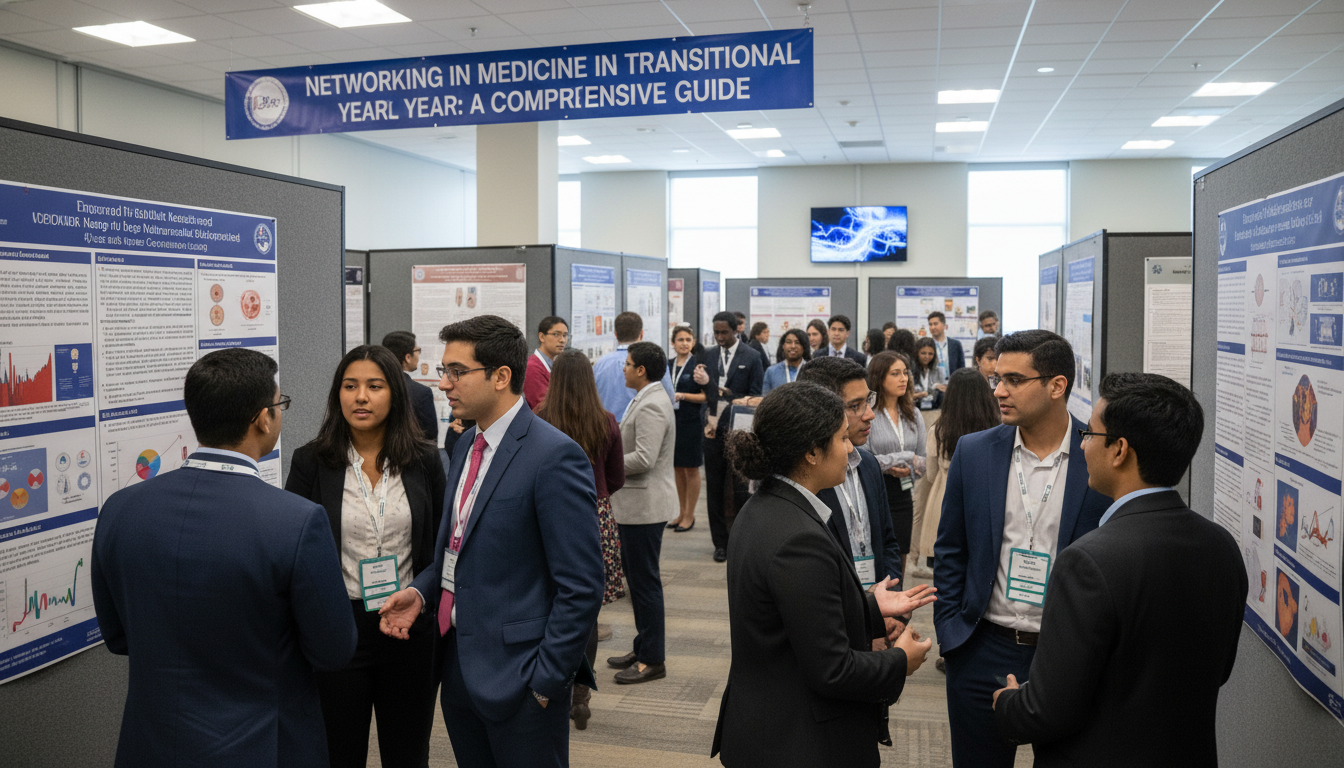
Conference networking can be especially powerful for TY residents, offering a chance to expand beyond your home institution. Even if your year is packed, attending one national or regional meeting can pay off.
1. Choose conferences strategically during your TY year
Prioritize:
Your advanced specialty’s main national meeting
(e.g., ASA for anesthesia, RSNA for radiology, AAN for neurology, AAD for dermatology)Regional society meetings
Smaller venues may make networking more accessible, with more time for one-on-one conversation.Subspecialty or interest-focused conferences
(e.g., medical education, quality improvement, global health, informatics)
If funding is limited, ask:
- Your TY program about conference funds or educational allowances
- Specialty departments for travel support if you’re presenting
- Organizations with travel scholarships for trainees
2. Prepare a simple conference networking plan
Before going:
Scan the program and highlight:
- Sessions aligned with your interests
- Speakers you’d like to meet
- Networking events (resident/fellow receptions, mentorship sessions, interest group meetings)
Research 5–10 people you might realistically encounter:
PDs, researchers, or educators from places you’re considering for residency or fellowship.Prepare your “story” in a 20–30 second version:
Who you are, your training status, your interest area, and what you’re hoping to learn or pursue.
Example:
“I’m a transitional year resident at [Institution] planning to go into diagnostic radiology. I’m especially interested in thoracic imaging and AI applications in workflow. I’m using this year to build my clinical foundation and get involved in imaging research.”
3. Practical strategies for conference networking
At the conference:
Prioritize smaller, interactive sessions
Workshops, interest group meetings, and hands-on sessions are better than huge plenaries for meeting people.Use the poster hall strategically
- Visit posters in your interest area and introduce yourself.
- Ask a question that shows you’ve read at least the abstract.
- If you connect well, ask: “Would you be open to my following up by email to learn more about how you got involved in this kind of work?”
Attend trainee-focused and mentoring events
Many societies have formal mentorship medicine programs, speed mentoring, or “meet the professor” lunches. Sign up early.Practice professional but approachable body language
Don’t stand alone staring at your phone. Join small groups, introduce yourself, and ask where they’re training and what they’re working on.
4. Follow-up: where conference networking actually pays off
Within a week after the conference:
Send brief, personalized emails to people you connected with:
- Thank them for their time.
- Mention a specific topic you discussed.
- Suggest a clear, reasonable next step (e.g., “Could we schedule a short Zoom meeting to discuss how students and residents get involved with your group’s projects?”)
If you presented a poster or talk, share a PDF or link if appropriate.
Add them to a simple tracking list (even a spreadsheet or notes file) with:
- Name, institution, role
- Where you met
- Interests/projects you discussed
- Your planned follow-up timing
Consistent, thoughtful follow-up is how “I met this interesting person” turns into “This faculty member helped me get an interview” or “We collaborated on a paper.”
Building a Sustainable Mentorship and Networking System During TY
Because transitional year residency is short and intense, you need systems to keep your network organized without adding stress.
1. Map your “network ecosystem” early in the year
Spend 30–60 minutes identifying:
Home institution contacts
- TY program leadership
- Attendings you already know or will likely work with
- Residents/fellows in your target field
- Research and QI leaders
External contacts
- Faculty from away rotations or medical school
- People you’ve met at conferences
- Alumni in your desired specialty
Group them loosely by role (mentor, sponsor, colleague/peer) and by specialty or interest.
2. Use light-weight tools to stay organized
Keep it simple; you don’t need a CRM system. Options:
- A spreadsheet with columns for name, role, department, last contact, next action
- A structured note in a cloud app (Notion, OneNote, Google Docs)
- Calendar reminders to check in with key mentors every few months
Aim to:
- Touch base with primary mentors 2–4 times per year
- Update sponsors when significant milestones occur (research accepted, match outcome, awards, etc.)
- Maintain informal contact with peers and near-peers through messages, group chats, or social media (if professional)
3. Make mentorship medicine a two-way street
Even as a TY resident, you can add value to your mentors:
- Show up prepared to meetings; send a brief agenda in advance
- Follow through on advice they give whenever feasible
- Share updates on how their guidance helped you
- Offer to help with small tasks (e.g., data collection, lit searches, drafting educational materials)
When mentors see you as reliable and appreciative, they are more likely to invest deeply and advocate strongly on your behalf.
4. Protect your time and energy
Networking should fit within a healthy residency life, not take it over. Guardrails:
- Set a realistic networking “budget”: e.g., 1–2 hours per week on average
- Combine networking with existing tasks:
- Turn end-of-rotation feedback meetings into networking moments
- Use commute time or post-call downtime for quick emails
- Practice saying no: you don’t have to accept every project offered. Choose those that align with your goals and capacity.
Digital and Social Networking in Medicine: Extending Beyond Your Institution
Beyond in-person networking, online platforms can significantly expand your access to mentors and opportunities—if used thoughtfully and professionally.
1. Professional online presence basics
During your transitional year residency, ensure that:
Your LinkedIn profile is up to date
- Professional headshot
- Clear headline (e.g., “Transitional Year Resident | Future Anesthesiologist | Interest in Perioperative Outcomes Research”)
- Brief summary and bullet points for major experiences
Your email address is professional
Ideally your institutional email, with a clear signature block (name, PGY level, institution, contact info).Public social media is curated
If you use X (Twitter), Instagram, or other platforms professionally, keep content appropriate for colleagues, PDs, and patients.
2. Using social media for medical networking
If you choose to engage:
- Follow organizations and leaders in your target specialty
- Engage with educational threads, journal articles, and conference content
- Avoid posting patient-identifiable information or venting about colleagues, staff, or programs
You can also:
- Join specialty-specific groups and communities (e.g., radiology Twitter communities, anesthesiology forums)
- Reach out politely via direct message when appropriate:
“I enjoyed your thread on [topic]. I’m a transitional year resident interested in [field] and was wondering if you have any advice for residents looking to get involved in [area].”
3. Virtual conferences, webinars, and interest groups
Many professional societies offer:
- Virtual journal clubs
- Resident/fellow webinars
- Online mentorship match programs
- Specialty interest groups
These can be particularly valuable during a TY program if your schedule limits travel. Treat them like in-person events:
- Show up on time
- Ask thoughtful questions
- Follow up with speakers or organizers as appropriate
Common Pitfalls in Transitional Year Networking—and How to Avoid Them
Networking in medicine is powerful, but there are ways it can go wrong if not handled carefully. Being aware of these pitfalls can protect your reputation.
1. Over-asking before delivering value
Repeatedly requesting letters, opportunities, or special favors from someone you barely know—or before you’ve shown reliability—can damage relationships. Instead:
- Focus first on demonstrating consistent clinical competence and professionalism
- Take on and complete small tasks to build trust
- Ask for feedback before asking for favors
2. Neglecting non-physician relationships
Nurses, advanced practice providers, therapists, pharmacists, and clerical staff are central to your daily work—and to your reputation. They can:
- Advocate for you informally
- Teach you practical skills and workflows
- Share insight into team dynamics and institutional culture
Respectful, collegial relationships with the entire team are a key part of effective networking in medicine.
3. Spreading yourself too thin
In a transitional year residency, there’s a temptation to say “yes” to every project and connection out of fear you’re not doing enough. This can lead to burnout and unfinished commitments.
Early on, define:
- Your top 1–2 academic/clinical focus areas for the year
- The maximum number of concurrent projects you can realistically handle
- A polite decline script, such as:
“Thank you for thinking of me. I’m at capacity with current projects and don’t want to commit to something I can’t give my best effort. If opportunities come up in [month/timeframe], I’d love to reconsider then.”
4. Failing to close the loop
Not responding to emails, forgetting to follow up on tasks, or disappearing after a meeting erodes trust. To avoid this:
- Keep a simple list of commitments (emails to send, tasks to complete)
- Use your calendar or task app to set reminders
- When plans change, communicate early:
“I’m sorry—my rotation unexpectedly changed and I won’t be able to meet the original timeline. Can we adjust the deadline or narrow the scope?”
FAQs: Networking in Medicine During a Transitional Year Residency
How early in my transitional year should I start networking?
Start in the first 1–2 months, but keep it simple:
- Focus on building a strong reputation on your first rotations
- Request feedback and demonstrate teachability
- Identify 1–2 potential mentors locally and ask if you can stay in touch
As you settle into the rhythm of residency, expand to more structured networking: conferences, research inquiries, and professional society engagement.
I’m introverted and find medical networking draining. Any tips?
Yes. You don’t need to be extroverted; you need to be strategic:
- Prioritize one-on-one or very small-group conversations
- Set manageable goals (e.g., “I’ll have two meaningful conversations during this event”)
- Prepare a few open-ended questions in advance (“What led you to this specialty?” “What projects are you most excited about right now?”)
- Schedule recovery time after big events whenever possible
Quality beats quantity. A few deep connections can be more valuable than dozens of superficial ones.
How do I ask for a strong letter of recommendation during my TY program?
Timing and context are key:
- Choose an attending who has worked with you enough to see your clinical performance and professionalism (often at least 2–4 weeks).
- Ask near the end of the rotation or shortly after, in person if possible:
“I’ve really valued working with you. I’m applying to [specialty] and was wondering if you’d feel comfortable writing a strong letter of recommendation for me.”
- Provide supporting materials:
- Updated CV
- Personal statement (even a draft)
- Brief bullet list of specific cases or contributions that highlight your strengths
If they seem hesitant, thank them and consider asking someone else rather than pushing.
What if my future specialty isn’t heavily represented at my transitional year institution?
You can still build a strong specialty network:
- Reach back to mentors from medical school in your desired field
- Use national specialty societies’ mentorship programs
- Attend at least one specialty-specific conference (in person or virtual)
- Seek away rotations or electives (if scheduling and program policies allow) at institutions strong in your field
- Leverage online communities and social media professionally to connect with faculty and trainees in that specialty
Combining local generalist mentors with remote specialty mentors can be highly effective.
Networking in medicine during your transitional year residency doesn’t have to be overwhelming or artificial. By anchoring your efforts in excellent clinical work, intentional relationship-building, and consistent follow-through, you can emerge from this one-year program with a powerful network of mentors, sponsors, and colleagues who will support your residency, fellowship, and beyond.