You open your inbox between cases. One reply from a cold email you sent a week ago. A local cardiologist actually wrote back: “Happy to chat. Let’s set up a time.”
Good. But here is the problem:
You do the Zoom, have a pleasant 25-minute conversation, thank them… and then. Nothing. You walk away with exactly one contact. No next step. No expansion. No network effect.
That is a waste.
The real play is this: turn one answered cold email into at least three new physician contacts. Every single time. On purpose, not by luck.
Here is the system for doing that.
The Core Idea: Design Your Cold Email for Multiplication, Not Just a Response
Most people write cold emails like this:
“Hi Dr. X, I am a second-year medical student interested in neurology. I admire your work in stroke. I was wondering if you had any research opportunities or could spare some time to talk about your career path.”
This kind of message has one target: a single yes or no from one person. If they say yes, great. If not, dead end.
You want something else: a structure that:
- Gets a reply.
- Positions you as someone worth helping.
- Makes “connecting you to others” the obvious and easy thing for them to do.
So the strategy has 3 phases:
- The email – written specifically to invite referrals.
- The conversation – run with a script that makes introductions natural.
- The follow-up – executed so well that they are actually proud to pass you on.
We will walk through each, plus templates and the exact phrases that work.
Phase 1: Write a Cold Email That Plants the Seed for Introductions
Your subject line and body need to do three jobs:
- Prove you are real and not spam.
- Make the ask extremely small.
- Open the door for them to think of other people who might help.
Ignore the fluffy “hope this finds you well” nonsense. Physicians skim. You have about 3 seconds.
Step 1: Use a subject line that makes sense in their world
You want something that says who you are and why you are in their inbox. Examples:
- “MS2 at [Your School] interested in [their subspecialty]”
- “Prospective [specialty] resident – quick question”
- “Student at [hospital name] interested in [their niche focus]”
Nothing clever. Just clear.
Step 2: A 6–7 sentence structure that actually works
Here is a template that I have seen get 30–50% response rates when done correctly:
Cold email template optimized for future introductions
Dr [Last Name],
My name is [Name], and I am a [MS3 at X / PGY1 in Y] with a growing interest in [their specialty or niche, e.g., advanced heart failure and transplant].
I recently [read your paper on… / heard you speak at… / rotated on your service / saw your name on the [hospital] heart failure team] and was struck by [one specific detail – a finding, comment, or approach].
I am trying to get a better understanding of what careers in [their field] actually look like day to day and how trainees have successfully positioned themselves for that path.
Would you be open to a brief 15–20 minute call in the next few weeks for me to ask a few focused questions about your trajectory and what you wish you had known at my stage? I am happy to work around your schedule and keep things concise.
Either way, I appreciate your time and your work in this area.
Best,
[Full Name]
[Role, School/Hospital]
[Phone]
[LinkedIn (optional)]
Where is the multiplication?
- You are not asking for a research spot. That puts them on defense.
- You are asking for advice. Physicians are wired to give it. They also know others who can.
- You are framing yourself as thoughtful, prepared, and concise—someone they will not regret sending to a colleague.
You do not explicitly ask for introductions in the first email. That comes later.
Common mistakes that kill this before it starts
Avoid these:
- Sending a wall of text. If they cannot read it on a phone within 15 seconds, it goes to the void.
- Leading with “I want research.” That screams “I need your letterhead,” not “I care about your work.”
- Being vague: “I am interested in all of internal medicine.” That is code for “I am not serious yet.”
- Attaching your CV unsolicited. Looks like you are applying for a job. Keep it light.
If you already blew it with a bad cold email, send a second one that is shorter and essentially resets the ask: “I realize my last message was too long; to be more concise…” Then use the template.
Phase 2: Turn One Conversation Into Three Contacts
You got the yes. Now the math happens.
Your goal for the call or meeting is threefold:
- Build enough trust that they are comfortable attaching their name to yours.
- Extract real information you actually care about.
- Make it painless, almost automatic, for them to introduce you to others.
Let us break that down into a simple protocol.

| Step | Description |
|---|---|
| Step 1 | Send targeted cold email |
| Step 2 | Physician replies yes |
| Step 3 | Prepare questions and background |
| Step 4 | 15-20 min call |
| Step 5 | Ask for 1-2 intros |
| Step 6 | Send follow up email |
| Step 7 | New contacts respond |
| Step 8 | Good rapport built |
Step 2.1: Prepare a one-page “mental brief” on yourself
You will never send this document to anyone. It is for you. So you sound coherent.
Include:
- 2–3 sentences on your background (school, year, any prior career, major interest).
- 1–2 specific interests in their field (e.g., “advanced heart failure,” not “cardiology”).
- 3–4 direct questions you want answered.
- 1 line on what you are hoping to do in the next 12–24 months (e.g., “apply for IM,” “explore physician-industry mix,” “find clinical research exposure in X”).
This is what keeps you from rambling or sounding lost.
Step 2.2: Use a tight call structure
I use the same skeleton almost every time. It works across specialties.
Minute 0–2: Open and frame
- Thank them for making the time.
- Re-state that you will keep it brief.
- Give a 20–30 second intro about who you are and where you are headed.
Example:
“Thank you again for taking time today, I really appreciate it. I will keep this to about 20 minutes.
Very briefly, I am a third-year at UVM, originally a biomedical engineering major, and over the past year I have become increasingly interested in advanced heart failure and transplant. I am trying to understand what this career actually looks like and how people at my stage can position themselves intelligently.”
Stop. Let them respond.
Minute 2–10: Ask focused career questions
Examples that consistently get useful answers:
- “If you were in my shoes today, with what you now know about the field, what would you do in the next 1–2 years?”
- “What are common mistakes you see trainees make when they say they are interested in [field]?”
- “How did you practically get from residency to your current niche? Was there a key fellowship, mentor, or project?”
- “If someone wanted to explore [their niche] for real, not just on paper, what would you look for in their experiences?”
Notice the pattern: short questions, no fluff, aimed at their experience, not generic advice.
Minute 10–15: Signal how you work
You want them thinking: “This student/resident follows through. I can safely introduce them.”
Do that by:
Paraphrasing key points back to them:
“So it sounds like early exposure to transplant clinic, plus some involvement in longitudinal outcomes work, is much more important than just OR time. That is helpful.”Asking one implementation question:
“For someone at my level, would that typically look like joining an existing project or trying to start something new with faculty?”
You are showing you are already thinking about logistics, not just daydreaming.
Minute 15–18: Make the ask for introductions
This is the multiplication step. Say something like:
“This has been extremely helpful. I know we are close to time, so I have one last question.
Are there 1 or 2 people you think would be good for me to speak with next—either here or elsewhere—who have taken a slightly different path in [field]? I would love to get a couple of additional perspectives, and I am happy to be very respectful of their time as well.”
Why this works:
- You are not asking for “Who else can you introduce me to?” which sounds grabby.
- You specify “1 or 2” – small request.
- You aim for “slightly different path,” which triggers them to mentally search for variety: academic vs community, procedural vs cognitive, clinician-educator vs researcher.
If they say yes, follow with:
“Thank you—that would be incredibly valuable. Would it be easier if I send you a short blurb you can forward, or would you prefer I reach out and mention I spoke with you?”
You have just reduced their friction. Good.
Minute 18–20: Close cleanly
- Re-affirm that you will follow up.
- Mention one concrete thing you plan to do based on the call.
“I will send a brief thank-you email later today. I will also reach out to the advanced HF team about sitting in on clinic as you suggested. Thank you again for being so candid about your path.”
You are leaving them with the impression: this person acts.
Phase 3: Follow-Up That Actually Generates New Contacts
Most people know they should send a thank-you email. Almost nobody uses it properly.
You will do three things in your follow-up:
- Lock in what you learned (for yourself).
- Make forwarding your name trivial.
- Convert those suggested names into actual conversations.
Step 3.1: Same day thank-you email template
Send this within 12 hours. That timeline signals that you are serious.
Subject: Thank you – [Your Name], [brief descriptor]
Dr [Last Name],
Thank you again for taking the time to speak with me today about your path in [field]. I especially appreciated your points about [specific insight #1] and [specific insight #2].
I will plan to [concrete action you will take – e.g., “reach out to the HF clinic coordinator about observing,” “speak with the fellowship program administrator about research options,” “start reading more on X topic you suggested”] in the coming weeks.
If you are still comfortable making an introduction to [Name A] and [Name B] (or anyone else you think may be appropriate), I would be very grateful. I am happy to send a brief blurb about my background if that would be helpful to forward along.
Thank you again for your generosity and candid advice.
Best,
[Full Name]
[Role, School/Hospital]
[Phone]
Notice:
- You remind them of the introduction in a low-pressure way.
- You are not creating a new ask; you are following up on what was already offered.
- You demonstrate you actually absorbed concrete content, not just “thanks for your time.”
Step 3.2: Provide a forwardable blurb
Make their life easy. This one step often doubles how many introductions they actually make.
You can either attach it at the bottom of your thank-you email or only send it if they say “yes, send something.” I lean toward including it from the start, clearly separated.
Example blurb:
—
Short blurb you can forward[Name] is a [MS3 at X / PGY1 in Y] with a strong interest in [field or niche]. They have prior experience in [1 line], and are currently exploring different career paths within [field] as they plan for [residency/fellowship].
They are thoughtful, respectful of time, and are hoping for a brief 15–20 minute conversation to ask focused questions about career planning and training in [field].
—
You are feeding them the exact language that will make you look competent when they hit “forward.”
Step 3.3: When you get names, move fast
If the original physician replies with:
“Happy to. I have copied Dr Jones and Dr Patel, both in our transplant program, who might be good people for you to speak with.”
Your job now:
- Reply all.
- Thank the original doctor.
- Address the new contacts directly with a very short, pointed message proposing a brief call.
Example:
Dr [Original Last Name], thank you again for both the conversation and for making these generous introductions.
Dr Jones, Dr Patel – it is very nice to meet you both. I am [Name], a [role] with an interest in [niche]. I would be grateful for the chance to learn from your perspectives on [field] if you have 15–20 minutes in the coming weeks.
I will follow your lead regarding timing and format and will be respectful of your schedules.
Best,
[Name]
Do not write your life story. They already saw the blurb. Your credibility is partly borrowed from the original doctor, so do not squander it.
You have now taken one cold email, turned it into one conversation, and leveraged that into two new contacts. That is three physicians total. The math is working.
Systematize It: Track, Repeat, Refine
You are in medicine. You live and die by documentation. Apply that same discipline here.
| Column | Example Entry |
|---|---|
| Physician Name | Dr Sarah Lee |
| Specialty/Niche | Advanced HF / Transplant Cardiology |
| Source | Cold email |
| Date Contacted | 2026-01-05 |
| Date Spoke | 2026-01-12 |
| Key Takeaways | Early HF clinic, outcomes research |
| Introductions Given | Dr Jones (HF), Dr Patel (Transplant) |
Use a simple spreadsheet or note:
- Who you emailed
- Who answered
- When you spoke
- What they told you to do
- Who they introduced you to
This does two things:
- Ensures you follow up properly months later (“you told me to do X; I did X”).
- Lets you see patterns—who responds, which templates work, which specialties are friendlier.
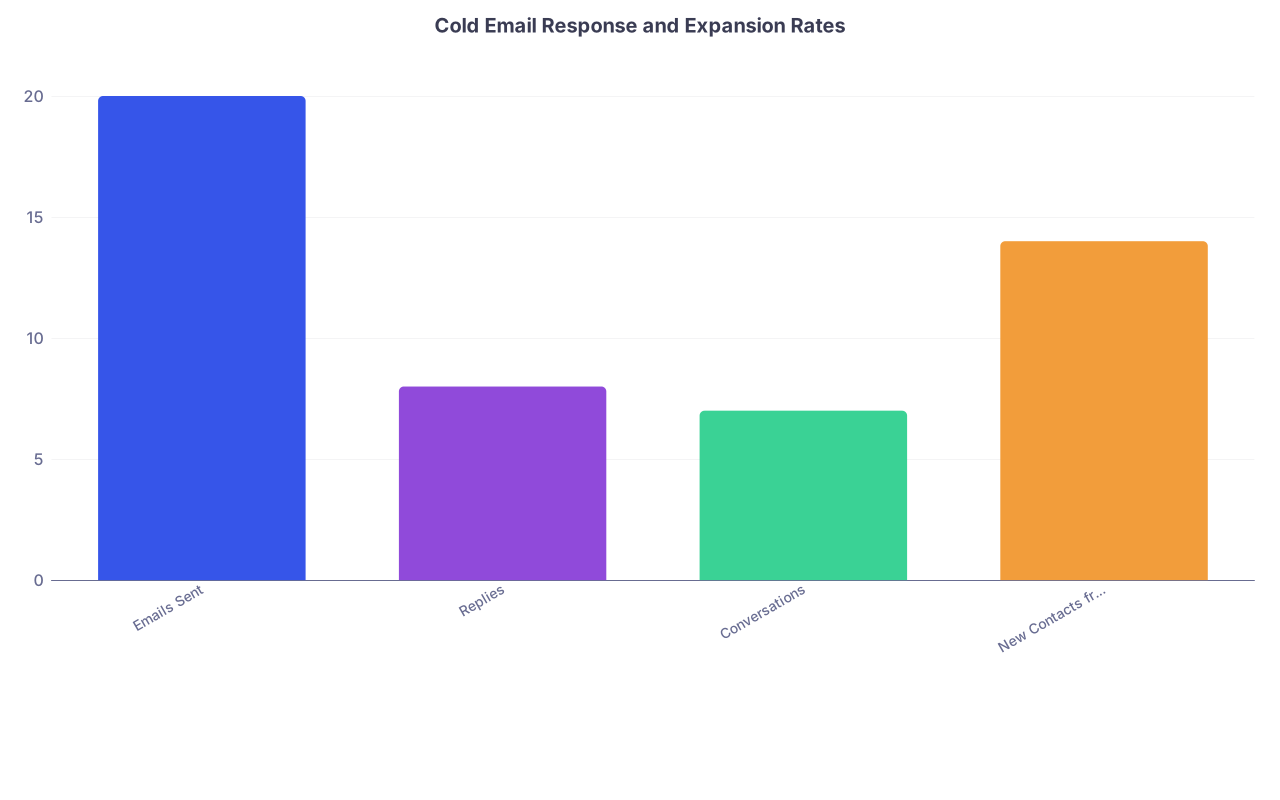
| Category | Value |
|---|---|
| Emails Sent | 20 |
| Replies | 8 |
| Conversations | 7 |
| New Contacts from Intros | 14 |
If you see that 20 emails led to 8 replies, 7 conversations, and 14 new contacts through introductions, you know the system is functioning.
Advanced Tactics to Boost Your Hit Rate
Once you have the basic system down, you can punch it up. A few levers that move the needle.
1. Stack credibility in your signature block
You do not need a 3-page CV. But do not be anonymous either.
Consider a concise signature:
[Name], MS3
[School of Medicine]
Visiting student, [Hospital Name], [Service], Spring 2026
[LinkedIn URL]
For residents/fellows:
[Name], PGY-2 Internal Medicine
[Program, Hospital]
Research interest: [10 words max]
[Email] | [Phone]
You are giving them safe reasons to say yes: you are real, you have an institution, you have some direction.
2. Time your emails like a human, not a robot
From watching actual reply times:
- Sunday late afternoon / early evening: surprisingly decent. People plan their week.
- Weekday early mornings (06:00–08:30): physicians clear inboxes before chaos.
- Avoid Friday late afternoon and Saturday nights unless you enjoy silence.
Is this absolute? No. But your odds do improve.
3. Use context when you can
If you share any environment, mention it early:
- “I am a third-year at the same school where you trained.”
- “I am on the [Hospital] medicine service this month and saw your name on the consult list.”
- “I was at your grand rounds last week about [topic].”
This moves you from “random internet person” to “someone in my extended orbit.”

4. Pre-empt their fear of being trapped
Many physicians avoid calls because they have been burned by students who talk for 45 minutes with no agenda.
You can remove that fear explicitly:
- In the email: “brief 15–20 minute call”
- At the start of the call: “I will keep this to 20 minutes.”
- If you hit 18 minutes and they look at the clock: “We are almost at 20 minutes; I want to be respectful of your time—one last quick question, if that is alright?”
That last sentence alone has gotten people invited back for more every time I have seen it used. Respect is attractive.
Turning One Into Three, Repeatedly
Let us walk a single concrete scenario start to finish.
You are an MS3 at a mid-tier school, interested in interventional radiology. Your school has exactly zero IR faculty.
- You identify three IR attendings within your state based on publication and hospital websites.
- You send each a targeted cold email using the template (5–6 sentences, specific niche: “image-guided oncology procedures”).
- One replies and agrees to a 20-minute Zoom next Tuesday.
- You prepare your one-page personal brief.
- You run the call using the structure above: intro, focused questions, implementation question, ask for 1–2 additional perspectives.
- They offer: “You should talk to Dr Nguyen; she is more involved in peripheral interventions, and Dr Shah, who runs our residency pipeline.”
- That afternoon, you send a thank-you email, mention 1–2 concrete insights, and include a forwardable blurb.
- Two days later, you get a reply-all introduction to both.
- You convert those introductions into two additional 20-minute calls.
- One of them mentions a virtual journal club and invites you; the other mentions a multi-center outcomes project and asks if you want to help with data abstraction.
From one replied cold email, you now have:
- 3 physician contacts
- 1 recurring IR touchpoint (journal club)
- 1 potential project
- A growing reputation as “the student who actually follows through”
Repeat this monthly and you will be “well-connected” long before residency applications.
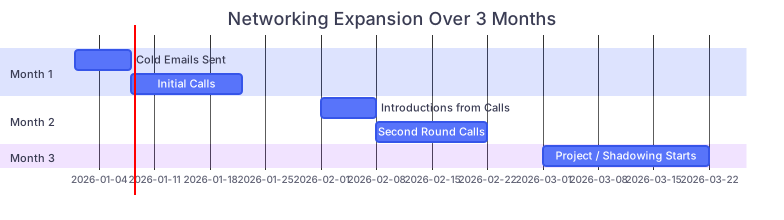
| Task | Details |
|---|---|
| Month 1: Cold Emails Sent | a1, 2026-01-01, 7d |
| Month 1: Initial Calls | a2, 2026-01-08, 14d |
| Month 2: Introductions from Calls | b1, 2026-02-01, 7d |
| Month 2: Second Round Calls | b2, 2026-02-08, 14d |
| Month 3: Project / Shadowing Starts | c1, 2026-03-01, 21d |
Common Failure Modes (And How to Fix Them)
Let me be blunt about where people screw this up.
Failure 1: “I do not want to bother them”
You are not asking them to co-sign your mortgage. You are asking for 15 minutes of advice. If your email is concise and respectful, the worst they will do is ignore it.
Fix:
Decide up front how many non-responses you will tolerate before taking it personally. I suggest at least 20. If you send 20 good cold emails and zero reply, then we can reevaluate your template. Until then, this is a numbers game.
Failure 2: Sounding needy or vague
“Any advice for someone like me?” is a weak question. It shows you have not done your homework.
Fix:
Use specific, time-bound questions:
- “If you were a PGY1 today interested in X, what would you do in the next 12 months?”
- “What do you look for when residents say they are serious about Y?”
Specificity signals respect for their time.
Failure 3: Never asking for introductions
If you do not ask, they will usually not offer. They are busy. They may like you and still not think of it.
Fix:
Steal this exact line and use it at the end of every useful conversation:
“Are there 1 or 2 people you think would be good for me to speak with next—maybe someone with a different path in [field]?”
You will be surprised how often this yields names.
Failure 4: Weak or nonexistent follow-up
You will forget what they said. They will forget you exist. Six months later you will wish you had a relationship.
Fix:
- Same-day thank-you with concrete insight.
- 4–8 week update email if you actually did what they advised:
“You suggested I reach out to X clinic and explore Y; I did that, and here is what happened (2 sentences). Thank you again; your advice made a difference.”
That kind of message is how you convert a one-off chat into a long-term mentor.