
You are logged into yet another virtual CME on a Tuesday evening. Chat window on the right, slides in the middle, a tiny video of the speaker at the top. You recognize a couple of names in the attendee list. You think, “I should probably message them.” You don’t. The session ends, people drop off, and the opportunity evaporates.
You got the credits. You learned something. But you built exactly zero relationships.
If that sounds familiar, this is for you.
The problem is not that online CME is “less personal” or that everyone is “Zoomed out.” The problem is that most physicians treat virtual CME like on-demand TV instead of like a live room full of colleagues.
You want real-world connections out of online CME? You need a system. Not vague “network more” advice. A repeatable playbook.
That is what I am going to give you.
Step 1: Stop Consuming CME Like a Passive Audience Member
First fix is mindset. If you treat virtual CME as a box-checking exercise, you will get exactly that: a box checked.
Start treating each online CME as if:
- You are walking into a real conference room.
- Every name on the attendee list is a potential collaborator, referral source, or career ally.
- You have 60–90 minutes to make 1–3 real contacts. Not 30. Just 1–3.
Define a networking goal before you log in
Spend 3 minutes before every online CME:
Answer this question:
“If I walk away from this with one valuable new connection, who ideally would that be?”- Same specialty, similar practice setting?
- Someone 5–10 years ahead of you?
- Someone at a specific institution or in a certain subspecialty?
Write a micro-goal:
- “Connect with at least 1 hospitalist who does quality improvement.”
- “Find 1 cardiologist who is active in clinical trials.”
- “Identify 1 person who mentioned burnout/QI to follow up with.”
Now you are not just “attending a webinar.” You are running a targeted search in a room full of physicians.
Step 2: Use the CME Platform Like a Professional Tool, Not a TV Remote
Different platforms give you different levers. Most physicians ignore them.
Here is how to exploit them systematically.
| Feature | Why It Matters |
|---|---|
| Attendee list | Targeted outreach, name recognition |
| Chat box | Public signaling, low-friction intro |
| Q&A panel | Position yourself as engaged/serious |
| Polls | Find like-minded clinicians |
| Breakout rooms | Fast, intimate conversations |
Attendee list: your real-time “who’s here?” scan
If the attendee list is visible:
Scan for:
- Names you recognize from:
- Past rotations
- Prior conferences
- Journal articles
- Specialty societies
- Institutional tags (e.g., “Mayo Clinic,” “Kaiser,” “Cleveland Clinic”)
- Relevant roles (“Medical Director,” “Program Director,” “Research Lead”)
- Names you recognize from:
Screenshot or quickly jot down 3–5 names that align with your goal.
Nothing fancy. “Dr. J. Patel – cardiology – Stanford” is enough.
You are building a short hit list for later follow-up.
If the attendee list is not visible, do not whine about it. Use the chat.
Step 3: Weaponize the Chat (Without Looking Desperate)
The public chat is how you get noticed. Most people use it badly—random comments, generic praise. You are going to use it like a signal flare.
Your first chat message: introduce yourself strategically
Within the first 5–10 minutes, drop a short, clear intro line in the chat. Not a resume. A locator beacon.
Examples:
- “John Smith, community cardiologist in Phoenix, focus on HF and telehealth.”
- “Emily Chen, PGY-2 IM at UCSF, interests in hospital medicine and quality improvement.”
- “Ahmed Rahman, rural FM in Iowa, doing a lot of addiction medicine and MAT.”
Why this matters:
- People doing similar work or with similar interests will notice.
- You have given others a hook to message you later (“I also do telehealth HF clinics…”).
Do not skip this because you feel awkward. You would introduce yourself in a physical room. Same rule here.
Ask one good question in the main chat or Q&A
Your question is not just for your learning. It is a calling card.
Make it:
- Decent depth (shows you are thoughtful, not just skimming),
- Specific to your practice context,
- Likely to resonate with others facing similar issues.
Examples:
Bad: “How do you treat hypertension in older patients?”
Better: “For patients with resistant HTN on triple therapy in a resource-limited rural setting, what is your practical next step before referral?”
Bad: “Any tips for burnout?”
Better: “For hospitalists working 7 on/7 off, have you seen any system-level interventions that actually reduced burnout instead of just mindfulness workshops?”
The right question draws your people out of the crowd. They remember your name.
Step 4: Turn Micro-Interactions Into Warm Leads During the Session
You do not need a long conversation during the CME. You need a reason to talk later.
Here is the sequence.
1. Watch for “connection signals” in the chat
Look for:
- People asking questions similar to yours.
- Physicians mentioning:
- Specific EHRs you also use.
- Practice types similar to yours (VA, safety-net, concierge).
- Research/QI interests overlapping with yours.
When someone “pings” your radar, note their name.
2. Send one brief, targeted private message (if allowed)
Mid-session or just after, message like you would at the back of a conference room.
Templates:
- “Hi Dr. Lee, I am also a community cardiologist dealing with a lot of HF readmissions. Your question about post-discharge follow up really resonated. Would you be open to a brief call sometime to compare approaches?”
- “Dr. Patel, liked your point about integrating behavioral health in primary care. I am at a rural FM clinic doing something similar. Happy to share what worked and what did not if useful.”
Key points:
- Be specific about the shared topic.
- Offer mutual benefit (“compare approaches,” “share what worked,” not “please mentor me”).
- Do not ask for big favors right away (no “Can you introduce me to your department chair?” on first contact).
3. If there are breakout rooms, use them like speed-dating for colleagues
When breakout rooms open:
- Turn your camera on if at all possible. People connect with faces.
- Do one 15-second “who I am + what I do” intro.
- Then ask one simple, open question that gets people talking.
Examples:
- “I am curious how others here are actually implementing this in their setting. Who has tried X in their clinic or hospital?”
- “Anyone here from community or rural settings? How different does this look for you?”
You are trying to identify one person you want to follow up with. That is it.
Step 5: Lock in the Follow-Up Before Everyone Logs Off
The biggest leak in networking: “We should connect” with no next step.
Fix it immediately.
During or right after the session, send a concrete suggestion
You are going to propose:
- A 15–20 minute meeting,
- About a clear topic,
- Within the next 7–10 days.
Sample messages you can send via:
- Platform DM (if available),
- Email (if shared),
- LinkedIn,
- Doximity,
- Society member directory.
Template 1: Same-level peer connection
“Dr. Garcia, enjoyed your comments in the breakout about managing post-op pain without overprescribing. I am an anesthesiologist at a community hospital in Ohio; we have been trying a similar pathway. Would you be open to a 20-minute Zoom in the next week or two to compare protocols and see if we can steal a few ideas from each other? Happy to send a couple time options if so.”
Template 2: Slightly senior person you do not want to annoy
“Dr. Nguyen, I appreciated your question on integrating palliative consults earlier in oncology care. I am a heme/onc fellow at MD Anderson working on a small QI project in this area. If you are open to it, I would value a 15–20 minute call to hear what has and has not worked at your institution. No expectations at all—just hoping to learn from your experience.”
Template 3: Same institution / local
“Dr. Shah, I noticed you are also at Northwell and working in stroke. I am a new hospitalist there, rotating on the neuro service, very interested in your protocol discussion. Could we grab 15 minutes on Zoom or a quick coffee on campus to talk through what is in place and where you see gaps?”
Three things these messages do right:
- They reference a specific, authentic connection point.
- They define a realistic ask.
- They make it easy to say yes.
Step 6: Use a Simple System So Contacts Do Not Die in Your Inbox
You are busy. They are busy. If you rely on “I will remember,” you will not.
You need a low-friction tracking method. Nothing fancy. But consistent.
Minimum viable tracking system
Pick one tool you already use daily:
- Notes app on your phone
- Simple Excel/Google sheet
- A basic CRM-like app (Notion, Airtable, whatever you actually open)
Create 5 columns:
- Name
- Institution / Specialty
- Where we met (CME name + date)
- Topic / why interesting
- Next action + due date
Example entries:
- “Sarah Lee, Kaiser – Hospitalist. Met: SCCM sepsis update 2/2026. Talked about sepsis order set and early ID consults. Next: send our order set PDF + schedule 15-min call by 2/20.”
After every online CME where you connect with someone, add them immediately. 60 seconds.
Follow-up cadence that does not feel forced
Here is a simple protocol:
- Day 0–2: Initial follow-up message proposing a call.
- Day 7: If no response, one short nudge:
- “Just bumping this once in case it got buried—no worries if now is not a good time.”
- After call: Send a 3–4 line thank-you + one concrete follow-up if relevant:
- “Sending the risk stratification tool we use.”
- “Will introduce you via email to our QI lead.”
- Every 3–6 months: Light-touch touchpoint if the connection is valuable:
- Forward a relevant article.
- Congratulate on a paper/role if you see it.
- Share a one-line update on a shared project/topic.
None of this is complicated. The hard part is doing it every time.
Step 7: Link CME Connections to Real-World Outcomes
Conversations are nice. You are not in this for “vibes.” You want real movement: better care, career growth, maybe future jobs.
You make that happen by proposing small, concrete collaborations instead of vague “Let’s keep in touch.”
Look for one small, low-risk next step
Examples that work well:
Clinical practice sharing
- “Could we swap our order sets or clinic workflows and see what might be adaptable?”
- Outcome: You both improve care without major bureaucracy.
Mini-QI / informal benchmarking
- “We are tracking 30-day readmits on our HF pathway. Are you tracking anything similar? Want to compare for 6 months?”
- Outcome: Shared benchmarks, maybe a future abstract.
Case-based micro-groups
- “What do you think about a quarterly 30-minute Zoom with 3–4 people from this CME who are also doing X? One tricky case each, discuss, done.”
- Outcome: Peer support and pattern recognition.
Teaching / local education
- “Would you be open to giving a 20-minute virtual talk to our residents on how you implemented your pathway? We could reciprocate on [topic you know well].”
- Outcome: Cross-institutional teaching, CV lines, resident exposure.
Once trust builds, bigger things are possible:
- Co-authoring review articles or practice pieces.
- Joint abstracts at the next conference.
- Multi-site QI or research.
But you start small. Always.
Step 8: Use the Right External Platforms to Cement the Connection
Relying on the CME platform alone is a mistake. Once the event is over, the room disappears.
You need to pull people into spaces you control and visit regularly.
Priority platforms for physicians
Here is how I rank them for professional networking value, not for memes:
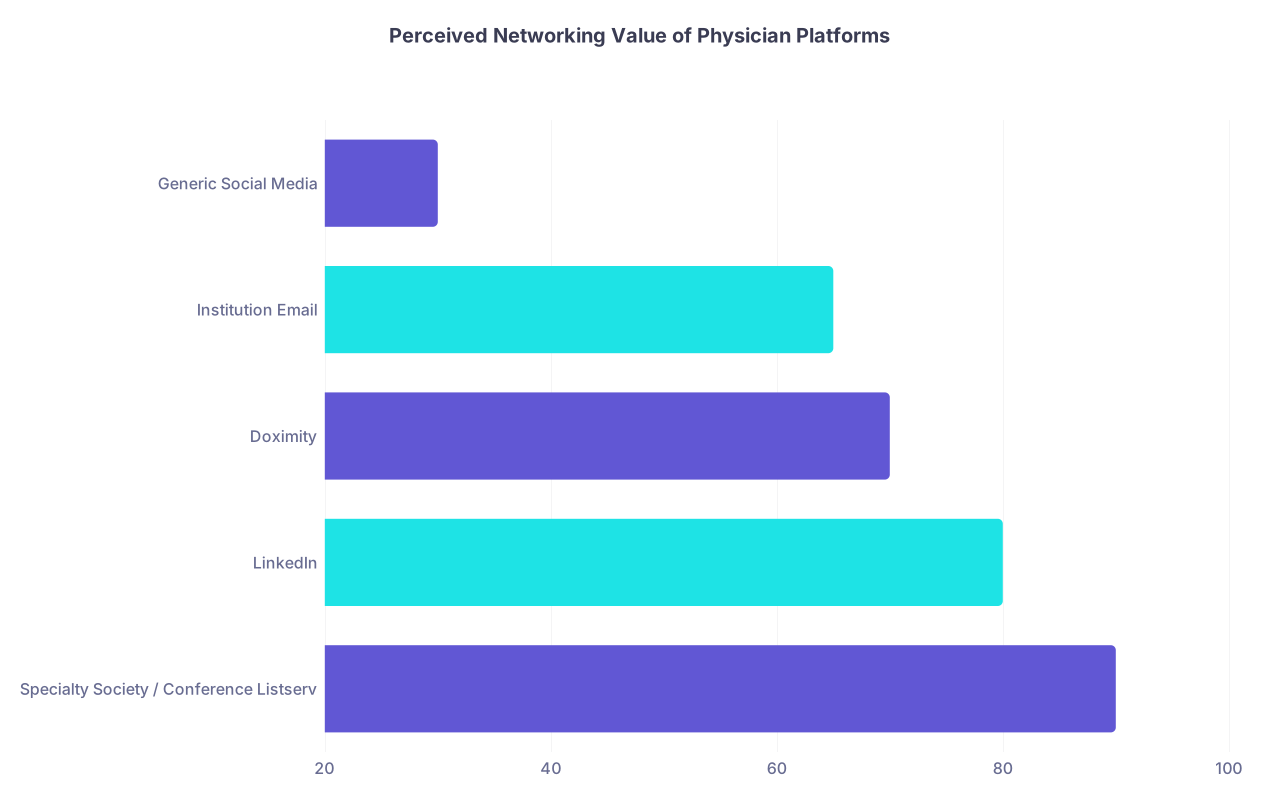
| Category | Value |
|---|---|
| Specialty Society / Conference Listserv | 90 |
| 80 | |
| Doximity | 70 |
| Institution Email | 65 |
| Generic Social Media | 30 |
Interpretation:
- Specialty society tools / listservs: Gold for niche collaboration.
- LinkedIn: Very good for tracking careers, messaging, and cross-specialty professional presence.
- Doximity: Good for finding verified physicians and sending messages; less dynamic.
- Institution email: Fine, but people change jobs; not durable.
- Generic social media (Twitter/X, Facebook, etc.): Can work, but signal-to-noise ratio is poor and many physicians are barely active.
My default move
- Add the person on LinkedIn with a personalized note:
- “Great to meet you at the ACC online CME on HF on 2/8. Enjoyed our chat about post-discharge clinics—would like to stay in touch about how your pathway evolves.”
If they are clearly active on Doximity, connect there as well or instead.
For tightly specialized topics (e.g., transplant ID, pediatric rheum), plug into:
- Specialty-specific Slack/Discord communities.
- Society message boards / listservs.
That is where real technical conversations happen.
Step 9: Build Your Reputation Across Multiple Online CME Events
One-off connections are fine. A professional reputation is better.
You want to be “that person” people remember and seek out. You do this by being consistent.
Pick a small set of themes you “own”
You cannot be known for everything. Choose 1–3 areas where you consistently show up.
Examples:
- “Community cardiologist doing serious work on telehealth HF.”
- “Hospitalist obsessed with sepsis bundles and ED/hospital collaboration.”
- “FM doc quietly building MAT and addiction services in rural settings.”
- “ID specialist who always has sane, real-world antimicrobial stewardship advice.”
Then across multiple CMEs:
- Ask questions in that domain.
- Share brief, practical experiences:
- “In our 200-bed community hospital, we tried X and Y; X failed, Y stuck because of Z.”
- Follow up with people in that same topic area.
After 6–12 months, you will notice:
- People recognize your name in chats.
- Speakers or moderators start saying, “Dr. X, good to see you again.”
- Colleagues reach out to you for advice or collaboration.
This is how you build a network without flying to 5 national meetings a year.
Step 10: A Concrete Playbook for Your Next Online CME
Let me put this together into a one-page protocol you can literally follow at your next session.

| Step | Description |
|---|---|
| Step 1 | Before CME - 3 min |
| Step 2 | Set 1 networking goal |
| Step 3 | Scan speaker and topic list |
| Step 4 | Open notes for names and ideas |
| Step 5 | During CME - first 10 min |
| Step 6 | Post intro line in chat |
| Step 7 | Scan attendee chat for signals |
| Step 8 | Note 3-5 interesting names |
| Step 9 | Mid-session |
| Step 10 | Ask 1 thoughtful question |
| Step 11 | Send 1-2 targeted DMs |
| Step 12 | Breakouts if available |
| Step 13 | Identify 1 person to follow up with |
| Step 14 | Immediately after session |
| Step 15 | Log contact in simple tracker |
| Step 16 | Send follow-up message within 24h |
| Step 17 | Schedule 15-20 min call |
| Step 18 | After call - propose small collab |
| Step 19 | Light-touch follow-up q3-6 months |
If you follow that flow for even 3–4 online CME events, you will feel the difference.
Not “maybe.” You will.
Advanced: Turning Repeated Online CME Presence Into Career Leverage
Once you are comfortable making 1–2 connections per event, you can push a bit further.
Here is where you turn online CME into tangible career capital.
1. Position yourself for speaking / panel roles
Every CME program director is constantly looking for:
- Clinicians actually doing real work,
- Who can explain it clearly,
- And who have shown up more than once.
You qualify for that faster than you think.
After a few events:
- Reach out to organizers:
- “I have attended several of your CME events on X this year and have been implementing Y at our institution. If you ever look for community practice voices or case-based sessions in this area, I would be happy to help or co-present.”
- Volunteer a concise one-paragraph summary of something you implemented and your outcomes.
One or two small talks start a snowball:
- More visibility → more invitations → stronger network.
2. Use online CME to prototype new career directions
Thinking about:
- Moving from clinical to leadership?
- Switching subspecialties?
- Relocating to a specific health system?
You can test the waters virtually.
Examples:
- Join multiple CMEs from a target health system or region.
- Ask smart, on-topic questions.
- Connect with leaders who show up repeatedly.
- Have brief calls focused on:
- “How does your group structure X?”
- “What do you wish you had known before moving into Y role?”
You are doing reconnaissance before ever applying for a job. That is how you stop “random” career moves and start making informed ones.
Common Mistakes That Kill Online CME Networking (And How to Fix Them)
Quick clean-up list.
Mistake: Waiting until after the event to think about networking.
Fix: Set a written goal and open your notes before the CME starts.Mistake: Trying to connect with everyone.
Fix: Identify 1–3 people per event. Depth beats breadth.Mistake: Sending vague follow-ups: “Let’s connect sometime.”
Fix: Always propose a specific, time-bound, low-burden next step.Mistake: Treating senior people like vending machines for opportunities.
Fix: Approach as a peer learner. Offer something back—cases, data, teaching, feedback.Mistake: No system. Contacts vanish in the inbox.
Fix: Use a minimalist tracker and follow-up cadence. Nonnegotiable.
Final Thoughts: What Actually Matters Here
Turn online CME into real-world connections by doing three things:
- Show up with intention. Every session: one networking goal, one good question, one new contact.
- Lock in the next step quickly. Do not leave “we should connect” hanging. Propose a short, concrete follow-up.
- Keep a simple system. Track who you met, why they matter, and what happens next. Then actually follow through.
Do this consistently and online CME stops being just another box to check. It becomes a quiet but powerful engine for your career, your collaborations, and frankly, your sanity in this field.