
A chair once slid a conference invitation across my desk and said, “I could send the ‘best person’… or I could send the person who’ll still be here in 10 years.” The “best person” on paper didn’t get the slot. The person who had been showing up to thankless committee meetings for three years did.
If you think big opportunities are handed out based purely on merit, you’re still reading the brochure version of academic medicine. Let me walk you into the back room and show you how it actually works.
What Counts as a “Big Opportunity” (in the Chair’s Mind)
You and your classmates don’t always label the same things as “big” that a chair does. Chairs are thinking in terms of institutional visibility, power, and long‑term strategic positioning.
We’re talking about:
- Being 1st or 2nd author on the “flagship” paper from a major project
- Getting nominated for national society committees or guideline panels
- Being put forward to give a high‑profile invited talk or grand rounds
- Leading a multi‑site trial or core in a big grant
- Being named “course director,” “service chief,” or “quality lead” for a visible initiative
These are the things that show up on promotion packets, dean’s reports, and external reputation metrics. They’re also finite. A chair might have three national slots to give in a year and twenty people who’d love one.
So the real question isn’t “who deserves it?” The real question in the chair’s head is:
“If I bet this scarce, high‑visibility chip on you, will it pay off for me, the department, and the institution?”
That’s the frame everything else hangs on.
The Real Criteria: What Chairs Actually Look At
Forget the official language in the faculty handbook. When a chair is sitting alone with the list of names, here’s what truly drives the decision.
1. Reliability Over Raw Talent
I watched a chair at a major academic center cross off a star resident’s name for a national presentation because, in his words, “I’m not gambling that she won’t flake again.”
She’d ghosted on a minor abstract deadline six months prior. Brilliant resident. Killer data. But she dropped a poster three days before the conference because she “wasn’t happy with the figures.”
What did the chair remember? Not her brilliance. Her risk.
Chairs value:
- People who meet deadlines without drama
- People who don’t need hand‑holding for every email or slide
- People who say yes sparingly, but then actually deliver
You want a harsh truth? A B+ person who is boringly reliable will be chosen over the A+ diva almost every time for high‑stakes stuff.
2. Risk to the Chair’s Reputation
Nobody says this out loud to trainees, but: every person a chair sends out into the world is a reflection of the chair.
If you blow a talk, come off as arrogant to a national committee, or ghost on a multi‑site call, the feedback doesn’t just come back to you. It comes back to your chair in phrases like:
“Thanks for sending Dr. X, but next time maybe someone else?”
So chairs are constantly running a quiet risk calculation:
“Are you going to embarrass me publicly, politically, or professionally?”
That risk has layers:
- Clinical risk: Are you going to leave service uncovered, trigger complaints, or miss patient care?
- Political risk: Are you going to say something tone‑deaf to the dean, the CEO, or the national society leadership?
- Professional risk: Are you going to show up late, under‑prepared, or obviously phoning it in?
You might be the smartest person in the room. But if your chair has ever had to apologize for you—lateness, rude email, poor communication—your name drops several spots for prestige opportunities.
3. “Return on Investment” for the Department
Chairs are not Santa Claus. They are investors. When they decide whose name goes on a big grant, big talk, or big committee, they’re thinking:
“If I give you this, what comes back to me and this department?”
The ROI they’re looking for:
- Future grants with the department as home base
- National committee roles that increase the department’s clout
- Reputation enhancements that help with rankings, recruitment, and philanthropy
- A future division chief, program director, or associate chair who stays
That’s why borderline good people with obvious long‑term loyalty often beat out stellar folks who look like flight risks.
If you’re constantly talking about going to industry, switching institutions, or jumping specialties, don’t be surprised when your chair doesn’t put you as the face of a 5‑year national initiative. They assume you’ll be gone before the payoff.
4. Political Debts and Alliances
This is the part nobody likes to talk about when they’re on the outside. Chairs owe favors. They trade them.
- The dean asked them to “support this rising star” from another department
- A powerful senior faculty member wants their protégé launched
- The hospital CEO wants more visibility for a particular service line
So sometimes the internal ranking is:
- Person the chair must pick (political pressure or explicit ask)
- Person the chair wants to pick
- Person who technically “deserves” it based on merit alone
I’ve watched chairs say, in closed meetings: “Yes, Sarah’s probably more deserving. But I owe John one, and if I don’t move his junior up on something this year, I’m going to pay for it on the budget votes.”
It’s ugly, but it’s real.
5. Who Is “Safe” Socially and Culturally
Look at who gets sent to external things. You’ll see a pattern.
Chairs favor people who can:
- Talk to anyone in the room, from a med student to a CEO
- Handle conflict or tough questions without getting defensive
- Avoid needless drama, gossip, or personal oversharing in professional spaces
If your chair has ever thought “I don’t know what version of them I’ll get today,” your name is not at the top of the “send them to represent us” list.
Basic emotional regulation and social awareness become high‑value traits when you’re being sent into rooms full of egos.
The Shadow File: The Stuff That Never Goes in Writing
Here’s the part that stings for a lot of smart, hardworking people: your chair is keeping a silent, informal ledger in their head. It’s not official. But it’s real.
It includes things like:
- Who shows up to low‑glamour tasks (M&M prep, recruitment dinners, curriculum revision)
- Who disappeared the minute residency/fellowship graduation was secure
- Who only emails when they want something vs. sharing wins, updates, and team credit
- Who has made the chair’s life easier vs. harder
Let me give you two composites I’ve seen again and again.
Dr. A
- Brilliant, high‑volume publisher
- Always a bit late with drafts
- Complains often about “wasting time” on committees
- Seen by staff as “demanding” and occasionally dismissive
Dr. B
- Solid but not spectacular CV
- Volunteers early for at least one unpleasant, necessary departmental task each year
- Staff like working with them; they say thank you
- Keeps the chair in the loop with quick, concise updates
Who do you think gets the chair’s quiet advocacy for “emerging leader award,” “national young investigator spotlight,” or “important society committee”?
It’s B. Over and over. Chairs know they can build B. A might succeed brilliantly, but is just as likely to blow up a relationship they need.
How Names Actually Get Picked: The Informal Process
You imagine a careful, criteria‑driven review. What actually happens is much messier and faster.

| Step | Description |
|---|---|
| Step 1 | Opportunity Appears |
| Step 2 | What does the institution want |
| Step 3 | Chair makes shortlist |
| Step 4 | Add protege of key ally |
| Step 5 | Proceed with internal picks |
| Step 6 | Risk and ROI gut check |
| Step 7 | Offer opportunity |
| Step 8 | Pick safer backup |
| Step 9 | Is there a political debt |
| Step 10 | Is this person safe to send |
Here’s roughly how it goes behind closed doors:
A major society emails: “Nominate one person from your department for this national committee / early career award / task force.”
The chair does not open a spreadsheet and rate everyone. They:
- Think of 3–5 names that immediately come to mind.
- Mentally cross off anyone who is high‑risk, high‑maintenance, or politically awkward.
- Filter the remainder through: “Who have I invested in? Who’s been loyal? Who can I trust not to embarrass us?”
- Then, if there’s time, maybe they send an email to division chiefs asking: “Anyone I should be thinking about for X?”
If your name isn’t coming to mind at step one or two, you’re already behind. That’s where “networking in medicine” actually lives—with your name living rent‑free in the right people’s heads.
Visibility vs. Proximity: Why Some People Always Seem to Get Picked
You’ve probably noticed a pattern. Certain residents, fellows, or junior attendings somehow end up on:
- The cool research project
- The teaching award nomination
- The national committee the chair sits on
It’s not random. And it’s not always that they’re “favorites” in the childish sense. It’s proximity and repeated exposure.
Chairs are busy. They don’t sit around studying everyone’s CV. They remember:
- Who has been in their office more than once—and not always asking for something
- Who presents well at conferences, M&M, grand rounds
- Who other powerful people mention positively by name
Think of it like this: there’s an internal “top of mind” list inside every chair’s brain. That list is built from:
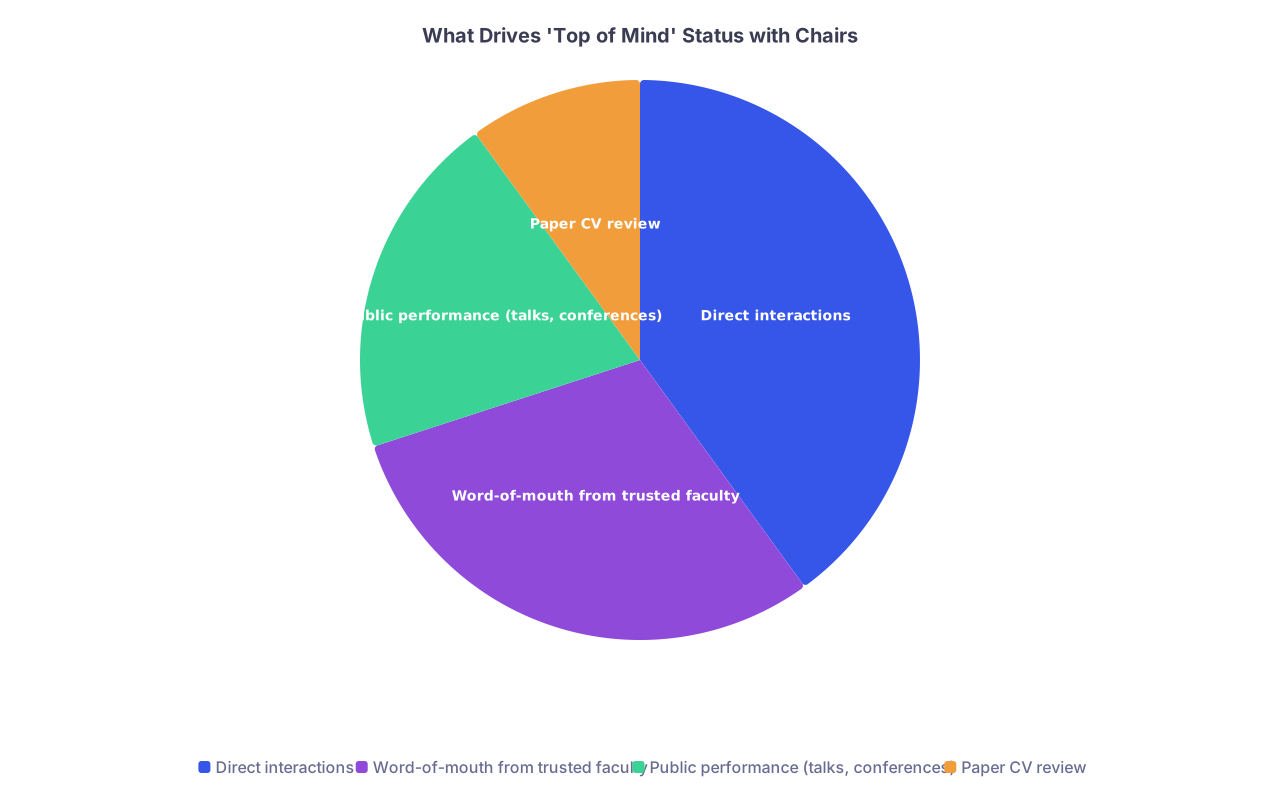
| Category | Value |
|---|---|
| Direct interactions | 40 |
| Word-of-mouth from trusted faculty | 30 |
| Public performance (talks, conferences) | 20 |
| Paper CV review | 10 |
Notice what’s smallest: “Paper CV review.” Chairs don’t sit with PubMed open trying to find the perfect person. They default to who they already know and have seen.
That’s why the resident who spends a year quietly killing themselves on a chart‑review project, never presents, never speaks up, never meets the chair outside a perfunctory handshake… loses to the resident who gave two excellent talks, served on a single important committee, and chatted with the chair after grand rounds three times.
Not because life is fair. Because chairs are human and overloaded.
The “Pipeline Bet”: Who Chairs See as Future Leaders
Here’s another level most trainees don’t realize exists. Chairs are constantly scanning for who they can groom as:
- Future program director
- Future division chief
- Future associate chair
Those people will get a wildly disproportionate share of “big opportunity oxygen.”
They’ll be:
- Given first dips on high‑yield committees
- Pushed onto society tracks (“You should run for council in the next few years”)
- Put on the big grants, even when others did more of the boring groundwork
Is it fair to the worker bees? No. But from the chair’s vantage point, this is pipeline building. They’re investing in people they believe will eventually help run the place.
So if you look around and wonder why one or two people in your cohort are suddenly everywhere, ask yourself:
“Does the chair see them as future leadership? What boxes did they check to send that signal?”
Usually it’s a mix of: decent scholarship, strong interpersonal skills, low drama, institutional loyalty, and a hint of political savvy.
How to Get Your Name Moved Up the List (Without Being Obnoxious)
You’re not going to change how the game is played. You can, however, change how visible you are to the people holding the cards.
Here’s how I’ve seen residents, fellows, and junior faculty quietly move themselves from “anonymous” to “go‑to” in a year or two.
1. Build a Track Record of Boring Reliability
Do not underestimate how powerful it is for a chair to hear the same refrain from multiple people: “They always get things done. On time. No fuss.”
That means:
- If you say yes, you treat the commitment like a contract
- You send drafts early, not minutes before deadlines
- You do not make your failure someone else’s emergency
Once a chair mentally files you as “safe pair of hands,” your risk score drops. That’s the doorway to bigger stuff.
2. Take at Least One “Unsexy but Visible” Role
I’m talking about roles that chairs actually notice:
- Residency or fellowship recruitment
- Curriculum redesign or QI initiative that reports directly to leadership
- Task forces the chair announces at department meetings
This is where you get facetime and where people higher up see you functioning in a group.
If you quietly volunteer for one of these, do solid work, and make the leader’s life easier, your name will come up positively when the chair asks, “Who’s good? Who’s ready?”
3. Curate How You Show Up in Public Forums
Every talk, M&M, poster session, or grand rounds is part of your audition.
Basic stuff, but shockingly often ignored:
- Accept feedback on your slides and style without getting defensive
- Handle questions with “That’s a good point, here’s how I think about it,” not “Well actually…”
- Credit your team and mentors out loud
I’ve been in rooms where a chair turned to me after a resident talk and said, “They’re going somewhere. Let’s keep an eye on them.” That’s when the mental file starts to change.
4. Make Light, Periodic Contact With the Chair
No, you don’t storm their office weekly. That’s annoying.
You do:
- Send a short email once or twice a year: quick update, one concrete win, one line of gratitude for support from the department
- Say hello and one sentence of substance after grand rounds if the moment is right
- Ask for 15 minutes once a year to get advice on a specific fork in the road (not your entire life story)
You’re not asking for opportunities in those moments. You’re building the sense that you’re thoughtful, serious, and plugged in. So when something comes across their desk, your name is at least on the mental whiteboard.
5. Make It Easy for Others to Nominate You
A little‑known trick: a lot of chairs want to help. They’re just stretched thin. If they have to dig to remember what you’ve done, you lose.
So you maintain:
- A concise, updated bio and CV
- A few lines that make your “angle” clear (e.g., “My focus is equity in perioperative care,” not “I do some research”)
When your mentor says, “I want to put you forward to the chair for this travel award / committee,” you hand them something they can drop straight into an email.
People who are easy to nominate get nominated.
Why This System Isn’t Fair—And Why It Isn’t Going Away
Let me be blunt: this system systematically advantages:
- People who are naturally socially comfortable
- People with mentors already wired into the web
- People who look and sound like prior “success stories” in that institution
There is bias. Gender, race, accent, training institution, all of it. Chairs are human, operating under pressure, defaulting to patterns.
But here’s the uncomfortable other side: you cannot “policy” your way into a purely meritocratic allocation of every single opportunity. Too many of these decisions are fast, soft, relational judgments about risk and representation.
So your job is twofold:
- Do good work. Obviously. None of this matters if you’re clinically unsafe or academically hollow.
- Make sure the right people repeatedly see you as: safe, reliable, additive, and loyal enough that betting on you feels smart.
If you ignore the second part on principle, you will watch less talented people leapfrog you for the next decade. I’ve seen it happen to excellent, bitter, invisible people. Over and over.
Years from now, you won’t remember which specific award you got or missed. You’ll remember when you finally understood that the “big opportunities” weren’t random—they flowed along predictable, human channels. Once you see those channels, you can stop standing on the bank waiting and start wading in on purpose.