
Last winter, I watched a residency director open two ERAS files side by side. On paper, they were clones—same Step scores, similar research, solid letters. He closed one after twenty seconds, then looked at the other and said, “This one is ours. I’ll call medicine and make sure they push for her.”
You think decisions are made in committees and official meetings. But the real sorting—the “who are we going to go to bat for” part—happens in hallways, text threads, and side conversations after conferences. That’s where faculty decide whom they’re going to champion. And those decisions are not as meritocratic or transparent as you probably want them to be.
Let me walk you through how it actually works.
The Myth You Believe vs. The Game They’re Actually Playing
Most students assume the hierarchy looks like this:
Work hard → Impress on rotation → Get a strong letter → Faculty advocate for you.
That’s the sanitized version we tell you in dean’s meetings.
The real decision tree in a faculty member’s head looks closer to:
- Do I know this person beyond a single rotation?
- Did they make my life easier or harder?
- If I push for them and they fail, does it come back on me?
- Are they “safe to recommend” to my friends at other institutions?
- Does helping this person cost me anything politically?
Championing someone is not just “writing a letter.” It’s private emails to program directors. Quiet texts: “Hey, keep an eye out for this name.” Calling a colleague and saying, “If they’re on the bubble, move them up.” That’s reputational capital. Faculty don’t spend that on everyone.
And here’s the part nobody tells you: the distance between “good rotation student who gets a standard strong letter” and “person we actively champion behind closed doors” is huge.
The Short List: Who Even Gets Considered for Advocacy
Faculty do not mentally track 40 students per year. They track maybe 5–10 names they’d go out of their way for. I’ve been in those rank meetings and side-bar conversations. The same pattern shows up every year.
Here’s who actually ends up on that internal “I’ll go to bat for them” list.
1. The Reliability Anchor
This is the student who never burned them. Never no-showed. Never blamed others. When something went sideways, they showed up early the next day, not sulking, not defensive, just ready to fix it.
Faculty remember:
- The student who stayed late with the intern to close notes without being asked.
- The one who took a dressing change off a drowning resident’s plate and didn’t broadcast it.
- The person who owned a mistake in a way that made the team trust them more, not less.
If a faculty member has to ask themselves, “Will this person embarrass me or create headaches if I recommend them?”—you’re already off the short list.
2. The Person Who Created Net Positive Energy
Sounds fluffy. It isn’t.
I’ve heard this exact line in selection meetings:
“She’s the one who just made the whole team less miserable. I’d love to work with her again.”
Faculty are exhausted. Residents are cooked. If you come in as the student who decreases friction—smooths communication, anticipates needs, never contributes to drama—you get remembered out of proportion to your objective metrics.
Not fake cheerfulness. Just low-maintenance consistency and emotional maturity.
3. The One Who Showed Trajectory, Not Perfection
Here’s a secret: most faculty are more impressed by visible growth than by polished-from-day-one brilliance.
Who gets talked about?
- The student who gave a terrible first presentation, took feedback seriously, and gave a completely different, tight talk two weeks later.
- The person who couldn’t tie a knot on Monday and was legitimately competent by Friday because they practiced.
- The one who went from “overly quiet” to “reliably speaking up with useful points” after being nudged.
You’re not being evaluated on a snapshot. You’re being evaluated on slope. Faculty are thinking: “If this is their growth curve now, what will they look like in 5 years?”
What Actually Happens Behind Closed Doors
Let me pull back the curtain on the conversations you never hear.
After a rotation ends, or when ERAS applications land, faculty talk. Not formally at first. In offices. On rounds. At 6:30 am in the work room before students show up.
Typical script:
“Hey, what do you think of Patel? She’s applying anesthesia, wants a home letter.”
“Oh yeah, she was on my ICU month. Solid. Not flashy, but I’d put my name on her.”
Or the opposite:
“He’s smart, very smart… but something feels off. I’d be careful putting my weight behind him.”
That “I’d be careful” is the kiss of death for true advocacy. They might still write you a letter. But they’re not calling anyone.
You need to understand there are tiers of support in faculty minds:
| Tier | What They Actually Do | How It Sounds to You |
|---|---|---|
| 1 – True Champion | Calls/texts PDs, emails colleagues, pushes ranking | “I’m happy to support you strongly.” |
| 2 – Strong Letter, No Extra Work | Writes a good letter, maybe answers a call | “I’ll write you a strong letter.” |
| 3 – Polite, Generic Support | Template letter, no advocacy | “Sure, I can write a letter.” |
| 4 – Reluctant/Neutral | Lukewarm letter if forced | “If you need another letter, I can help.” |
| 5 – Quiet No | Avoids being asked or nudges you elsewhere | “Have you thought about other letter writers?” |
You only feel the difference between Tier 1 and Tier 3 when interview offers and rank positions start to diverge from what your scores would predict.
How They Decide: The Real Criteria They Use
I’ve sat in more than one meeting where the spreadsheet said one thing and the room decided something else because a few faculty were willing to go to war for specific names.
Let’s break down what makes someone “worth fighting for” from a faculty standpoint.
1. Safety: “Will This Person Blow Up in My Face?”
This is the first filter. If there’s any whisper of:
- Unprofessional behavior
- Poor boundaries
- Blaming nurses/residents
- Gossiping about colleagues
You’re done as a champion candidate. You might not even know an incident was reported. Faculty do.
There’s usually a hidden blacklist of “never recommend strongly” students. Not official, not written. But shared. A single bad story travels fast among attendings.
2. Predictability Under Stress
Faculty think about you under worst-case conditions, not best-case.
They imagine:
- 2 am trauma call
- Angry family demanding answers
- A medication error unfolding in real time
They ask themselves: “Based on what I saw, do I trust this person not to unravel, not to lie, not to hide?”
If you melted down over a schedule change or snapped at a nurse, they extrapolate that behavior under much higher stakes. Rightly or wrongly.
3. Alignment with the Destination Program
This is a big one students miss.
Faculty do a quick mental matching:
- You → Your personality/work style
- Destination program → Culture, intensity, expectations
If you’re a very gentle, conflict-avoidant person gunning for a notoriously malignant surgical program, some faculty won’t champion you as hard because they foresee you being chewed alive. They’d rather nudge you toward a place where you’ll survive—and where their recommendation won’t lead to a disaster.
They’re not always right. But that’s the calculation.
4. Reciprocity (Yes, This Is Real)
Faculty are human. They like to help people who:
- Made an effort to stay in touch
- Showed genuine interest in their work, not just their title
- Helped with department things—student interest groups, QI projects, recruitment days
If the first time you contact someone is: “Hi Dr. X, I rotated with you two years ago, can you write me a strong letter for derm?”—you’re asking for a large favor with zero relationship equity.
The students who get championed are often the ones who, months before, sent a short update:
“Hi Dr. X, just wanted to thank you again for the ICU month. I ended up joining a sepsis QI project; your teaching on shock was what got me interested. Hope you’re doing well.”
That reads as, “I’m invested, I’m thoughtful, and I see you as a real mentor, not a vending machine for letters.”
Concrete Behaviors That Move You Into “I’ll Go to Bat for You” Territory
Let’s get specific. I’ll give you the kind of behaviors that have, in my experience, flipped faculty from “good student” to “I will call my friends about this person.”
Owning Problems Without Drama
Example I still remember:
Student misplaced a consent form. Caught it before the case. Instead of deflecting, they told the resident immediately, helped re-consent the patient, and apologized to the attending once—not five times.
Post-op, the attending said: “That’s a resident move. They handled it like an adult.”
That’s somebody you champion.
Making Residents’ Lives Noticeably Easier
Faculty listen very closely to what residents say about you. If residents like working with you, you’ve already won half the battle.
You become memorable when residents say things like:
- “We got out on time because she prepped all the discharge instructions.”
- “He actually pre-charted meaningfully, not just copying last note.”
- “She never disappeared. If we needed something done, she was right there.”
Attendings know residents don’t hand out that kind of praise lightly.
Producing Even a Small, Finished Product
You want faculty to see you as more than transient labor. The bar is lower than you think.
Stuff that gets noticed:
- Turning an informal chart review into an actual abstract and submitting it.
- Taking over a half-built QI project and pushing it to completion.
- Making a concise, useful handout or template that the team actually uses after you leave.
Most students say, “We should do X.” Very few see anything through. Faculty remember the ones who finish.
Why Some Clearly Talented Students Never Get a Champion
Let me be blunt. Every year, there are students who are:
- Brilliant
- Hardworking
- Scoring off the charts
…but nobody is willing to champion them behind closed doors.
Reasons I’ve heard, nearly verbatim:
- “Incredible fund of knowledge, but I would not trust him in a conflict.”
- “She’s good, but she disappears when things get tough.”
- “Very strong clinically, but there’s something off in how he talks to nursing staff.”
These are not things that show up in your Dean’s letter. But they absolutely show up in the gap between how you expect to do in a competitive match and how you actually do.
And then there’s this one, which no one will say to your face:
- “Great on paper, but I don’t know her. I can’t put my name on someone I barely interacted with.”
If you float through clinical years without any faculty who know you beyond “pleasant, did well,” you’re trusting your entire trajectory to your CV alone. That’s a mistake in competitive fields.
Networking Without Being Gross: How Students Actually Build Champions
Networking in medicine is not handing out business cards at conferences. It’s creating a small group of faculty who:
- Know your story
- Have seen you work under pressure
- Believe your trajectory is up
- Trust you not to make them regret supporting you
Here’s how people do that effectively without feeling like sales reps.
Intentional, Not Desperate, Follow-Up
After a strong rotation, the smart student sends one concise email:
“Dr. Y, thank you for the opportunity to work with you on wards. I especially appreciated your teaching on X; it changed how I think about Y. I’m leaning toward internal medicine and would value your advice as I plan sub-Is. Would it be okay if I reached out later this year when I have a clearer sense of programs?”
No ask for a letter. No CV attached. Just opening the door.
You build from there with:
- Occasional meaningful updates
- Genuine questions about next steps
- Offering to help with things they already care about (research, clinic projects, teaching)
Choosing the Right People to Invest In
Another truth students miss: some attendings will never champion anyone. They’re checked out, politically weak, or just cautious to a fault.
You want:
- People who are respected in the department
- Faculty who regularly sit on residency selection, promotions, or med school committees
- Attendings residents clearly respect (they usually also have influence)
Those are the champions whose emails and calls carry real weight.
The Future: This Is Not Getting Less Relational
You might hope that as the process gets more “structured”—more standardized letters, more holistic review, Step 1 pass/fail—that informal advocacy will matter less.
Wrong direction.
When you remove one hard filter (like a three-digit Step score), committees lean even more on trusted voices. They ask:
- “Who do we know in this pile?”
- “Who has someone we trust saying, ‘Take this person’?”
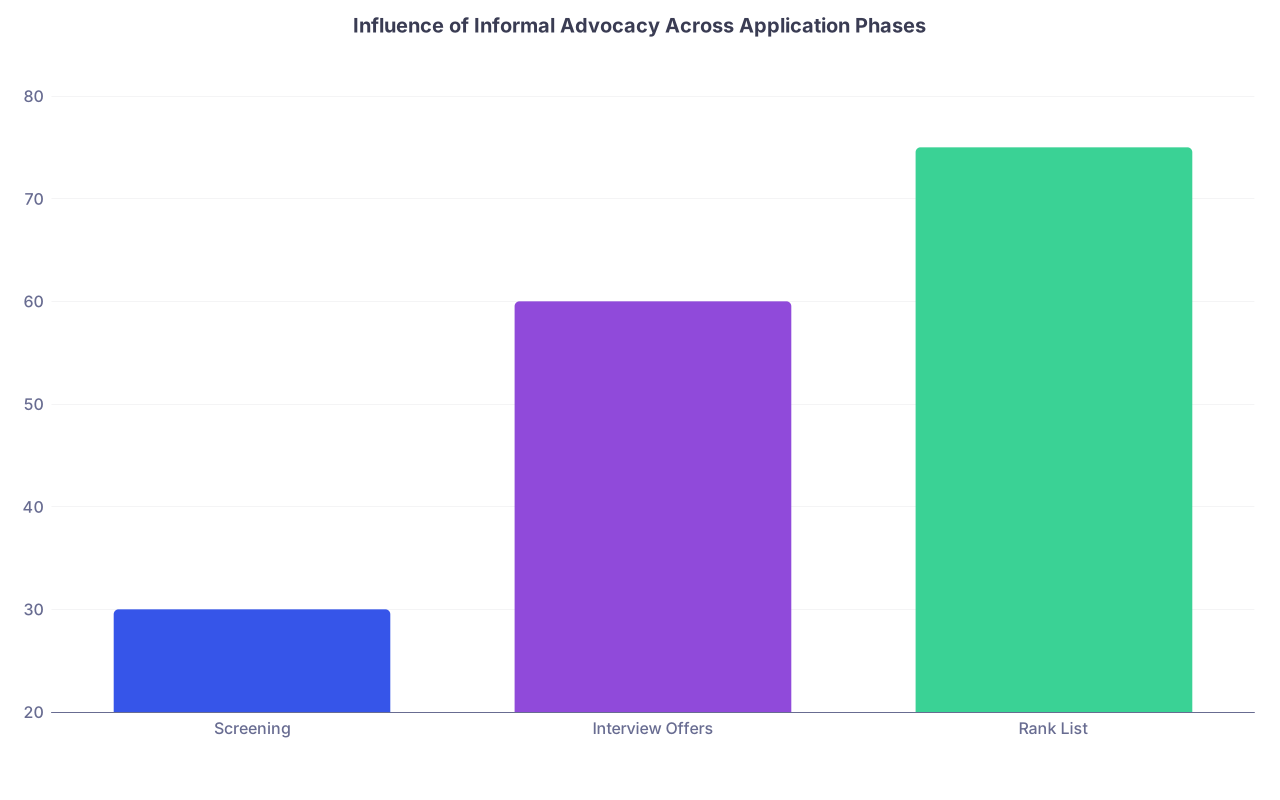
| Category | Value |
|---|---|
| Screening | 30 |
| Interview Offers | 60 |
| Rank List | 75 |
That’s my rough, very real-world estimate of how often I’ve seen an applicant’s trajectory changed by private advocacy at each phase, as a percentage of borderline cases. The later in the process you go, the more that behind-the-scenes champion matters.
The AI, the metrics, the dashboards—they’ll help filter. But when a program is staring at 40 interchangeable-seeming applicants, they’ll still lean heavily on: “Who will our people vouch for?”
A Simple Mental Model: How a Faculty Member Decides to Champion You
Think of it like a quick internal scoring system. No one writes this down, but the math happens in their heads.

| Step | Description |
|---|---|
| Step 1 | Student asks for support |
| Step 2 | Polite generic letter only |
| Step 3 | Standard strong letter, no extra effort |
| Step 4 | Limited support |
| Step 5 | Careful, targeted advocacy |
| Step 6 | Full behind the scenes champion |
| Step 7 | Trust their behavior |
| Step 8 | Know them well |
| Step 9 | See strong growth and reliability |
| Step 10 | Program fit and risk low |
Your job is to move yourself as far down that path as possible before you ever send an email asking for a letter.
What You Should Actually Do Differently Starting Tomorrow
Let me strip this down to moves that change your trajectory.
First, on every rotation, act as if one attending and one resident from that month will be critical to your future—because they might.
That means:
- Zero gossip
- Visible reliability
- Short learning curve on feedback
- Making residents’ lives easier in concrete ways
Second, identify 3–5 potential long-term faculty relationships by the middle of third year. Not 15. A focused few.
Third, keep those relationships alive in a way that doesn’t make you feel slimy:
- Occasional brief updates
- Asking for advice before you need a letter
- Offering help on work they already care about
Fourth, understand that asking for “a strong letter” is not the same as asking someone to be your champion. The second one sounds like:
“I’m applying to X. I would be deeply grateful not only for a strong letter but also for any advocacy you’d feel comfortable offering if programs reach out. If you don’t feel you know me well enough to support me in that way, I completely understand.”
You’re signaling you know the difference. And you’re giving them a clean out, which actually makes it more likely that people who do believe in you will go all in.