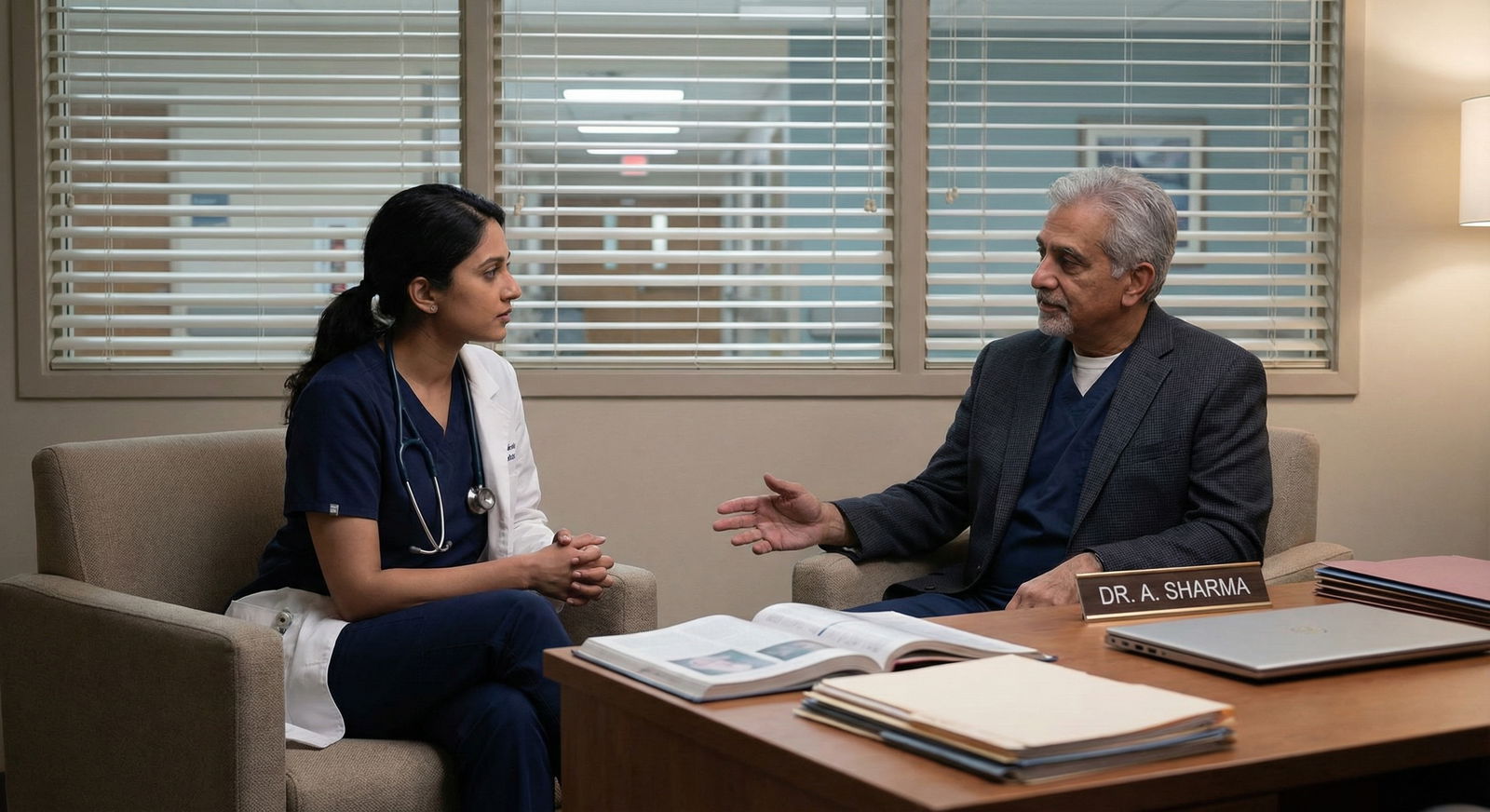
You are a second‑year at a mid‑tier state school. No home dermatology program. Zero neurosurgeons on faculty. The “advising” for your desired specialty is basically: “Have you considered family medicine?”
Meanwhile, you keep hearing the same thing from podcasts, upperclassmen, and program directors: “Networking matters. You need mentors in your target specialty. Away rotations are built on who knows you. Strong letters come from people in the field.”
You look around your school and think: “From who, exactly?”
You are not crazy. You are under-resourced. That is a different problem, and it has a solution.
This is how you build a specialty‑specific network from almost nothing.
Step 1: Get Ruthlessly Specific About What You Need
Before you start firing cold emails into the ether, you need a clear map of what you’re actually trying to build.
For a competitive specialty (derm, ortho, plastics, neurosurgery, ENT, IR, etc.), you need at minimum:
- 1–2 true mentors in the specialty (people who know you, vouch for you, and give unfiltered advice)
- 1–2 strong letter writers in the specialty (must be known in their field or at least at an academic center)
- 1 research connection in that specialty (not necessarily at your school)
- 2–3 program contacts at institutions where you might rotate or match (residents or faculty who know your name)
- Some peer network: med students and residents one or two stages ahead of you in the same specialty
If you build that, you’re not “behind.” You’re actually ahead of many students at schools that do have home programs but never bothered to use them.
Write this down as a checklist. Do not leave it in your head.
| MS Year | Primary Networking Goal | Secondary Goal |
|---|---|---|
| MS1 | Find 1 mentor, 1 resident contact | Join national specialty org |
| MS2 | Join 1–2 research projects | Attend 1 conference (virtual/ in-person) |
| MS3 | Secure 2 letters in specialty | Build contacts at 3–5 programs |
| MS4 | Maintain 3–5 active mentors | Leverage contacts for away rotations and rank list |
This is your blueprint. Now you go get the people.
Step 2: Exploit Every Local Angle (Even If There’s “No Program”)
Your school “doesn’t have” your specialty. Fine. It still has:
- An affiliated hospital system
- Alumni
- Rotating residents and fellows
- Adjacent specialties
You mine that first.
2.1. Identify hidden faculty and adjacent specialists
You’d be surprised how often a small department or lone specialist exists off the radar.
Here’s your search sequence:
Hospital website search
Go to your main teaching hospital and any affiliated hospitals’ websites. Search for:- The specialty name
- Subspecialty terms (e.g., “spine,” “microvascular,” “Mohs,” “epilepsy surgery”)
- “Director,” “Section Chief,” “Service Chief”
Your med school directory
Look at:- Adjacent departments: general surgery, internal medicine subspecialties, radiology, pathology
- Joint appointments: “Assistant Professor, Neurosurgery and Orthopedics” — that is your person.
Operative or consult schedules
When you rotate through surgery, medicine, ED, or ICU:- Check who is being consulted for your target problems.
- When a patient gets an “outside” specialty consult, ask: “Which attending covers that?” Write down names.
Now you have names. Next you convert names into introductions.
2.2. Targeted, professional cold emails (that actually get answered)
Most students are terrible at cold emails. Long, vague, and asking for “mentorship” is how you get ignored.
You are going to send short, surgical emails.
Template:
Subject: MS2 interested in [Specialty] – brief intro and question
Dear Dr. [Last Name],
My name is [Name], and I am an MS[Year] at [School]. I am very interested in [Specialty], especially [specific area if you have one – e.g., spine, reconstructive, interventional oncology]. Our school does not currently have a home [Specialty] program, so I am reaching out directly to learn from physicians in the field.
I read that you [reference something specific – a clinic you run, a paper you published, a role you hold]. I would be very grateful for the chance to ask you 2–3 brief questions about how a student at a school without a home program can prepare effectively for a career in [Specialty].
Would you be available for a 15–20 minute phone or Zoom conversation over the next few weeks? I am happy to work around your schedule.
Thank you for your time and consideration,
[Full Name], MS[Year]
[School]
[Cell]
Key points:
- Ask for 15–20 minutes, not “mentorship”
- Show you did some homework
- Be explicit that your school lacks a home program. This buys you goodwill.
Send 5–10 of these. Expect maybe 30–40% response. That is normal.
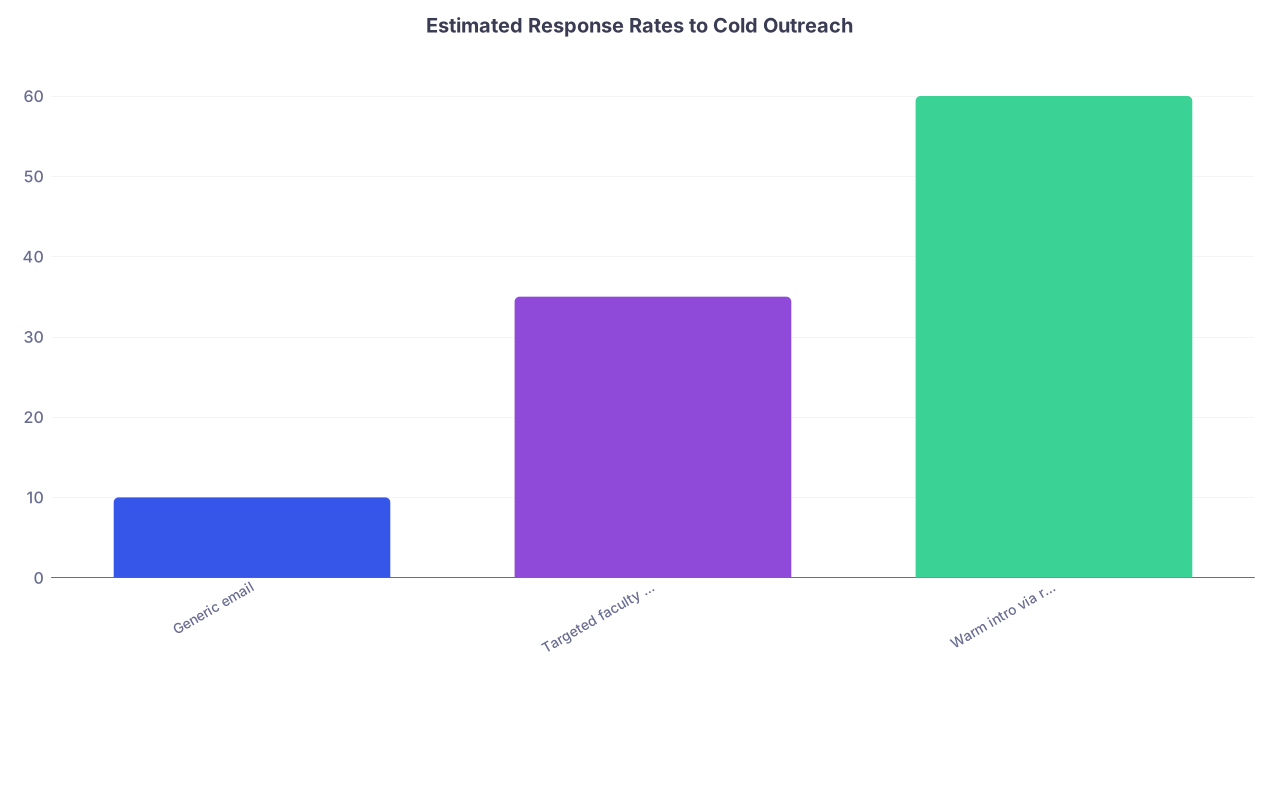
| Category | Value |
|---|---|
| Generic email | 10 |
| Targeted faculty email | 35 |
| Warm intro via resident | 60 |
2.3. When you get a meeting: your script
You are not there to impress them with knowledge. You are there to:
- Get clarity on what matters for this specialty
- Signal that you are serious and organized
- Open the door to future help
Rough flow for a 20‑minute call:
Open (1–2 minutes)
- Thank them for their time.
- One‑sentence background: “I’m an MS2 at X, interested in Y, no home program, trying to be intentional early.”
Ask 3–4 specific questions (not “Tell me your story”)
Examples:- “For students without a home [Specialty] program, what have you seen work well when they apply to residency?”
- “From your perspective, how many specialty-specific research projects do successful applicants usually have?”
- “If you were in my position, what would you prioritize first in MS2?”
- “When it comes time for away rotations, what separates the students who get strong letters from those who do not?”
Close with a clear, low-friction follow‑up ask
- “Would it be alright if I checked in a couple of times a year as I move through my clinical years?”
- “Is there anyone else you think I should talk to, given my situation?”
You are asking for permission to stay on their radar and for one additional connection. That is how a network starts.
Step 3: Use National Organizations to “Borrow” a Network
Your school might be weak. The national specialty organization is not.
Nearly every specialty has:
- A main professional society (e.g., AANS, AAOS, AAD, SIR, ACOG)
- A student or resident section
- A mentorship or outreach committee
You are going to treat these like an extension campus.
3.1. Join the right orgs and sections
Search “[specialty] medical student national organization.” Typical hits:
- Neurology – American Academy of Neurology (AAN), Student and Resident Section
- Orthopedics – American Academy of Orthopaedic Surgeons (AAOS), Medical Student section
- Dermatology – American Academy of Dermatology (AAD), Resident & Student Association
- Radiology / IR – Society of Interventional Radiology (SIR), Medical Student Council
Pay the student membership fee. If cost is an issue, email and ask about fee reductions. Plenty of societies have them; they just do not advertise them loudly.
Then do what 95% of students do not: actually engage.
3.2. Sign up for formal mentorship programs
Most specialty societies run some version of “Match med students with residents/faculty for mentoring.”
Do this:
- Join the student/resident section
- Go to their webpage and actively look for:
- “Mentorship”
- “Student outreach”
- “Career development”
- Fill out whatever form they have — and in the “comments” box, explicitly mention:
- “No home program”
- “Looking for guidance on building a competitive application from a resource-limited school”
That line changes who they pair you with. I have seen students matched with very senior faculty simply because it tugged the “underdog” string.
3.3. Virtual committees and projects: the quiet goldmine
National org student sections always have committees:
- Research or abstracts committee
- Social media or communications team
- Outreach to med schools
- Case report or webinar teams
These are:
- Remote
- Year-round
- Filled with residents and faculty who remember your name
You email the committee chair (usually a resident) with something like:
Dear Dr. [Last Name],
I am a [Year] medical student at [School], very interested in [Specialty]. Our school does not have a home [Specialty] program, so I am trying to get involved through national organizations.
I saw that you are involved with the [Committee Name]. Are there any ongoing projects, webinars, or student roles where I could contribute reliably over the next 6–12 months?
I am particularly comfortable with [list 1–2 skills: literature review, basic stats, making slides, social media drafting, etc.].
Thank you for any guidance you can share.
[Name]
You are not asking for special favors. You are offering labor. That is how you build relationships at a distance.
Step 4: Build Research Connections Without a Lab Down the Hall
You probably will not get an NIH-funded R01 derm lab at your school if there is no derm department. Stop waiting for that.
You are going to:
- Start with low‑threshold, high‑yield projects
- Work with off-site faculty
- Use remote collaboration like a professional
4.1. Understand what “counts” in your specialty
Different fields care about different things. You want to align with reality, not online myths.
Example patterns I routinely see:
- Derm / plastics / ortho / neurosurg – value:
- Case reports and case series
- Retrospective chart reviews
- Surgical technique or outcomes papers
- IM subspecialties / heme‑onc / cards – more:
- Retrospective cohort studies
- Quality improvement (QI)
- Clinical trials subanalyses
- Radiology / IR – strongly:
- Case reports
- Image‑based series
- Technical notes
You will ask your early mentors this direct question:
“Given my current level and school type, what 1–2 types of research projects should I target that are realistic and still meaningful for [Specialty]?”
Then you go find or create those.
4.2. Research by email: how to get on a project
Once you have at least one faculty in the specialty (local or national) willing to talk to you, you can pivot to a research ask.
Do not open with, “Can I do research with you?” Too vague. You need something like:
“If you have any ongoing chart reviews, case series, or projects where a motivated student could help with data collection, references, or drafting sections, I would be very interested, even if the topic is narrow.”
You are:
- Signaling you understand your place
- Offering concrete, unglamorous work
- Lowering the barrier to them saying “yes”
Once someone says yes:
- Agree on timeline (when they want a first draft of your section or data extraction done)
- Clarify role and authorship expectations early
- Use a simple shared document (Google Docs, OneDrive) and meet every 2–4 weeks
Is this glamorous? No. Does it produce concrete additions to your CV and regular contact with specialists? Yes.
Step 5: Residents Are Your Most Powerful Network Node
Faculty write the letters. Residents open the doors.
You want residents in your specialty to know your name, like you, and think of you when opportunities pop up.
5.1. Where to find them
- On your own rotations (Surgery, Medicine, ICU, ED) — residents who mention they are going into your field
- Through national org mentorship programs
- Social media (Twitter/X, sometimes Instagram, less often LinkedIn) where residents in your field discuss cases, research, or education
- Program websites — search “resident list” for target residencies, then look for any who attended mid‑tier or DO schools like yours. They tend to “get it.”
5.2. How to approach without being annoying
You can reach out to residents with a more informal, but still respectful tone:
Hi Dr. [Last Name],
My name is [Name], an MS2 at [School] interested in [Specialty]. I found your name through [X: program website, national society, a talk you gave].
My school does not have a home [Specialty] program, so I am trying to learn from people who successfully matched from similar backgrounds.
If you have 10–15 minutes sometime, I would love to ask a few questions about what you focused on in pre‑clinical/clinical years and what you wish you had started earlier.
I know you are very busy, so no worries at all if now is not a good time.
Best,
[Name]
Ten minutes. Respect for their time. Clear topic. That gets a yes more often than you think.
Once on a call, ask things like:
- “What did you do at your school that actually moved the needle for applications?”
- “If you were me, and had no home program, what would your top 3 priorities be this year?”
- “Are there programs you think are particularly open to applicants from schools like mine?”
You are asking them to map the landmines for you. That insight saves you a year of trial and error.
Step 6: Conferences and Away Rotations – Turn Them Into Networking Machines
You can attend a national or regional meeting and come home with nothing but a tote bag. Or you can come home with 3 new mentors and an away rotation lead.
Your call.
6.1. Before the conference: set up the game board
If you are going to spend money to go, treat it like an investment:
Register early and look for:
- Student discounts
- Travel scholarships (yes, they exist)
- Abstract deadlines
Submit something. Anything.
Case report, QI project, poster. Even a small project gives you:- A concrete reason to be there
- A line for your CV
- An excuse to email faculty ahead of time: “I will be presenting X…”
Identify 5–10 people to target:
- Authors on papers you admire
- Program directors from programs you might apply to
- Leaders in the student section Create a 1‑page document with:
- Name
- Institution
- What they do
- One question you would ask them if you got 2 minutes

| Step | Description |
|---|---|
| Step 1 | Register for Conference |
| Step 2 | Submit Abstract or Poster |
| Step 3 | Identify 5-10 Target Contacts |
| Step 4 | Email 2-3 Before Meeting |
| Step 5 | Attend Talks and Poster Sessions |
| Step 6 | Introduce Yourself After Sessions |
| Step 7 | Follow Up Within 48 Hours |
6.2. During the conference: move with a plan
You are not there to sit in the back row all day.
Your actions:
- Go to student/resident events and introduce yourself to 3 people at each
- If someone you admire gives a talk, go up afterwards:
- “Thank you for your talk on X. I am a med student at Y, no home program in [Specialty], but very interested in [specific niche]. Would you mind if I emailed you a question or two as I plan my clinical years?”
That 15-second interaction makes your later email a warm contact rather than another cold one.
Take brief notes in your phone after each meaningful encounter:
- Name
- Role
- One detail about conversation
- Whether you have permission to follow up
6.3. Away rotations: networking on hard mode
Away rotations are where specialty networking becomes real.
If your school has no home program, away rotations are not optional. They are your audition and network engine combined.
Your away rotation goals:
- Impress 1–2 attendings enough to get a strong letter
- Get 1–2 residents to advocate for you when your application appears
- Leave with at least one specific project or opportunity to continue remotely (case report, QI, etc.)
How you do this:
- Show up early, know the schedule, volunteer for reasonable work
- Ask 1–2 faculty for end‑of‑rotation feedback; frame it as:
- “I am coming from a school without a home [Specialty] program, so this is my main exposure. I want to improve as fast as I can. Could you share 1–2 things I did well and 1–2 things I should work on before residency?”
Then, at the end, with those who like you:
“Dr. [Last Name], I really appreciated working with you this month. I am committed to [Specialty] and will be applying this cycle. Would you feel comfortable writing a strong letter of recommendation for me?”
You ask for a strong letter. Direct. Not timid.
Step 7: Use Social Media and Online Communities Without Being Weird
Yes, real networking happens online in medicine now. But most med students either:
- Avoid it entirely, or
- Overshare and look unprofessional
You are going to sit in the middle.
7.1. Twitter/X and specialty communities
In many specialties (neurosurgery, EM, cards, IR, derm), academic conversations live on Twitter/X.
Your strategy:
- Create a professional account:
- Name, “MS2 at X, interested in Y,” no memes in the bio
- Follow:
- 30–50 attendings and residents in your specialty
- Your target programs’ departments
- The national specialty organization
For 2–3 months, you mostly listen.
Then start:
- Liking and occasionally retweeting useful content
- Posting 1–2 thoughtful comments per week:
- “As a med student, I found this thread on [topic] especially helpful for understanding [X]. Thank you for sharing.”
This is not about “building a brand.” It is about making yourself a familiar, reasonable presence. Then, when you DM someone for a brief question, you’re not a complete stranger.
7.2. Discord/Slack/online groups
A lot of student and resident sections now run Slack or Discord servers:
- Channels for mentorship
- Research opportunities
- Program‑specific Q&A
Get in these. Lurk a bit. Then respond to calls like:
- “Looking for med student to help with lit review on X”
- “Need someone to help design a simple survey”
You do that work well once or twice, your name starts circulating. That is a network.
Step 8: Turn Networking Into a System, Not Random Bursts
If you treat networking like last‑minute cramming, it will show.
You want small, consistent actions over years.
8.1. Monthly networking checklist
Here is a simple structure that works:
Each month, aim for:
- 1 new contact in your specialty (faculty, resident, or senior student)
- 1 follow‑up email or check‑in with existing contact
- 1 small contribution to a project, committee, or research task
- 1 “visibility” action (attend a webinar, ask a question at a talk, post a thoughtful comment online)
That is it. Monthly. Not heroic.
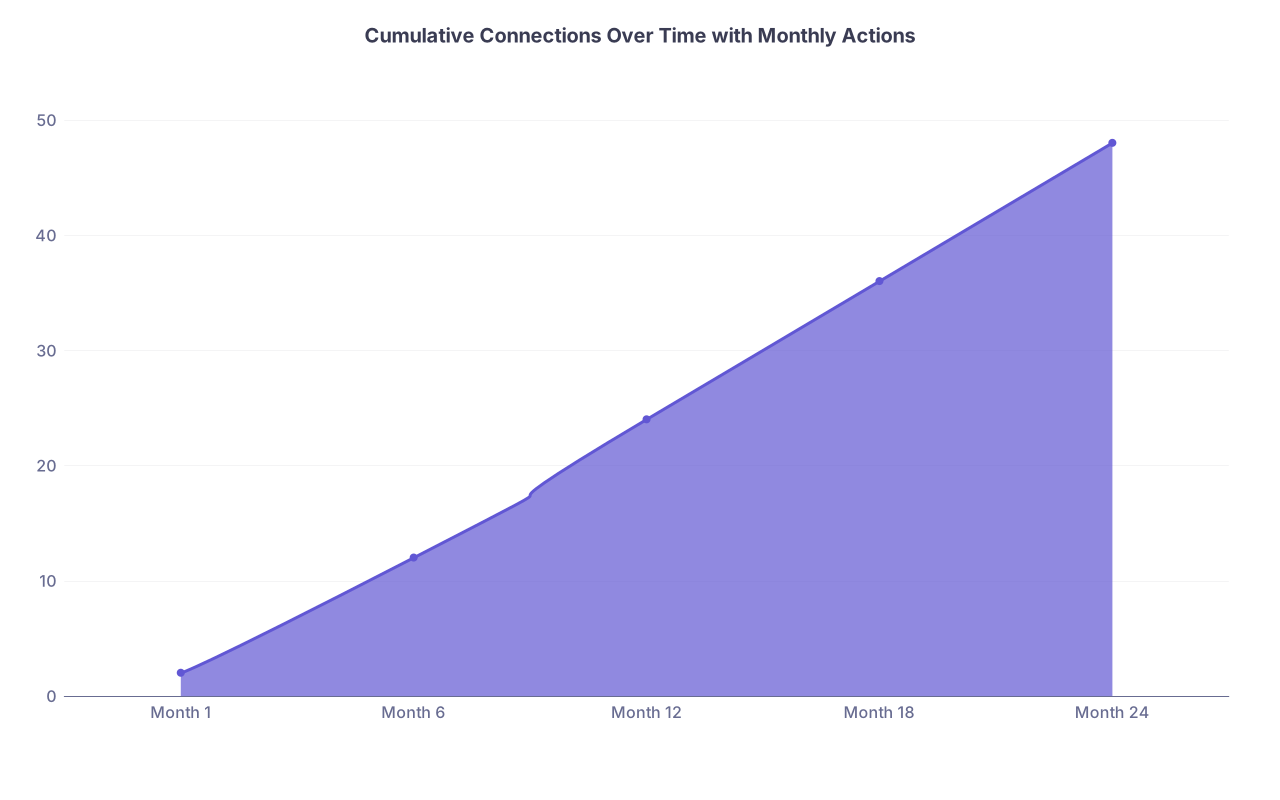
| Category | Value |
|---|---|
| Month 1 | 2 |
| Month 6 | 12 |
| Month 12 | 24 |
| Month 18 | 36 |
| Month 24 | 48 |
Do this for two years and you are not “the student with no home program.” You are “the student who seems to know everyone.”
8.2. Track relationships like you track assignments
Set up a very simple spreadsheet or note with columns:
- Name
- Role (faculty/resident/student)
- Institution
- Specialty
- How you met
- Last contact date
- Next action (e.g., “Send update after exam,” “Ask about away rotations in May”)
Review it every 4–6 weeks. Send 3–5 short update emails:
“Just wanted to share a quick update – I completed my first surgery rotation and confirmed that [Specialty] is still where I feel most engaged. I also started helping on a small [project]. Thank you again for your advice back in March; it helped me prioritize aways for next year.”
People like to see that their advice mattered. It deepens the connection.
Step 9: How to Handle Rejection, Silence, and Awkwardness
You will:
- Get ignored
- Get short, uninterested replies
- Have awkward Zooms
That does not mean networking “isn’t for you.” It means you are doing it correctly.
Guidelines:
- No response after 2 weeks? One polite follow‑up. Then move on.
- One‑word or generic replies? Do not push. That person is not your mentor.
- Awkward first call? Assume 50% of that is on them. You can always send:
- “Thank you again for your time. Your point about X was very helpful; I will follow up after I [do Y].”
You are aiming for 3–5 strong mentors or recurring contacts. You may have to email 30–40 people over a couple of years to find them. That ratio is normal.
Step 10: Put It All Together – A Sample 12‑Month Plan
Let me give you a concrete scenario. You are MS2, aiming for neurosurgery from a school with no neurosurgery department.
Months 1–3
- Search hospital website → find 1 ortho spine surgeon, 1 neurologist who does epilepsy centers
- Cold email both → get 1 meeting
- Join AANS (American Association of Neurological Surgeons) student section
- Apply for their mentorship program
- Start a simple spreadsheet to track contacts
Months 4–6
- Mentorship program matches you with a neurosurgery resident at a different institution
- Resident connects you to faculty there for a Zoom
- Faculty suggests: “Start with a case report or small chart review”
- You ask politely if they have any such projects → get on one remote project
- Attend 1–2 neurosurgery webinars; ask 1 decent question in Q&A
Months 7–9
- Finish draft of your portion of the research project
- Submit abstract to a regional neurosurgery meeting
- Join a student committee in AANS (e.g., webinar or outreach)
- Reach out to 2–3 neurosurgery residents from programs you are curious about for 10‑minute advice calls
Months 10–12
- Present poster (even virtually) at regional meeting
- At conference, introduce yourself to 3 faculty, 3 residents
- Follow up within 48 hours with short thank‑you emails
- Ask your main faculty mentor for advice on away rotation strategy and letters
You now have:
- 1–2 neurosurgeons who know your name and work
- 2–3 residents who have talked to you
- 1 research product, maybe 2
- A presence inside the national student section
That is a serious network. From a school that “does not have neurosurgery.”

Common Mistakes That Kill Your Networking Efforts
A few patterns I see over and over:
Waiting for the “perfect” mentor
You do not need a world‑famous chair on day one. You need someone 2–10 years ahead who will answer email.Email novels
If your email scrolls on a phone, it is too long. Be sharp. Be clear.One‑off conversations with no follow‑up
A “network” is not a pile of business cards. It is people who have seen your name more than once.Pretending you have resources you don’t
Being honest about lacking a home program is not weakness. It is context. Plenty of faculty and residents respond very well to that.Trying to “network” with everyone
You do not need 100 mentors. You need a handful of real ones.

If You’re Late in the Game (MS3 or Early MS4)
You woke up to this reality during clerkships. That is fine. You just compress the plan.
For late starters:
- Focus on away rotations plus one fast but meaningful project
- Use away rotations aggressively for:
- Performance
- Letters
- Resident connections
- Ask every faculty at the end of a successful away:
- “Are there any small projects or case reports where I could help as I apply?”
Double down on national meetings, even if just regional. And be direct with mentors:
“I came to [Specialty] later in medical school, and my institution does not have a home program. I am working to build connections and experiences quickly but thoughtfully. If there is anything you think I should prioritize in the next 3–4 months, I would value your advice.”
That kind of candor works better than pretending you had a 4‑year master plan.

Key Takeaways
You can absolutely build a specialty‑specific network without a home program if you stop waiting for your school to fix it and instead use national organizations, residents, and remote projects.
Small, consistent actions beat heroic one‑offs. One new contact, one follow‑up, one small contribution per month compounds into a serious network over 1–2 years.
Be honest, be specific, and be useful. Clearly state that you lack a home program, ask focused questions, and offer real help on unglamorous work. That combination makes people want to invest in you.