

It’s 11:47 p.m. You’re sitting in front of your laptop, reading yet another med school forum thread where everyone casually says things like, “My mentor, an academic cardiologist, told me…” or “My PI, who’s also a neurosurgeon, suggested…”
And you’re just sitting there thinking:
I don’t know a single doctor. Not one.
No family in medicine. No family friends. No neighbor in scrubs. Your parents’ contacts are all accountants and teachers and random people in your hometown who definitely don’t have an MD after their names.
Your brain jumps straight to the worst-case scenarios:
- “Does this mean I’m already behind?”
- “How am I supposed to get shadowing?”
- “Are med schools going to judge that I don’t have a physician letter?”
- “Do normal people actually… just know doctors?”
Let me say this clearly: starting with zero connections is way more common than it looks online. You just don’t see those people bragging in comment sections. They’re too busy quietly building their own network from scratch.
You’re not doomed. But you are going to need a plan.
Reality check: who actually “knows doctors”?
Here’s the unfiltered truth: a huge portion of premeds are playing this game on easy mode because of one simple thing—social capital.
- Their mom is a pediatrician.
- Their uncle is a surgeon at the big academic center.
- Their neighbor is “happy to let them shadow anytime.”
You don’t see the invisible advantages, you just see the outcomes: insane letters, prestigious shadowing, early research, someone to read their personal statement.
You? You’re on hard mode. No sugarcoating that.
But hard mode isn’t unwinnable. I’ve seen:
- First-gen students with no healthcare contacts end up at top 20 schools.
- Community college transfers who cold-emailed their way into competitive research labs.
- Nontrads who started in retail, met one nurse, and that turned into an entire network of physicians over 2–3 years.
The difference wasn’t “connections.” It was manufacturing opportunities instead of waiting for someone to hand them over.
Step 1: Stop thinking “I know zero doctors.” Start thinking “I know zero yet.”
The phrase “I don’t know any doctors” sounds permanent. Like a personality trait. It’s not. It’s just your starting condition.
Right now, your situation is probably something like:
- No family in medicine
- No obvious person to ask for a shadowing hook-up
- No idea what “networking” even looks like in medicine
- Low-key panic that this means your application will look fake or thin
Let’s strip this down.
There are really only a few things you actually need from “knowing doctors” as a premed:
| Perceived Need | Actual Practical Need |
|---|---|
| Fancy personal mentor | 1–2 approachable physicians to ask questions |
| Big-name letter writer | Solid, specific letter from someone who knows you |
| Endless shadowing at top hospitals | Consistent, meaningful exposure anywhere |
| Insider knowledge of the process | Honest guidance from people in the trenches |
You don’t need a dean of medicine as your godparent. You need a small but real network that you built yourself.
Step 2: Use the only secret weapon you actually control – being useful
The worst networking advice is: “Just reach out and ask to pick their brain.”
That works if your dad golfs with them. It’s awful cold.
Most physicians are:
- Overworked
- Time-poor
- Constantly asked for favors
So if your whole pitch is “Hi, I’m random, please help me,” that’s dead on arrival 90% of the time.
You need a different angle: make their life slightly easier or at least respect their time so much it stands out.
Very concrete ways to do this:
Through research labs
You’re not “using” a physician; you’re joining a team and doing real work. Many labs have MDs or MD/PhDs attached.- Check your university website for clinical or translational labs.
- Look for titles like “assistant professor of medicine,” “clinical research,” “cardiology division,” etc.
- Email saying you’re willing to start as a volunteer, data entry, chart review, whatever.
Once you’re in the lab, guess what? You now know a doctor. Probably more than one.
Through clinical volunteering
A lot of hospitals have volunteer roles in clinics, pre-op areas, front desks, etc. You might not be allowed to follow physicians into patient rooms right away, but you’re in the ecosystem.Your job:
- Show up on time. Every time.
- Be ridiculously reliable.
- Be the volunteer that nurses and staff actually like.
Then after a few weeks or months, you say something like:
“I’m premed and really interested in learning more about what physicians do. Is there anyone here you think might be open to talking with me or letting me shadow for a few hours one day?”
That’s not random cold-contact anymore. That’s an internal referral from staff they trust.
Through campus premed / health orgs
Does your school have:- AMSA
- Premed club
- Minority Association of Pre-Medical Students (MAPS)
- Any health careers advising office?
These groups often invite physicians to speak. That’s your way in. Not by fangirling after the talk, but:
- Ask a thoughtful question publicly.
- After the event, say: “I appreciated what you said about X. I’m a premed here and don’t have many connections in medicine. Would it be okay if I emailed you once or twice with some questions about your path?”
- Then actually email. Short. Specific.
Step 3: Cold email, but do it like someone who respects their inbox
Yes, we’re going to talk about cold emailing. And yes, it feels horrible.
You will feel like a nuisance. You will imagine them rolling their eyes and saying, “Ugh, another premed.”
Some will ignore you. A few will say no. But some will quietly say yes. And that’s all you need.
Here’s the pattern that works better than “Hi, can I shadow?”:

Subject lines that don’t suck:
- “Premed student interested in [specialty] – brief question”
- “Student at [Your School] hoping to learn about [field]”
- “Prospective med student, no family in medicine – guidance?”
Simple template (fill with your actual details):
Dear Dr. [Last Name],
My name is [Name], and I’m a [year] at [school] studying [major] and preparing to apply to medical school. I don’t have any family in medicine, so I’m trying to learn more by reaching out to physicians directly.
I’m particularly interested in [their specialty or something specific you saw on their bio/publication]. If you ever have 15–20 minutes for a quick phone or Zoom conversation, I’d be really grateful to hear about how you chose your path and what you enjoy (or don’t) about it.
I know your time is limited, so no worries at all if it’s not possible. Either way, thank you for what you do for patients and trainees.
Best,
[Name]
[School]
[Phone]
Why this works better:
- You’re not immediately asking for shadowing, which is a heavy lift.
- You’re acknowledging you have no built-in connections (many physicians respect this).
- You’re time-bounding the ask.
Then, if the call goes well and they seem kind, you can later say:
“Would it ever be possible to shadow you for a half-day sometime? No pressure at all—just asking.”
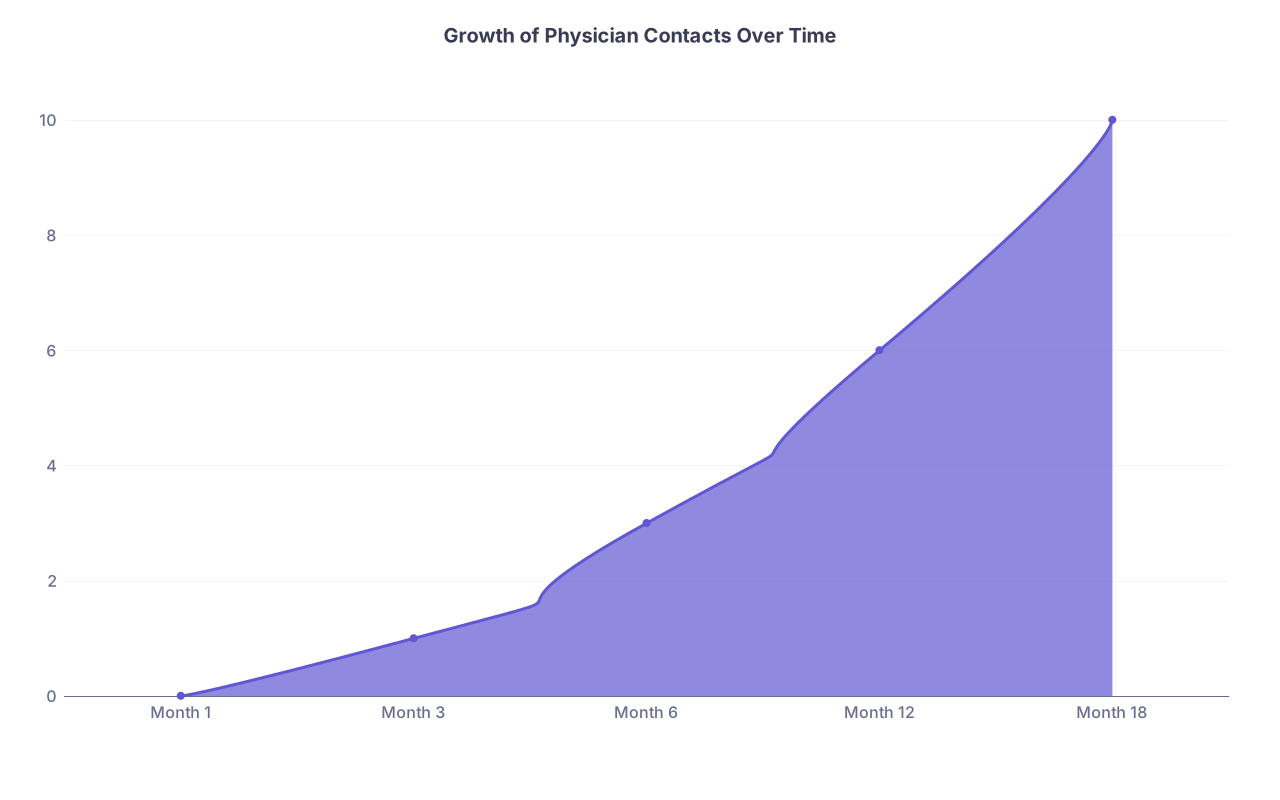
Step 4: Understand compounding: one doctor leads to three
Networking in medicine isn’t linear. It’s not “meet 10 doctors, have 10 total contacts.” It’s more like:
- Meet 1 doctor.
- That doctor introduces you to 2 others over 6–12 months.
- One of those invites you to a group project, conference, clinic, etc.
- Suddenly you’ve met half a dozen physicians and residents.
| Category | Value |
|---|---|
| Month 1 | 0 |
| Month 3 | 1 |
| Month 6 | 3 |
| Month 12 | 6 |
| Month 18 | 10 |
The hard part is going from 0 → 1. After that, if you’re dependable and not annoying, people will vouch for you.
Your script for this:
“I’ve really appreciated your guidance. If there’s anyone else you think I should talk to—maybe someone in [different specialty / academic vs community / research-heavy]—I’d love to reach out with your permission.”
Simple. Not desperate. Most will think of at least one person.
Step 5: What about letters of recommendation if you start from zero?
This is one of the scariest parts. You imagine every other applicant sending in glowing letters from “family friends” who’ve known them since childhood and you’re stuck with… a random chemistry professor.
Breathe.
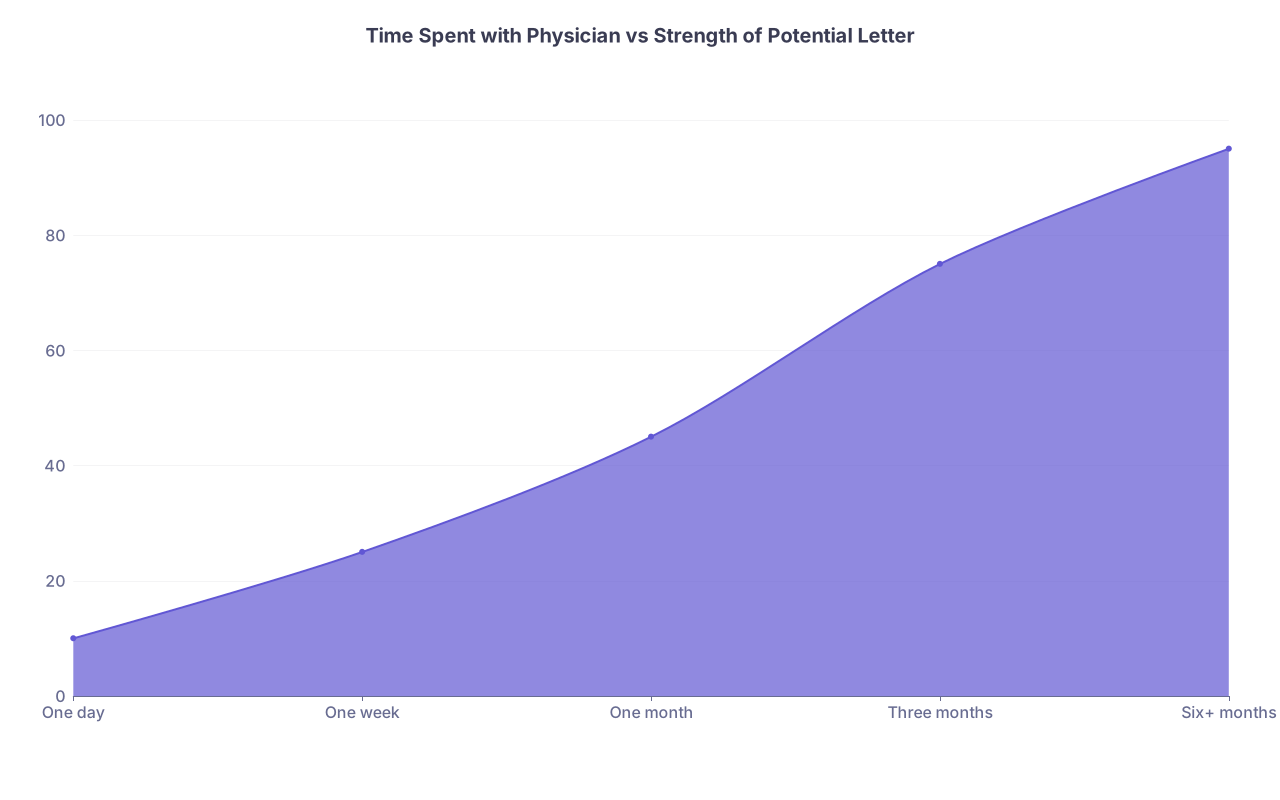
Med schools do not expect every applicant to have some deep, lifelong relationship with a physician. They mainly care that:
- Someone can speak to your work ethic and reliability
- Someone clinically can say: “I’ve seen this person with patients. They’re not a monster.”
- Your story and activities aren’t totally disconnected from any real-life medical exposure
You can absolutely build to a strong letter over 6–18 months by:
- Volunteering in the same clinic or department consistently
- Joining a physician-led research project
- Shadowing the same doctor repeatedly instead of collecting “one-day” experiences from 12 different people
| Category | Value |
|---|---|
| One day | 10 |
| One week | 25 |
| One month | 45 |
| Three months | 75 |
| Six+ months | 95 |
If you have:
- A science faculty letter
- A non-science or character letter
- One solid clinical letter from a physician or advanced practice provider who actually knows you
You’re fine. Seriously.
Step 6: Scripts for people who feel socially awkward and extremely not “network-y”
If you’re imagining some extrovert working the room at a hospital fundraiser, forget it. That’s not what we’re doing here.
Networking in medicine is often:
- One email
- One 20-minute conversation
- One “thank you again, this really helped” follow-up
- Checking in every few months with a short update
Some plug-and-play lines you can actually steal:
When you’re nervous to follow up:
“Hi Dr. X,
I hope you’ve been well. I really appreciated your advice back in [month]. I wanted to share a quick update: [one sentence]. Thank you again for taking the time to speak with me—it’s meant a lot as I’m figuring this out.”
When you want to turn a one-off interaction into an ongoing thing:
“If it’s okay, I may reach out again in a few months as I get closer to applying. Your perspective has been really grounding for me.”
When you want to ask for shadowing after an initial conversation:
“If it ever fits with your schedule to have a student shadow for a half day, I’d be grateful for the chance to see what your work looks like in person. Totally understand if that’s not possible at your site.”
None of this is smooth or brilliant. It’s just respectful, clear, and not weird.
Step 7: Where to look if you truly have nothing right now
You might be thinking, “My school is tiny, my town is tiny, and the hospital in my area doesn’t even have a volunteer program.”
Okay. That’s harder. But still not the end.
Try:
| Option | Where to Look |
|---|---|
| FQHC / community clinics | HR pages, clinic websites |
| Free clinics | Premed clubs, local med schools |
| Telehealth shadowing | Online programs (some paid, vet them) |
| State/local med society | Their websites, student sections |
| Online mentorship programs | SNMA, LMSA, APAMSA, specialty orgs |
And yes, sometimes you’ll have to cold email outside your city. Shadowing might end up in a nearby bigger town. That’s annoying but common.
You are allowed to build a network that isn’t geographically tiny and local. Email and Zoom exist. Use them.
Step 8: Don’t let the comparison game eat you alive
Let me guess: someone in your organic chem class already has:
- A neurosurgeon mentor
- Research at the big-name hospital
- A scribe job at an ER
- A letter basically locked up as a sophomore
And you’re sitting there like, “Cool, I just learned what a DO is last month.”
You need to remember this: med school adcoms like people who had to build from nothing. They’ve straight up said, “We read context.” First-gen, low-income, nontraditional, rural, no-family-in-medicine—this isn’t a penalty. If anything, it explains your story.
What will hurt you isn’t starting late. It’s ending the same because you let the panic paralyze you.
A quick visual: how this actually plays out over time
Here’s what a realistic “from zero” path can look like over ~2 years:

| Step | Description |
|---|---|
| Step 1 | Today - Know 0 doctors |
| Step 2 | Start clinical volunteering or research |
| Step 3 | Meet 1 physician through work |
| Step 4 | Ask for 15 min conversation |
| Step 5 | Shadow for half day |
| Step 6 | Shadow regularly or join project |
| Step 7 | Ask if they know others to talk to |
| Step 8 | Meet 2-3 more physicians |
| Step 9 | Secure 1 strong clinical letter |
Is it fast? No. Is it flashy? No. Does it work? Yes.
FAQ – Exactly 5 Questions
1. Will med schools judge me if I don’t have a letter from some prestigious physician?
Not in the way you’re imagining. They’re not sitting there comparing how famous your letter writer is. They care more that the letter:
- Sounds like the writer actually knows you
- Describes real behaviors (reliability, compassion, work ethic)
- Fits with your story and activities
A detailed letter from Dr. Nobody at Community Hospital is better than a vague, generic letter from some big-name surgeon who barely remembers your face.
2. What if I cold email 30 doctors and no one responds?
Then you adjust, not quit.
First, check your emails:
- Are they too long?
- Are you asking for shadowing in the first sentence?
- Are you sending from a school email (looks more legit)?
Then:
- Try different departments
- Try community hospitals, not just the big academic center
- Ask staff/volunteers at clinics if they know physicians who take students
- Leverage any small connection: your school, your town, your language, your background
Also, 30 emails isn’t actually that many. Sad but true.
3. Is it weird to say “I don’t know any doctors” when I reach out?
No. Honestly, it can be disarming in a good way. Many doctors are first-gen or came from non-medical families and remember exactly how it felt.
Just don’t use it as a guilt trip. Frame it like:
“I don’t have any family in medicine, so I’m trying to learn more by reaching out directly to physicians when appropriate.”
You’re showing effort, not begging.
4. How long do I need to know a doctor before I can ask for a letter?
Rule of thumb: they should have seen you repeatedly over months, not hours.
As a rough guide:
- <1 month / a few shifts: too early
- ~3 months of consistent involvement: borderline but possible if intensive
- 6+ months: usually enough for a meaningful letter
You can ask something like:
“I’m planning ahead for my med school applications. Do you feel you know me well enough to write a strong letter of recommendation, or would you prefer I ask someone who’s worked with me longer?”
That gives them an out if they’re not the right person.
5. What if I end up applying with almost no physician shadowing because my area is so limited?
Then you explain it. You do what you can—virtual shadowing, clinical volunteering, scribing, anything that puts you near patient care—and you make it clear in your application that you:
- Understand what physicians do
- Have seen healthcare from some angle
- Aren’t going in blind
In secondaries or interviews, you can say:
“I come from an area with very limited access to physicians and shadowing opportunities, which made it harder to get traditional shadowing. I compensated by [X, Y, Z]. It also made me see how uneven access to medicine is, which is a big part of why I want to become a physician.”
That’s honest. And powerful.
Here’s what you can actually do today, not in some vague future:
Find one nearby hospital, clinic, or research lab website. Just one.
Identify three names: physicians or MD/PhDs whose work looks even mildly interesting.
Draft one email using the template above and send it to one of them.
Don’t overthink the perfect target. Just get yourself from “I know zero doctors” to “I’ve taken one concrete step toward meeting one.” That’s how this whole thing starts.


