

You’re standing in a crowded “networking reception” after grand rounds. Everyone else seems to know exactly what to say. They’re laughing about some conference in Chicago, or that one attending’s golf swing, and you’re just…holding a plate of cheese, trying not to look like you’d rather be in an empty call room.
And in the back of your mind you’re thinking: “If I hate small talk this much, am I just screwed? Am I going to miss out on research, letters, fellowships…everything…because I can’t fake this schmoozy social person thing?”
Let me answer that directly: no, you’re not screwed. But if you keep equating “networking” with “small talk,” you’re going to make yourself miserable and probably undercut yourself in the process.
First: You’re Not Broken For Hating Small Talk
Let’s put this on the table. A lot of us in medicine hate small talk.
You didn’t go into this field because you’re obsessed with talking about the weather and weekend plans with semi-strangers under fluorescent lights. You went into it to solve problems, help patients, nerd out about physiology, whatever. Not to hover around a cheese platter wondering when it’s your turn to smile and nod.
I’ve watched so many students and residents quietly panic at “networking” events because they think:
- “Everyone else here is naturally charming. I’m the only one faking it.”
- “If I don’t say something brilliant in the next 15 seconds, this attending will never talk to me again.”
- “If I walk up to them, I’ll be annoying. If I don’t, I’m wasting my career.”
Reality check: most people in that room are more awkward than they look. The difference is that some of them have scripts and mental shortcuts they lean on. You…probably don’t yet. So your brain fills the gap with: “I’m terrible at this, and it will ruin my future.”
That’s the part we need to fix.
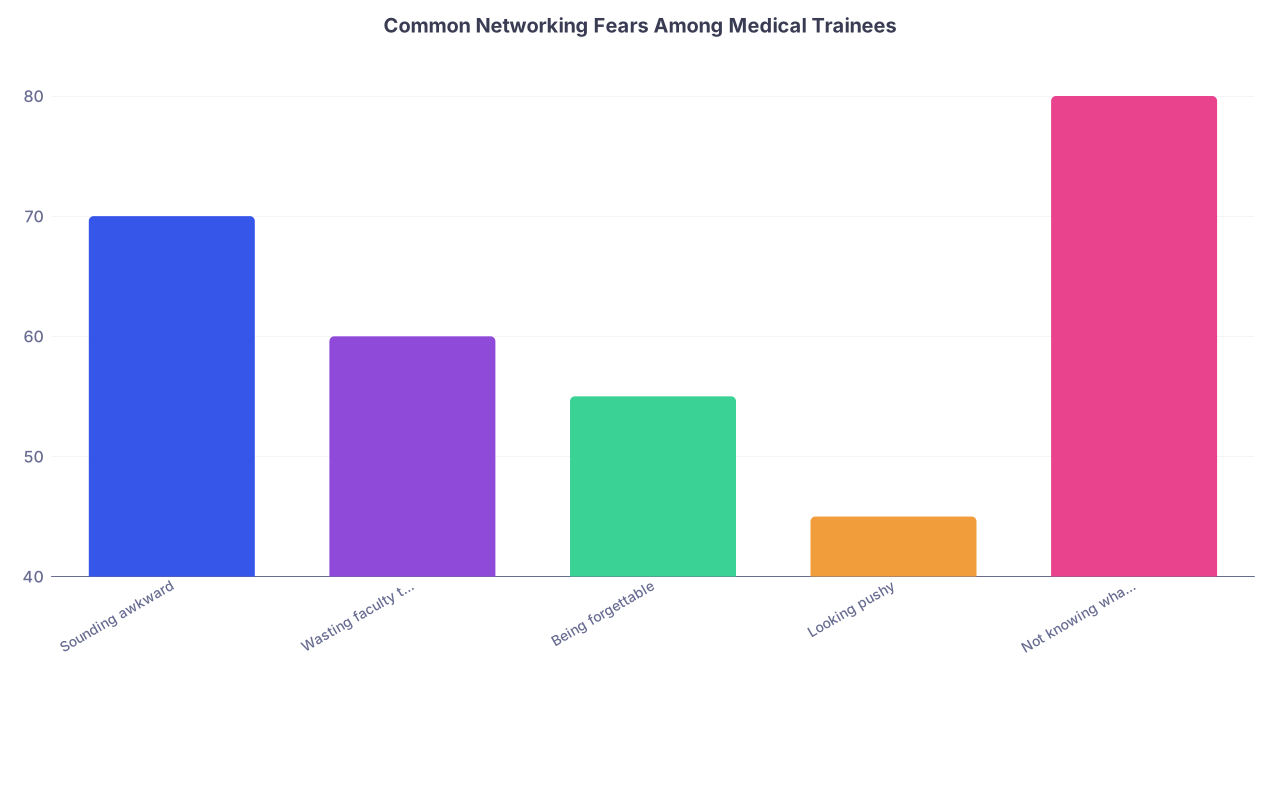
| Category | Value |
|---|---|
| Sounding awkward | 70 |
| Wasting faculty time | 60 |
| Being forgettable | 55 |
| Looking pushy | 45 |
| Not knowing what to say | 80 |
What Networking Actually Is (And What It 100% Is Not)
Strip away the buzzword. “Networking” in medicine is basically:
- People remembering who you are
- Associating you with something specific (interests, reliability, personality)
- Having enough positive interactions that they’re comfortable saying your name in a room you’re not in
That’s it.
It’s not:
- Being the funniest person at the reception
- Working every room like a pharmaceutical rep
- Telling long stories about your vacation or your “passion for medicine” to anyone with a pulse
Some of the best networking I’ve seen had zero small talk. A student sends a thoughtful follow-up email after a lecture. A resident quietly helps an overworked attending by pre-charting and later says, “If you ever hear of any QI projects in this area, I’d love to help.” A shy MS3 who hates receptions sits down one-on-one with a faculty mentor every 2-3 months and slowly builds a real relationship.
They’re not “good at small talk.” They’re consistent, clear, and not a pain to work with. That’s network gold.
So yes, you can hate small talk and still network. But you do need some way to:
- Start conversations
- Keep them going long enough to be remembered
- Follow up
That’s the game. Not “be the life of the party.”
How To Network Without Feeling Like a Fake Extrovert
Let’s walk through what this actually looks like in practice, step by step, assuming you’re someone whose soul shrivels at the phrase “So, where are you from?”
1. Use “Content” As Your Crutch
If you hate open-ended small talk, don’t start there. Anchor everything to something external.
That can be:
- The talk they just gave
- A paper they wrote (that you actually skimmed, not just the title)
- A patient case they discussed on rounds
- A project they mentioned in passing
Instead of, “So, how’s your day going?” (kill me), you say:
- “I really liked your point about X in the talk—especially the part about Y. Do you think Z is realistic in most hospitals?”
- “I read your paper on ___ before this lecture. I was curious how you handled ___ at your institution.”
- “On rounds this morning, you mentioned you changed your practice after ____ study. Was that controversial in your group?”
This doesn’t feel like “networking.” It feels like…talking about medicine. Which you actually care about.
2. Prepare 2–3 Reusable Questions So You’re Not Scrambling
Your brain will blank in the moment. That’s normal. So you don’t rely on your brain. You carry two or three questions you can ask almost any faculty member.
Examples that don’t feel horribly fake:
- “If you were a resident right now and wanted to get into [field], how would you spend your time outside of clinicals?”
- “For students who are interested in [field], what separates the ones you remember from the ones you don’t?”
- “What do you wish applicants understood about your specialty/program that they usually don’t?”
These questions do three things:
They get them talking (so you’re not carrying the conversation), they make you look thoughtful, and they give you useful intel.
3. Short Conversations Are Fine. You Don’t Have To Linger.
You’re allowed to talk to someone for three minutes and then leave. That doesn’t make you rude or awkward. It makes you efficient.
A basic script:
You: Ask your question, listen to their answer, respond briefly.
Them: Talks, maybe asks you a little about yourself.
You: “This was really helpful, thank you. I don’t want to take too much of your time, but I’d love to email you about [tiny specific thing]. Is there an address you prefer?”
Done. You got their attention once, you’ll consolidate later via email when you’re less socially fried.
4. Make Email Your Superpower
If you hate small talk, email is your best friend. You get to think. Edit. Delete the weird sentence.
Most people screw this up by sending vague, “I’d like to pick your brain” emails that go nowhere. You want short, specific, and anchored to a real interaction.
Something like:
Dr. Smith,
I’m the MS2 who asked you about resident research at the end of your heart failure talk on Tuesday. I really appreciated your suggestion about starting with QI work.
If you know of any ongoing heart failure-related QI projects that could use an extra pair of hands for data collection or chart review, I’d be grateful if you’d keep me in mind. I’m especially interested in readmission reduction and patient education.
Thanks again for your time,
[Name, class, contact]
No life story. No begging. Very clear ask, very low pressure.
That’s networking. And there’s zero “So, uh…how about that weather?”

5. Build Depth With a Few People, Not Surface With Everyone
The biggest mistake anxious people make is trying to talk to everybody at once because they’re terrified one missed conversation equals one lost opportunity forever.
You don’t need 30 attendings who sort of know your face. You need like 3–5 people who actually know how you think and work.
So instead of spreading yourself thin at every event:
- Pick 1–2 people you genuinely find interesting
- Talk to them briefly
- Follow up
- Meet occasionally for 15–30 minutes
- Do something useful with/for them if possible (project, clinic, presentation)
Over months, that becomes a solid relationship. That’s the part that leads to, “Oh, I know someone who’d be great for that. Let me email them.”
But What About Research, Letters, And “Networking Your Way In”?
This is where the panic really kicks in, right? “If I don’t go to every mixer and charm every PD, I’ll never get the good projects or letters. Other people will, because they’re better at this.”
I’ve seen it work very differently in real life.
Here’s how opportunities usually appear, even for people who hate networking:
- They show up consistently on a team and don’t create drama
- They ask 1–2 focused questions that show they’re paying attention
- They follow up once or twice by email about something specific
- They say “yes” to one reasonable project, then follow through
- The attending gets used to their name in their inbox and on their service
At that point, doors start to open that look like “Oh, they must be a networking expert,” but really it’s just repeated, low-drama, semi-boring reliability.
If you’re worried that every missed reception = lost opportunity, here’s the truth: the main currency in medicine is not “witty at conferences.” It’s “helpful over time.”
You can absolutely build that even if you skip half the social stuff because it drains you.
| Style | Outcome in Medicine |
|---|---|
| Loud at every reception | Sometimes memorable, sometimes forgettable |
| Rarely follows up by email | Opportunities fizzle out |
| Quiet but consistent on teams | Builds strong reputation over months |
| Focused, specific follow-up | Leads to projects and letters |
| Knows everyone shallowly | Few people go to bat strongly |
| Knows a few people deeply | Strong advocates for applications |
Handling The Worst-Case Scenarios Your Brain Keeps Throwing At You
Your brain loves disaster movies. So let’s walk through some of the ones I hear all the time.
“What if I say something awkward and they remember me forever…in a bad way?”
Then you’ll join the rest of us. Everyone has at least one deeply cringe interaction they replay at 2 a.m.
The truth: faculty meet hundreds of trainees. They don’t remember most of your words. They remember patterns.
If you’re:
- Generally respectful
- Interested in learning
- Not chronically weird or boundary-ignoring
One slightly awkward conversation won’t kill anything. If you’re really horrified about something you said, you can even repair it with a calm follow-up: “Hey, I felt like I phrased X clumsily earlier—what I meant was Y.” That shows self-awareness, not doom.
“What if I don’t network enough and end up with no letters and no research?”
This fear is loud, but usually overestimates how perfect everything has to be.
You do need:
- A few solid clinical letters from people who’ve actually seen your work
- Ideally some involvement in projects, but it doesn’t have to be 10 first-author papers in NEJM
You can get both of those mostly by:
- Taking clinical work seriously
- Asking on rotations, “Do you have any projects I could help with, even something small?”
- Staying in touch with 2–3 attendings over time
None of that requires being a social butterfly.
“What if everyone else is out there networking and I’m at home exhausted?”
They are. And some of them are wasting their time.
There’s a point of diminishing returns. Going to 3 receptions and talking to 1–2 people in a real way beats going to 12 events where you just hover and smile and say, “So, where are you from?” and no one remembers a thing.
Your energy is finite. If you’re burned out, your “networking” vibe will be off anyway—rushed, needy, scattered. I’d rather you go home, sleep, then send two thoughtful emails the next day.

| Step | Description |
|---|---|
| Step 1 | See faculty at talk/rounds |
| Step 2 | Anchor to content - ask 1 question |
| Step 3 | Short conversation |
| Step 4 | Get preferred email |
| Step 5 | Send specific follow up within 48h |
| Step 6 | Offer help on small project |
| Step 7 | Follow through reliably |
| Step 8 | Build long term relationship |
Tactical Scripts For People Who Hate Small Talk
You probably want concrete words, not just concepts. So here are a few plug-and-play lines you can adapt.
Approaching an attending after a talk:
“Hi Dr. ____, I’m [name], an [MS2/PGY1] here. I really liked your point about ___, especially how you handled ____. I was wondering, in your experience, how realistic is it to ____?”
Exiting a conversation:
“Thanks so much for talking with me—I don’t want to take too much of your time, but this was really helpful. I might email you if I have more questions about [topic], if that’s okay?”
Asking about projects without sounding desperate:
“I’m trying to get some experience with projects in [area]. Do you know of anything going on that could use help with chart review/data collection/literature searches? I’m happy to do the unglamorous parts.”
Following up after a rotation:
“Dr. ____,
I really appreciated working with you on the ___ service last month. Your approach to [specific thing] gave me a better framework for [whatever].
If you hear of any [field]-related QI or small projects that could use extra help, I’d love to be considered.
Thank you again,
[Name]”
Notice: none of this is clever. None of it is “great small talk.” It’s straightforward and respectful. That’s enough.
FAQ (Exactly 6 Questions)
1. Do I have to go to networking events if they drain me?
No. You don’t have to go to all of them. I’d pick a few high-yield ones: visiting professor talks in your field, department retreats where residents and faculty mingle, or specialty interest group events. Go in with a plan to talk to one or two people and then leave. The rest of your “networking” can happen in clinical settings and via email.
2. I’m introverted. Does that automatically put me at a disadvantage in medicine networking?
Not automatically. Introverts often listen more, think before they speak, and follow through carefully—those are huge assets. The disadvantage only shows up if you use “introverted” as a reason to avoid any interaction at all. You don’t need to become an extrovert; you just need a sustainable way to create and maintain a few key relationships.
3. What if I email someone once and they never respond—is that a sign I’m annoying?
Usually it’s a sign they’re drowning. People miss emails constantly. You’re allowed one polite follow-up after 7–10 days: “Just bumping this to the top of your inbox in case it got buried.” If they ignore that, then yes, move on. That’s not a moral judgment on you; it’s just a data point that they’re not the right person right now.
4. How early in training should I start “networking”?
Earlier than feels comfortable, but not in a forced way. As an MS1/MS2, that might mean emailing one lecturer per block whose talk you genuinely liked. As a clinical student, it might mean asking about projects on rotations where you click with an attending. You don’t need some giant “strategy.” Just start accumulating a few humans who know you exist.
5. Can I get strong letters of recommendation without being a “favorite” or super chatty on rounds?
Yes. Many attendings actually prefer writing letters for the solid, quiet worker who asks good questions and takes feedback well over the loud, constantly-talking student. To help them, you can politely ask at the end of a rotation, “Based on working with me, do you feel you could write a strong letter of recommendation?” That gives them an out if they can’t, and if they say yes, you’re probably in good shape.
6. Is it really possible to “network my way into opportunities” without feeling fake?
Yes, but only if you stop thinking “networking” equals “performing.” You’re not auditioning; you’re building working relationships. If you anchor conversations to real content, keep them short, follow up specifically, and be reliable over time, you are networking—even if you skip the small talk, hate receptions, and would rather be home in sweatpants. The opportunities tend to follow the people who quietly make themselves useful and stay on the radar, not just the ones who talk the loudest.
If you remember nothing else: you don’t have to love small talk, you don’t have to go to everything, and you don’t have to magically turn into an extrovert. You do need a repeatable way to start a real conversation, follow it up, and stay useful over time. That’s enough to build a network that actually works for you, without burning out your sanity in the process.


