

The fear of “being annoying” ruins more opportunities in medicine than a low Step score ever will.
I’m not exaggerating. I’ve watched students ghost faculty after one email because they were sure they were “bothering them” — while those same faculty were telling me, “I wish more students followed up, I get so many emails I just lose track.”
So you, sitting there rereading the same draft for the fifth time, wondering: Can I email again? Am I about to destroy my career over one follow‑up? Let’s walk through this like actual humans who have anxiety and want to succeed anyway.
The Ugly Truth: Faculty Ignore Emails Constantly (And It’s Not About You)
Here’s the part no one says out loud: a huge percentage of your emails die in the inbox swamp.
Not because the faculty hate you. Not because they judged your CV and decided you’re worthless. Most of the time, it’s because:
- They checked your email on their phone walking between cases and thought, “I’ll reply later.”
- They had 60 new messages that morning and yours slid off the first screen.
- They starred it. Never looked at the star again.
- They replied in their head. Never with their fingers.
I’ve sat in offices where attendings scroll their phone and say, “Crap, I never replied to this student from last week,” and then… keep scrolling. Not because they don’t care. Because their brain is fried.
You read silence as: They’re mad at me. I annoyed them. I should never email again.
They experience silence as: Oh yeah, I meant to get back to that…
This is why follow‑ups matter. And why “being annoying” is way less of a risk than your anxiety is telling you.
The Baseline Rule: How Often You Can Email Safely
Let me give you the simple answer you actually want before we spiral into the what‑ifs.
If you’ve never met them in person and are cold emailing:
- First email: your intro/ask
- If no response: wait 5–7 days, then send one polite follow‑up
- If still nothing: wait another 7–10 days, send one last follow‑up
- After that: stop. You move on. They’re a no.
So that’s maximum 3 total emails per “ask” to a cold contact, spread over 2–3 weeks.
If you already have a relationship (you’ve worked with them, rotated with them, they know your face and name):
- First email: your question/update/ask
- No response: 3–5 days, one follow‑up
- Still nothing: 5–7 days, another follow‑up
- If it’s time‑sensitive (e.g., letter due date): you can add one final “deadline is approaching” email 2–3 days before
So around 3–4 total emails is very normal if something has a deadline.
Is this a rigid law? No. But these rhythms keep you in the “persistent and professional” lane instead of the “wow, okay, relax” lane.
To make this less abstract:
| Situation | Total Emails | Typical Gaps (days) |
|---|---|---|
| Cold email, no response | 2–3 | 5–10 between |
| Known faculty, no deadline | 2–3 | 3–7 between |
| LOR with hard deadline | 3–4 | 3–7 + 2–3 pre-deadline |
| Scheduling a meeting | 2–3 | 2–5 between |
| Post‑meeting thank you | 1 | Same/next day |
You’re not annoying at 2–3 well‑spaced, respectful emails. You’re organized.
The “Annoying” Threshold: What Actually Crosses the Line
Your brain probably tells you you’re annoying at email #2. Most faculty won’t even register you as persistent until email #2 or #3.
Here’s what does genuinely read as annoying or unprofessional:
- Emailing daily or every other day about the same thing
- Sending multiple emails in one day if it’s not an emergency
- Dramatic subject lines like “URGENT!!!! PLEASE RESPOND”
- Guilt‑tripping: “I really need this, I’m very stressed, please respond”
- Short, context‑less follow‑ups like, “???” or “Just checking again” with no content
- Forwarding your own previous email repeatedly like a chain
You’re nowhere near this line if you’re sending:
“Just wanted to follow up on the email I sent last week regarding potential research opportunities. I know you’re very busy — no rush, but I wanted to make sure it didn’t get lost in your inbox.”
That’s not annoying. That’s normal.
Here’s how real faculty actually react to follow‑ups (things I’ve literally heard):
- “Thank god they followed up, I completely missed that.”
- “I appreciate when students remind me. I forget stuff.”
- “If a student emails me three times, I assume they’re serious. I like that.”
They get annoyed by tone and frequency, not by a couple of spaced, polite emails.
Different Scenarios: How Often You Can Email Without Losing Your Mind
Let’s break the anxiety by being weirdly specific. Because vague advice is what leaves you spiraling at 2 a.m.
1. Cold Emailing for Research / Mentorship
You email Dr. X about research.
Timeline that won’t make you look unhinged:
- Day 0: Initial email
- Day 6–7: Follow‑up #1
- Day 14–17: Follow‑up #2 (final)
If there’s no response after that, you’re not “being ghosted because you’re terrible.” You’re just not a priority. Which sucks, but it’s not personal. Move on to the next person.
And yes, you can be emailing multiple faculty in parallel. You’re not in a monogamous relationship with a potential PI.
2. You Already Worked With Them (Attending From a Rotation)
This is where people really over‑correct. You feel like you’re “bothering” them because you already “took so much of their time” on the rotation.
Reality: if you worked hard and they liked you, they expect you to email.
Say you want a letter:
- 4–6 weeks after the rotation: first email requesting an LOR
- If no answer: follow up in 5–7 days
- Still nothing: follow up again in ~7 days
- If they verbally agreed in person but haven’t submitted by the deadline, you absolutely can:
“Just a gentle reminder that the letter for my residency application is due in 3 days (on X date). I really appreciate your support and understand you’re very busy.”
That’s not annoying. That’s how letters get in on time.
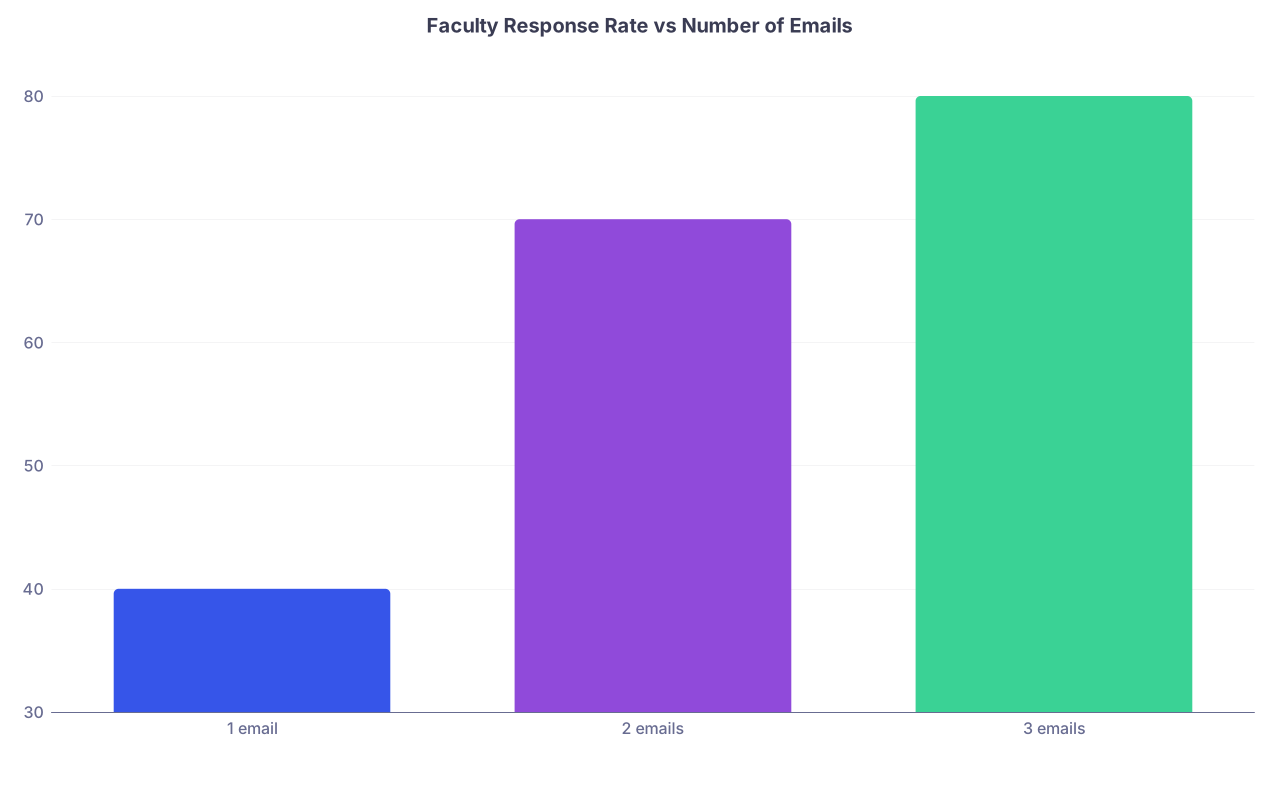
| Category | Value |
|---|---|
| 1 email | 40 |
| 2 emails | 70 |
| 3 emails | 80 |
I’ve seen this pattern over and over: a lot of faculty don’t respond to the first email. But once a student sends a reminder or two, responses jump.
3. Scheduling a Meeting or Shadowing
This one is more time‑sensitive, so the gaps can be slightly shorter.
- Day 0: “Would you be available to meet sometime in the next 2–3 weeks?”
- Day 3–4: “Just following up to see if there’s a time that works for you.”
- Day 7–10: “Following up once more in case my previous messages got buried. Totally understand if your schedule doesn’t allow for a meeting right now.”
After 2–3 total messages, let it go. If they’re this hard to reach for a 20‑minute meeting, they’re probably not going to be an accessible mentor anyway.
4. After an Interview / Networking Event
This is where people worry about “clingy” energy.
Normal sequence:
- Same day or next day: thank‑you email
- Later (weeks to months): update email only if there’s something meaningful to say (new publication, leadership, major milestone, or you’re applying to their program)
What’s safe:
- A thank‑you now
- One update email in a few months
- Another email the following cycle if you’re applying / re‑applying somewhere relevant
You are not supposed to maintain weekly contact. That actually would be weird.
How to Follow Up Without Sounding Needy or Desperate
You’re afraid of the content of the follow‑up being judged, not just the timing. So steal some language.
You want your follow‑ups to be:
- Short
- Polite
- Assume positive intent (their inbox, not their rejection)
- Have a clear “why” you’re following up
Example for research:
Subject: Follow‑Up – Student Interested in Cardiology Research
Dear Dr. Smith,
I hope your week is going well. I wanted to briefly follow up on my email from last week regarding potential cardiology research opportunities in your group.
I know your schedule is very busy, but if you’re currently taking students, I’d be grateful for the chance to discuss how I could get involved, even in a small role.
Thank you again for your time and consideration.
Best regards,
[Name]
Example for letters:
Subject: Gentle Reminder – Letter of Recommendation
Dear Dr. Lee,
I hope you’re doing well. I wanted to send a gentle reminder about the letter of recommendation for my residency application. The ERAS deadline is [date], so the letter would ideally be submitted by then.
I really appreciate your support and the time this takes. Please let me know if you need any additional information from me.
Best,
[Name]
Notice what we’re not doing: apologizing for existing. “Sorry to bother you” every other sentence just makes you sound like you think you’re a bother.
You’re not. You’re a student trying to do what you’re supposed to do.
The Catastrophe Scenarios Your Brain Is Inventing (And What Actually Happens)
Let’s just drag the worst‑case thoughts into the light.
“If I email again, they’ll be angry and blacklist me.”
Faculty who care enough to blacklist you over two polite follow‑ups are walking red flags. You don’t want them as your mentor, your letter writer, or frankly anywhere near your career.
What actually happens 99% of the time:
- They reply and apologize for the delay.
- Or they still ignore you because they’re drowning.
- Or they quickly say no and you move on.
Blacklisting is a huge, dramatic word that rarely applies here.
“They’ll tell other faculty I’m annoying.”
I’ve heard many attendings gossip about lazy students, unprofessional students, unethical students. I have never once heard: “This student sent two follow‑up emails. So annoying. Never work with them.”
What they do say is:
- “This student is really on top of things.”
- “They’re persistent. I like that.”
- Or nothing at all, because your emails aren’t that memorable.
“I’ll ruin my chances at this specialty/school/program.”
The specialty is not watching your inbox behavior like Big Brother. A single faculty member being mildly annoyed (again, unlikely at 2–3 follow‑ups) doesn’t kill your whole future.
What kills more futures is the opposite: never reaching out, never following up, never reminding letter writers, and then wondering why your application is thin and your letters are missing.

| Step | Description |
|---|---|
| Step 1 | Student sends first email |
| Step 2 | Thinks faculty hates them |
| Step 3 | Email lost in inbox |
| Step 4 | Does not follow up |
| Step 5 | Follows up after a week |
| Step 6 | Faculty replies or declines |
| Step 7 | Missed opportunity |
| Step 8 | No response |
Practical Rules So You Don’t Overthink This Every Time
Let’s make this mechanical, so you’re not reinventing your anxiety wheel with every email.
- When you send an important email, set a reminder (phone, calendar, task app) for a follow‑up date. Don’t just “remember.”
- Default gaps:
- 5–7 days for cold emails
- 3–5 days for known faculty
- After you hit 3 total emails with no response on one specific ask, you’re done. You’re not weak for stopping. You’re professional.
- Never send follow‑ups when you’re emotionally flooded. Write it, save it, re‑read when you’re calmer, then send.
- Assume silence is logistics, not character judgment. Because most of the time, that’s exactly what it is.
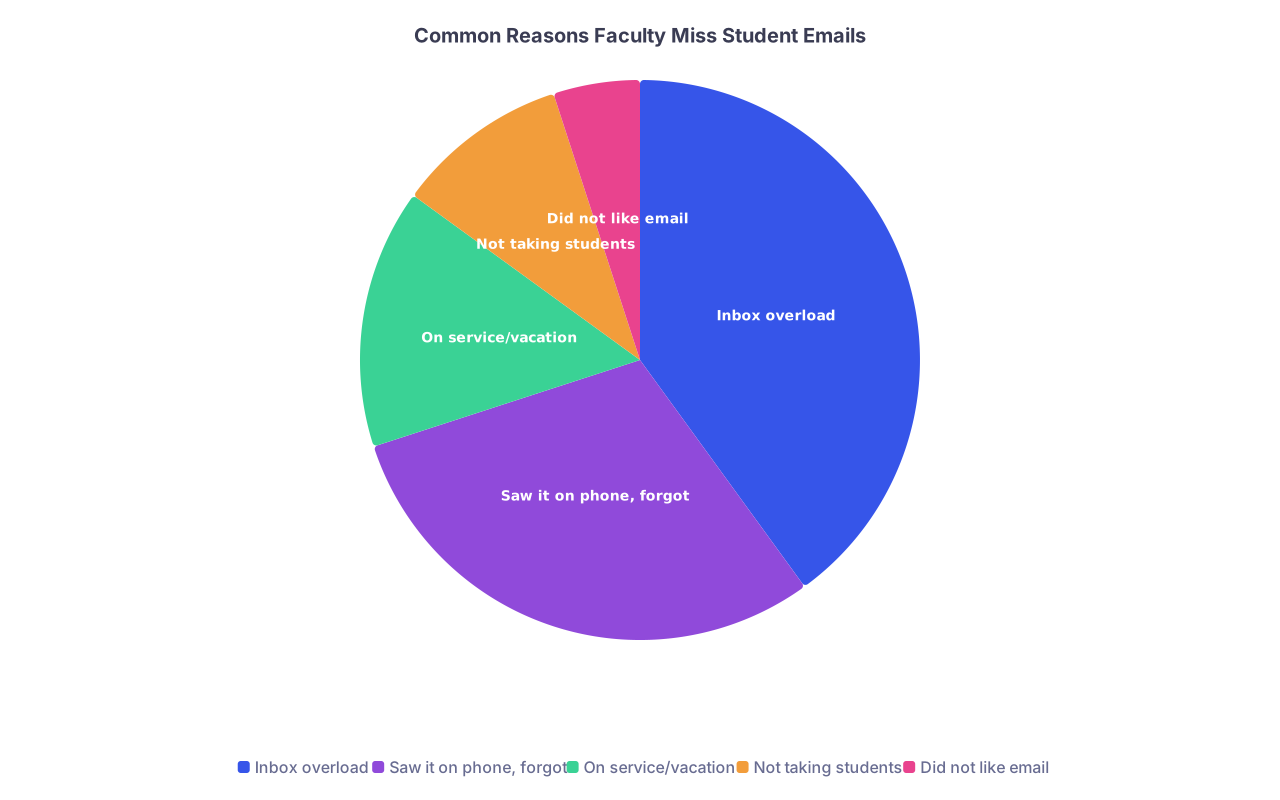
| Category | Value |
|---|---|
| Inbox overload | 40 |
| Saw it on phone, forgot | 30 |
| On service/vacation | 15 |
| Not taking students | 10 |
| Did not like email | 5 |
Notice that tiny slice for “did not like email.” That’s the one your brain obsesses over. It’s also the least common.
FAQs
1. Is it rude to follow up if they haven’t answered my first email?
No. One follow‑up is expected, even appreciated. Faculty know their inboxes are chaotic. A polite follow‑up after a reasonable gap (5–7 days for cold contact, 3–5 for someone you know) is standard, not rude.
2. What if I realize I forgot something important in my first email?
You can send a second email the same day or next day that says: “Apologies for the second email — I realized I forgot to include [X].” That’s fine. Just don’t make a habit of sending 3–4 fragmented messages; if possible, include missing pieces in your follow‑up instead of a barrage of mini‑emails.
3. Can I email a different faculty in the same department if one doesn’t answer?
Yes. This is normal. Just don’t CC five attendings in a cold email blast. Email individuals separately, tailor your message to each person, and if you’re worried about overlap, you can be transparent later: “I’d previously reached out to Dr. X but understand they may not be taking students right now.”
4. How long should I wait before assuming they’re not interested?
If you’ve sent 3 total emails over 2–3 weeks with no response, assume they’re not available or not interested enough to prioritize you. That’s your permission to mentally close that door and focus on other people instead of torturing yourself.
5. What if they respond weeks later after I gave up and went with someone else?
You’re allowed to pivot. You can reply with something like: “Thank you so much for getting back to me. I’ve just committed to a project with another group, but I really appreciate your response and would be interested in future opportunities if they arise.” No one’s offended by that. That’s just adult life.
Key points, so you don’t need to reread this at 1 a.m.:
- Two to three polite, spaced follow‑ups are normal, not annoying.
- Silence is usually inbox chaos, not a secret hatred of you.
- You lose far more by disappearing than you ever will by following up like a professional.


