
Formal mentorship in medicine is wildly overrated. The messy, unstructured, “grab coffee with whoever will say yes” approach quietly beats most polished mentorship programs over a 10–20 year career.
You’re told to “find a mentor,” “join a mentorship program,” “get matched with a senior physician.” The implication: if you don’t have a capital-M Mentor, you’re behind.
The data – and real careers – tell a different story.
The Big Myth: You Need A Formal Mentor To “Make It”
The myth goes like this:
Join a structured mentorship program → get paired with the right person → gain wisdom, opportunities, and sponsorship → thrive.
What actually happens in a lot of hospitals, med schools, and residencies?
You get:
- A random match based on department or vague “interests”
- One or two stiff 30–45 minute meetings
- Then…silence
I’ve lost count of how many residents and junior attendings have said some version of:
“I was assigned a mentor, we met once, they were nice but busy, and nothing came of it.”
And it’s not just anecdotes.
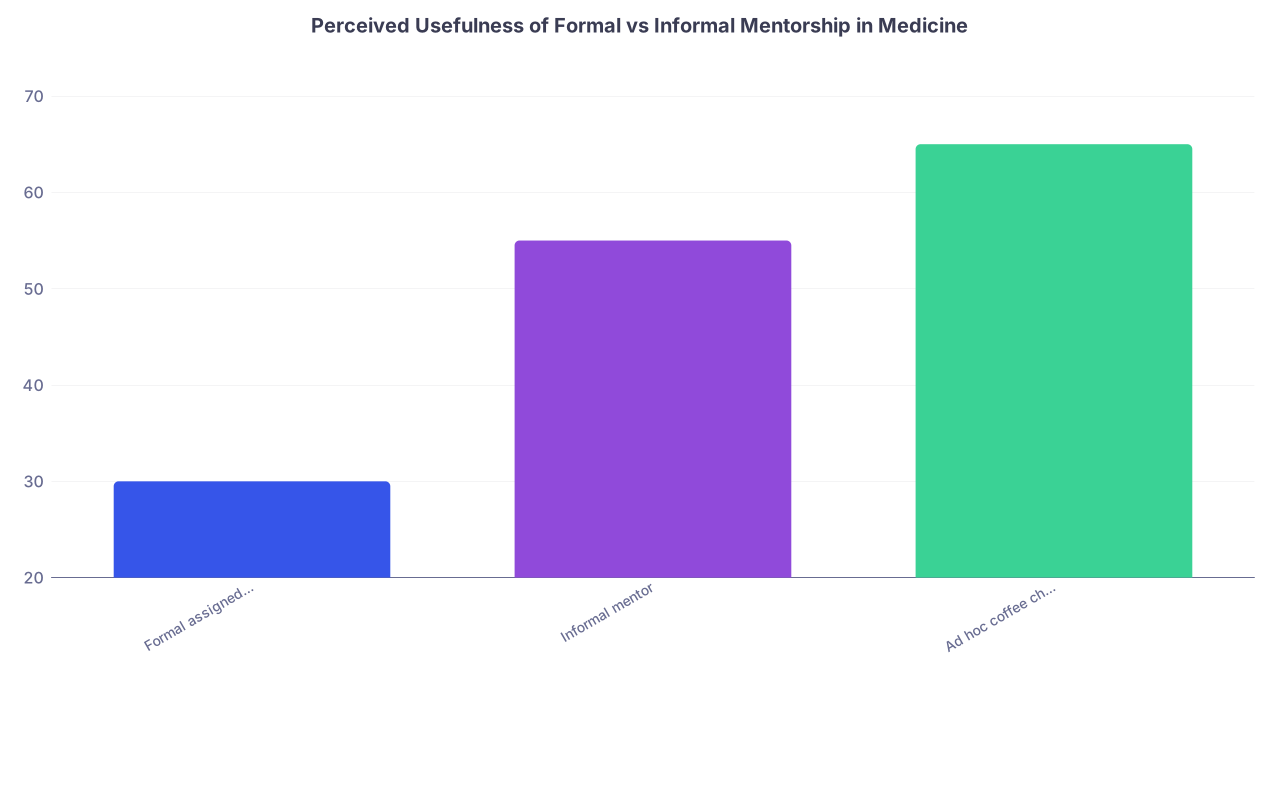
| Category | Value |
|---|---|
| Formal assigned mentor | 30 |
| Informal mentor | 55 |
| Ad hoc coffee chats | 65 |
Those numbers mirror what repeatedly shows up in surveys of physicians and trainees: informal, self-initiated connections (often starting as something as small as a coffee) consistently rank as more useful, more influential, and more enduring than formal pairings.
Why? Because real careers are built on:
- Weak ties
- Serendipity
- Repeated light-touch interactions over time
Not on one appointed guru whose calendar hates you.
What Random Coffee Chats Actually Do (That Programs Don’t)
Let’s be specific. “Random coffee chats” is not a cute metaphor. I mean literal, low-stakes, non-scripted conversations with people you don’t already know well:
- A fellow from a different service
- A PI from another department
- An alum visiting for Grand Rounds
- A hospital administrator who seems oddly competent (these matter more than you think)
Those chats beat formal mentorship long-term for six reasons.
1. They Build Networks, Not Dependencies
Formal mentorship assumes a vertical model: junior person → senior person → wisdom flows down.
Random coffee chats assume a network model: you steadily accumulate weak ties in different domains.
Over a 15-year arc, the network model wins. Every time.
Because:
- That community peds doc you had coffee with? Five years later they’re running a statewide quality initiative and need a hospital liaison.
- The radiology resident you chatted with as an intern? Now they’re faculty and can get your weird case into a teaching conference.
- The administrator you met for 20 minutes? They remember you when there’s a new clinical pilot needing a clinician champion.
Weak-tie theory is not fluff. Mark Granovetter’s work on “The Strength of Weak Ties” has been replicated across fields: weak ties create more novel opportunities than your closest inner circle.
Medicine pretends it’s immune. It is not.

| Step | Description |
|---|---|
| Step 1 | Random Coffee Chat |
| Step 2 | Weak Tie |
| Step 3 | Stay Light Contact |
| Step 4 | Collaboration |
| Step 5 | Leadership Opportunity |
| Step 6 | Referral or Consultation |
| Step 7 | New Need Arises |
Formal programs rarely create this network effect. They give you one primary relationship, which is risky. If that person leaves, burns out, or just isn’t a fit, you’re stuck.
2. They Match Reality: People Change, Interests Shift
Here’s the dirty secret of mentor matching: it assumes that a 2nd year resident knows what their career will look like at 45.
They don’t.
I’ve watched:
- Medicine interns become full-time palliative physicians
- Hotshot surgical residents move into admin and never go back to the OR
- Research-obsessed med students drop academic tracks for community practice once kids, geography, or burnout enter the picture
Formal mentorship often anchors you to yesterday’s version of yourself. You get matched based on a declared interest from an application you filled out in 10 rushed minutes:
“Interested in: cardiology, research, leadership.”
Then you get a cardiology researcher who loves bench work and committee meetings. Two years later, you want hospitalist lifestyle and time for your family. Good luck making that fit.
Random coffee chats self-correct. You can continuously recalibrate who you talk to as your interests evolve. No guilt. No program coordinator. No “we really want you to maintain this relationship” pressure.
You just…start having coffee with different people.
3. The Power Imbalance Is Lower (And That Matters)
Formal mentorship screams hierarchy.
Title. CV. Academic rank. All right there.
So what happens?
You self-censor. You perform. You show them your best self, not your real self.
“I’m thinking of leaving the lab.”
“I’m not sure I even want to stay in this specialty.”
“I’m considering moving states for my partner’s career.”
Those are risky topics with someone who writes your letters, controls your promotion vote, or co-authors your papers.
Informal coffee chats, especially with people slightly outside your org chart or specialty, are safer. You’ll actually tell the truth. Which is the only time advice is worth anything.
I’ve seen this over and over:
- Residents unload real doubts on a faculty from another department at a conference coffee break
- Med students get the “unofficial version” from a recent grad over Starbucks across the street, not from their assigned mentor in the dean’s office
- Early attendings ask raw questions about money, contracts, and regret to a visiting speaker at post-talk drinks – not to their division chief
Lower stakes. Higher honesty. Better decisions.
4. Serendipity Beats Strategic Planning (Long-Term)
Medicine loves structure and predictability. So we pretend careers can be “planned” with 5-year mentor-guided roadmaps.
Show me a 20-year attending whose path closely matches what they “planned” as a PGY-2. I’ll wait.
Career-defining breaks in medicine are often:
- A random invitation to help on a grant because someone remembered you from a hallway chat
- A colleague mentioning a new role “you’d be weirdly perfect for” during a quick coffee between cases
- A visiting professor tossing you onto a project because you asked one sharp question after Grand Rounds
Those events are not the output of a clean mentoring plan. They’re emergent properties of being known by many people, each a little bit, across time.
Random coffee chats maximize surface area for those collisions.
Formal mentorship narrowcasts your attention to one node in the network. Sometimes that node helps. Often, it’s just another meeting.
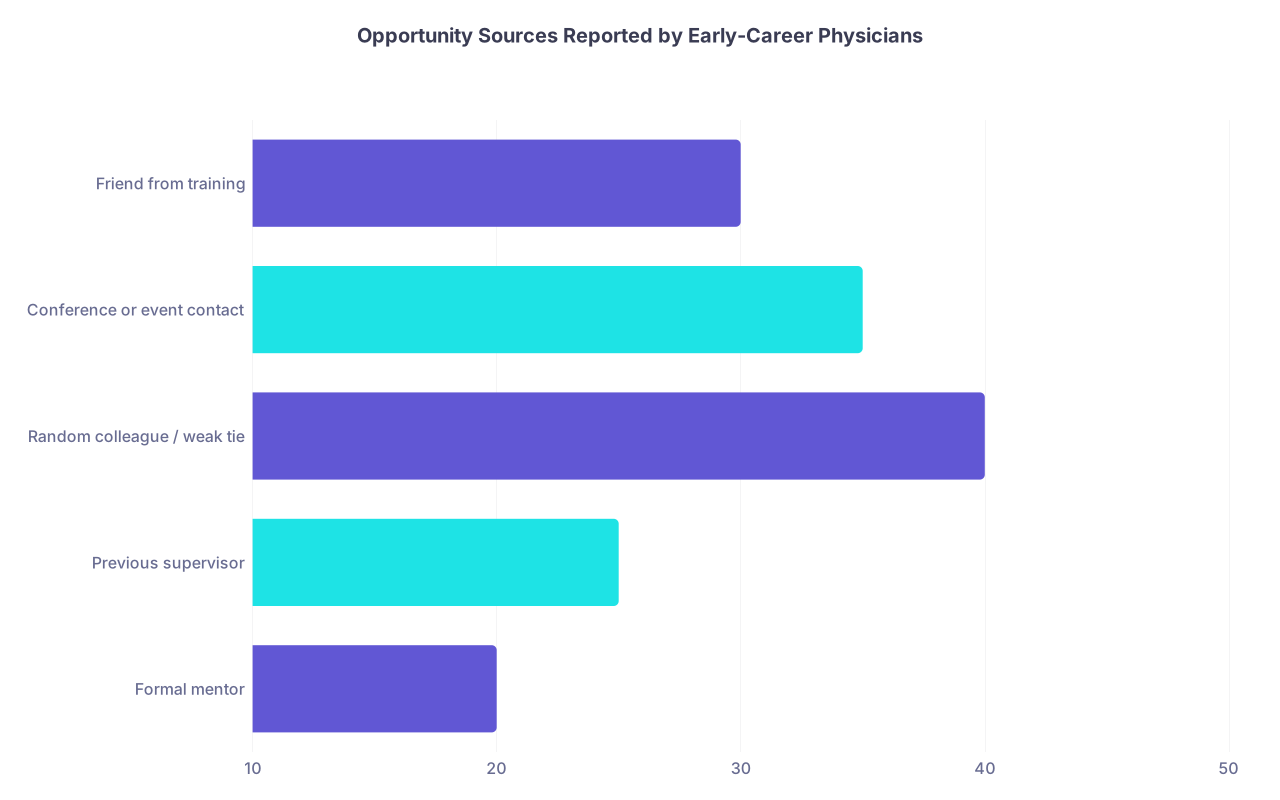
| Category | Value |
|---|---|
| Formal mentor | 20 |
| Previous supervisor | 25 |
| Random colleague / weak tie | 40 |
| Conference or event contact | 35 |
| Friend from training | 30 |
Those weak ties and loose contacts dominate where actual opportunities come from.
5. They Fit the Reality of Time and Burnout
Senior clinicians are drowning. Clinics, RVUs, admin creep, family demands, inboxes, and a constant churn of “just one more thing.” Mentorship gets squeezed.
So what survives?
- Fast favors
- Quick emails
- 15-minute coffees between cases or visits
Formal programs often demand:
- Long-term commitment
- Structured annual goals
- Documentation and reporting for the institution
So what do busy attendings do? They say yes, then under-deliver. Not because they’re bad people. Because the system is unrealistic.
Random coffee chats, on the other hand, respect time scarcity:
“Could I grab you for 20 minutes sometime this month to ask you about how you ended up in palliative care?”
That’s a yesable ask. And from 20 minutes, you can build: a follow-up email, another quick coffee, a consult, a connection to their colleague.
Micro-mentorship compounds better than overpromised mega-mentorship.
6. They Diversify Who You Learn From
Formal programs unintentionally bias toward:
- People who are already visible
- People who are already successful in traditional terms
- People who look good in a brochure or on a committee slide
You end up with a small pool of “usual suspects” serving as mentors for everyone. Same perspectives. Same politics. Same well-worn advice.
Random coffee chats allow for:
- The mid-career doc who quietly negotiated a 0.7 FTE and is actually happy
- The hospitalist who left academics and came back with a completely different lens
- The PA who understands workflow better than half the attending physicians
- The quality officer who can explain where decisions really get made
You want exposure to the weird paths, the non-obvious tradeoffs, the people who opted out and don’t regret it. They’re usually not chairs of mentoring committees.
How To Make Random Coffee Chats Actually Work
Let me be blunt: “Random” does not mean “chaotic and lazy.” There’s a skill to this.
Here’s the practical playbook.
Who To Ask
You’re aiming for:
- 1–2 levels ahead of you (fellow, junior attending, mid-career)
- Different departments or roles (admin, allied health, QI, informatics)
- People whose trajectory you respect, not just whose CV looks shiny
If you can’t think of anyone, walk your hospital and look at name badges. Or skim recent Grand Rounds speakers. Or alumni lists. You’re surrounded.
How To Ask (So They Say Yes)
Keep the ask short, specific, and time-bound. Example:
“Hi Dr. Lee, I’m a PGY-2 on medicine and I’m exploring non-traditional academic paths. I really appreciated your comments during Grand Rounds about balancing QI work with clinical time. Would you be open to a 20-minute coffee sometime in the next few weeks so I can ask you 2–3 questions about how you shaped your role?”
Why this works:
- Specific topic
- Respectful of time
- Clear you’ve paid attention to something they said or did
- Not asking them to be your Mentor For Life

What To Talk About
Ditch the generic “tell me about your career.” Ask questions that produce real signal:
- “What were the two or three decisions that most changed your career path?”
- “If you were me right now, what would you stop wasting time on?”
- “What did you think you wanted at my stage that turned out to be wrong?”
- “When did you seriously consider quitting or changing direction?”
Take brief notes after, not during. Keep it conversational.
Follow-Up Without Being Annoying
The follow-up is where coffee chats turn into a real network:
- Same day or next: short thank-you email with one concrete takeaway you’re acting on.
- 2–3 months later: brief update – “You mentioned X; I tried Y; here’s what happened. Thanks again.”
- If appropriate: send them a paper, article, or opportunity you think might interest them once in a while.
No “can you be my mentor?” needed. You’re already building a mentor network, one coffee at a time.

| Step | Description |
|---|---|
| Step 1 | Identify Person |
| Step 2 | Send Short Ask |
| Step 3 | 20 min Coffee |
| Step 4 | Send Thank You |
| Step 5 | Apply Advice |
| Step 6 | Send Brief Update |
| Step 7 | Light Ongoing Connection |
Why Institutions Keep Pushing Formal Mentorship Anyway
If random coffee chats are so effective, why do schools and hospitals keep rolling out “robust structured mentoring programs” with matching algorithms and glossy PDFs?
Because institutions like:
- Things they can measure
- Things they can present to accreditors
- Things that look orderly and intentional
Informal networks are hard to count. Harder to package in a report. Impossible to brand with the hospital logo.
So you get:
- Matching software
- Satisfaction surveys
- Checklists of meetings
And then you quietly watch as the real career-shaping conversations happen in the hallway, at the coffee stand, and in the back row after Grand Rounds.
| Feature | Formal Mentorship Program | Random Coffee Chats |
|---|---|---|
| Number of relationships | 1–2 assigned | 20–100 over years |
| Fit with evolving interests | Often poor | Self-adjusting |
| Time demand on mentors | High, inflexible | Low, flexible |
| Serendipity / opportunities | Limited | High |
| Psychological safety | Variable | Often higher |
| Institutional visibility | High | Low |
If you rely only on the formal side because “that’s what’s offered,” you’re playing the wrong game.
How Many Coffee Chats Do You Actually Need?
You do not need to turn this into another exhausting KPI. But here’s a realistic target that compounds:
- 1 coffee chat per month during med school or residency
- 1–2 per month in early attending years
Over a decade, that’s easily 100+ conversations. Even if only 10–20% lead to anything concrete, that’s 10–20 meaningful opportunities, collaborators, or sponsors.
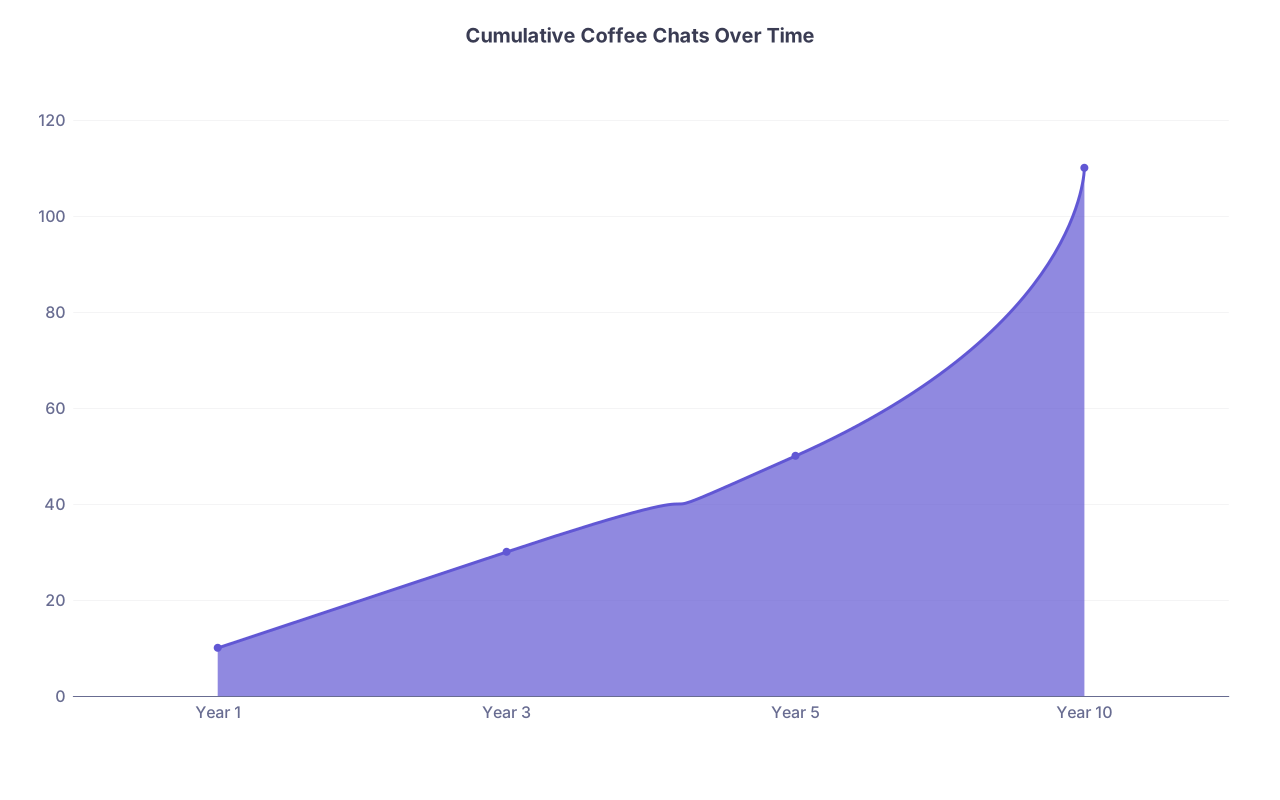
| Category | Value |
|---|---|
| Year 1 | 10 |
| Year 3 | 30 |
| Year 5 | 50 |
| Year 10 | 110 |
You’re not trying to befriend everyone. You’re increasing the odds that, when the right moment comes, you already exist in the mental Rolodex of someone who can open a door.
That is exactly how most real “breaks” in medicine happen.

The Part People Get Wrong
Random coffee chats are not about charm. Or extroversion. Or “networking” in the gross, salesy sense.
They’re about curiosity plus repetition:
- You stay curious about how other people actually built their lives
- You repeat the habit of reaching out, briefly, with respect
If you’re introverted or awkward, great. You’re less likely to fake it. Most senior people are allergic to slickness but responsive to genuine interest.
You don’t need a 10-year plan. You need the next coffee.