
The Myth of the Single ‘Big Mentor’ and How Real Careers Advance
What if I told you that chasing a single “big-name mentor” is one of the fastest ways to stall your career in academic medicine?
You know the story you’ve been sold. Find the famous PI. Attach yourself like a remora to their name. Get their letter, their projects, their network. Ascend.
It sounds tidy. It’s also mostly wrong.
Let’s dismantle the fantasy and replace it with how careers in medicine and academic science actually move: through networks, portfolios of mentors, and repeated weak ties—not one heroic sponsor pulling you up by the white coat.
The Big Mentor Fantasy vs How Careers Actually Work
Walk into any med school advising session and you’ll hear some version of: “You just need one strong mentor. Ideally a big name.” People whisper names like they’re cheat codes: “If you can get into Dr. X’s lab, you’re set.”
Here’s what the data and real career trajectories show instead.
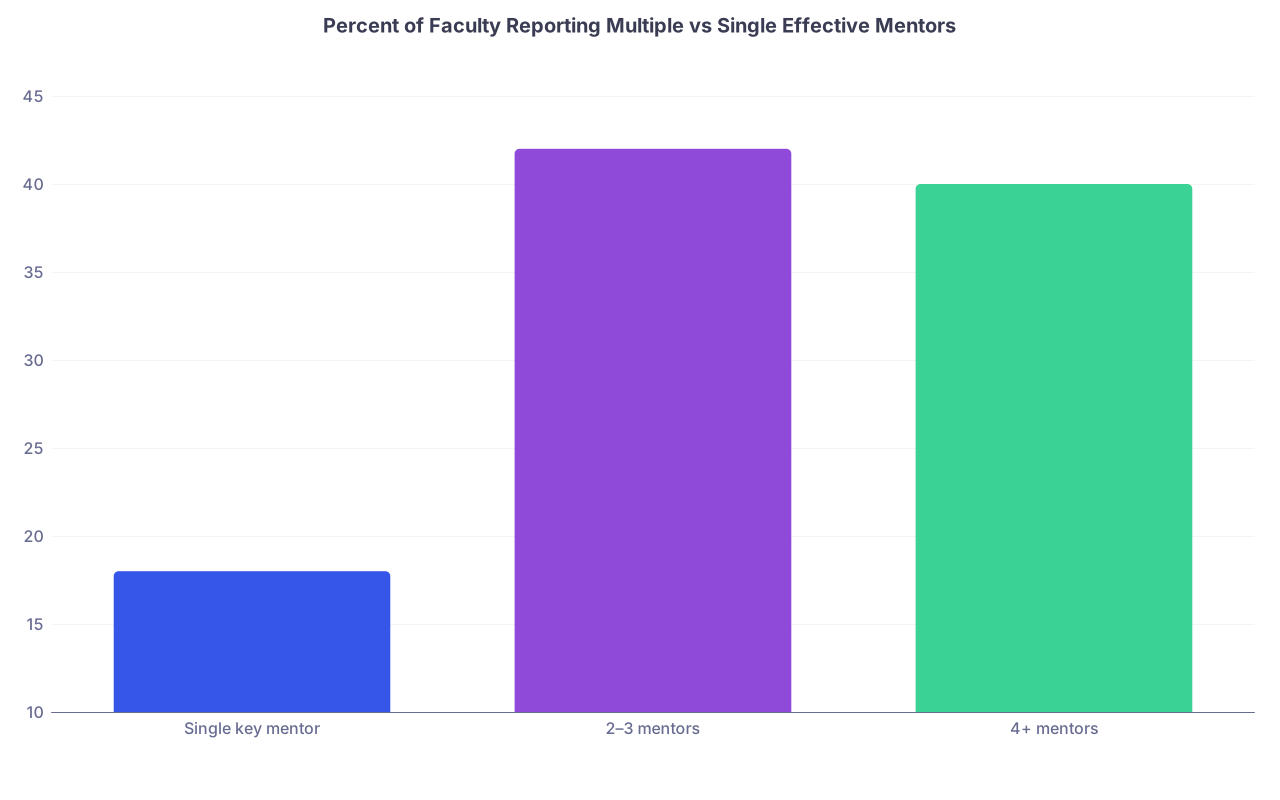
| Category | Value |
|---|---|
| Single key mentor | 18 |
| 2–3 mentors | 42 |
| 4+ mentors | 40 |
Those numbers are consistent with several mentoring surveys in academic medicine: the majority of successful faculty report multiple effective mentors, not a single central figure. And when you look at promotion, publication productivity, and grant success, the pattern is blunt: people with diversified mentoring relationships do better.
The “one big mentor” model is comforting because it simplifies a messy system. But medicine and academia run on:
- Interlocking networks
- Overlapping projects
- Informal recommendations
- Repeated casual interactions
Not on one almighty letter-writer deciding your fate.
I’ve watched this play out in real time. Two residents in the same department:
Resident A landed the brand-name chair as “mentor.” Year 1: thrilling. One R01 project, monthly 1:1s, got their name on a couple of middle-author papers. Year 2: chair becomes department-wide PI on a massive trial, travels constantly, misses 80% of meetings, replies to emails in 3–4 weeks if at all. Resident A has no backup network. Progress flatlines.
Resident B never got near the chair. Worked with an early-career assistant professor on a QI project, an associate professor on a small retrospective study, and a hospitalist on a curriculum project. Different people, different scopes. By graduation: three first-author papers, strong letters from three directions, and—most importantly—four people independently emailing program directors to say “You want this person.”
Resident B looked “less mentored” on paper initially. In reality, they were building the structure that actually moves a career: a web, not a pillar.
Why the “Big Mentor” Obsession Hurts You
The myth isn’t just inaccurate. It’s actively harmful in a few specific ways.
1. It confuses status with usefulness
High-prestige people have limited time and competing priorities. A mentor’s H-index does not correlate linearly with how much they will actually do for you.
I’ve seen students fixate on the divisional celebrity who’s on every panel, NIH study section, and national guideline committee. They wait months for a meeting. Meanwhile, the hungry associate professor across the hallway, who actually has time to edit drafts, introduce them to collaborators, and help design a realistic project, gets ignored.
(See also: Why Random Coffee Chats Beat Formal Mentorship Programs Long-Term for more.)
The data from mentoring satisfaction surveys is consistent: mentees rate availability and responsiveness as more important than sheer seniority but keep chasing prestige anyway.
2. It makes you fragile
If your whole career strategy is “this one person will open doors,” you’ve built a single point of failure into your trajectory.
That person can:
- Move institutions
- Step into a leadership role and become inaccessible
- Shift research focus away from your interests
- Develop conflicts with other people you need
Or, bluntly, they may just not like doing the grind of mentoring as much as they like the idea of mentoring.
A diversified mentor portfolio is career risk management. It’s the academic version of not putting your entire retirement into one meme stock.
3. It hides the real power players: weak ties and lateral connections
A lot of doors open in medicine not from your primary mentor, but from:
- A co-author who liked working with you
- A fellow who is now junior faculty at another institution
- A resident a year above you who joins a selection committee
- A collaborator on a minor project who later invites you onto a big one
Those are weak ties and lateral ties, not vertical patronage. They do not show up when you obsess over one towering figure.
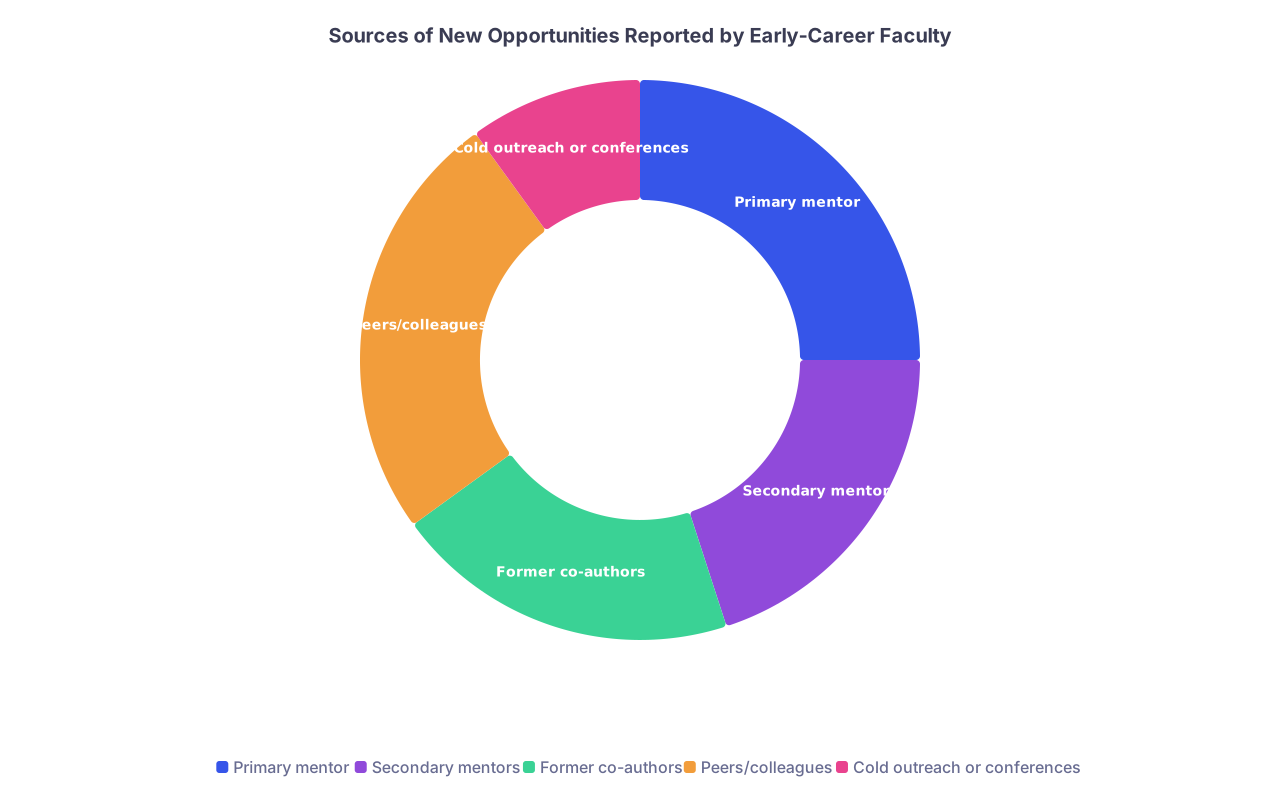
| Category | Value |
|---|---|
| Primary mentor | 25 |
| Secondary mentors | 20 |
| Former co-authors | 20 |
| Peers/colleagues | 25 |
| Cold outreach or conferences | 10 |
Primary mentors matter. They’re just not the whole story. And for many people, not even the majority of the story.
What Actually Moves Careers in Medicine: Mentor Portfolios and Networks
Strip away the hero narrative and look at patterns across people who advance quickly in medicine—into competitive fellowships, leadership roles, or funded research. You see the same structure over and over.
They have different mentors for different functions.
You don’t need five “super mentors.” You need a functional mix:
- A technical mentor who helps with the nuts and bolts: methods, study design, stats, writing.
- A political/strategic mentor who understands institutional dynamics, credits you publicly, and steers you away from political landmines.
- A sponsor (this is not the same as a mentor) who uses their reputation to get you onto committees, talks, or key projects.
- A peer or near-peer mentor who shows you the unwritten rules a year or two ahead of you.
Sometimes one person covers two or three roles. Rarely all of them. That’s the point.
The people who “magically” get invited to stuff? They’re usually benefiting from multiple independent recommendations. Not one grand puppet master.
| Aspect | Single Big Mentor Model | Mentor Portfolio Model |
|---|---|---|
| Risk if mentor leaves | High | Low–moderate |
| Access to diverse skills | Limited to one person | Broad, role-specific |
| Network reach | Narrow, through one hub | Wide, multi-hub |
| Resilience to conflict | Poor | Stronger alternatives |
| Typical for high performers | Less common | Very common |
Once you understand this, the question shifts from “How do I get Dr. Famous?” to “What functions do I need covered, and who actually behaves in ways that show they’ll support me?”
How Careers Really Advance: Evidence and Lived Patterns
Look at how promotions and opportunities actually get decided.
Selection committees talk about you in rooms you’re not in. They don’t say “Who is their mentor?” They say, almost verbatim:
- “I’ve heard good things about her from three different people.”
- “He’s on a lot of projects with folks across departments; everyone says he delivers.”
- “She’s junior but already plugged into the X collaborative; people seem to like working with her.”
That is network talk, not lone-mentor talk.

| Step | Description |
|---|---|
| Step 1 | Show up and do solid work |
| Step 2 | Deliver for multiple small projects |
| Step 3 | Earn trust of several mentors |
| Step 4 | Get recommended for bigger roles |
| Step 5 | Join committees and collaborations |
| Step 6 | Visible track record across network |
| Step 7 | Promotion or competitive fellowship |
Notice what’s missing: “Get picked by deity-level mentor and wait.”
Studies of promotion and grant success in academic medicine repeatedly find that:
- Cross-department collaborations correlate with higher productivity.
- Multi-mentor arrangements are associated with more publications and higher satisfaction.
- “Sponsorship”—people advocating for you in rooms you’re not in—is critical, and often comes from collaborators, not your nominal “mentor.”
Isolated protégés of a single star? They exist. But for every one success story, there are plenty whose CVs are duct-taped to that mentor’s lab and crater when they try to operate independently.
How to Build the Network That Actually Helps You
Enough theory. Here’s what building a real, functional career-advancing network looks like in practice, especially for students and residents.
Step 1: Stop hunting the unicorn, start mapping the ecosystem
Instead of asking, “Who is the biggest name?”, ask:
- Who is doing work I actually find interesting?
- Who replies to email?
- Who has prior mentees that look successful and not burned out?
- Who is early- or mid-career and clearly building something?
In most departments, the people who will actually shape your trajectory aren’t the most famous. They’re the mildly overworked associate professor cranking out manuscripts at 11:30 p.m., or the new hire with a K award trying to staff their projects.
Step 2: Think “small bets” with multiple people
The smart move isn’t to beg one person for a life-defining project. It’s to do several small, well-scoped things with different people and see who behaves like a real ally.
For example, during a single year you might:
- Join a simple retrospective chart review with one faculty member.
- Help with survey distribution and analysis for another.
- Co-create a resident teaching session with a third.
You’re not “fully committing” to any of them. You’re doing trial runs. You observe:
- Who gives you credit?
- Who responds to drafts?
- Who introduces you to others?
- Who seems genuinely invested in your growth vs. their throughput?
Those people become the anchors in your mentor portfolio.
Step 3: Exploit near-peers shamelessly (in a good way)
The most underrated “mentors” in medicine are 1–5 years ahead of you: senior residents, fellows, new assistant professors.
They:
- Remember the application process you’re about to go through.
- Know which faculty are good, which are toxic, and which are just disorganized.
- Are often more available than the giant names.
And—this matters—they will soon sit on admissions, hiring, and award committees. Or be texting with the people who do.
When I look at people with surprisingly fast advancement, they nearly always have a thick web of near-peer relationships and informal advice channels. That doesn’t show up as “big mentor” on a CV, but it shows up everywhere else.
The Hard Part: Letting Go of the Hero Story
The “find a big mentor” narrative persists for one reason: psychologically, it’s comforting. It feels like if you can just impress this one person, you’re safe.
Reality is messier. It also gives you more agency.
Your progress will come from:
- Doing repeated, visible, reliable work across multiple collaborations.
- Being easy to recommend: responsive, prepared, low-drama.
- Having several people who can vouch for you from different angles.
One person cannot fully “save” your career. Nor can one person fully tank it if you’ve built a broad-enough base. That’s the real insurance.
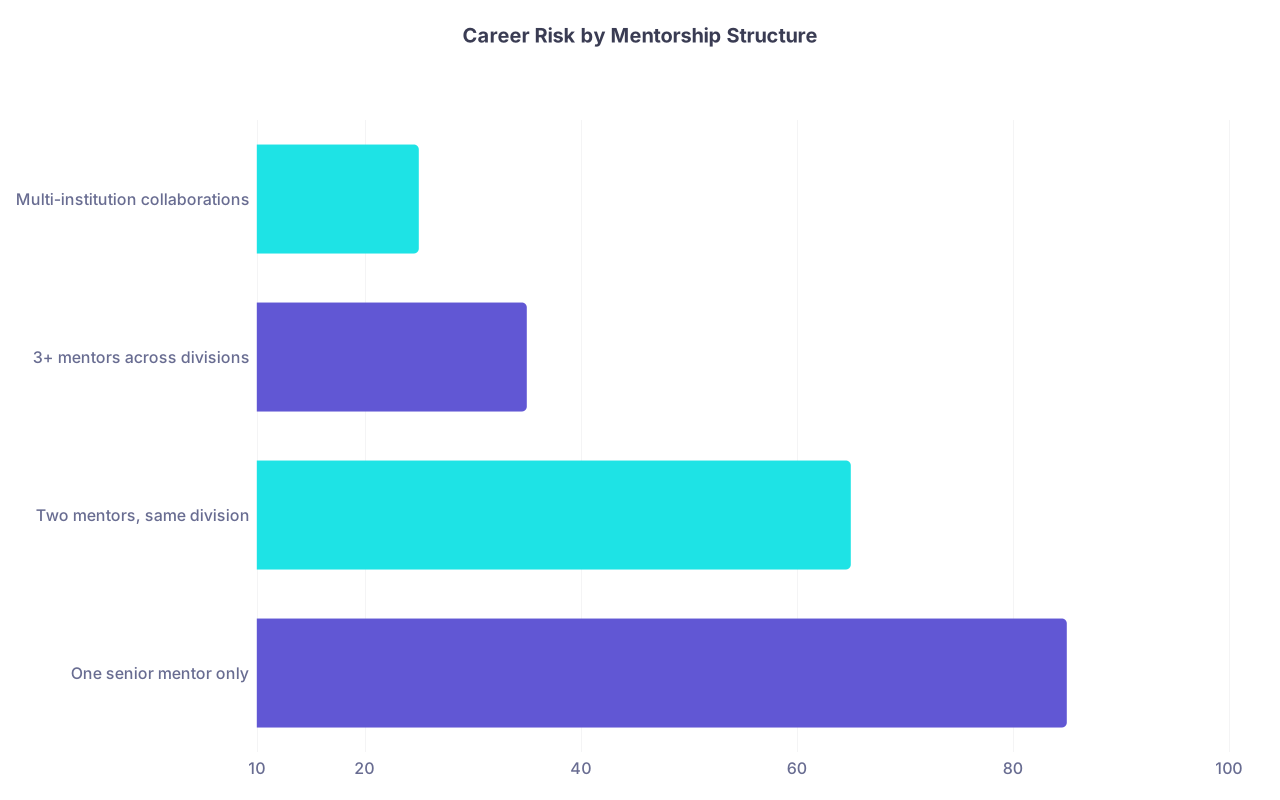
| Category | Value |
|---|---|
| One senior mentor only | 85 |
| Two mentors, same division | 65 |
| 3+ mentors across divisions | 35 |
| Multi-institution collaborations | 25 |
Interpret that however you want, but the directional point is obvious: broader, cross-cutting mentorship and collaboration structures are less fragile and more predictive of advancement.
A Saner, More Accurate Mentoring Strategy
If you’re in medical school, residency, or early faculty and feel behind because you don’t have The Famous Mentor yet, you’re probably fine. What you actually need is:
- Two to four people who demonstrably support you in different ways.
- A habit of taking on projects that are small enough to finish and visible enough to matter.
- A growing web of weak and lateral ties who know you as competent and easy to work with.
Sure, if a big name reaches out and genuinely engages, great. Add them to the portfolio. But stop treating that as the main quest. It’s just one side quest.




The Bottom Line
Three points, stripped of the mythology:
- Careers in medicine rarely advance because of a single “big mentor”; they advance through a portfolio of mentors and a wide, active network.
- Chasing prestige over availability and breadth makes you fragile; diversify your mentors by role, not just by reputation.
- The people who move fastest are usually not the ones attached to a single star, but the ones reliably delivering across multiple collaborations—and being recommended by many voices, not just one.