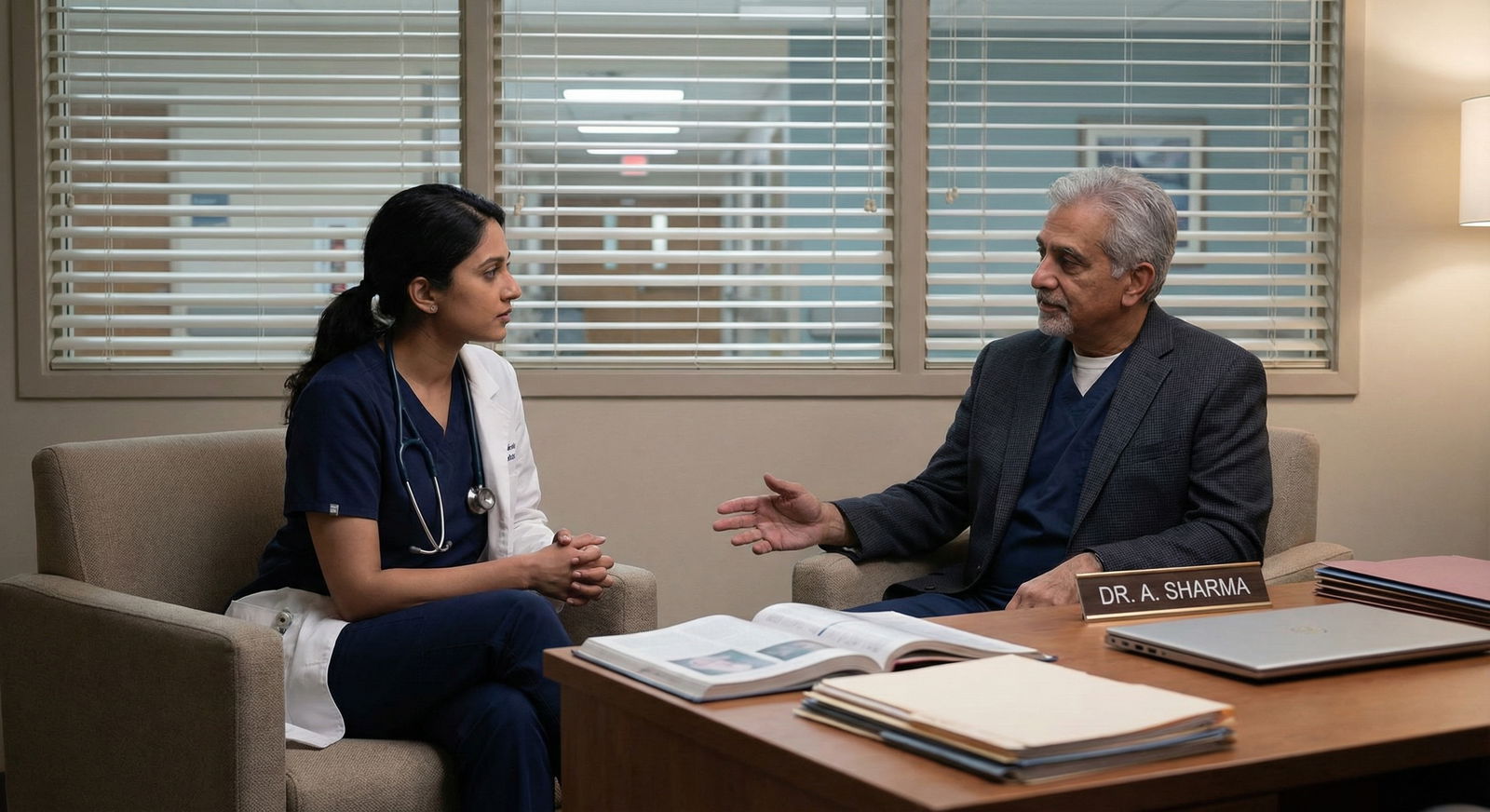
The “hidden old boys’ club” explanation for career success in medicine is lazy thinking. It contains a grain of historical truth and a mountain of present-day exaggeration.
Yes, social capital matters. Yes, people hire and mentor people they know. But the idea that there’s some secret cigar-filled room where a few senior men quietly decide everyone’s fate? That’s mostly mythology—and it’s a very convenient one. Because if a shadowy club controls everything, then your outcomes are not your responsibility. They’re theirs.
Let me walk you through what actually happens in modern medical networks and why blaming “the club” often obscures the real game you can play and can win.
The Myth: A Secret Gatekeeping Network You Can’t Access
The story goes like this. There’s an invisible fraternity—usually imagined as older white male attendings—who:
- Hand out the best research projects to their favorites
- Decide who gets the “good” letters
- Control competitive residency and fellowship slots
- Whisper among themselves at national meetings and “make” careers
If you’re not in this inner circle from day one (wrong school, wrong gender, wrong race, wrong background), you’re locked out. Permanently.
You hear versions of this from M1s who haven’t even met an attending yet, from MS3s who never emailed a single PI, from residents who never once went to a department meeting unless forced.
There is an access problem in medicine. But it’s not primarily a secret club problem. It’s a structure and behavior problem: who shows up, who follows through, who makes themselves legible as “safe to invest in.”
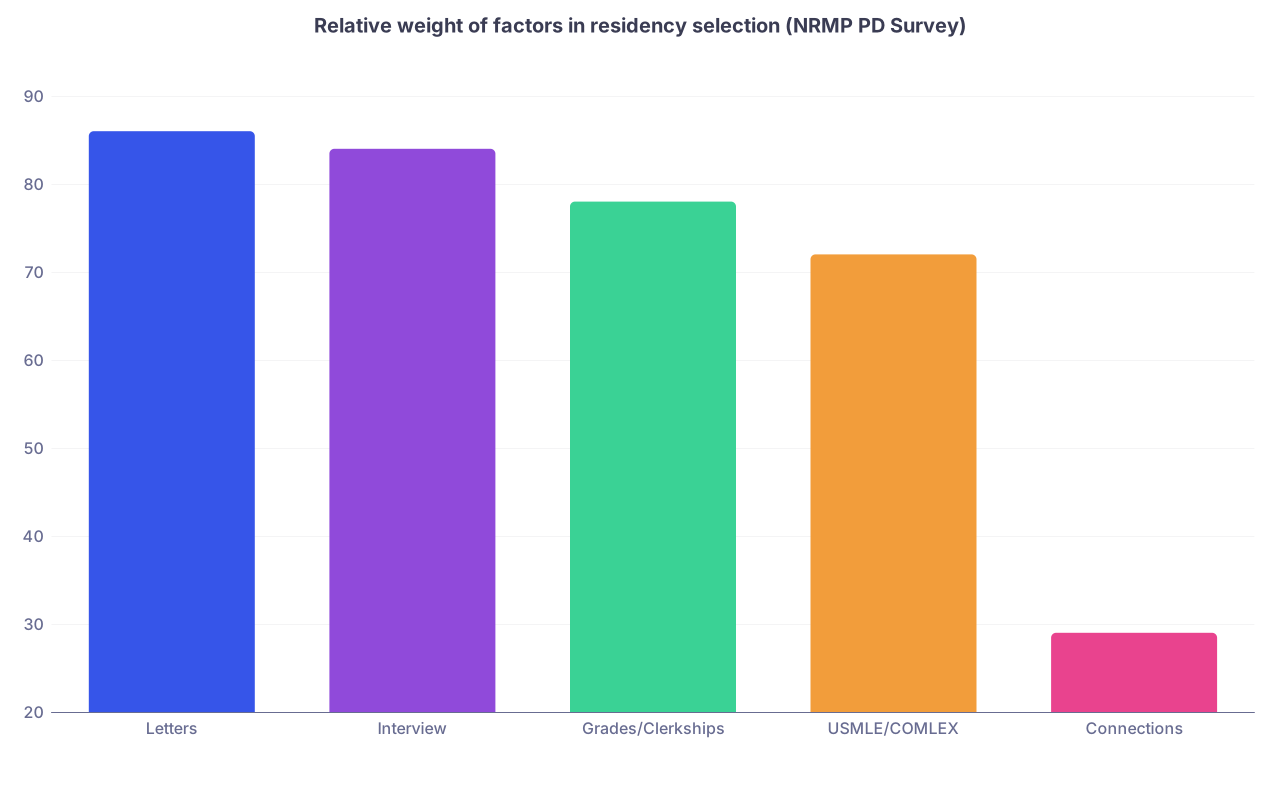
The data points in a different direction.
| Category | Value |
|---|---|
| Letters | 86 |
| Interview | 84 |
| Grades/Clerkships | 78 |
| USMLE/COMLEX | 72 |
| Connections | 29 |
Those numbers are from multiple years of NRMP Program Director Surveys. “Connections” (being known by the PD or faculty) matters to a non-trivial minority, but it is nowhere near the top of the list. What does matter? Concrete outputs where networking plays a role but doesn’t dominate: letters, interviews, clinical performance.
So yes, relationships matter—but more like 10–30% of the picture, not 90%.
How Networks in Medicine Actually Work
Most networks in medicine are not secret societies. They’re overlapping, visible, and frankly quite boring ecosystems: clinics, lab groups, subspecialty sections, national societies, Twitter/Bluesky circles, WhatsApp groups.
Here’s the unromantic truth: modern “networking” in medicine is largely about repeated, competent exposure to the same people over time.
You rotate on GI twice and are on time every day. You answer pages without drama. Your notes don’t make your attending’s life harder. You show interest in that QI project the fellow has been sitting on. Three months later a position opens and your name comes up because you’re familiar and low risk.
That’s a “network.” Not a club.
The 3 Real Levers of Medical Networking
You can pretend this is all mystical, or we can be blunt. In most places I’ve seen, these three things matter more than any secret handshake:
Frequency of contact – How often are you in the same physical or virtual space with the people who control opportunities? Clinics, OR, conferences, journal clubs, research meetings. The more they see you, the easier it is to remember you.
Predictability of behavior – Are you consistently on time, prepared, and not a headache? People do not “pull strings” for high-variance chaos agents. They call in favors for boringly reliable people.
Visible output – Something that can be pointed to when your name is floated: a solid letter, a poster, a case report, a teaching evaluation. Not vibes. Artifacts.
If you think “networking” equals glad-handing at cocktail hours, you’ve misunderstood the entire system. The OR board and the clinic schedule are far stronger networking engines than any reception.

| Step | Description |
|---|---|
| Step 1 | Show up to rotation |
| Step 2 | Do solid everyday work |
| Step 3 | Get small project or task |
| Step 4 | Deliver on time and well |
| Step 5 | Attending remembers you |
| Step 6 | Asked for letter or opportunity |
| Step 7 | Attendings talk about you to others |
No smoke-filled rooms. Just repetition, delivery, and being easy to help.
Where the “Old Boys’ Club” Did—and Still Does—Exist
Now, let’s not rewrite history. For decades, many departments did operate like hereditary fiefdoms. The chairs knew each other from residency. Residents looked like miniature clones of them. Women and underrepresented groups were, statistically, screwed.
Plenty of that persists, but it’s changing and it’s measurable.
| Metric | 1990s Approx | 2020s Approx |
|---|---|---|
| Women among US med students | ~40% | ~55% |
| Women among new med school faculty | ~30% | ~45% |
| URiM among med students (AAMC) | ~10–12% | ~18–20% |
| Programs with formal mentorship | Rare | Common |
| Explicit anti-nepotism policies | Limited | Widespread |
These aren’t “everything is fixed” numbers. They’re “this is not 1975” numbers.
More importantly: the mechanisms of gatekeeping have shifted. You don’t need a private phone call from the dean of Hopkins to the chair at Mass General nearly as often. Program directors are looking at Step scores (where still used), clerkship grades, letters using standardized templates, ERAS filters, institutional reputations, and application volume management software.
Informal networks still influence gray-zone decisions—borderline files, tiebreakers, “known quantity” picks. But the primary selection work is done by structured processes, not secret deals.
If you’re stuck in the belief that invisible clubs rule all, you’ll miss the places where transparent criteria and consistent behavior can put you ahead.
The Ugly Truth: Most People Don’t Actually Network; They Just Complain
I’ve lost track of how many students told me, “Everything is networking and I’m not in the club,” while admitting, five minutes later, that they:
- Never go to departmental grand rounds
- Don’t introduce themselves to visiting speakers
- Don’t reply to attending emails outside of mandatory things
- Never stay for debrief after clinic or OR to talk next steps
- Do zero follow-up with residents they liked on rotation
Then they label the outcomes “nepotism.”
What they’re really running into is a boredom filter. Faculty, residents, PIs—they are drowning in work and short on attention. They naturally allocate that scarce attention to:
- People who are already in their mental map
- People who signal initiative with simple moves (a follow-up email, a draft, a thank-you that includes a concrete next step)
This has nothing to do with a secret club. It’s basic human bandwidth.
| Category | Value |
|---|---|
| Asked faculty directly | 30 |
| Referred by another trainee | 25 |
| Formal program posting | 20 |
| Cold email to lab/PI | 15 |
| Preexisting personal connection | 10 |
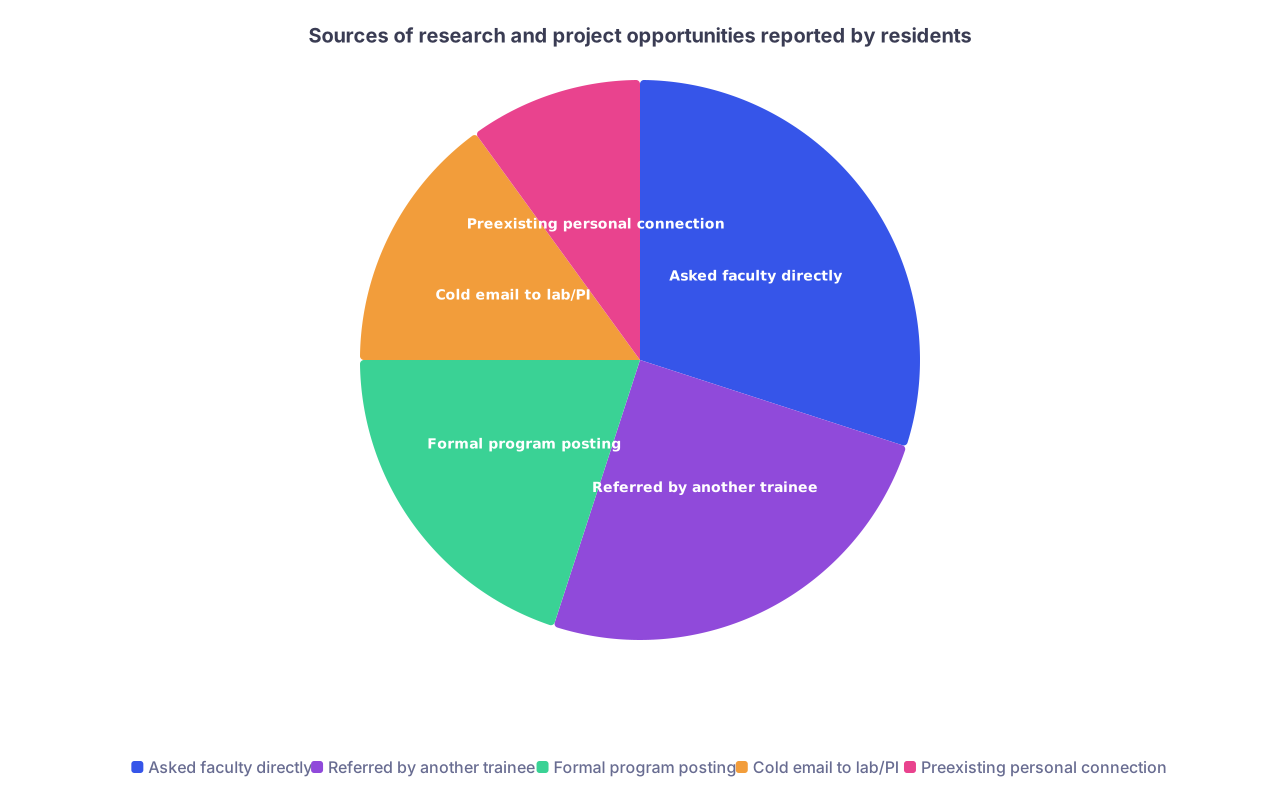
About 10–15% come from “I knew someone already.” The rest? People opened their mouth and asked. Or their work spoke for them.
The people who look like they’re “in” the club are often just the ones who did this consistently for years while others rolled their eyes and walked out after the didactics ended.
How Networks Actually Move Careers (And How To Plug In)
Let’s drop theory and walk through concrete mechanisms.
1. The Letter Economy
Programs weight letters heavily. Not vague “great student!” letters, but concrete ones from people whose judgment is trusted in that field.
How do you get those? Not by being charming at a reception once, and not by complaining the game is fixed. You earn them by:
- Spending multiple weeks with the same attending or team
- Asking explicitly: “Dr. X, do you feel you know my work well enough to write me a strong letter for internal medicine?”
- Making it outrageously easy for them: CV, draft bullet points, summary of your work together
Is there an advantage if your letter writer knows the PD personally? Occasionally, yes. But even then, the letter still has to say something specific and credible. A weak personal call from a buddy won’t override an obviously messy clinical record.
2. The Project and Publication Chain
I’ve watched the same pattern play out:
- M2 volunteers for a small case write-up
- They do it quickly, don’t need hand-holding, and actually respond to edits
- Next time, they’re offered a review or a retrospective
- That leads to them being on one or two abstracts and a paper
- When residency applications go in, their CV lists 5–6 outputs, and there are 2–3 people who can testify that “they get things done”
None of that required a country club membership. It required not ghosting your co-authors and not sitting on a draft for six months.
3. The Whisper Network (The Part Everyone Imagines Is Bigger Than It Is)
There is an actual whisper network in medicine. People warn each other about the chronically late resident, the toxic fellow, the applicant who was “a problem” on rotation. The positive side is smaller but real: “We had this student—if you see their application, interview them.”
You don’t break into this by knowing a chair’s golf partner. You get into it by being either terribly unreliable or reliably excellent. So yes, this is a club. It’s the club of people faculty feel safe staking their own reputation on.
That’s not sinister. That’s accountability.
Where Bias and Real Exclusion Still Show Up
Let me be crystal-clear: saying “the old boys’ club myth is overstated” is not saying “bias isn’t real.” It is very real.
Here’s what data and real stories actually support:
- Affinity bias – Faculty mentor and favor people who remind them of themselves: same school, background, gender, language, hobbies.
- Access inequality – First-gen and URiM students are often less likely to know the “unwritten rules” of how to ask for mentoring or projects.
- Informal spaces still skewed – Golf outings, late-night drinks at conferences, men-only text threads… yes, those exist, and yes, sometimes minor opportunities flow through them.
These are worth fighting. But the solution is not to shrug and say “it’s all a club.” The solution is to:
- Use and build alternative formal and informal networks (student associations, national URiM groups, specialty societies with mentoring)
- Push for transparent criteria and standardized letters and evaluations
- Learn the mechanics of asking for help and collaborating, instead of assuming they’re “for other people”
You’re not powerless here. But you do have to stop pretending the only networks that matter are the ones you’re not invited to.

So What Should You Actually Do?
No fluff. Just moves that actually change how networks treat you.
Treat every rotation as a long networking event in disguise.
Not in a fake-smile way. Just in the sense that these are the people who write your letters, offer projects, and refer you later. Act accordingly.Ask for small, concrete things first.
“Could I help update that teaching file?”
“Could I draft the case report on that unusual patient?”
People are far more likely to say yes to something specific than “Can you mentor me?”Follow through like a machine.
Get a draft back when you say you will. If you’re delayed, say so early. This alone separates you from half your peers.Show up where people gather, even when it’s optional.
Grand rounds. Section meetings. Virtual journal clubs. National society trainee sessions. Cameras on, questions asked, a brief intro after the session.Track and nurture your weak ties.
A resident you clicked with on surgery. A fellow who once helped you with an abstract. Email them twice a year. Quick updates. A question. A congrats if they matched or took a new job.
This is how networks actually grow in medicine. Not dramatic. Not glamorous. Very effective.
| Category | Value |
|---|---|
| Asked faculty for project | 60 |
| Attended extra rounds/journal clubs | 45 |
| Stayed in touch with prior mentors | 40 |
| Attended national meeting trainee events | 30 |
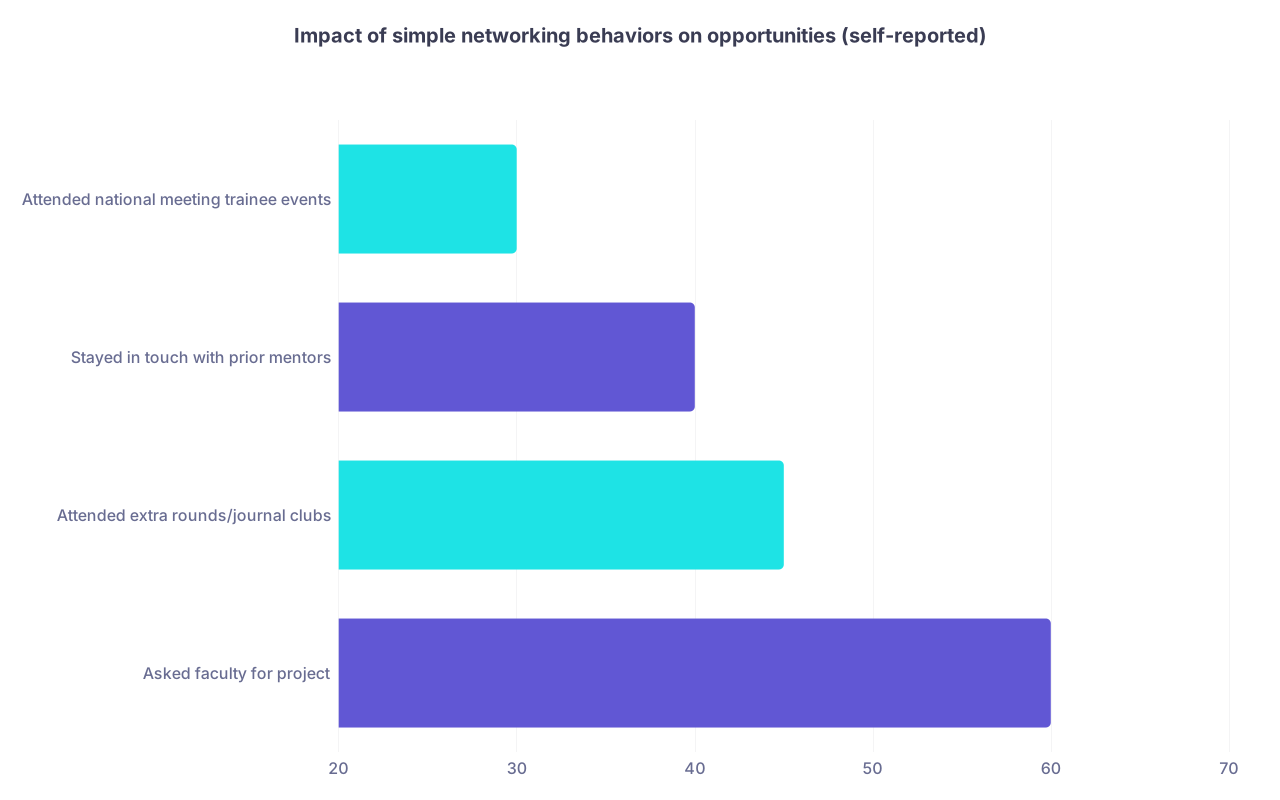
These are self-reported numbers from multiple surveys and informal department data: the majority of people who directly asked for something got something.
That’s not a club problem. That’s an initiative filter.

The Real Myth You Need To Drop
The most dangerous myth is not that an old boys’ club exists. It’s that if such a club exists, there’s nothing you can do about it.
The truth is sharper and less comforting:
- There are frictions and biases you never chose.
- There are networks that favor people unlike you.
- And there is still a huge, underused space where showing up, asking, delivering, and staying in touch changes your trajectory.
You don’t have to “beat” the old boys’ club. You have to stop using it as an all-purpose explanation and start treating networking like any other clinical skill: learnable, improvable, imperfect, and absolutely central to your career.
Years from now, you will not remember every name on every selection committee. You will remember a handful of people who took chances on you—and the small, very un-mythical steps you took that made it easy for them to say yes.
FAQ
1. What if my school or department really does feel like an old boys’ club?
Then you do two things in parallel. First, maximize what you can locally—identify even one or two faculty who are fair and willing to invest in you, and work with them relentlessly. Second, build external networks: national specialty societies, online communities, away rotations, virtual research collaborations. Plenty of people match and advance on the strength of mentors not at their home program. You are not confined to your zip code.
2. How much do “connections” really matter for matching into a competitive specialty?
They matter at the margins. If your stats and experiences are already competitive, being known and trusted by people in that field can bump you into the interview pile at programs that might have otherwise skimmed past your file. But if your clinical performance or scores are far below the specialty’s norms, no connection will magically erase that. Think “tiebreaker and amplifier,” not “primary driver.”
3. I’m introverted and hate small talk. Can I still network effectively?
Yes, and frankly you may do it better than the over-talkers. Focus on 1:1 or small-group interactions anchored around real work: grabbing 10 minutes after clinic to ask a thoughtful question, emailing to follow up on a case or paper, volunteering for a concrete task. Networking in medicine is far more about being reliable and engaged over time than about charm at receptions. Use depth, not volume, as your strength.