
You do not need a famous letter writer to match. You need a credible one who actually knows you and can write something specific. The obsession with “big-name” letters is mostly mythology, selectively reinforced by a few flashy anecdotes and a lot of anxious groupthink.
Let’s dismantle this properly.
The Myth of the Magic Name
Walk through any med school hallway during application season and you’ll hear the same lines:
- “I have to get a letter from the department chair.”
- “If I don’t have a ‘name’ on my letters, I’m dead for top programs.”
- “This surgeon is on every big paper; one letter from him will seal it.”
I’ve watched students chase “famous” attendings they barely worked with, collect bland, generic letters, and then wonder why their interview invites look… average. Meanwhile their quieter classmates—who got detailed letters from mid-career, non-famous but engaged faculty—ended up at very competitive programs.
So what does the actual data say?
Short answer: programs care far more about content and source type (role, specialty, chair vs non-chair) than whether your letter writer is Twitter-famous or has an H-index of 75.
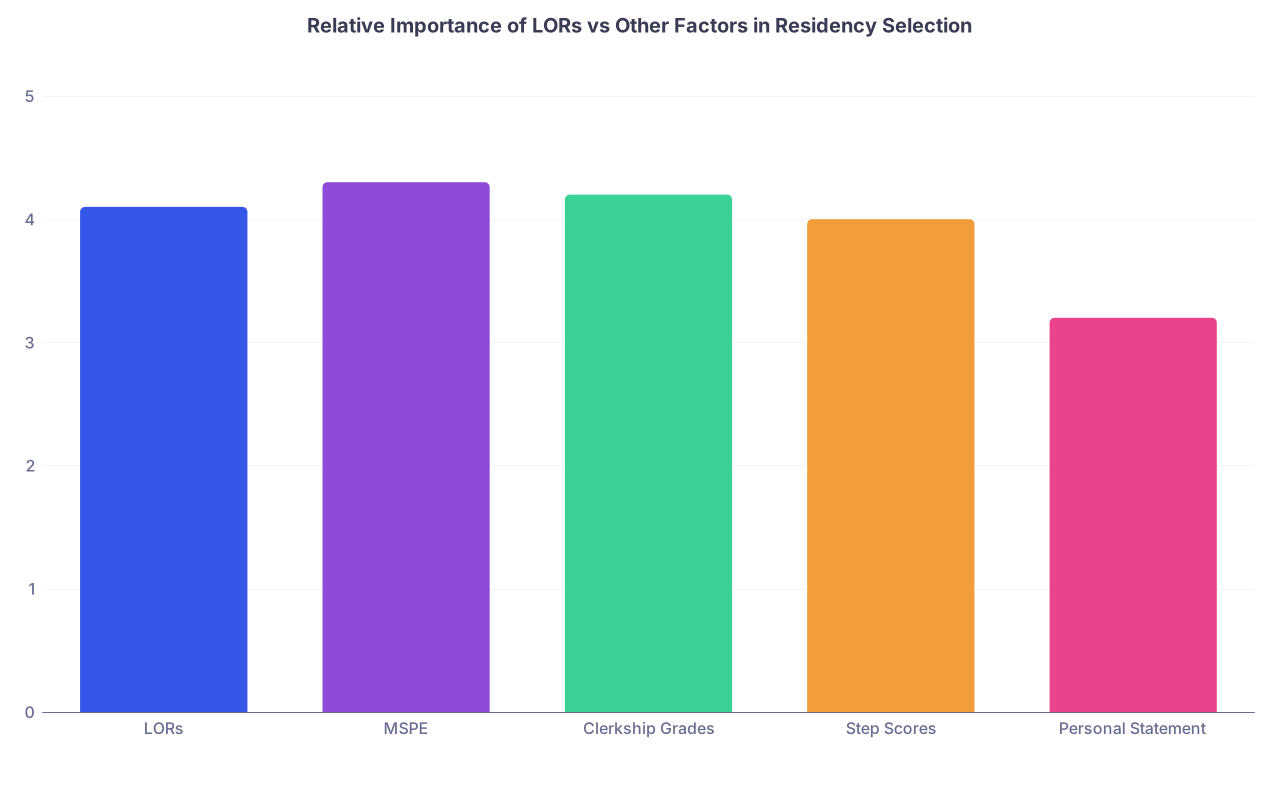
| Category | Value |
|---|---|
| LORs | 4.1 |
| MSPE | 4.3 |
| Clerkship Grades | 4.2 |
| Step Scores | 4 |
| Personal Statement | 3.2 |
(Importance rating from NRMP PD Survey, mean scores on a 1–5 scale; varies a bit by specialty but the pattern is stable.)
Letters matter. A lot. But who writes them only helps you if that person can convincingly say you’re great in their context.
What Program Directors Actually Read for
Program directors are not starstruck interns. They’re pattern recognizers. They’ve been reading letters for years. They know who phones it in and who doesn’t.
The NRMP Program Director Survey (which is probably the closest thing we have to “hard data” on this question) consistently shows:
- Letters of recommendation in the specialty are among the top factors for granting interviews and ranking.
- The strength and specificity of letters matter far more than superficial prestige.
What they never say is “we care if the writer has 20k followers, an endowed chair, or a blue-check email signature.”
Here’s the kind of letter that moves the needle:
- Describes direct observation of you over time
- Includes concrete examples: specific patients, situations, tasks
- Compares you to a meaningful cohort (“top 5% of residents I’ve worked with in 15 years” is real; “excellent” is noise)
- Addresses your performance in the context of residency: reliability, teamwork, judgment, teachability, integrity
Here’s the kind of “famous” letter that does nothing:
“I had the pleasure of working with Dr. X during a two-week elective. She is bright, pleasant, and hardworking. She will do well in any residency program she joins.”
Translation in PD brain: “I barely remember this person, but they asked me for a letter; they were fine; I have no evidence either way.”
If your “big name” can’t or won’t write something deeper than that, their reputation is useless to you.
What the Match Data and Surveys Actually Show
People want randomized controlled trials of “famous vs non-famous letter writer.” You’re not going to get that. What we do have:
- NRMP Program Director Surveys (2016, 2018, 2020, 2022)
- Specialty-specific PD surveys (EM, IM, Ortho, etc.)
- SOAP/match outcomes correlated with obvious factors: Step, grades, AOA, number and type of letters
- A lot of real-world behavior: who gets interviews, what PDs say openly at meetings, what letters actually look like behind the scenes
Let me sketch a simplified comparison that aligns with how PDs talk privately:
| Factor | Real Impact on Match | Student Obsession Level |
|---|---|---|
| Specialty-specific letter | High | Medium |
| Detailed, concrete examples | Very High | Low |
| Comparative statements | High | Low |
| Writer is known to PDs | Moderate | High |
| Writer is nationally famous | Low–Moderate | Very High |
Notice the mismatch. Students are burning energy on the last two rows, while the top three are where most of the actual signal sits.
“But Aren’t Chairs Required?”
Sometimes. In some specialties, a “chair letter” or departmental letter is de facto standard. Think:
- Internal Medicine: many academic IM programs expect a “departmental” or “chair” letter (often a composite letter built from multiple evaluations).
- Surgery: chair letters are common and can matter more at high-end academic places.
Here’s the nuance students miss: the important variable is the role and the format, not the individual’s fame.
A chair letter is powerful because:
- It signals departmental backing.
- It often synthesizes feedback from multiple faculty and residents.
- The chair’s name is a proxy for “the department vouches for this person,” not “this person is internationally known.”
If your program generates a standardized chair letter, the “fame” of that chair is secondary. What matters is that the department has looked at your entire performance and didn’t issue a warning shot.
What About Programs Where “Everyone Knows Everyone”?
In ultra-small specialties (peds heme/onc, transplant, some surgical subspecialties), PDs do recognize a lot of the names. But this familiarity cuts both ways.
A famous writer with a history of over-inflated, useless letters is a liability, not an asset. PDs will literally say, “Oh, it’s another generic praise-letter from X; ignore the superlatives.”
On the flip side, a less-famous but trusted writer whose letters have been reliably predictive of resident performance? That person’s name carries much more weight within that micro-ecosystem than random “fame.”
So yes, names matter a bit—but only within specialist circles, and only when tied to a known signal quality. It’s reputation for honesty and calibration, not Twitter clout.
Why Generic “Famous” Letters Can Hurt You
Let me be blunt: a generic letter from a celebrity academic often reads like a polite non-endorsement. PDs know exactly what’s going on:
- Student shadowed for two weeks, maybe did a case or two.
- Writer barely interacted with them.
- Student begged for a letter because “your name is big, it’ll help.”
- Writer doesn’t want to harm the student, doesn’t want to lie either, so they drop into safe, vague language.
You end up with:
- No concrete examples
- No comparative statements
- No sense of longitudinal mentorship
- A tone that screams “obligatory”
Now contrast that with a letter from a non-famous associate professor who:
- Supervised you for 8 weeks on an acting internship
- Watched you manage overnight cross-cover
- Saw how you handled a crashing patient at 3 a.m.
- Met with you to go over feedback and saw you improve
That person can truthfully write:
“I worked with Alex for 8 weeks as his supervising hospitalist. He independently managed a 16-patient census, took overnight cross-cover, and repeatedly showed strong clinical judgment. On two separate occasions, he correctly identified early sepsis in complex patients before the senior resident, escalated care appropriately, and improved outcomes. Among over 150 students and residents I’ve worked with, he is in the top 10% in reliability and clinical reasoning.”
No one cares that this hospitalist isn’t on NEJM papers. This letter is gold.
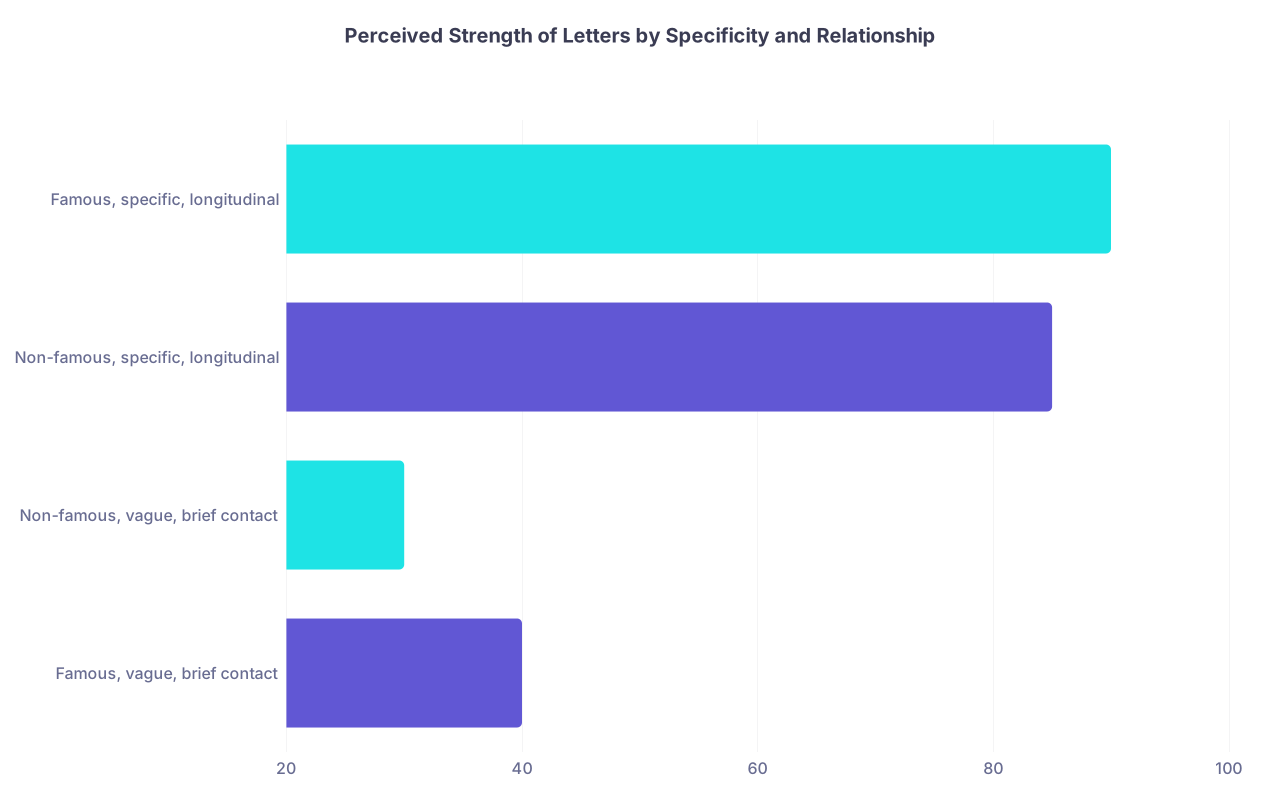
| Category | Value |
|---|---|
| Famous, vague, brief contact | 40 |
| Non-famous, vague, brief contact | 30 |
| Non-famous, specific, longitudinal | 85 |
| Famous, specific, longitudinal | 90 |
(Think of these as PD “strength scores” out of 100, based on how they describe impact in surveys and discussions.)
How PDs Actually Use Letters in Decision-Making
Most programs use letters in two main phases:
Screening / interview invite
- Do the letters confirm you’re safe, functional, and not a walking disaster?
- Do any letters raise subtle red flags: “with appropriate supervision,” “will benefit from close guidance,” “pleasant” with no other content?
Ranking / tie-breaking
- When two applicants look identical on paper, the one with sharper letters—more specific, more clearly enthusiastic, more comparative—wins.
At no point is anyone saying, “This letter is generic and content-free, but wow, look at that famous name at the bottom; bump them up.”
What does happen is more like:
- “Three strong, detailed letters from people I trust > one vaguely positive note from a Nobel laureate I’ve never met.”
Or internally:
- “This writer’s last three ‘top 1%’ students were mediocre residents. I discount everything they say by 50%.”
Fame without calibration just means your letter is noise dressed in expensive stationary.
When a “Big Name” Actually Helps
There are narrow, specific scenarios where a famous letter writer genuinely can move the needle—but it’s not because of the name on its own.
It helps when:
- The famous person actually knows you well (longitudinal research mentor, multi-project collaborator, or direct clinical supervision over months).
- They are trusted in the community for writing honest, calibrated letters, not gush for everyone.
- Their letter is clearly individualized, with details that only someone who truly worked with you could know.
In those cases, the name acts as a shortcut: PDs think, “If X says this person is excellent and X doesn’t say that lightly, that’s a strong signal.”
This is rare. Because genuinely high-profile faculty who also write detailed, honest letters do not have infinite bandwidth. If they wrote five-page love letters for every student who touched their service for 10 days, that reputation for discernment would evaporate.
So yes—if you’ve done three years of meaningful research with a big-name PI who saw you take projects from idea to publication, your letter from them is probably high value. But not because they’re famous. Because they actually know your work and are selective with praise.
What You Should Actually Optimize For
Stop asking, “Who’s the most famous person I could possibly get?” and start asking:
- Who has seen me at my best and worst clinically, not just on a good day?
- Who has watched me over time (a sub-I, longitudinal clinic, multi-month research)?
- Who gave me feedback that I integrated—and would they be willing to mention that growth?
- Who is known locally for writing honest, detailed letters?
Your optimal letter mix, in most mainstream specialties, looks more like this:
- At least two letters from attendings in your chosen field who supervised you closely and can describe concrete work.
- Any required “chair/department” letter as dictated by specialty norms.
- Optionally, a research letter if it’s a substantial, multi-year experience and the writer can speak to your independence, persistence, and analytical ability.
If one of those happens to be a famous person who fits the above? Great. If not, you are not at a systemic disadvantage.

| Step | Description |
|---|---|
| Step 1 | Potential Letter Writer |
| Step 2 | Consider someone else |
| Step 3 | High priority letter writer |
| Step 4 | Use if you need additional strong letter |
| Step 5 | Direct supervision >4 weeks? |
| Step 6 | Can they recall specific cases or projects? |
| Step 7 | In your desired specialty or key role? |
Notice what's missing: any decision node labeled “Are they famous?”
Future of Medicine: Fame Is Getting Even Less Important
As applications bloat and everyone has 3–4 letters, PDs are being forced to triage harder. Trends that make “fame letters” even less valuable:
- Standardization creep: Some specialties (EM did this first) push toward standardized letter formats (like SLOEs). These emphasize content and comparative metrics, not prose or prestige.
- Pattern recognition across cycles: Programs track whose letters are “all superlatives, no signal.” Over time, serial inflators get discounted.
- Application overload: No one has time to decode cryptic name-dropping. Clear, structured, content-dense letters are easier to process than flowery, vague praise from a celebrity.
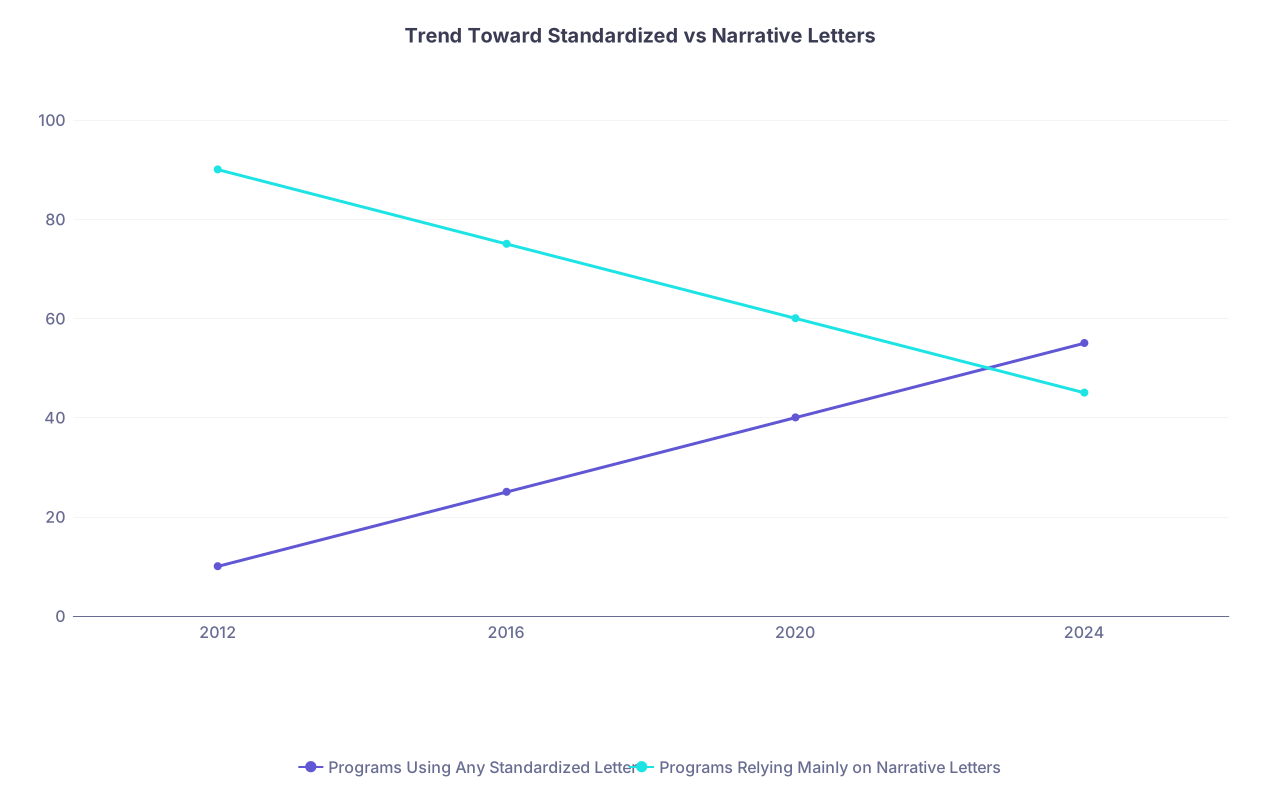
| Category | Programs Using Any Standardized Letter | Programs Relying Mainly on Narrative Letters |
|---|---|---|
| 2012 | 10 | 90 |
| 2016 | 25 | 75 |
| 2020 | 40 | 60 |
| 2024 | 55 | 45 |
The direction is clear: the system is trying, imperfectly, to move away from vibes and toward more reproducible signals. “Famous name on a vague letter” is the definition of vibes.
When to Walk Away From a Big Name
Here’s a practical litmus test. If a very senior or famous person says any of the following when you ask for a letter:
- “I’d be happy to write you a supportive letter.”
- “Sure, but we only worked together a short time, so it might be a bit general.”
- “Why do you not ask Dr Y, who knows your work more closely?”
They’re telling you: this letter will be bland at best. Believe them. Say “thank you” and go ask Dr Y.
If you push ahead anyway because “but they’re the chair,” that’s on you.
And if someone you thought was a “smaller name” immediately starts asking for your CV, evaluations, and says, “Let’s schedule 30 minutes to talk about where you’re applying so I can write a strong, specific letter”—that’s your real asset.

The Bottom Line: Three Things That Actually Matter
Strip away the rumors and hero worship, and you’re left with this:
Specificity beats prestige. A detailed, candid, example-filled letter from a non-famous attending you worked closely with is more powerful than a generic note from a celebrity.
Role and context beat name recognition. Specialty-specific letters, required chair/department letters, and writers known locally for honest, calibrated evaluations carry real weight—regardless of national fame.
Famous helps only when it’s real. A big-name letter is valuable only if that person actually knows you well, is selective with praise, and writes a content-dense, individualized letter. Otherwise, it’s just letterhead.
You do not win the Match with endorsements from people who barely remember you. You win it with evidence—documented by people who actually watched you do the work.