
Networking does not “trump” Step scores. But Step scores do not “trump” networking either. The idea that one of these is the magic key is exactly how students get burned.
Programs are not choosing between “perfect test-taker” and “social butterfly.” They’re choosing between complete packages in a brutally competitive ecosystem. And the data—NRMP, program director surveys, match outcomes—show something very different from the Twitter hot takes.
You want the real hierarchy? Scores and objective metrics get you in the door. Relationships and reputation decide what happens once you’re inside. Ignore either one and you’re playing with half a deck.
Let’s strip the mythology off this topic.
The Myth: “If You Network Right, Scores Don’t Matter”
I keep hearing some version of this in hallways and Discord servers:
“Bro, if you just do away rotations and get close with the PD, they don’t care about Step.”
No. That’s not how this works.
Look at what program directors actually report when they’re not posturing on social media.
The 2022 NRMP Program Director Survey (yes, the one they actually use to decide policy) still shows exam performance and academic metrics sitting near the top of importance, even post–Step 1 pass/fail. Step 2 CK, clerkship grades, class ranking, and school performance remain core filters.
At the same time, that same survey shows something else students underestimate: letters of recommendation in the specialty, perceived “fit,” and rotation performance with the program are also near the top. Those last three are precisely where networking lives.
So no, networking doesn’t make scores meaningless. It just becomes the decisive factor once you’ve cleared the basic bar that allows someone to advocate for you.
To make this less abstract:
| Factor Type | Typical Use in Selection |
|---|---|
| Step scores | Initial screen / eligibility |
| Clerkship grades | Screen + competitiveness signal |
| Research output | Screen in academic programs |
| Rotations at site | Performance + strong networking |
| Letters of rec | Trust + ranking decisions |
Anyone telling you “networking is all that matters now” is usually:
- Someone in a less competitive field who doesn’t realize how different neurosurgery vs family medicine look.
- Someone with strong connections trying to backfill a story about why they succeeded.
- Or someone selling you an away-rotation or “networking” strategy package.
Where Scores Actually Dominate (And Where They Don’t)
Let me be blunt: your Step score still shapes which doors even exist for you.
I’ve sat in rank meetings where one comment ends the discussion: “We love her, but her Step 2 is 210 and we just got burned last year on board pass rates.” Conversation over. Nobody is throwing away a 95% board pass rate to “take a chance” because you shook hands well on rounds.
At the same time, I’ve watched mid-range Step candidates leapfrog higher scorers on rank lists because three attendings said, “If this person comes here, I’ll absolutely work with them.”
Here’s the split most people miss:
Scores are thresholds and blunt sorting tools.
Programs are drowning in applications. They need something crude to go from 1,200 applications to 400. That’s scores and hard metrics. They’re not reading every personal statement at minute one.Networking is a precision tool that operates later in the pipeline.
Once you’re in the 400, scores have rapidly diminishing returns. A 250 vs 240 doesn’t move people like “this student was outstanding on our service and patients loved them.”
Let’s visualize competitiveness vs leverage:
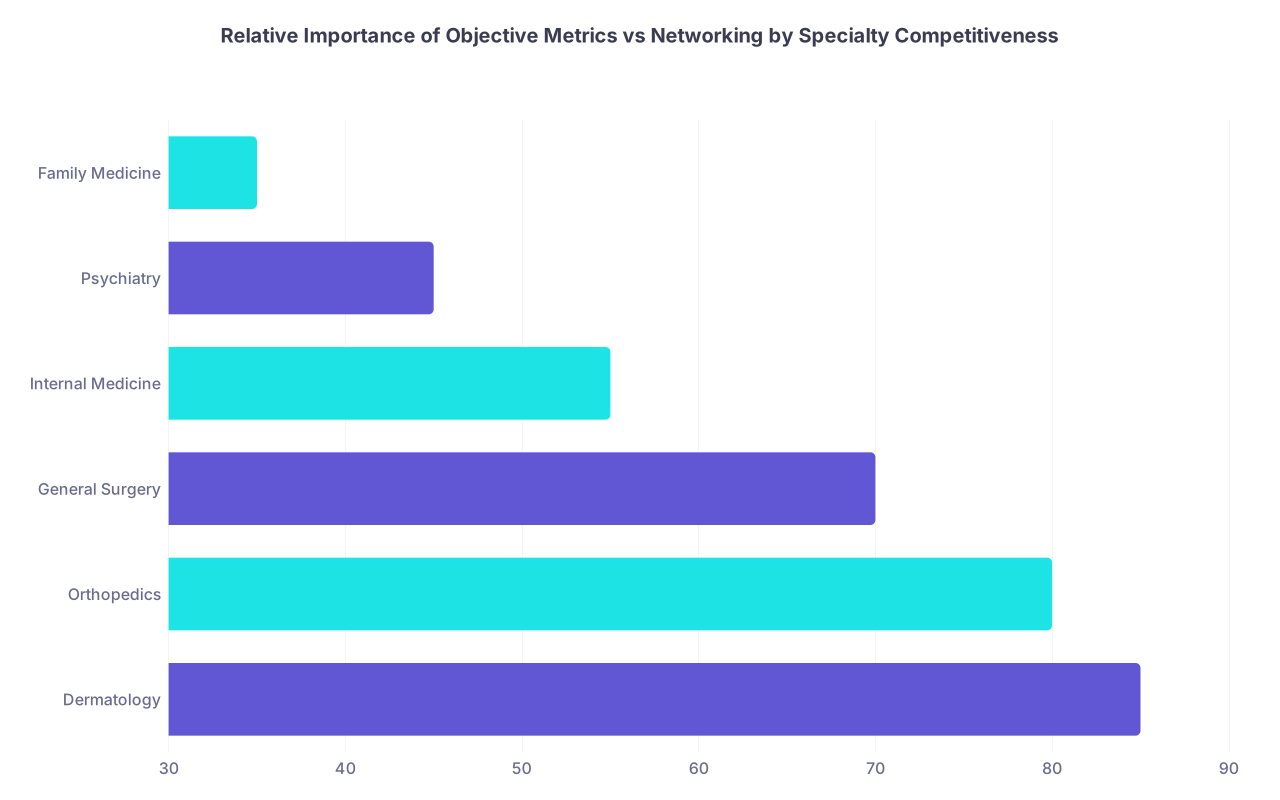
| Category | Value |
|---|---|
| Dermatology | 85 |
| Orthopedics | 80 |
| General Surgery | 70 |
| Internal Medicine | 55 |
| Psychiatry | 45 |
| Family Medicine | 35 |
Imagine that chart as “how hard objective metrics hit you” as specialty competitiveness rises. The more competitive the field, the less networking can rescue a seriously weak application. It can still help—sometimes massively—but it won’t rewrite physics.
Case 1: High Scores, No Network
This is the student with a 255 Step 2, top-quartile rank, solid research, but:
- Never did an away in their target region.
- Didn’t talk to faculty early.
- Applied broadly but generically.
- No one you know has ever heard their name.
What happens?
They get a bunch of interviews. They get ranked decently at a bunch of places. But they don’t end up at the hyper-desired programs with tightly knit applicant pipelines. In post-interview discussions, the phrase you hear is, “Great on paper, but I didn’t get a sense of them,” while someone else with slightly lower metrics and stronger in-person impressions jumps ahead.
They still match. Usually well. But they leave prestige on the table because no one was truly invested in getting them.
Case 2: Strong Network, Mediocre Scores
Here’s the flip side. Step 2 in the low 220s. Solid but not eye-catching clerkship performance. However:
- Did a sub-I at the home program and an away at Dream Program A.
- Worked on a small but real project with Dr. Big-Name.
- Got a call made on their behalf from an alumnus who now runs a program.
What happens?
They get interviews at places where their raw stats alone might not have broken through. Once in the room, their familiarity and perceived fit count heavily. I’ve seen someone like this land a mid-tier academic spot in a moderately competitive specialty while a 240 with no footprint at that site got passed over.
Key detail: this only works if the scores clear a basic competence bar. You don't network your way out of failing Step, multiple attempts, or abysmal evaluations at most serious programs.
The Real Engine of “Networking”: Who Trusts You Enough to Vouch for You?
Another misconception: people think networking in medicine is like business school schmoozing—cocktail hours, LinkedIn spam, elevator pitches. That’s not how it plays out on the ground.
In medicine, “networking” is just a fancy way of saying:
Who has actually seen you work and is willing to spend political capital on you?
Those are:
- Attendings who watched you on a busy inpatient month and know you don’t crumble at 2 a.m.
- Research mentors who saw you grind through a dataset instead of ghosting after the intro meeting.
- Current residents who tell the PD, “That sub-I was one of the best we’ve had in two years.”
That’s all networking. It’s just not branded as such.
If you want to understand where it shows up structurally, look at the same NRMP PD survey. “Letters of recommendation in the specialty” are consistently among the highest-rated tools programs use. Why? Because they’re structured endorsements from actual relationships.
Here’s how different elements play over the application timeline:
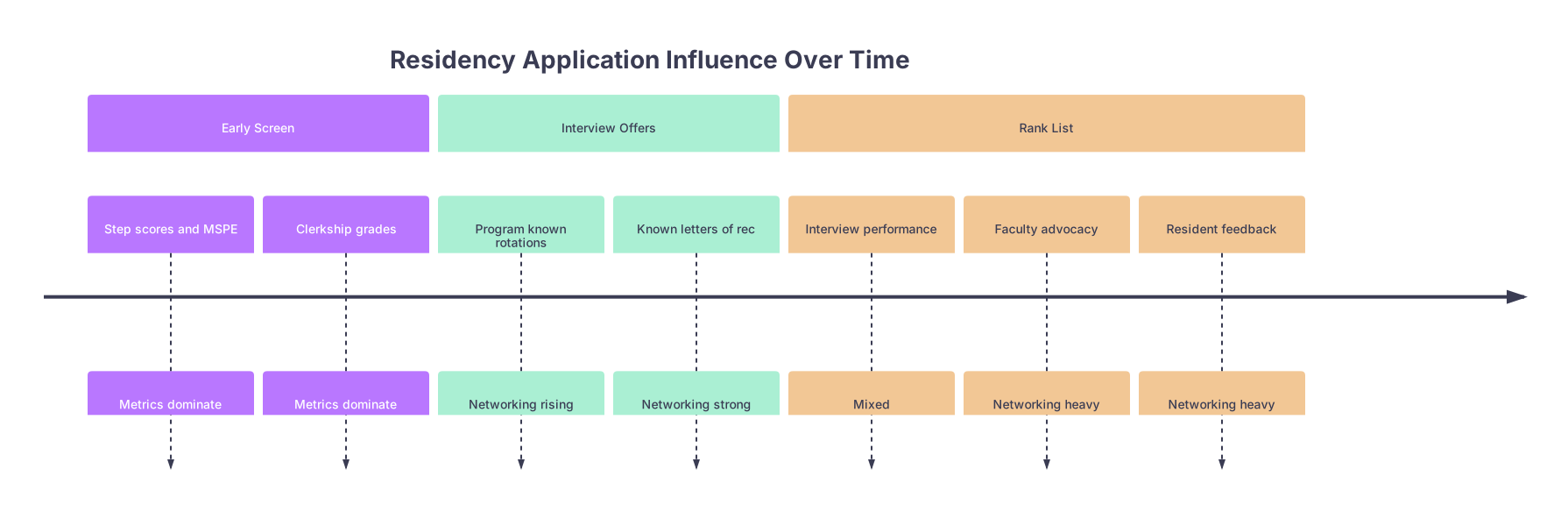
| Period | Event |
|---|---|
| Early Screen - Step scores and MSPE | Metrics dominate |
| Early Screen - Clerkship grades | Metrics dominate |
| Interview Offers - Program known rotations | Networking rising |
| Interview Offers - Known letters of rec | Networking strong |
| Rank List - Interview performance | Mixed |
| Rank List - Faculty advocacy | Networking heavy |
| Rank List - Resident feedback | Networking heavy |
Notice what’s missing? “Met the PD at a random conference once.” That alone rarely moves the needle. Real networking in medicine is sustained exposure plus trust.
Away Rotations: Where Networking Actually Moves Match Outcomes
If you want one place where networking can legitimately approach “trumping” scores, it’s away rotations and sub-Is.
I’ve seen the following scenario repeatedly in surgery, ortho, EM, and neuro:
- Applicant A: 250 Step 2, good school, no rotation at the program, comes off slightly awkward interview day, no one really remembers them.
- Applicant B: 236 Step 2, did a month-long sub-I there, showed up at 5 a.m., stayed late, never complained, residents loved them, wrote a strong case log, patients remembered their name.
Rank meeting conversation sounds like this:
“Yeah A has the better score, but B crushed it here. I’d rather work with B for the next 5 years.”
Applicant B ends up ranked higher. That’s networking plus performance overpowering a 10–15 point Step gap.
Is this universal? No. Some hyper-score-conscious programs will still default to the test taker. But at many midsize and even some big-name places, the person who proved themselves in that environment gets the nod.
This is also where proximity and institutional pipelines matter. Programs are far more comfortable taking a “risk” on a known quantity trained in a familiar system.
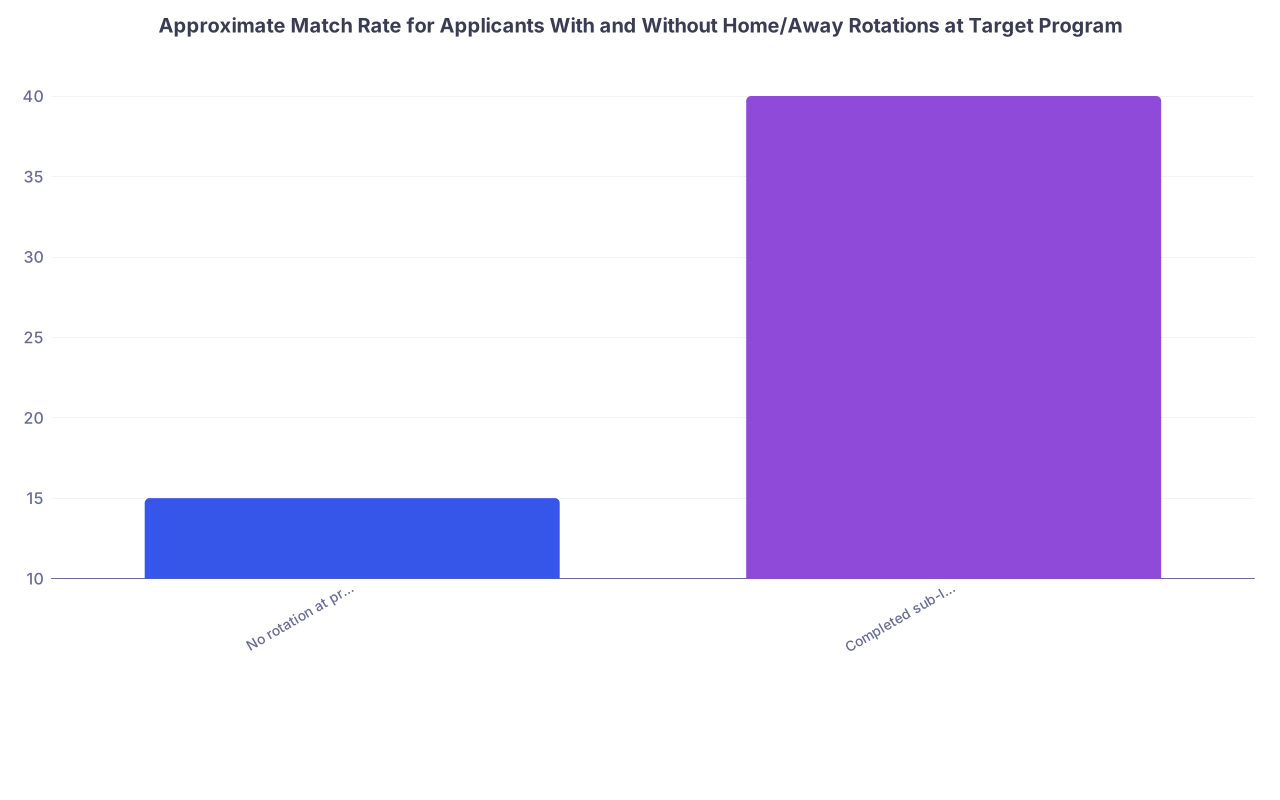
| Category | Value |
|---|---|
| No rotation at program | 15 |
| Completed sub-I/away at program | 40 |
The precise numbers vary by specialty and program, but the pattern holds: the conversion rate from interview to rank-list love skyrockets when people know you.
The Ugly Truth: Networking Helps the Already-Advantaged More
Here’s where I’ll piss a few people off: networking is not some egalitarian alternative to Step scores. It often amplifies existing advantages.
Who networks “well” in medicine?
- Students at big-name academic centers that routinely send people to top residencies.
- People whose schools have alumni at every major program making backchannel calls.
- Applicants whose mentors are on guideline committees or speak at every national conference.
If you’re at a new or lower-tier school, or an international grad, your access to those pipelines is weaker by default. That does not mean networking is useless for you. It means you have to be brutally strategic and realistic.
Things I’ve watched actually help “underdog” applicants:
- Targeting away rotations at places with a history of taking grads from similar schools.
- Building small but real research relationships—case reports, QI projects—with people who actually publish, not just “CV line” fluff.
- Getting close to one or two champions who are willing to personally email or call.
What does not help much:
- Spraying generic “I’d love to learn more about your program” emails to faculty you’ve never met.
- Dropping into conference booths for 3 minutes and calling it “networking.”
- Collecting selfies with speakers instead of asking for a concrete next step like, “Could I help on that dataset you mentioned?”
Networking is not magic. It’s leverage. And like all leverage, it’s easier to apply when you already have something solid underneath—competence, scores, and actual work.
So What Should You Actually Do?
You’re not here for theory. Here’s the practical reality check.
If your scores are strong for your target specialty:
- Do not coast. Scores alone will not differentiate you among a pile of other high scorers.
- You should be building real relationships early—first year clinical for home program, early third year for aways.
- Once you pass some basic thresholds, your marginal gain from “one more research line” is often lower than from a month where residents say, “We want this person back.”
If your scores are average or slightly below average:
- You cannot just “network your way out” of bad numbers in the most competitive fields. Be honest with yourself about specialty and tier.
- But within a more realistic target range, networking can absolutely shift you from community to academic, or from less desirable location to a stronger fit.
- Your best bet is fewer, deeper relationships—one PD, one research mentor, one clerkship director—who know you WELL enough to advocate, not 20 people you said hi to once.
If your scores are significantly below bar for your dream specialty:
You’re not in a “network harder” situation. You’re in a “change strategy” situation.
That might look like:
- Pivoting to a related but less competitive field (IM instead of cardiology pipe dream via direct match; FM instead of heme/onc path) and planning to find your niche there.
- Taking extra time to strengthen Step 2, doing an MPH or research year only if it leads to real skill/score improvement, not just optics.
- Or being brutally honest about geography/program tier and using networking to maximize outcomes within that tighter range.
Last point: networking is not a substitute for being good. It’s an amplifier. If you’re competent and decent to work with, networking lets more people see that and remember you. If you’re unreliable, networking just means more people know not to rank you.
The Bottom Line
- Networking does not erase Step scores, but it absolutely reshapes outcomes for applicants who are already within a realistic range for a given specialty and program tier.
- Scores and objective metrics mostly control who gets considered; networking and reputation largely control who gets chosen among those considered.
- The people who win this game consistently are not the best networkers or the best test takers—they’re the ones who are good enough on paper and unforgettable in person, where it counts.