This article is for educational purposes only. It is not financial advice, not legal advice, and not tax advice. Figures vary by individual circumstances, so consult a qualified professional before acting.
Introduction
For broader context on maximizing your professional reach, check out why its all about who you know is only half true in medicine.
Here's the myth: you need to fly to San Diego, drop $2,000 on registration and a hotel, shake five hundred hands at a national conference, and suddenly your career trajectory bends upward. I've watched residents believe this. I've watched program directors sell it. And I've watched the data refuse to back it up.
Let me be direct. The dominant narrative in graduate medical education is that large national meetings, think AHA, ASCO, RSNA, ACEP, are where careers get made. Residents are encouraged, sometimes subtly pressured, to attend. "Go to the big meeting," the advice goes. "Network. Get your name out there." But when you actually look at what moves the needle for residency networking, meaningful, durable, productive professional relationships that translate into mentorship, collaboration, letters, and eventually jobs, the evidence points somewhere else entirely.
Local and regional case presentations, society meetings, and grand rounds routinely outperform national conferences on the metrics that matter: sustained contact, faculty accessibility, follow-through rate, and conversion to tangible outcomes. The national conference has its place, but it is wildly overrated as a networking tool, and the opportunity cost is real.
This matters because time is the scarcest resource in residency. Every conference day is a day you're not in clinic, not publishing, not sleeping, not with your family. If you're going to invest that day in networking, you should know what actually works and what just feels productive.
The Core Challenge
The core problem with national conferences as a networking tool is the signal-to-noise ratio. They're too big. The average major medical conference hosts 10,000 to 30,000 attendees. The faculty you want to meet are running between committees, giving back-to-back talks, dodging pharmaceutical reps, and trying to get to lunch. You are one of several thousand trainees trying to corner the same person. The handshake you get at a poster session is not a network. It's a photo op.
To avoid common pitfalls when meeting senior colleagues, read about common conference networking errors that make you forgettable.
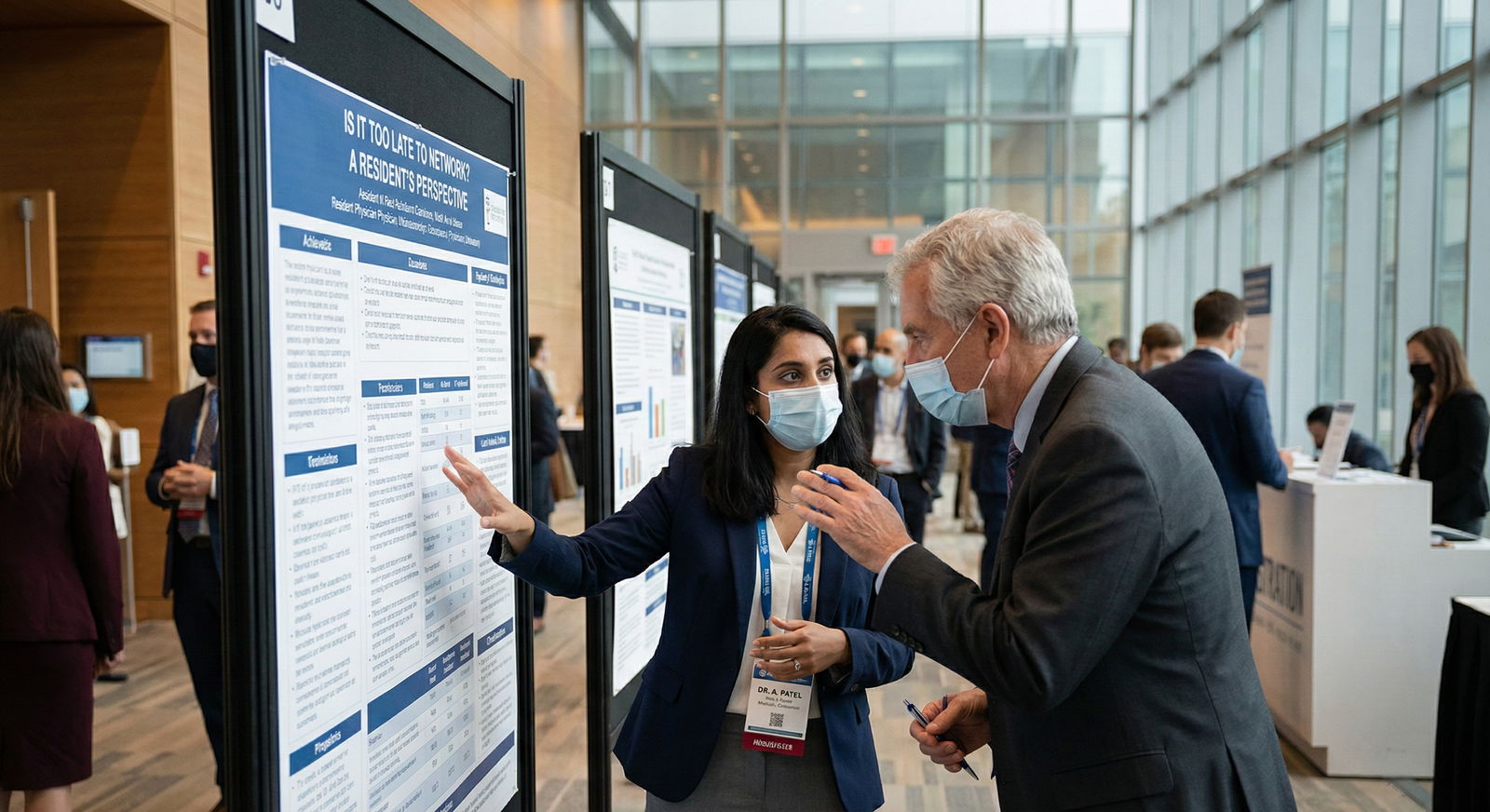
I've seen it happen dozens of times. A resident introduces themselves to a prominent researcher at a national meeting. The researcher is polite, maybe takes a business card, maybe offers a vague "let's keep in touch." Then the resident follows up by email. No response. Another follow-up. Nothing. Six months later, the connection is dead. This is not a failure of the resident. It's a structural failure of the format. National conferences are optimized for information delivery, not relationship formation. The people you want to meet are saturated with inputs, and you're one of thousands.
Now compare this to a local case report at a regional society meeting. You present a thirty-minute talk to an audience of forty people. Half of them are faculty from programs in your region. After the talk, three of them approach you. One is a program director. One is a researcher whose work you cited. One is a community attending who has a job opening. You have lunch with two of them. You exchange direct emails. You follow up the next week. They remember your name because they saw your face, heard your voice, and watched you handle questions for half an hour. That is a network.
The data bears this out. Survey work on professional network formation in medicine consistently shows that sustained, repeated, low-stakes contact produces stronger professional ties than single high-stakes encounters. Proximity matters. Frequency matters. Shared context matters. The regional society meeting gives you all three. The national conference gives you none.
The common pitfall is mistaking attendance for networking. Residents come back from national conferences with a stack of business cards and a sense of having "been there." But if you audit those contacts six months later, the conversion rate is abysmal. Maybe one in twenty becomes an actual working relationship. The rest are ghosts. The energy was spent, the money was spent, the day off was spent, and the yield was a vibe.
The other pitfall is the assumption that bigger is better. A poster at a national meeting sounds impressive on a CV. It is. It demonstrates productivity and interest. But it does not, by itself, build a network. A poster is a one-way broadcast. You stand next to it. People walk by. Some ask a question. Almost none of them remember your name the next day. A case report at a local meeting, by contrast, is a performance. You're on stage. You're answering questions. You're visible. The asymmetry is striking: the smaller venue produces the larger professional footprint.
How do you navigate this successfully? You stop treating national conferences as your primary networking vehicle and start treating them as supplementary. You redirect the bulk of your networking energy toward venues where you can be seen, heard, and remembered. You present locally and regionally first. You build a base of relationships within driving distance. Then, when you do go to a national meeting, you go with a specific, pre-arranged agenda: two or three targeted meetings with people you've already begun relationships with locally or via email, not a scattershot attempt to meet strangers in a sea of ten thousand.
Actionable Next Steps
Here's the plan. It's not complicated, but it requires discipline.
First, inventory the regional and state societies relevant to your specialty. There are more than you think. Most specialties have a state chapter that meets annually, often with much smaller attendee counts, two hundred to five hundred people. These are gold mines. Submit a case report or a small research abstract. The acceptance bar is reasonable. The audience is engaged. The faculty are local. This is where networks are actually built.
Second, present at your own institution's grand rounds whenever the opportunity exists. It sounds trivial. It isn't. Your own faculty are the people who will write your letters, nominate you for awards, and connect you to their contacts. The more they see you present, the more invested they become. Internal visibility is the most undervalued currency in residency.
Third, when you do attend a national conference, come with a hit list. Identify two or three people you want to meet. Email them two weeks before the meeting. Reference their work. Propose a specific time, coffee on Thursday at 7 a.m., or a brief chat at the poster session at 2 p.m. Most faculty will say yes to a specific, low-friction request. They will ignore a vague "I'd love to connect sometime at the meeting." Specificity converts. Vagueness evaporates.
Fourth, follow up within seventy-two hours of any meeting or presentation. Not a week later. Not when you "get around to it." Seventy-two hours. The follow-up should reference one specific thing from your conversation. Not a generic "great meeting you." A specific: "You mentioned the challenge of measuring outcomes in X, I came across this paper and thought of our conversation." That is how a contact becomes a connection.
Fifth, maintain the connection. Quarterly contact is the minimum viable frequency. Send a relevant article. Comment on their recent publication. Invite them to give a talk at your institution. Relationships decay without input. Most residents build a contact and then let it sit. Don't.
Resources to use: your program coordinator (they know the regional society deadlines), your institution's research office (they track internal presentation opportunities), and your own faculty mentors (ask them which regional meetings they attend and whether you can come). Use Google Scholar alerts to track the output of people you've met so you have a natural reason to reach out. Use Doximity and LinkedIn for maintaining light contact, but don't mistake the platform for the relationship.
Key Takeaways
Be prepared. Showing up to a meeting without a submitted abstract, a target list of people to meet, and pre-arranged outreach is not networking. It's tourism. Preparation is the single biggest differentiator between residents who build networks and residents who collect badges.
Focus on high-yield areas. Local and regional venues, your own institution's grand rounds, and pre-arranged targeted meetings at national conferences, that's where the yield is. The rest is noise. The national conference is not useless. It's just not the main event. Treat it accordingly.
And remember: the best network is not the biggest one. It's the one where people remember your name after you leave the room. That almost never happens in a convention center with thirty thousand people. It happens in a hotel conference room with forty. Go there.