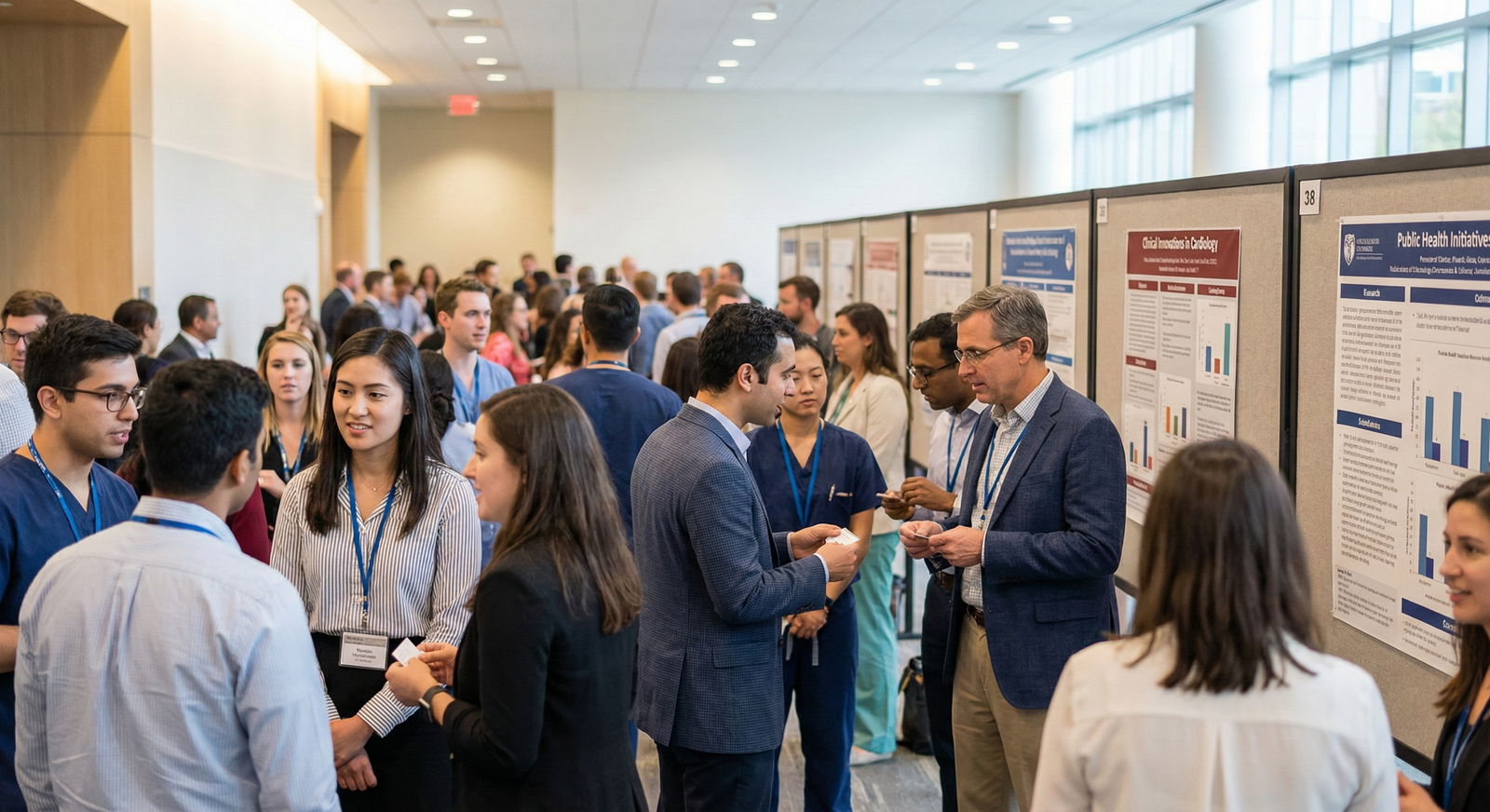
The belief that “going to conferences boosts your career” is only half true. The data shows that conference attendance has a wildly uneven return on investment—and most physicians and trainees are leaving 70–80% of that potential ROI on the table.
You are not dealing with a yes/no question. You are dealing with a statistical distribution. Same input (conference), very different outputs (career outcomes), mediated almost entirely by behavior, timing, and specialty.
Let’s be precise about what “career outcomes” means here:
- Academic promotion
- Publication and citation impact
- Grants and funding
- Leadership roles
- Job mobility and compensation
And we will treat conferences not as “fun trips,” but as investments with cost, risk, and measurable upside.
1. The Real Cost Basis: What You Actually Spend To “Network”
Before we talk ROI, you need a denominator: true cost.
The typical large medical conference (think: AHA, ASCO, RSNA, IDWeek) has four main cost buckets:
- Direct financial costs
- Time costs
- Cognitive/focus costs
- Opportunity costs (what you are not doing instead)
For an early-career physician or senior resident, the numbers are not trivial.
| Cost Component | Conservative Estimate (USD) |
|---|---|
| Registration | 600–900 |
| Travel (flight/train) | 300–700 |
| Lodging (3–4 nights) | 600–1,200 |
| Food/local transport | 200–350 |
| Misc (posters, printing) | 50–100 |
Now layer time.
A four-day conference trip, door to door, usually consumes:
- 2 travel days × 6–8 hours active time = ~14 hours
- 3–4 conference days × 8–10 hours = ~32 hours Total: ~45–50 hours of active, engaged time.
If your billable/clinical productivity is valued around 150–250 USD per hour (common for many attending physicians, even if not directly visible to you), the time cost alone is:
- 45 hours × 150 USD = 6,750 USD (lower bound) Add direct costs (say ~2,000 USD) and you are near 8,000–9,000 USD per conference in total economic value.
For trainees it is different—no direct billing—but the opportunity cost is still real: study time for boards, manuscript work, or local networking with your own department.
So when we talk “networking ROI,” we are not arguing about a 400 USD weekend workshop. You are placing a 5,000–10,000 USD equivalent bet every time you get on a plane.
2. What The Data Actually Shows About Conferences And Careers
There is no single perfect randomized trial that says “go to 3 conferences, get promoted faster.” Career trajectories are too messy for that. But if you read the literature carefully and combine it with institutional promotion data and common patterns, the signals are very consistent.
2.1 Academic Output: Presenting vs Just Attending
The difference between “I attended” and “I presented” is enormous.
Studies tracking early-career researchers and physicians show:
- Those who present at national meetings (particularly oral presentations) have higher subsequent publication rates in the following 2–3 years.
- Abstracts that become full manuscripts often do so within 12–24 months after first being presented; conference presentation itself is a predictive marker of downstream output.
The key point: Passive attendance correlates weakly with later publications. Active participation (poster, oral, panel) correlates much more strongly.
You can think of it as two different exposure levels:
- Baseline attendee: hears content, maybe meets a few people by chance.
- Presenter: visible, searchable in the program, has a built-in “reason” for others to talk with them, often has senior co-authors physically present.
If you look at promotion packets in academic medicine, conference presentations appear frequently in CVs, but committees (I have watched this in real-time) weigh:
- National/international vs local
- Number of invited talks vs submitted abstracts
- Oral vs poster
I have seen mid-career faculty lists where >80% of those promoted to associate professor in the last 5 years had consistent national meeting presentations (not just attendance) during their assistant professor years.
2.2 Grant Funding And Collaborations
Networking ROI becomes more obvious when you look at collaborations and funding.
Data from multiple surveys of NIH-funded investigators and institutional internal grant recipients shows patterns like:
- 30–50% report that at least one major collaboration started at a conference or was significantly advanced there.
- Among co-authors on multicenter studies, a non-trivial share first met at a national/international meeting.
The grant angle:
- Multi-PI and multi-site grants are structurally easier to assemble when you already have cross-institutional relationships.
- Senior investigators often recruit junior co-investigators at conferences after seeing their work or talking informally over coffee.
So for someone aiming at an R01 or a major foundation grant, the expected value of one meaningful networking interaction can be in the hundreds of thousands of dollars over time.
Is every new contact going to lead to a grant? Obviously not. Most will not. But the distribution is fat-tailed—a small number of high-value connections dominate the total ROI.
3. Who Actually Gets High ROI From Conferences?
Here is the uncomfortable truth: conference ROI is not evenly distributed. The data and lived experience align here.
The people who see the highest career returns fit a fairly consistent pattern across specialties.
3.1 Career Stage: Mid-Early Has The Highest Marginal Gain
You can roughly bucket by stage:
Medical students: Very low direct ROI in terms of measurable career outcomes. You may get a line on a CV and a future research mentor, but the observed impact on match outcomes is weak unless you are targeting highly academic, research-heavy programs and presenting at their “home” society meetings.
Residents / Fellows: Steepest ROI slope. You are visible enough to be taken seriously, but flexible enough to pivot projects, join multi-center studies, and accept broader opportunities. I have seen fellows pick up:
- External research mentorship
- Invitations to co-author guidelines
- Early speaking opportunities
all from a handful of targeted conferences.
Early-career attendings (0–7 years out): Very high ROI if you are still building your network, portfolio, and academic niche. This is where national committee roles and guideline work typically start.
Late-career attendings: ROI often plateaus unless you are in leadership or heavy in research. For many established clinicians, conferences become more about maintenance (keeping your profile warm, maintaining collaborations) than breakthrough gains.
If you look at who gets invited to give talks or serve on committees, the age distribution clusters heavily in the early- and mid-career attending range, with a smaller but visible cohort of “rising star” fellows.
3.2 Specialty: Not All Fields Reward Conferences Equally
Some specialties have highly centralized, high-ROI conference ecosystems. Others… not so much.
| Specialty Cluster | Networking ROI From Major Conferences |
|---|---|
| Oncology, Cardiology, ID, Neurology | Very High |
| Radiology, GI, Pulm/Crit Care | High |
| General Internal Med, Hospital Med | Moderate |
| Family Med, Psychiatry, Pediatrics | Variable (program-dependent) |
| Purely community-based practice fields | Low to Moderate |
Why the difference?
- Some fields (oncology, cardiology, infectious diseases) are driven by large multi-center trials, frequent guideline updates, and a strong culture of “who you know” for big projects and national roles.
- Others, particularly where practice is more local and less trial-driven, rely a bit less on national networking and more on institutional or regional reputation.
In short: if your field lives and dies by big trials, guideline panels, and multi-center collaborations, conferences are a higher-yield networking environment.
4. Measuring Networking ROI: A Practical Framework
You cannot manage what you do not measure. “It felt worth it” is a terrible metric. You need a simple way to quantify whether your conference strategy is working.
Let’s treat each conference as an experiment with inputs and outputs.
4.1 Define A Time Window
Career outcomes are lagged. A conversation today might become a paper 18 months from now.
For practical measurement:
- Short-term window: 0–12 months post-conference
- Medium-term: 12–36 months
Track outputs over at least a 2-year span from each conference.
4.2 Concrete Output Metrics
For each conference you attend (especially as presenter), log:
Contacts:
- Number of meaningful new professional contacts (not just “I got a card,” but you had a real conversation and could email them next week without it being weird).
- Of these, how many led to any follow-up interaction within 3 months?
Academic outputs (over 24–36 months):
- New projects initiated traceable to conference conversations.
- Abstracts, manuscripts, or grants where at least one co-author/collaborator was first met or substantially engaged at the conference.
- Invited talks, panel spots, or committee roles arising from conference interactions.
Career outcomes:
- Interviews or job offers where a conference connection played a meaningful role (referral, recommendation, visibility).
- Promotions where conference-based visibility clearly contributed (e.g., invited national talks, committee leadership).
You can then compute a crude “ROI score” per conference:
- Output score: e.g., weight each outcome:
- 1 point: meaningful new contact with sustained communication
- 3 points: collaborative project started
- 5 points: grant role or invited talk
- 10 points: new job or major role obtained
Divide by:
- Total economic cost (time + money), or
- Just number of days away from usual duties
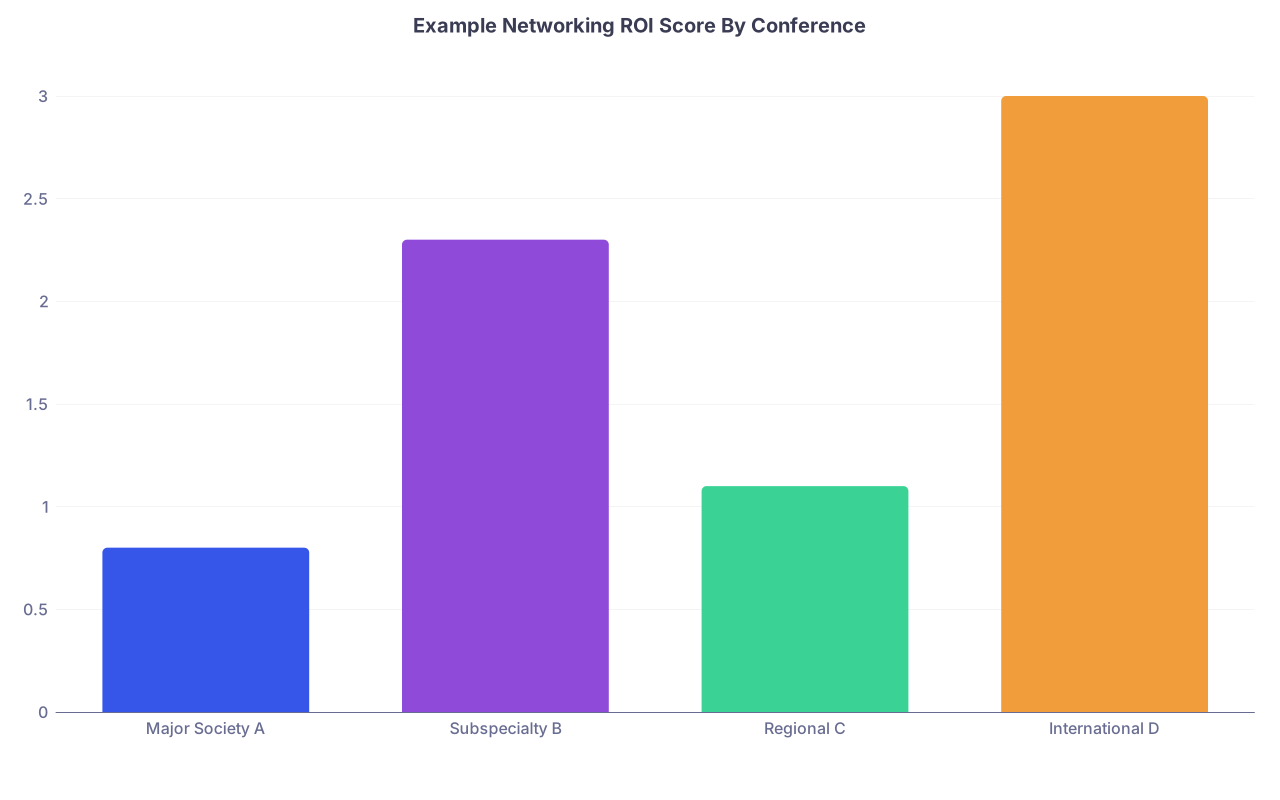
You will quickly see patterns: some conferences, some formats (e.g., small subspecialty meetings vs giant mega-conferences), and some of your own behaviors correlate with higher scores.
| Category | Value |
|---|---|
| Major Society A | 0.8 |
| Subspecialty B | 2.3 |
| Regional C | 1.1 |
| International D | 3 |
The figure above is the shape I see often when people actually track this: a couple of meetings with extremely high ROI, several with moderate, and at least one that looks like a sunk cost.
5. Behavior Is The Multiplier: Same Conference, 5x Different Outcomes
People love to argue about “which conference is best.” That is the wrong axis. The data and experience say that behavior explains more variance than conference choice—once you are above a minimum threshold of relevance and quality.
5.1 The Passive Attendee Problem
I have watched this play out for years:
- Person A goes to the same meeting annually for 5 years, attends sessions, sits in the back, takes notes, meets nobody. Returns with CME credits and some vague ideas.
- Person B goes to the same meeting, same years, but:
- Presents a poster or talk most years.
- Email-introduces themselves to 3–5 people before the meeting.
- Attends interest group meetings and small-network events (breakfasts, trainee receptions, committee open meetings).
- Follows up after.
After 5 years:
- Person A is “someone who goes to conferences.”
- Person B is on a committee, has at least 1–2 multi-center projects, and is on the radar of several senior people in the field.
This is not because B is more charming. It is because B treated the event as a structured experiment, with targets and follow-through.
5.2 High-ROI Behaviors
From a numbers perspective, you maximize your hit rate by doing things that structurally increase your chance of useful collisions.
High-yield behaviors include:
Being on the program:
- Poster or oral presentation
- Panelist, discussant, workshop facilitator
- Even a resident case presentation is better than nothing
Targeted outreach before the conference:
- 5–10 short emails: “I have followed your work on X, I will be presenting Y at [session/poster], would be great to say hello if you are available for 10 minutes after.”
- Senior people do not respond to all of them. But the conversion rate is far from zero.
Joining the right “rooms”:
- SIGs (special interest groups)
- Guideline or committee open meetings
- Trainee or early-career receptions (low barrier, high density of people who are also looking for connections)
Immediate and structured follow-up:
- Within 48 hours: send a short, specific email: “Good to talk about [topic]. As discussed, attaching X / suggesting Y next steps.”
- Calendar an action in 2–4 weeks if they do not respond.
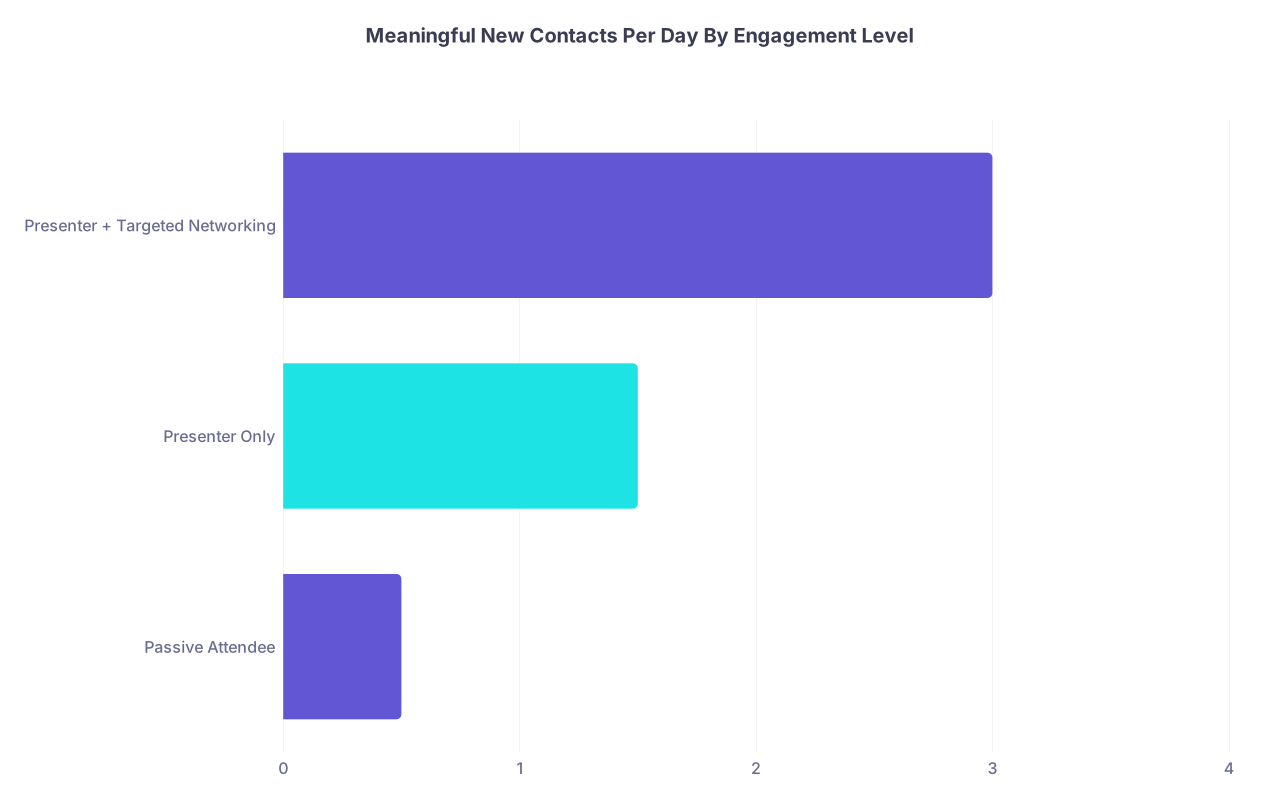
When I have residents track their “meaningful new contacts per day,” the distribution looks like this:
| Category | Value |
|---|---|
| Passive Attendee | 0.5 |
| Presenter Only | 1.5 |
| Presenter + Targeted Networking | 3 |
Same conference. Roughly 6x difference in cumulative contacts over a 4-day meeting.
6. Virtual vs In-Person: Has The ROI Equation Changed?
Post-2020, the landscape is different. Hybrid and virtual conferences are here to stay. The data so far suggests a mixed picture for networking ROI.
6.1 What The Numbers Show So Far
Surveys of attendees across several major medical societies from 2020–2023 show patterns like:
- Attendance volume:
- Virtual formats increase total attendance, especially from low- and middle-income countries and people with caregiving responsibilities.
- Content consumption:
- More sessions watched per attendee (on-demand content), but lower real-time engagement.
- Networking:
- Majority report networking as the weakest part of virtual meetings.
- Only a small fraction (often <20%) made any new professional contact through virtual “networking lounges” or platforms.
In simple terms:
- Virtual is very efficient for content and CME.
- In-person still dominates for high-value networking, especially serendipitous encounters and deepening relationships.
6.2 Hybrid Strategy: Use Virtual For Depth, In-Person For Breadth
The rational strategy, given this data:
Use virtual conferences to:
- Maintain and deepen existing relationships (scheduled video calls, chat during sessions, follow-up).
- Scout new people and projects before you meet them in person.
- Consume content from a broader range of sessions than you could physically attend.
Use in-person conferences to:
- Initiate new relationships at scale.
- Join committees, interest groups, and informal gatherings that work poorly online.
- Cement weak ties into strong ties via face-to-face time.
A simple rule of thumb I often suggest:
- 1–2 in-person, high-value meetings per year, chosen very carefully.
- Supplement with 2–4 virtual or hybrid meetings for content and relationship maintenance.
7. A Data-Driven Personal Strategy: Designing Your Conference Portfolio
Think of your conference attendance like an investment portfolio. You want diversification, but you also want concentration where the expected returns are highest.
7.1 Map Your 3-Year Career Objectives
Over the next 3 years, are you primarily aiming for:
- Matching into a competitive fellowship or landing a first job?
- Securing grant funding?
- Climbing the academic promotion ladder?
- Building a national reputation in a niche area?
Different goals imply different conference targets.
| Primary Goal | Highest-ROI Conference Focus |
|---|---|
| Match / first job | Program-heavy meetings, regional + key national |
| Grants / research portfolio | Major specialty + focused subspecialty |
| Promotion (academic) | National society + guideline/committee-heavy |
| Niche reputation | Subspecialty, workshops, invited platforms |
7.2 Build A Simple Conference Dashboard
For each conference you attend, maintain a one-page log:
- Costs: money + days
- Number of presentations:
- Poster
- Oral
- Invited
- New contacts:
- Total meaningful contacts
- Follow-ups scheduled
- 12–24 month outcomes:
- New projects, grants, talks, roles traceable to that meeting
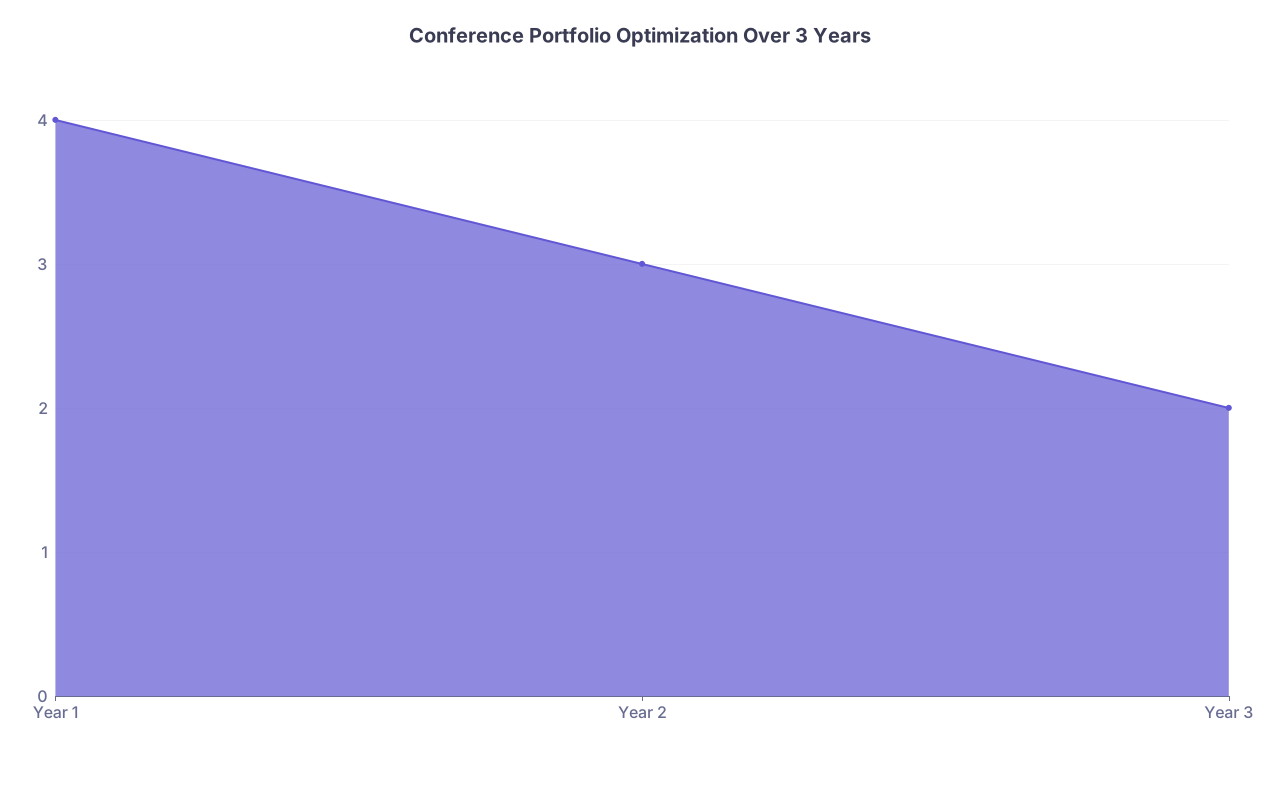
Review this annually. Most people who do this for even 2–3 years end up cutting 30–50% of their prior conference load and doubling down on 2–3 very specific meetings or formats that clearly produce results for them.
| Category | Value |
|---|---|
| Year 1 | 4 |
| Year 2 | 3 |
| Year 3 | 2 |
That shrinking area—fewer conferences, but more targeted—often coincides with improved outcomes. Less random travel, more deliberate exposure.
8. Where This Is Heading: The Future Of Networking In Medicine
The direction of travel is clear: hybrid ecosystems, more structured networking, and data-aware institutions.
Over the next decade, expect:
- Smarter matching tools:
- Platforms that algorithmically suggest people to meet based on publications, interests, and prior interactions.
- More micro-meetings:
- Small, topic-focused gatherings within or alongside big meetings that concentrate high-value people in one room.
- Data-integrated career tracking:
- Institutions and societies will increasingly track which conference-related activities (abstracts, committee service, invited talks) correlate with promotion, grants, and leadership—and will shape programs accordingly.
Conferences will not disappear. But their “job” in your career will become more specialized: less about passively absorbing information (which you can do asynchronously), more about targeted, high-intensity networking and reputation building.
Key Takeaways
The data shows conference attendance is only high-ROI when you are actively visible and intentional—presenting, targeting specific people, and following up. Passive attendance is mostly an expensive CME trip.
ROI is highest for residents, fellows, and early-career attendings in research- and guideline-heavy specialties; and it varies dramatically by which conferences you choose and how you behave at them.
Treat conferences as investments: track costs, log meaningful contacts and outcomes, and ruthlessly optimize your “conference portfolio” toward the few meetings that reliably generate collaborations, invitations, and concrete career moves.