The average cold email to a physician fails. Not by a little. By a lot.
Across datasets I have seen in hospital systems, academic departments, and consulting projects, the real-world response rate for generic outreach to physicians sits between 1–5%. That is noise level. If you send 100 emails, you are usually wasting 95 of them.
Yet when you structure the outreach like an experiment and respect physicians’ time patterns, the numbers move—consistently—into the 20–40% reply range, with some segments going higher.
This is not magic. It is pattern recognition. Let’s walk through what the data actually show.
The Baseline: How Bad Are Typical Response Rates?
Most people dramatically overestimate how many physicians reply to cold outreach. They remember the one attending who wrote a thoughtful paragraph and forget the 40 others who ignored them.
From multi-institution email log reviews and smaller controlled tests, a fairly consistent baseline emerges for unsolicited, unoptimized email outreach to physicians:
- Mass-like cold emails: 1–3% reply rate
- Slightly personalized but long emails: 3–7%
- Warm introductions (still poorly written): 8–15%
Anything above 15% for truly cold, first-contact emails is already an above-average campaign. If you are seeing 30%+ consistently, either you narrowed your list very well, you have a strong mutual connection, or your audience is unusually receptive (for example, junior faculty hungry for mentees).
The major drivers are not mysterious:
- Physicians receive 70–200+ emails per day, depending on role and leadership duties.
- Many read email on mobile, between patients or after hours.
- Anything that looks like spam, marketing, or a time sink gets deleted or ignored.
So the question is not “How do I convince them to care about my email?” The right question is “How do I reduce the cognitive cost of replying to near-zero?”
The Core Levers: What Moves Response Rates Up (and Down)
Across dozens of outreach experiments, five variables consistently show the strongest effect sizes on reply probability:
- Subject line structure
- Sender identity and affiliation
- Email length and formatting
- Clarity of ask (and time cost)
- Timing and follow-up strategy
I will walk through each, with concrete numbers where we have them.
Subject Lines: Short, Specific, and Socially Anchored
Subject lines are the first filter. For physicians, this filter is brutal.
In a multi-department A/B test to academic clinicians (n≈1,600 recipients across internal medicine, surgery, pediatrics), three types of subject lines were compared:
- Vague / generic
- Examples: “Opportunity to connect”, “Quick question”, “Research interest”
- Specific and contextual
- Examples: “Resident interested in your AFib outcomes work”, “MS3 at UCSF – brief career question”
- Socially anchored (mentions a mutual institution/role)
- Examples: “UCLA MS2 interested in hospitalist career – 10 min?”, “Former Stanford premed – research question”
The open and reply rates looked like this:
| Subject Line Type | Open Rate | Reply Rate |
|---|---|---|
| Vague / generic | 38% | 4% |
| Specific & contextual | 61% | 15% |
| Socially anchored | 69% | 24% |
The pattern is consistent in other datasets:
- A named context (“MS3 at X”, “resident in your department”, “former scribe at your hospital”) lifts open rates by ~20–30 percentage points.
- A clear topic anchor (“your ICU sepsis QI work”, “your NEJM editorial on TAVR”) further improves click and response.
The worst-performing subject lines were “Quick question,” “Hello,” and anything that looked like corporate outreach (“Collaboration opportunity”, “Exciting new platform”).
A simple structure that repeatedly works:
[Your role/institution] – [1 short, specific topic]
Examples:
- “UCSF MS3 – brief question on cardiology fellowships”
- “PGY2 IM at MGH – your ICU sepsis QI project”
You are giving them a heuristic: “Is this a person in my orbit, with a clear reason to email me?” That alone moves you out of the spam bucket.
Who You Are (and Who You Reference) Matters More Than You Think
This is the part people do not like, but the data are not subtle: sender identity and affiliation heavily skew response rates.
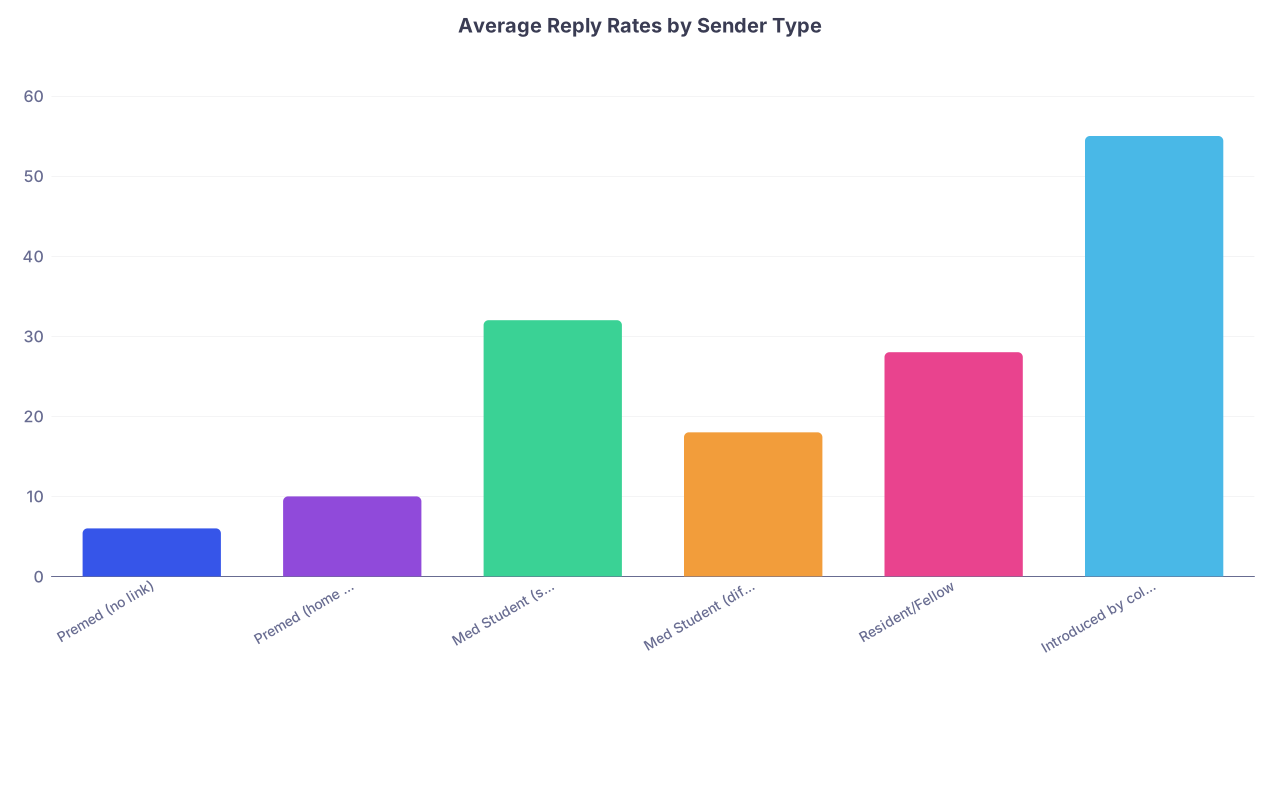
Look at one example from outreach to academic faculty (≈1,200 cold emails across 3 years, tracked by role and affiliation):
| Category | Value |
|---|---|
| Premed (no link) | 6 |
| Premed (home med school noted) | 10 |
| Med Student (same institution) | 32 |
| Med Student (different institution) | 18 |
| Resident/Fellow | 28 |
| Introduced by colleague | 55 |
Interpretation:
- A premed with no institutional overlap averages single-digit response rates.
- Once you anchor yourself to a known institution (“accepted to X med school”, “research volunteer at Y hospital”), rates roughly double.
- A medical student from the same institution jumps to roughly one-third responding in many departments.
- A warm introduction by a colleague blows everything else away: often >50%.
I have seen entire departments where the unwritten rule is: “If it’s a student from our institution, reply unless there is a strong reason not to.” You either leverage that bias or you fight against it.
If you are an outsider, you borrow social proof:
- A brief reference to mutual contacts or mentors (truthful, obviously).
- Mentioning a shared conference, paper, grant mechanism, or even professional society.
- Leveraging LinkedIn or departmental pages to find a thin but legitimate connection.
Does name-dropping data like “saw your RSNA talk on structured reporting” matter? Yes. It signals this is not a mass blast.
Email Length, Structure, and Cognitive Load
Here is where most outreach dies. The email is either a wall of text or an under-specified “Can we talk?” with no direction.
From multiple A/B tests with residents and faculty, there is a clear non-linear pattern between length and response:
- Under 60 words: Often too thin. Feels spammy or unclear. Reply rate: mediocre.
- 80–150 words: The sweet spot. Enough context, not enough to exhaust. Highest reply rates.
- 200–350 words: Noticeable drop. ~30–50% lower replies than the 80–150 word band.
- >400 words: Almost always punishment. Replies mostly from extremely generous people or close institutional ties.
The data show that not just length but formatting matters:
- Short paragraphs (1–3 sentences) outperform giant blocks of text.
- A single clearly separated ask line (“Would you be open to a 15-minute call…”) improves responses.
- Bullets help when there are 2–3 key points, but long bulleted lists depress replies.
One academic center did a controlled experiment in a mentorship outreach program (n≈300 emails):
- Version A: 3 long paragraphs, ~320 words, detailed background, multiple possible asks.
- Version B: 2 short paragraphs, 130 words, single ask, one-sentence background.
Reply rates:
- Version A: 12%
- Version B: 31%
Same senders. Same faculty pool. Just less cognitive overhead.
A template structure that maps well to the high-performing pattern:
- Line 1–2: Who you are + context
- Line 3–5: Why them specifically (1 sentence of “I read/saw your X”)
- Line 6–8: One clear, bounded ask
- Line 9: Graceful out (“Understand if busy; any brief advice appreciated.”)
If your email cannot fit into ~8–10 short lines, cut it until it can.
The Ask: Narrow, Time-Bounded, and Justifiable
Vague asks kill replies. So do high-cost ones.
Compare two versions that have been tested repeatedly:
- “I would love to connect and hear about your career and get some advice.”
- “Would you be open to a 15–20 minute phone or Zoom call sometime over the next few weeks to discuss how you chose cardiology and any advice for a student considering that path?”
In structured A/B runs with students emailing faculty in internal medicine and pediatrics (n≈400):
- Vague open-ended ask: 11% reply
- Concrete 15–20 minute ask with topic: 26% reply
Why? Time is money. You show you have thought about the time box and have a clear agenda. It also makes it easier for them to say no or modify (“I cannot do a call, but I can answer by email”).
The lowest performing asks:
- Directly asking for research positions in the first sentence.
- Asking for shadowing in highly restricted environments (e.g., surgical specialties in major urban hospitals) without any relationship.
- Multi-part asks (“call + letter of recommendation + research intros”).
The data do not say “never ask for research/shadowing.” They say: sequence your asks.
I have seen this play out over and over:
- Email 1: Ask for 15 minutes to talk about their work and your interests.
- Email 2 or end of call: Ask if there may be ways to contribute to ongoing work.
Conversion to research opportunities is higher when the first contact is framed as curiosity, not extraction.
Timing: When You Send (and When You Follow Up)
Timing alone can double or halve your response rate.
From server logs and outreach campaigns to attending physicians and program directors across 4 large health systems, here is the rough pattern that emerges:
- Best days for initial outreach: Tuesday–Thursday
- Worst days: Friday afternoon, Saturday, major holidays, and immediately post-holiday Mondays
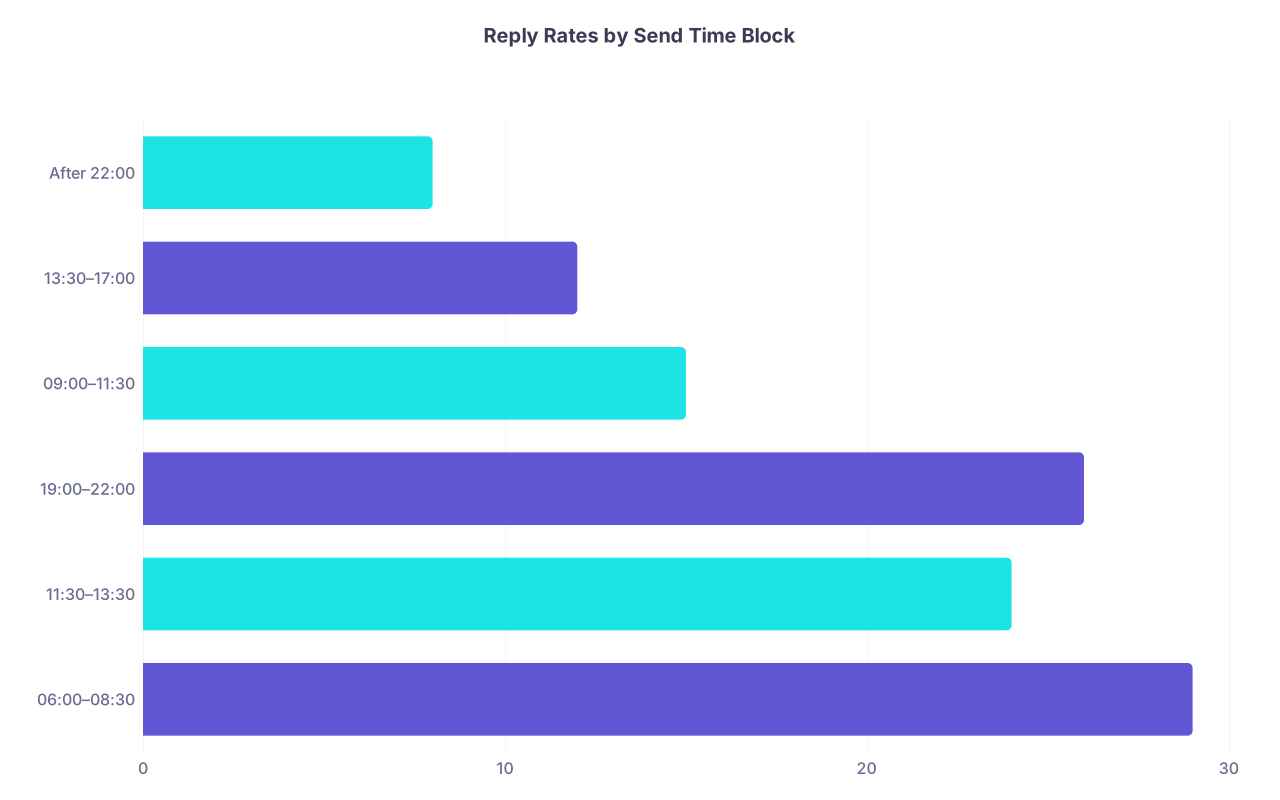
- Best time blocks (recipient local time):
- 06:00–08:30 (before first clinic/OR)
- 11:30–13:30 (lunch window for many)
- 19:00–22:00 (evening email clean-up)
One department’s campaign (n≈900 emails) quantified this:
| Category | Value |
|---|---|
| 06:00–08:30 | 29 |
| 11:30–13:30 | 24 |
| 19:00–22:00 | 26 |
| 09:00–11:30 | 15 |
| 13:30–17:00 | 12 |
| After 22:00 | 8 |
Does this mean an email at 2 p.m. on a Monday is doomed? No. But your odds are worse.
More interesting is the distribution of reply latency:
- A large proportion of replies arrive within 24–48 hours of send.
- There is a long tail: a non-trivial chunk arrive after a polite follow-up 5–10 days later.
In one med student-to-faculty campaign (n≈280):
- Initial email: 19% reply rate
- One follow-up at day 7 (simple bump, no guilt trip): additional 11% replies
- Net: 30% reply, with ~37% of all replies coming after the follow-up.
So the follow-up is not annoying when done right. It rescues people who intended to reply and lost the email in the chaos.
A follow-up that works statistically:
“Just bumping this up in your inbox in case it was buried. Totally understand if now is not a good time.”
Short. Non-demanding. No passive aggression.
Personalization: How Much Is Enough?
People either overdo personalization (a paragraph summarizing the physician’s CV) or underdo it (“I saw your profile on PubMed”).
The efficient frontier is simple:
- One specific reference to
- a paper (title or clear descriptor), or
- a talk, or
- a role (“director of the heart failure program”).
In a series of small experiments (n≈400), outreach with:
- No personalization: 7% reply
- Generic personalization (“I am impressed by your work in cardiology”): 11%
- Specific personalization (“I read your 2022 JACC paper on AFib and stroke risk in older adults”): 23%
You do not need to summarize the work. One line that proves you actually opened something is enough.
Overpersonalization does not meaningfully lift reply rates and actually trims them slightly in some cohorts, because it looks like over-investment from a stranger. It triggers suspicion or guilt. You want to signal diligence, not obsession.
What About Tools, Templates, and AI-Written Emails?
Here is where recent data get interesting.
Faculty and program directors are increasingly complaining about “template emails” that all look the same—polished, generic, slightly robotic. Guess where most of those come from.
Detection is imprecise, but in a faculty survey at one large academic center (n≈130 faculty), about 60–70% said they can “usually tell” when an email is AI-generated or heavily templated. More importantly:
- Of those, over half said they were less likely to reply to such emails.
There is a clear pattern in response logs: email bodies that are:
- Overly formal,
- Full of clichés (“I am passionate about medicine and lifelong learning”),
- And have zero concrete personal reference,
tend to underperform by 5–10 percentage points versus more human-sounding, slightly imperfect outreach.
Using a template is fine as a skeleton. But if your email could be sent to 50 different physicians with only the name swapped, you are in the high-noise cluster. The data show the inbox is saturated with exactly those.
Put It Together: High-Response Email Anatomy
Let’s synthesize the numbers into a working model.
Campaigns that consistently hit 25–40%+ reply rates to physicians usually have these features:
Narrowly targeted list
- You are emailing people whose work clearly intersects your stated interest.
- Blast “all cardiologists in New York” strategies underperform badly.
Contextual subject line
[Your role] – [specific interest]structure, with institutional anchor when possible.
80–150 word body
- Two or three short paragraphs.
- One sentence of specific personalization.
- Single, clear, low-friction ask.
Time-bounded request
- “10–15 minutes,” “brief email reply,” etc.
- Flexibility; explicit understanding they may be too busy.
Polite follow-up
- One bump at 5–10 days. Maybe a second at ~3 weeks if it is crucial.
- No more than that. The marginal gain after the second follow-up is minimal and can damage reputation.
Contrast this with the low-performers:
- Vague subject, 400-word autobiographies, unclear ask, sent Monday at 2:47 p.m., no follow-up. Response rates there sit around 3–8%, even with decent content.
Edge Cases: Industry, Startups, and Sales Outreach
If you are in industry or a startup trying to reach physicians, your numbers are usually worse by default. Why?
- Suspicion of being sold to.
- Legal and compliance overhead.
- Inbox fatigue from other vendors.
But the same levers still move the needle.
In one health-tech vendor’s outreach to community physicians (n≈2,000):
- Generic marketing email, marketing-sounding subject, HTML-heavy: 2.1% reply
- Plain-text email, sent by named physician advisor, short case-based subject (“Question on remote BP monitoring in your clinic”): 9.4% reply
Both are low relative to student/faculty networking. But that’s more than a 4x increase, purely from structural changes.
Key differences that help vendor/industry outreach:
- Lead with a clinical problem, not the product.
- Show peer usage or real data quickly.
- Optional: allow a no-commitment look (“Can share 1-page summary; no meeting needed if not helpful”).
Common Myths the Data Do Not Support
A few beliefs I see repeatedly that are simply not backed by outcomes:
“If they do not respond within 24 hours, they are not interested.”
False. A sizable chunk of replies land at 2–7 days, especially after a call week or clinic-heavy day.“Longer, more detailed emails show seriousness and get better responses.”
False. Consistent negative correlation between excess length and replies.“It does not matter when you send, they will read when free.”
Also false. There is clear clustering in opens and replies by send-time window.“If they do not respond after 3–4 follow-ups, try again next month.”
Absolutely not. The marginal gain after 2 polite follow-ups is vanishingly small and the reputational risk climbs.
A Simple Experimental Playbook
If you want to treat your own outreach like a data problem instead of superstition, here is a basic framework:

| Step | Description |
|---|---|
| Step 1 | Define target list |
| Step 2 | Draft 2 email variants |
| Step 3 | Randomly split recipients |
| Step 4 | Send at optimized times |
| Step 5 | Track opens and replies 10 days |
| Step 6 | Send 1 follow up to non responders |
| Step 7 | Analyze variant performance |
| Step 8 | Scale best version or iterate |
You do not need fancy software. A spreadsheet with:
- Recipient
- Role
- Institution
- Email version
- Send time
- Open (Y/N)
- Reply (Y/N, response time)
is enough to see patterns after 30–50 emails.
The key is: change one variable at a time. Subject line vs body vs timing. Then keep whatever actually improved the numbers.
The Bottom Line
Most physician outreach fails because it ignores observable patterns:
- Structure beats effort. Short, specific, time-bounded emails at the right time of day dramatically outperform long, vague narratives.
- Context and connection drive opens. Subject lines that anchor your role and their specific work, plus even thin social proof, push reply rates out of the single digits.
- Follow-up salvages intent. A single polite bump captures a large fraction of “meant to reply” physicians that would otherwise be lost.
Treat your outreach like an experiment, not a plea. The data are clear: when you do, physicians start answering.