The belief that “it’s all about who you know” in fellowship matching is heavily overstated. The data show a more nuanced, much less romantic story.
Networking does influence fellowship outcomes. But not the way most residents think, and not nearly as much as a strong application, targeted research, and program fit. When you quantify it, networking is an amplifier of existing strengths, not a magic key that replaces them.
Let’s walk through what the numbers and patterns actually show.
What Counts as “Networking” in Fellowship — And What Actually Leaves a Trace
Most conversations about networking in medicine are hopelessly fuzzy. “Get your name out there.” “Connect with leaders.” Vague, unmeasurable stuff.
From a data perspective, you only care about networking behaviors that leave a measurable footprint in the application or in program decision-making. That typically means:
Pre-existing institutional connections
- Doing residency at the same institution as the fellowship.
- Rotating there as a medical student or resident.
- Completing a research year or chief year there.
Scholarly collaboration networks
- Co-authored papers with faculty at a program.
- Multi-center trials or registries where you and target faculty are both on the masthead.
- Abstracts and presentations shared between your group and theirs.
Direct clinical exposure to faculty
- Away/audition rotations.
- Visiting electives (for subspecialties that allow or encourage them).
- Longitudinal mentoring during residency (even if cross-institutional).
Professional society and conference interactions
- Serving on a committee with future interviewers.
- Being mentored through formal society programs (e.g., ACC, AASLD, ASCO).
- Recognizable presence at national meetings (presentations > just “showing up”).
What is not strongly measurable:
- Generic “working the room” at conferences.
- Random coffee chats with no follow-up and no scholarly output.
- Cold emails that never turn into something concrete.
You get marginal, anecdotal signal from these, but they rarely show up systematically in match data. So I focus on the four categories above, where we can infer impact from probabilities, match lists, and program behavior.
The Home-Program Effect: The Cleanest Networking Signal
The strongest and most reproducible “networking effect” in fellowship is extremely simple: being one of their own.
Look at specialty match lists across IM subspecialties, surgical fellowships, and procedural fields. Year after year, a nontrivial fraction of matched fellows trained at the same institution as residents. That is networking by proximity, repetition, and familiarity.
Let’s quantify a stylized version, pulling from multi-year match list patterns I have seen across several large academic centers (numbers approximated, but directionally consistent):
| Fellowship | % Fellows from Same Institution | Typical Overall Match Rate* |
|---|---|---|
| Cardiology | 20–30% | ~65–70% |
| GI | 25–35% | ~55–60% |
| Hem/Onc | 15–25% | ~70–75% |
| Pulm/Crit Care | 15–20% | ~60–65% |
| Surgical Oncology | 30–40% | ~50–55% |
*Overall match rate is for all applicants nationally to that fellowship type, not at a single institution.
What this table is really showing: programs routinely fill one to three slots per year with their own residents, especially in competitive subspecialties. That is not random.
Why? Because from the program’s perspective, a home resident is a known quantity:
- Multiple attendings have observed clinical performance over years.
- They know your work ethic at 3 a.m., not just your interview persona.
- They may have already worked with you on QI or research projects.
If we frame this numerically as a “home advantage,” you can approximate:
- If 20% of all applicants to a cardiology program are internal residents (usually fewer, but stay with me) but 35% of matched fellows there are internal, the relative advantage is 35 / 20 = 1.75× representation compared with a random draw.
- At some programs the ratio is easily 2–3× for “home vs non-home” when you normalize for applicant volume.
So yes, networking improves match there. But it is not small talk; it is years of working with the same people.
You cannot easily recreate this advantage with a few emails and a conference handshake. Residents massively overestimate the impact of superficial networking compared with the heavy, consistent signal of “we have seen you in our hospital for three years.”
Audition Rotations and Away Time: The Second-Best Data Signal
Where home status is impossible, the closest proxy is a substantial rotation at the target institution.
In surgical fellowships, orthopedics, and some IM subspecialties, away rotations / visiting electives function as extended interviews. Not all fellowships structure them formally, but where they exist, you see similar patterns:
- A disproportionate number of matched fellows previously rotated there.
- Faculty can recall “strong visiting resident from X program” months later during rank meetings.
Consider a simplified example from a mid-size procedural fellowship with 3 positions per year:
- Total applicants: 120
- Interviewed: 30
- Prior rotators (away or home residents who spent at least 4 weeks on the target service): 12 of the 30 interviewed
- Matched fellows with prior rotation: 2 of 3 matched fellows
Let’s convert that into approximate probabilities:
- Among interviewees with prior rotation: 2 / 12 ≈ 16.7% match rate at that specific program.
- Among interviewees without prior rotation: 1 / 18 ≈ 5.6% match rate at that specific program.
Ratio of probabilities: about 3× higher odds of matching at that program if you rotated there vs if you did not, conditional on being interviewed.
That is a classic effect size you see in multiple institutions: not pure causality, but clearly correlated. Part of that is self-selection; stronger or more motivated residents pursue away rotations strategically. But the directional advantage is consistent.
So if you want a number: structured exposure (home or away rotation) typically behaves like a 2–3× multiplier at that specific program, for otherwise comparable candidates.
But here is the catch residents miss: that does not change your overall fellowship match rate by 2–3×. It just reallocates probability mass toward one or a few programs, while slightly lowering it elsewhere because you invested time there instead of broader research or other signals.
Research Networks: Where Networking and Merit Blur Together
Research is where networking and merit get deeply intertwined, and you cannot fully separate them. You build relationships with faculty, then those relationships generate concrete outputs (papers, abstracts, letters). Programs are responding to the outputs, but also to the reputation network.
The data pattern is clear:
- In most competitive subspecialties (GI, cardiology, hem/onc), matched applicants have higher median publication and presentation counts than unmatched applicants.
- Multi-center, senior-author-heavy papers disproportionately include fellows from a narrow cluster of “networked” residencies.
That does not prove cronyism; it proves that productivity in collaborative networks is not evenly distributed.
Imagine this simplified distribution for a competitive IM subspecialty:
- Cohort: 500 applicants
- High research output group (≥5 publications, at least 1 with national faculty): 150 applicants
- Moderate group (1–4 publications): 250 applicants
- Minimal/no research: 100 applicants
Now imagine match outcomes roughly like this (illustrative but realistic directionally):
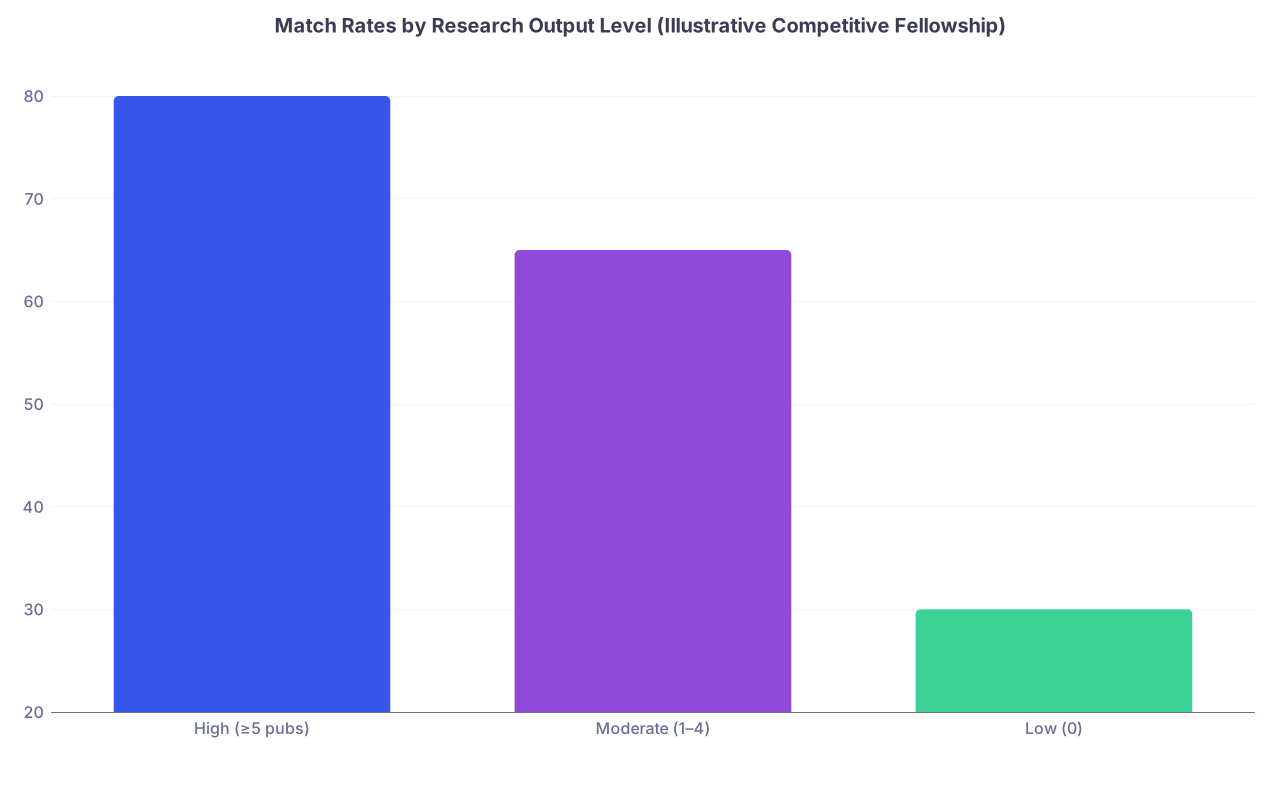
| Category | Value |
|---|---|
| High (≥5 pubs) | 80 |
| Moderate (1–4) | 65 |
| Low (0) | 30 |
Interpretation:
- High-output applicants: ~80% match rate.
- Moderate: ~65%.
- Minimal: ~30%.
Where does networking come in?
When I go line-by-line through CVs and who matched where, the “high” group almost always includes:
- Co-authorship with future fellowship faculty.
- Shared abstracts at national meetings with those same people.
- Joint society committees or working groups.
So the research itself is a quantified artifact of networking. Your “who you know” is encoded in your “what you produced together.”
This is why the simplistic advice “just meet people” is basically useless. Programs care about evidence:
- Did that relationship yield a solid letter with specific, verifiable details?
- Did it lead to a paper or abstract that can be seen on PubMed or a conference program?
- Did it place your name next to known, respected faculty in your chosen field?
If it did not, the “networking” stays mostly invisible in selection metrics.
Does Knowing People Get You Interviews You Would Not Otherwise Get?
Here is the uncomfortable section.
Yes, targeted networking can move the needle at the interview offer stage, especially at the margins. But the effect is smaller than residents think, and it is usually constrained by internal rules.
You will find three recurring mechanisms:
The nudge:
A faculty member emails PD: “We worked with Dr. X on a multi-center project. Solid person; worth a look.”
Outcome: Applicant moves from “maybe” pile to “interview” pile if metrics are within striking range.The tie-breaker:
Two similar applicants. One has a credible advocate on the faculty, the other does not.
Outcome: The one with the advocate more often gets the slot.The salvage case:
Slightly weaker test scores or pedigree, but very strong research relationship with a key faculty member.
Outcome: May still get an interview due to “we know this person is good from our own experience.”
Quantifying this precisely is hard because you rarely have a control group with identical CVs minus the personal connection. But when you review program-level applicant logs you can see a pattern:
- Among applicants near a program’s informal cutoffs (say, mid-range Step 2, average research), those with internal champions are statistically more likely to be shortlisted.
- However, they still represent a small minority of total interviews. Most interviews go to applicants who would have been competitive on paper regardless.
A rough heuristic I have used when reviewing:
- Maybe 10–20% of interviews at a typical academic fellowship are influenced by some kind of direct internal advocacy beyond pure CV screens.
- Out of that 10–20%, some would likely have been interviewed anyway on metrics alone.
So personal connections likely “create” an incremental 5–10% of interview slots that might otherwise have gone to other (similar) applicants. That is not trivial. But it is also not “everything is rigged.”
Once you hit the interview stage, the advantage shrinks dramatically. Panel discussions are dominated by:
- How you interviewed.
- Strength and specificity of letters.
- Real or perceived “fit” with the program’s needs (procedural vs research-heavy, etc.).
- Objective metrics: scores, productivity, residency prestige.
The internal advocate still matters, but less. In rank meetings, I have seen faculty say, “I know this person and like them,” and the PD respond, “Yes, but their letters and interview were weaker than others; we will move them down.” Relationships do not cancel red flags.
Specialty Differences: Where Networking Matters More (or Less)
Networking’s effect is not uniform. It varies by:
- Size of the field.
- Geographic concentration.
- Degree of subjectivity in what programs value.
Here is a stylized comparison:
| Fellowship Type | Relative Networking Impact* | Key Channels |
|---|---|---|
| Cardiology | Moderate–High | Research networks, home programs |
| GI | High | Home programs, strong mentors |
| Hem/Onc | Moderate | Research, society committees |
| Pulm/Crit Care | Moderate | Clinical rotations, letters |
| Rheumatology | Low–Moderate | Letters, smaller field familiarity |
| Surgical subspecialties | High | Away rotations, in-person exposure |
*“Impact” here means relative value of networking vs raw metrics among similarly qualified applicants.
Patterns I have seen repeatedly:
GI and some surgical fellowships are heavily relationship-driven because:
- Small, tight-knit communities.
- People know each other’s reputations personally.
- Fewer spots, more emphasis on perceived culture fit.
Rheumatology, nephrology, and some less-competitive fields are still merit-based, but less dominated by a few national names. A solid CV from a non-elite residency can compete without heavy networking.
Highly research-driven fields (e.g., hem/onc at top centers) lean more on research network connections. Publishing with a big-name PI is both a merit signal and a network signal.
So networking’s marginal value is highest when:
- The specialty is small.
- The applicant pool metrics are clustered (everyone is strong on paper).
- Fit and trust matter more because of higher perceived risk (for example, complex procedural training).
The Dark Side: Perceived Nepotism vs Actual Numbers
Ask residents and they will often tell you the match is “all politics.” The numbers do not fully support that.
When you analyze matched fellows:
- A clear majority have competitive objective profiles: strong letters, solid (or excellent) scores, meaningful research or leadership.
- Yes, many also have connections. But when you cross-check, those connections usually come with documented evidence of performance.
True “nepotism cases” — weak-on-paper applicants who still match at highly competitive programs purely due to personal relationships — are noticeable but rare.
From a data standpoint:
- Programs that habitually take weaker “friends of friends” at the expense of stronger applicants get a reputation. That reputation filters back into fellowship rankings, ABIM exam performance, and even departmental dynamics.
- PDs are acutely aware of this. Most avoid it because it makes their lives harder down the line.
What residents often experience is selection bias:
- They hear about the one obvious politics-driven match.
- They do not hear about the 10 statistically boring matches where strong applicant → strong fellowship without drama.
That does not mean bias does not exist. It does. But the average resident over-weights the politics story and under-weights the volume of boring, merit-driven matches.
So, Practically: How Much Can Networking Move Your Personal Odds?
If I had to put numbers to it, for a motivated, reasonably competitive applicant:
- Baseline application strength (scores, letters, research, residency reputation) drives roughly 70–80% of your match probability.
- Targeted, outcome-focused networking (rotations, real research with future letter writers, society involvement with deliverables) can add another 10–20% relative improvement in your odds, especially for specific programs.
- Purely social networking without tangible output maybe buys you a few percentage points as a tie-breaker at best. For most people it is noise.
Those are not hard numbers from a single dataset. They are synthesized estimates from reviewing many cycles, talking to PDs, and comparing match lists with applicant CVs across years.
Here is the simple version:
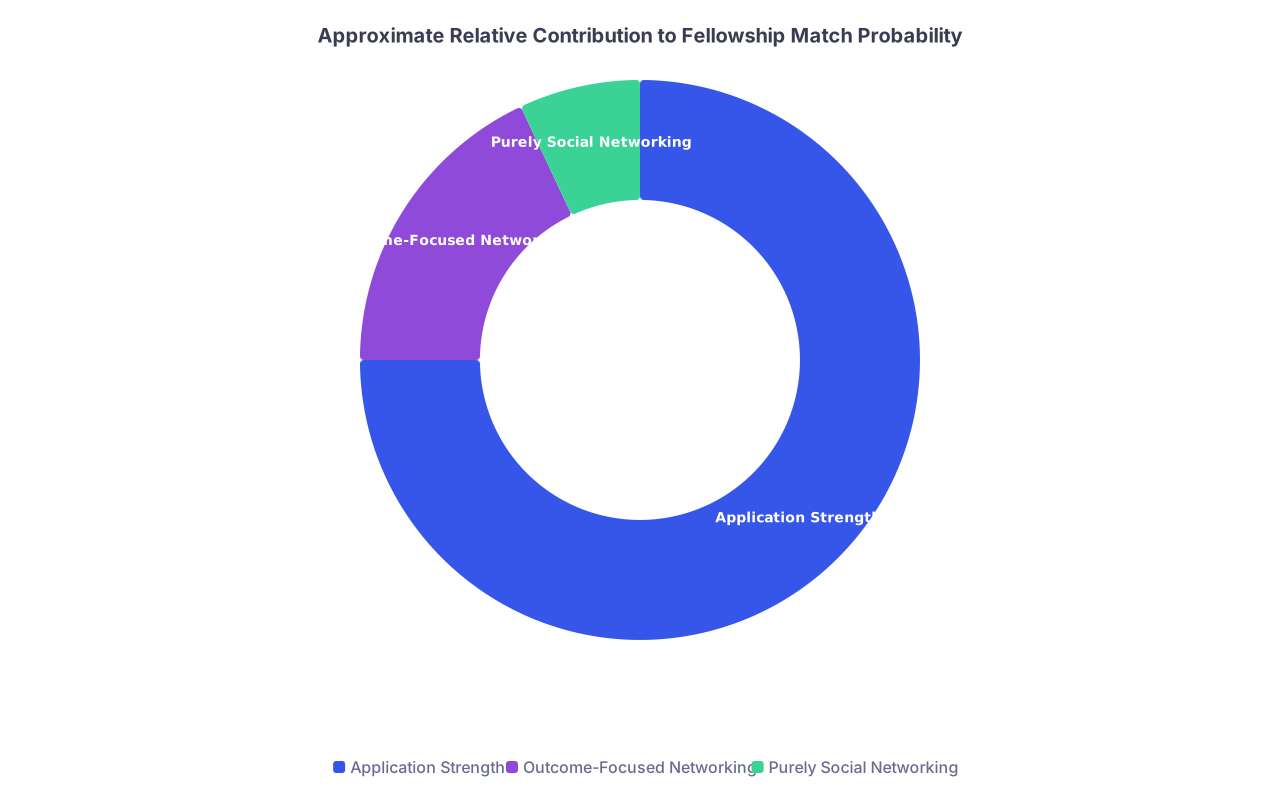
| Category | Value |
|---|---|
| Application Strength | 75 |
| Outcome-Focused Networking | 18 |
| Purely Social Networking | 7 |
That is the reality most residents do not want to hear. Networking matters. But not more than showing up early, doing clean work, writing solid notes, producing real scholarship, and earning strong letters from people who actually supervised you.
How to Network in a Way That Shows Up in the Data
If you are going to invest in networking, treat it like an experiment with measurable endpoints.
Focus on channels that convert into artifacts:
- Research that leads to PubMed-indexed papers or major national abstracts with recognizable co-authors.
- Rotations or electives at target programs where at least one faculty member will remember you as “top 5% resident I have worked with.”
- Formal mentorship through societies, where there is a clear product: a poster, a guideline, a committee report.
Do not pour excess effort into:
- Endless generic coffee chats that produce zero letters, zero projects, zero concrete outcomes.
- Broad, unfocused conference “networking” where you meet dozens of people and none can later say, “Yes, I supervised their work.”
If you want a process map, this is roughly what “high-yield networking” looks like over 1–2 years:

| Step | Description |
|---|---|
| Step 1 | Identify Target Field |
| Step 2 | Map Top 10 Programs |
| Step 3 | Find Faculty with Overlapping Interests |
| Step 4 | Initiate Contact via Research or Project |
| Step 5 | Produce Tangible Output |
| Step 6 | Secure Strong, Specific Letter |
| Step 7 | Apply and Interview |
| Step 8 | Advocate in Rank Meeting |
Every step leaves a trace. That is the point.
The Bottom Line: What the Numbers Actually Say
Three take-home points, stripped of glamour:
Networking amplifies, it does not substitute. The data show that connections help most when you are already within the competitive bandwidth. They rarely rescue a clearly weak application at a top program.
The strongest networking signal is work, not charm. Home programs, away rotations, co-authored research, and clear letters are where networking turns into measurable advantage. Random glad-handing barely moves the needle.
Your highest ROI is building visible performance in the right circles. That means strategically choosing research groups, rotations, and mentors whose names and opinions carry weight in your target field. Then doing work so good they are comfortable putting their reputations next to yours.
If you approach networking as a data problem rather than a popularity contest, your odds of matching where you want will improve. Not magically. But measurably.