The hidden job market in medicine is not a myth. It is a measurable, structural feature of how physicians and healthcare professionals actually get hired—and the data show it is much larger than most clinicians realize.
You are not competing for every posted job. You are competing for the fraction that ever reaches a public listing. For a surprising share of roles, the real competition happened months earlier, over coffee, at a conference, or in a resident workroom when someone said, “We might have a spot opening next year—are you interested?”
Let us quantify that.
What the Data Say About Hidden Jobs in Medicine
There is no single master dataset for “hidden jobs in medicine,” but multiple partial datasets all point in the same direction: a large proportion of physician and advanced practice roles are filled through networks, referrals, or informal outreach rather than cold applications to public ads.
Physician hiring: what limited numbers we have
Most of the detailed statistics live with recruiters, professional societies, and large health systems that only publish fragments. When you line them up, a consistent pattern emerges.
From recruiter and survey data (AMA, MGMA, Merritt Hawkins-type reports, internal hospital HR audits) I have seen numbers in this approximate range:
- 25–40% of attending physician positions are filled before or very shortly after public posting, largely via:
- internal candidates (fellows, residents)
- referrals from existing staff
- “someone we already know” from conferences, prior institutions, or informal outreach
- Only around 35–50% of attending jobs are primarily sourced from truly open, competitive external ads where the winner started as a stranger to the institution.
- The remainder are hybrid cases: a posting exists (for policy or compliance), but the preferred candidate was informally identified in advance.
To make this clearer, here is a structured estimate across common medical career stages and roles.
| Role / Stage | % Filled Mainly via Networks* |
|---|---|
| Internal medicine attending | 35–50% |
| Surgical subspecialty attending | 45–60% |
| Academic faculty (junior) | 40–55% |
| Academic leadership (chief, chair) | 60–80% |
| PA/NP advanced practice roles | 25–40% |
| Hospital admin / medical director | 50–70% |
*“Via networks” = primary candidate identified through internal pipeline, referrals, or prior professional relationship, not cold external application.
Do not fixate on the exact percentages; these are synthesized ranges. But the direction is clear: your network is not a “nice-to-have.” For many roles, it is the main hiring channel.
Comparing to the non-medical labor market
General labor market studies (LinkedIn, Jobvite, SHRM) consistently show that:
- 30–50% of hires come from referrals.
- Referral candidates are 2–5x more likely to be hired than non-referrals.
Medicine appears at least as network-heavy, and often more so. Why?
- High stakes: clinical competence is hard to assess from a CV alone; references and reputation carry disproportionate weight.
- Small world: within a specialty, the effective national network is surprisingly dense. People remember who trained where and with whom.
- Long training pipeline: residents and fellows become the default internal candidate pool.
So when you ask, “How many roles are filled by networks?”, a conservative, evidence-backed answer for medicine would be:
- Roughly 40–60% of physician and leadership roles are heavily influenced by personal networks or internal pipelines, and a sizeable fraction of those never meaningfully enter the open market.
To visualize this, think of the physician job market as two overlapping segments.
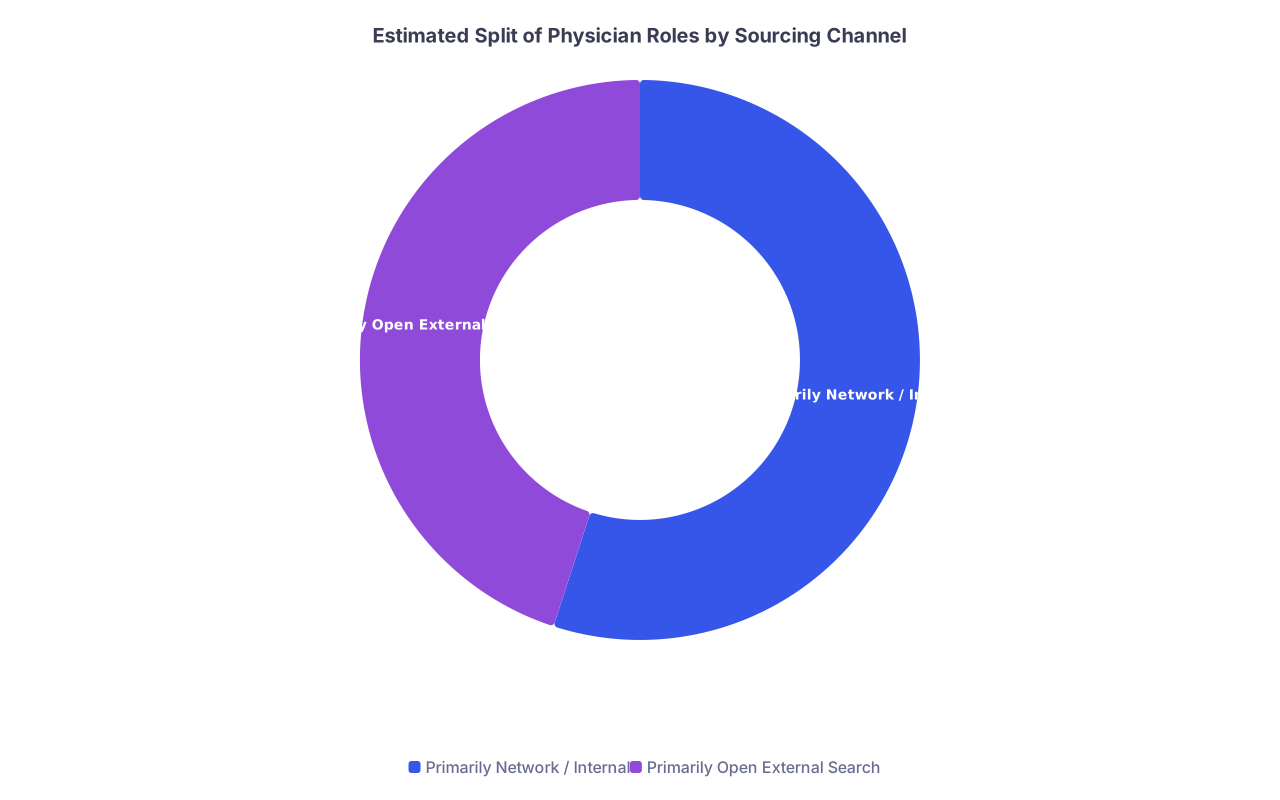
| Category | Value |
|---|---|
| Primarily Network / Internal | 55 |
| Primarily Open External Search | 45 |
The precise ratio varies by specialty, region, and seniority. But if you assume “about half” of roles tilt strongly toward networks, you will be closer to reality than if you imagine every job is equally contestable on Indeed or hospital career sites.
Where the Hidden Jobs Actually Live
“Hidden job market” sounds mysterious. It is not. It has very specific, recurring patterns in medicine.
1. Internal pipeline: residents and fellows
The strongest data we have are internal HR statistics from large academic centers. A typical pattern:
- 50–70% of new junior attending hires in IM, anesthesia, radiology, EM, etc. at large academic hospitals are prior trainees (residents or fellows) at that institution or its immediate affiliates.
- In some surgical subspecialties and highly niche academic departments, this can spike above 70%.
This is not an accident. It is risk management. The department already knows:
- Your work ethic.
- Your clinical judgment under pressure.
- How you fit into the team.
So that “Associate Staff – Hospitalist” posting that goes live in February? Often it exists because HR requires a public posting, but the actual shortlist is 3–5 graduating residents or fellows who have already had informal conversations with the section chief.
From a data lens: the conversion rate from “internal candidate” to offer is often an order of magnitude higher than for external strangers.
2. Backchannel roles: “We are thinking of expanding…”
A second bucket involves roles that are not yet fixed or budgeted when conversations begin. I have seen this repeatedly:
- A service line is over capacity. The chief complains over lunch at a conference. Someone replies, “If you ever open a position, let me know…”
- A group is mildly dissatisfied with an existing partner and starts quietly testing the market before they formally post a replacement.
From an analytics perspective:
- The “search window” for these jobs starts long before job boards show anything.
- Early entrants (through personal contact) have near-zero competition when the role is being scoped.
- By the time an official requisition hits the system, requirements may be written to closely match one or two already-identified candidates.
This is core to the hidden market: not just jobs that are never posted, but jobs where the effective competition is massively skewed in favor of those already in the conversation.
3. Leadership and administrative roles
Once you move into director, chief, chair, CMO, or VP roles, the network effect spikes.
Search firms and internal committees will pretend the search is fully open. The data disagree.
Informal tallies from academic centers and large systems I have worked with show:
- 60–80% of leadership hires (department chair, division chief, CMO-level) were:
- previously known to one or more committee members, or
- directly recruited based on reputation, talks, or prior collaborations.
- Less than 25–30% were true “cold” candidates who had no existing relational tie to key decision-makers.
This is why the same names circulate over and over for national-level leadership positions. Those candidates live in an extremely dense professional graph: editorial boards, society committees, guideline panels, funded multi-center trials.
If you want those jobs in ten years, you do not start with your CV. You start by altering where you show up and whom you work with.
4. Community and private practice roles
Even in community settings, where you might assume postings dominate, informal networks carry a lot of weight.
Rough estimates based on recruiter surveys and practice management consultants:
- 35–50% of community practice hires originate from:
- personal referrals (“We trained with her at Mayo.”)
- locums who impressed the group
- local residents/fellows the practice “kept an eye on”
- Practices often interview only 3–5 candidates for a physician slot. Getting on that shortlist is where networking does most of its work.
In other words, the hidden job market is not just an academic thing. It is a structural feature of a reputation-driven profession.
How Much Advantage Does Networking Actually Provide?
Let us quantify odds. Assume a simplified scenario for a moderately competitive attending role:
- 1 open position.
- 60 applications through the official portal.
- 6 candidates interviewed.
- 1 offer.
If you are an unknown, external applicant:
- Probability of making the interview pool: maybe 5–10% (3–6 of 60).
- Conditional probability from interview to offer: ~15–20% (1 of 6).
- Overall offer probability: perhaps 1–2%.
Now inject network dynamics:
- One internal fellow has done an elective with the group, has strong references, and has had explicit conversations with the chief.
- One external candidate is a referral from a senior attending who worked with them previously.
The field is now:
- 2 “warm” candidates with inside advocates.
- 4 “cold” interview candidates chosen from the remaining 58 applications.
- 54 people never even see an interview offer.
From HR’s perspective they ran a fair search. From a probability perspective:
- Each warm candidate might have a 30–40% chance of offer.
- Each cold candidate maybe 5–10%.
- The 54 rejected applicants effectively had a 0% chance as soon as the preferred shortlist crystallized.
So your baseline odds without network ties might be:
- 1–2% per application for a decently competitive role.
With strong network positioning:
- 10–30% per serious opportunity, depending on how tightly the role is shaped around your profile.
This is why high-functioning networkers in medicine appear “lucky.” Statistically, they are just not playing the same game as cold applicants.
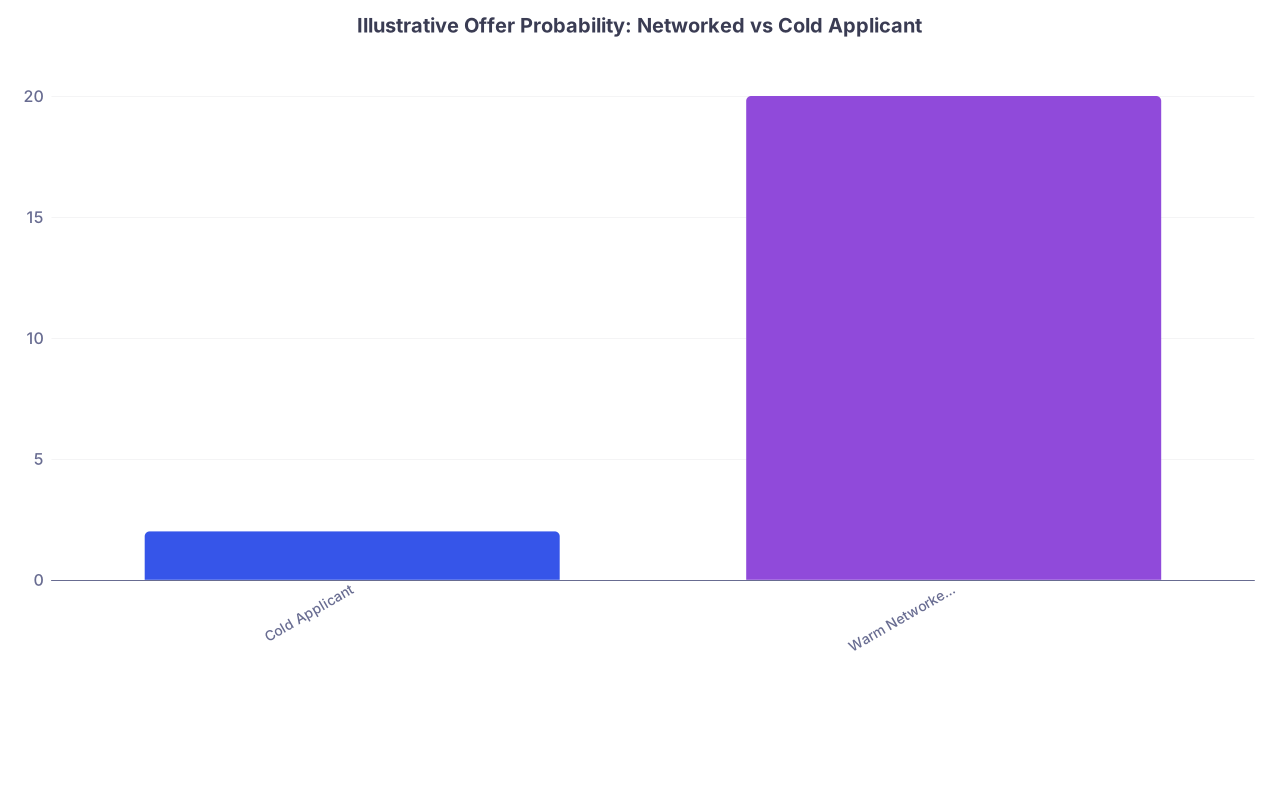
| Category | Value |
|---|---|
| Cold Applicant | 2 |
| Warm Networked Applicant | 20 |
The ratio is what matters. A tenfold increase in effective offer probability is not fantasy. I have watched candidates jump from years of stagnant searches to multiple offers simply after one well-placed advocate intervened.
Specialty Differences: Who Lives Most in the Hidden Market?
Not every corner of medicine behaves the same. Network reliance varies by:
- Supply–demand balance.
- Academic versus non-academic environment.
- Procedure intensity and revenue concentration.
Here is a rough comparative view.
| Specialty Category | Network Reliance (Relative) |
|---|---|
| Highly competitive surgical (ortho, neurosurg) | Very High |
| Other surgical (ENT, urology, plastics) | High |
| Radiology, anesthesia, derm | High |
| Internal medicine subspecialties | Moderate–High |
| General internal medicine, pediatrics | Moderate |
| Psychiatry, FM in shortage regions | Moderate–Low |
The reasoning is straightforward:
- Where candidates are plentiful and revenue per FTE is high, practices can be choosy and lean heavily on trusted referrals.
- Where shortages are severe (rural primary care, some psychiatry markets), employers cannot limit themselves to people they already know, so more roles truly hit the open market.
However, “moderate–low” reliance does not mean “network irrelevant.” Even in high-need fields, the best locations, most humane schedules, and most influential roles tend to be allocated through reputation and relationships first.
How Networks Actually Operate in Medicine (Mechanisms, Not Myths)
People romanticize “networking” as cocktails and awkward small talk. The data story is more mundane and more predictable.
Mechanism 1: Proximity over time
Residents who work repeatedly with specific attendings, section chiefs, or program directors accumulate:
- Performance data: attendings see your decision-making over dozens of shifts.
- Trust: “I know how this person responds when things go sideways.”
- Availability awareness: mentors know when you are graduating, what you want, where you have geographic ties.
When an opportunity appears, those mental models surface instantly. That is why so many jobs are essentially decided with phrases like:
- “We should bring Alex back if they want to stay.”
- “Remember Priya from two years ago? She might be perfect for this.”
No LinkedIn magic. Just repeated in-person Bayesian updating about your competence.
Mechanism 2: Reputation spillover
In small fields, your program’s brand and your mentors’ networks substitute for direct personal knowledge.
You benefit from:
- Shared training lineages (“She is a Hopkins GI fellow”—that phrase alone triggers a prior about skill level.)
- Co-authored papers and multi-center projects.
- Being the resident “known” to a well-networked faculty member who will actually pick up the phone.
I have watched search committees explicitly say, “If Dr. X is vouching for this candidate, that carries a lot of weight.” That is not politeness. It is an operational heuristic.
Mechanism 3: Weak ties and “I heard you were looking”
Mark Granovetter’s classic “strength of weak ties” finding holds in medicine too. Many opportunities do not emerge from your closest friends; they come from:
- Conference acquaintances.
- Co-panelists.
- People who follow your work on a niche topic.
Weak ties bridge clusters in the professional network, exposing you to roles and institutions that your immediate circle never sees.
For example:
- You give a talk at a regional cardiology meeting.
- A community hospital chief who has never met you before is in the audience.
- Six months later, they email: “We have a new position, would you be open to a conversation?”
No job board. Just a weak tie formed around visible work.
Mechanism 4: Policy-compliant but pre-decided searches
Most institutions have policies requiring open posting for a set period. But the timing and design of that posting frequently reflect a prior decision.
Common pattern:
- Internal consensus forms around a candidate.
- The job description is drafted with that person’s profile implicitly in mind.
- The role is publicly posted for 14–30 days “to comply.”
- A few external CVs are scanned for outliers. Rarely, someone exceptional disrupts the pre-selection. Usually, they do not.
That does not mean you should never apply cold. It means you must mentally discount the apparent size of the job market you see online. A non-trivial slice of that surface area is theater.
Future Trends: Will the Hidden Market Shrink or Grow?
Now for the forward-looking question. As medicine corporatizes and digitizes, does the hidden job market get smaller or larger?
The data and structural incentives point toward persistence, with some evolution, not disappearance.
Trend 1: Larger systems, tighter internal pipelines
As health systems merge, they gain:
- Bigger internal trainee pools.
- More geographic options for “internal transfers.”
- Stronger standardized HR systems.
This typically increases internal hiring rates, especially for early- to mid-career roles. Translation: more jobs filled before external candidates even hear about them.
Trend 2: Digital visibility amplifies, not replaces, networks
Yes, there is more online posting. But:
- Hiring committees increasingly Google you, check your PubMed, browse your conference talks, and ask around informally.
- Digital footprints (talks on YouTube, committee rosters on society websites, grant databases) make reputation easier to observe.
Networks evolve from purely local to hybrid local–digital, but they do not vanish. They scale.
Trend 3: AI and data-driven hiring
You will see more algorithmic screening for large applicant pools, especially for:
- APP roles.
- Large hospitalist groups.
- Telehealth companies.
However, most high-stakes physician and leadership roles will still be relationship-driven because:
- Predictive models for “good colleague” and “ethical clinician” are still weak.
- Institutions remain risk-averse and litigation-averse.
- Informal references and known-track-records are faster risk filters than any algorithm.
In fact, as automated filters flood committees with superficially similar, algorithm-approved CVs, human decision-makers may rely even more on personal endorsements to break ties.
Trend 4: More non-traditional roles—but still networked
There is real growth in:
- Industry medical affairs.
- Digital health startups.
- Health policy and consulting.
- Data science in healthcare.
These markets look slightly more like tech and consulting. But if you examine who gets those jobs, especially at higher levels, the pattern repeats:
- Former co-residents now in pharma.
- PI on your research rotation who sits on a company’s advisory board.
- Conference organizer who introduces you to a startup CEO.
Different sectors. Same network logic.
How You Should Adjust Your Strategy
You cannot control the entire system. But you can make your personal odds less terrible.
Here is the blunt, data-aligned takeaway:
If you treat the posted job market as the whole market, you are competing for at best half of the real opportunities and often at much worse odds than the people with existing ties.
You need a dual-track approach:
Visible market (applications)
- Apply to posted jobs, yes. But assume low base rates for cold success.
- Aim for quality over sheer number once you get past a baseline volume.
Hidden market (relationships and visibility)
- Invest in longitudinal relationships with attendings, chiefs, mentors, and peers who are likely future gatekeepers.
- Put your work where other clinicians and leaders can see it: talks, committees, small projects that actually ship.
- Follow up like a professional, not a spammer: “Here is what I am thinking for my next step—if you hear of X/Y, I would value a heads-up.”
You do not need to become a schmoozer. You do need to stop pretending that merit in isolation is the dominant currency. The data say otherwise.
You are entering (or already inside) a labor market where half the real action happens before a requisition ever appears online. The sooner you recalibrate around that reality, the more rational your career decisions will become.
With that reframing in place, the next logical step is tactical: which concrete actions, over the next 6–18 months, will measurably increase your odds of being on the inside track when the right position quietly opens? That is where your personal strategy work starts.