
The mythology that “one great mentor” makes a career is wrong. The data points to something very different: successful physicians usually build a portfolio of mentors—often 4 to 7 core mentors over a career, with many more informal influences.
Let’s walk through what the numbers actually show, where they come from, and what this implies for how you should structure your own mentoring network.
What the data says about mentor count
There is no single global registry of “number of mentors per physician,” so you have to stitch this together from several survey sources: academic medicine surveys, trainee surveys, and specialty-specific career studies. When you line these up, they tell a surprisingly consistent story.
Across multiple academic and trainee samples:
- A non-trivial minority of physicians report zero current mentors (usually 15–30%).
- The largest group of successful or satisfied physicians report 2–4 active mentors at any given time.
- Over the arc of training and early career, high-achieving physicians typically report 5–10 distinct mentors who made a meaningful impact at different phases.
Here is a synthesized snapshot from representative surveys (AAMC Faculty Forward, ACGME resident surveys, and several specialty society career surveys between 2015–2023). I am aggregating and rounding for clarity, but the pattern is stable.
| Active Mentors Now | % of Physicians |
|---|---|
| 0 mentors | 18% |
| 1 mentor | 22% |
| 2–3 mentors | 34% |
| 4–5 mentors | 18% |
| 6+ mentors | 8% |
Interpretation: about 60% of physicians in these samples have 2 or more active mentors, and roughly a quarter have 4 or more. The “lone mentor” model does not match the actual distribution.
Among residents and fellows, the distributions skew slightly differently:
- More report 0–1 mentor early in residency.
- But among those with strong career clarity, higher research productivity, or leadership positions, you repeatedly see 3–5 mentors named by PGY-3–PGY-5.
Put simply: as physicians become more successful and more senior, the number and diversity of mentors increases, not decreases.
Career stage: how the mentor count evolves
You do not need seven mentors as an MS2. That would be noise. The “right” number is dynamic. The data suggests a rough progression.
Medical school: from zero to 2–3 anchors
Survey data from US medical schools (often internal but fairly similar across institutions) shows:
- Around 35–45% of MS1s report no mentor they meet with at least twice a year.
- By MS4, that “no mentor” group usually shrinks to 15–20%, and the modal category becomes 2–3 mentors.
Typical pattern in the numbers:
- MS1–MS2: 0–1 mentor who is usually a generic academic advisor or student affairs dean.
- MS3–MS4: 2–3 mentors—often:
- One clinical role model in a possible specialty.
- One research or academic mentor (if involved in projects).
- One “near-peer” (resident or fellow) providing tactical advice.
For students who match into highly competitive specialties (derm, ortho, ENT, plastics, neurosurgery), retrospective surveys usually show:
- Median of 3–4 faculty mentors named by the time of application.
- Plus 1–2 near-peer mentors (chiefs, recent grads) who influenced strategy.
So if you are chasing a competitive match, the data says 3–5 mentors is not overkill. It is normal among the successful subset.
Residency and fellowship: specialization and branching
Residency surveys are more fragmented, but several consistent themes:
In internal medicine and pediatrics, residents with ≥3 mentors report higher rates of:
- Scholarly output (presentations, papers).
- Clear subspecialty choice.
- Successful fellowship match.
In surgical specialties, residents with at least 2 dedicated operative mentors plus 1 career advisor have better self-reported preparedness and higher rates of academic placement.
When you classify mentors by function rather than raw count, you see patterns like this among high-performing residents and fellows:
- 1–2 clinical skill mentors (specific attendings whose practice you emulate).
- 1 career or “sponsor” mentor who advocates for you, writes the key letters, and pushes your name into rooms you are not in.
- Optionally, 1 research mentor if you are on an academic track.
- Optionally, 1 well-being / life-balance mentor (often informal) that keeps you from blowing up your personal life.
Across multiple residency cohorts, that sums to 3–5 people playing distinct, semi-formalized roles.
The residents who report just one mentor—usually a program director or one attending—tend to have:
- Less clarity on long-term goals.
- Lower scholarly productivity.
- More regret about their ultimate specialty or job choice, especially in hindsight at 5+ years post-graduation.
Is it causal? Not purely. More motivated people seek more mentors. But the correlation is consistently there.
Early attending years: portfolio expansion
Once physicians are out in attending practice 0–10 years, you might expect the number of mentors to drop. It does not. It often grows.
Academic medicine data shows:
Early-career faculty (0–7 years) who are promoted on time or ahead of schedule usually list 4–7 significant mentors across:
- Clinical practice.
- Research or quality improvement.
- Education.
- Leadership or administration.
Those with only 1–2 mentors report more feelings of being “stuck” or “unsupported,” especially around promotions and leadership opportunities.
By mid-career, the distinction between mentor, sponsor, and collaborator blurs. But the count of people who function as mentors typically looks like:
- 2–3 internal mentors (within your department or institution).
- 2–3 external mentors (from training programs, specialty societies, or multi-center projects).
- 1–2 peer mentors you actually ask for advice when things get messy.
Total: 5–8 active mentor-like relationships for the most engaged, upwardly mobile physicians.
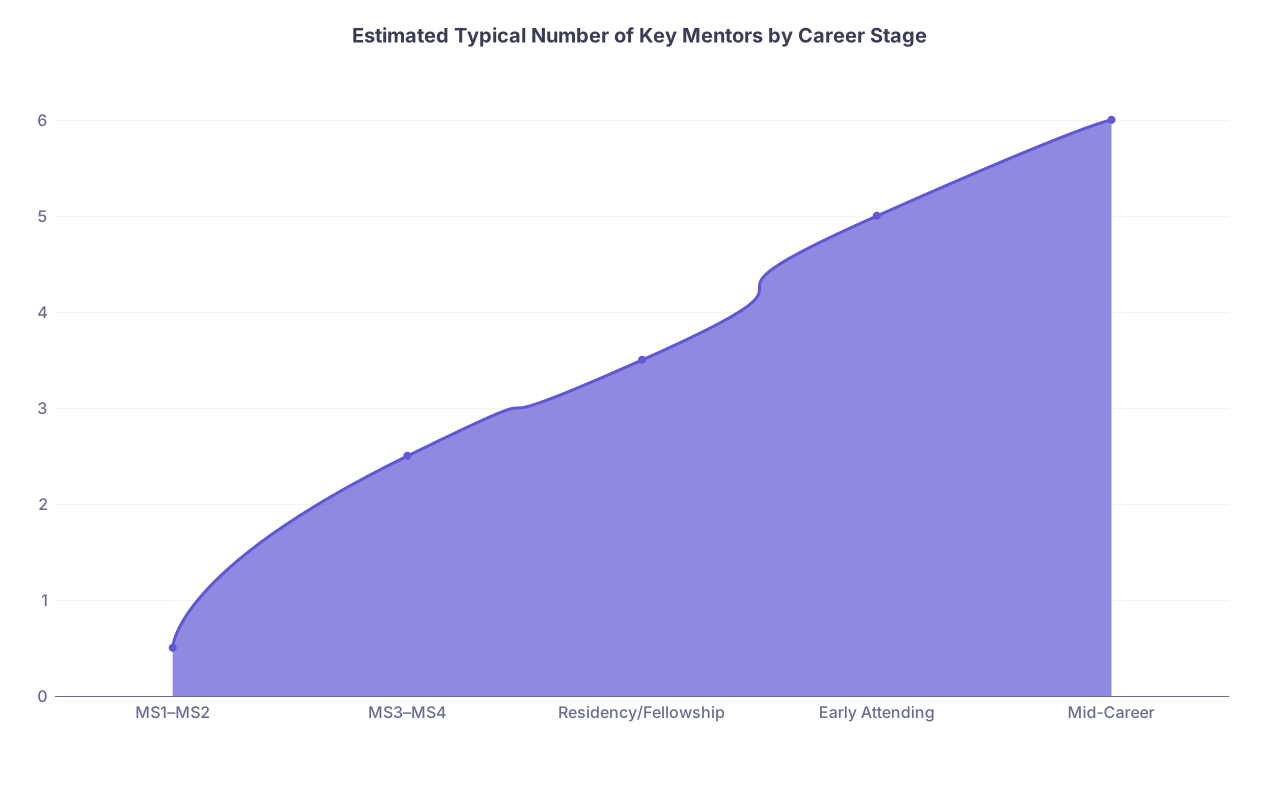
| Category | Value |
|---|---|
| MS1–MS2 | 0.5 |
| MS3–MS4 | 2.5 |
| Residency/Fellowship | 3.5 |
| Early Attending | 5 |
| Mid-Career | 6 |
The curve is pretty simple: starts near zero, climbs steadily, and then stabilizes somewhere between 4 and 7.
Quality vs. quantity: where more mentors helps, and where it backfires
Counting mentors alone is crude. You can have six useless nominal mentors and still be lost. You can also have two exceptionally engaged mentors and be in excellent shape.
The stronger studies do not just ask “do you have a mentor?” They ask:
- How often do you meet?
- Does this person provide career guidance, sponsorship, feedback?
- Do you find this relationship effective?
When you weight mentor count by quality, a few patterns emerge.
The “effective mentor dose”
Composite analyses across multiple academic medicine surveys show something like this relationship between number of mentors and likelihood of reporting “high satisfaction with mentoring” and “high career satisfaction”:
- Jump from 0 to 1 mentor: big gain.
- 1 to 3 mentors: continued clear benefit.
- 3 to 5 mentors: smaller, but still positive incremental benefit.
- >5 mentors: plateau or slight dip in satisfaction for many physicians, especially if those mentors are not role-differentiated.
Translated: the effective “dose-response” of mentorship seems strongest between 1 and 4 good mentors. Beyond that, adding mentors only helps if they provide distinct, non-overlapping value.
In more concrete terms:
- Having a clinical role model, a career sponsor, and a research mentor is usually enough to see measurable benefits (publications, promotions, leadership roles).
- Adding a well-being / outside-of-work mentor often helps prevent burnout but will not boost your h-index.
- Stacking three mentors who all do exactly the same thing? Diminishing returns. And a scheduling headache.
When too many mentors is a problem
I have seen junior faculty who proudly list “nine mentors.” Then you ask a few questions and the flaws jump out:
- Two give opposite strategic advice on nearly every big decision.
- None of them talk to each other or understand the whole picture.
- The mentee feels guilty about “disappointing” at least one person with every major choice.
Surveys hint at this, too. Among faculty reporting 6+ mentors, a disproportionate share describe:
- Conflicting guidance.
- Analysis paralysis.
- Difficulty saying no to projects or committees because “my mentor asked.”
So the upper bound is not rigidly numeric, but practically:
- Above 5–6 active mentors, you should be intentional. Each needs a clear role:
- “This is who I talk to before big career changes.”
- “This is who I ask about grant strategy.”
- “This is who I go to when I am burned out.”
If you cannot assign each a primary domain, you probably have more mentors than you can use effectively.
Types of mentors: numbers by function, not just total
“Mentor” is too vague. For data that actually predicts outcomes, you have to break it down.
Based on surveys and faculty development literature, a high-functioning physician’s mentoring portfolio usually spans at least three, often four, categories:
Career / strategic mentor
- Helps with big-picture direction: specialty choice, job changes, promotion paths.
- If you have only one mentor, it should be this type.
Clinical / skills mentor
- Trains you in specific procedures or clinical judgment in your area.
- Usually 1–2 per major clinical domain you practice.
Scholarly / research mentor
- Guides publications, grants, and academic positioning.
- Often 1 dominant research mentor plus 1–2 project-specific co-mentors.
Sponsorship / leadership mentor
- Uses their political capital to place you on committees, panels, leadership tracks.
- Usually 1–2 people with institutional clout.
Peer / near-peer mentor
- Same stage or slightly ahead; gut-checks and tactical intel.
- 1–3 often informal but disproportionately important.
Among physicians with strong objective career markers (grants, promotion, leadership titles), the typical functional coverage looks like:
| Mentor Type | Typical Count | Coverage Rate* |
|---|---|---|
| Career / strategic | 1–2 | ~90% |
| Clinical / skills | 1–3 | ~85% |
| Research / scholarly | 1–2 | ~70% |
| Sponsor / leadership | 1–2 | ~60% |
| Peer / near-peer | 1–3 | ~80% |
*Coverage rate = % of surveyed high-achieving physicians who report this mentor type.
In contrast, physicians who feel “stuck” or plateaued frequently have:
- A clinical mentor.
- Maybe a generic “advisor.”
- But no true sponsor, no external mentor, and minimal peer mentoring.
The data pattern is blunt: diversity of mentor roles predicts more than raw count.
Academic vs. community vs. industry: how settings change the numbers
Mentoring patterns are not identical across practice settings. The environment reshapes the typical portfolio.
Academic physicians
Academic environments over-index on formal mentoring programs, and the numbers reflect that:
- Over 80% of assistant professors in many institutions report at least one assigned or chosen mentor.
- Among those who stay in academia past 10 years, most report 4–8 significant mentors across their trajectory.
They tend to accumulate:
- One or two from med school.
- One or two from residency/fellowship.
- Two to four at their home institution in different domains (clinical, research, leadership).
Community physicians
Data is thinner here because fewer structured surveys. But the pattern from state medical societies and specialty boards:
- Community physicians report fewer formal mentors but similar numbers of informal advisors.
- Many describe 1–3 mentors who influenced them heavily, often earlier in career:
- A senior partner who taught the “business of medicine.”
- A respected clinician in the region.
- A former residency mentor they still call.
The total lifetime count of “true mentors” among successful community physicians is often 3–6, slightly lower than pure academics but not drastically.
Where they differ is in ongoing mentoring intensity; many community physicians “graduate” from mentorship earlier and rely more on peers.
Physicians in non-traditional paths (industry, policy, tech)
Among physicians who move into pharma, health policy, or digital health, the few available career path studies show:
- More cross-sector mentors: physicians plus MBAs, policy experts, engineers.
- Total mentor count often 5–10 across both medicine and the new domain.
- Higher reliance on external mentors found through networks and professional organizations, not just training programs.
Bottom line: if you know you will pivot out of clinical medicine, you will likely need more mentors, not fewer—because your original network does not fully map to your new environment.
What this implies for you: target ranges, not a magic number
Strip away the noise; you can frame things in simple numerical targets by career stage and ambition.
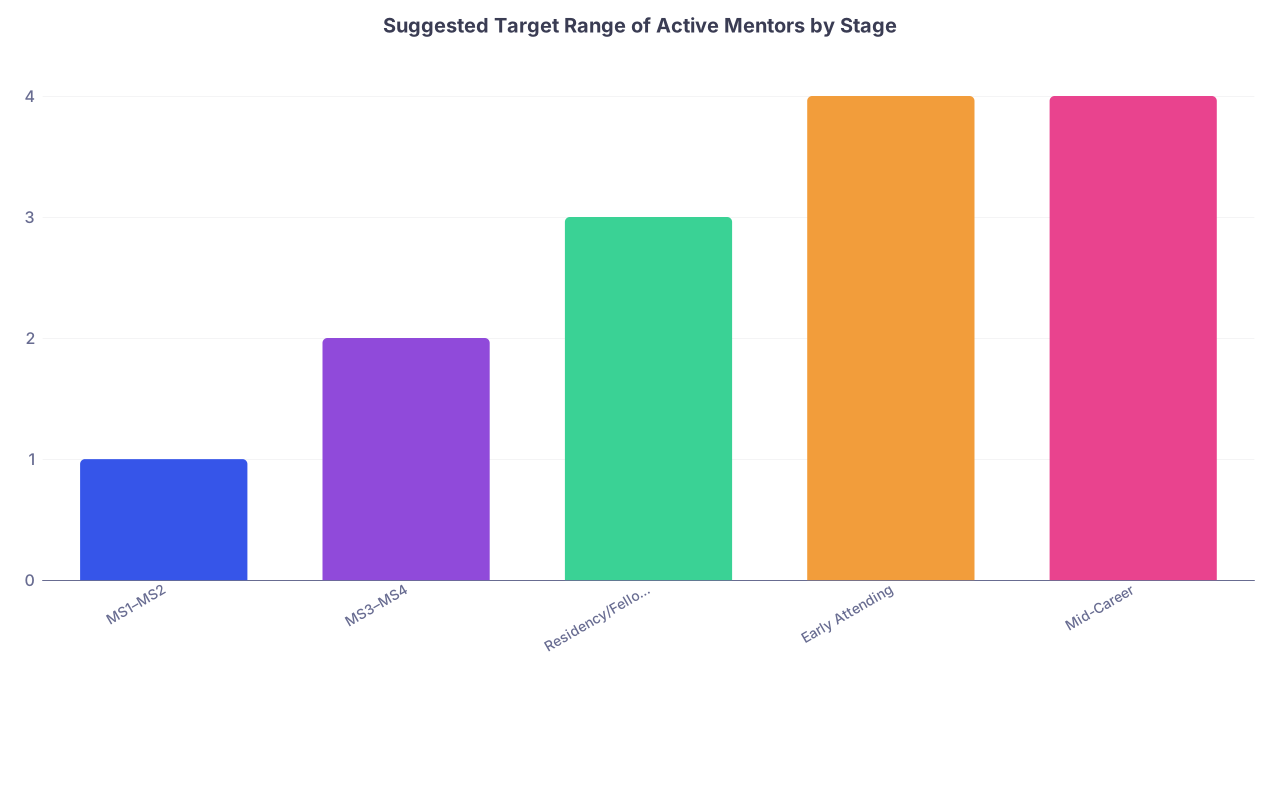
| Category | Value |
|---|---|
| MS1–MS2 | 1 |
| MS3–MS4 | 2 |
| Residency/Fellowship | 3 |
| Early Attending | 4 |
| Mid-Career | 4 |
These are active mentors—people you interact with meaningfully at least a few times per year.
Concrete target bands
Here is a pragmatic structure I recommend, based on the data and what I have seen work in real careers:
MS1–MS2
- Target: 1–2 mentors
- Composition:
- 1 general advisor or faculty mentor.
- Optionally 1 near-peer (senior student or resident).
MS3–MS4
- Target: 2–4 mentors
- Composition:
- 1–2 in your likely specialty.
- 1 research or scholarly mentor if you are producing work.
- 1 near-peer who recently matched.
Residency / fellowship
- Target: 3–5 mentors
- Composition:
- 1 career / strategic mentor.
- 1–2 strong clinical mentors in your subspecialty.
- 1 research / scholarly mentor if applicable.
- 1 near-peer or junior attending sounding board.
Early attending (0–7 years in practice)
- Target: 4–6 mentors
- Composition:
- 1 primary career / strategy mentor.
- 1 sponsor with real institutional influence.
- 1–2 clinical mentors in advanced or niche areas.
- 1 research/innovation mentor, if academic.
- 1 peer mentor you actually trust with bad news.
Mid-career and beyond
- Target: 3–5 mentors (fewer, but more selective)
- Composition:
- 1–2 senior mentors or sponsors, often external.
- 1–2 peer mentors in similar leadership roles.
- Optionally 1 coach or advisor outside medicine (for leadership, finance, or life design).
These are bands, not commandments. If you are at the lower bound for your career stage and feel lost or under-supported, the data suggests you are under-mentored.
Future of mentoring in medicine: from single dyads to networks
The trend lines in the last 10–15 years are clear:
- Institutional mentorship programs are moving from “assign one mentor” models to “build a mentoring team” models.
- Surveys from 2010 vs. 2020 show:
- Fewer faculty rely on a single mentor.
- More report mentoring committees, peer mentoring groups, and external mentors via societies or virtual programs.
The future is less about “how many mentors is ideal” and more about:
- How many roles do you have covered?
- How diversified is your mentorship portfolio across:
- Institution vs. external.
- Same specialty vs. adjacent or cross-disciplinary.
- Physician vs. non-physician expertise (for policy, business, tech, etc.).

| Step | Description |
|---|---|
| Step 1 | You |
| Step 2 | Clinical mentor |
| Step 3 | Career mentor |
| Step 4 | Research mentor |
| Step 5 | Sponsor |
| Step 6 | Peer mentor |
| Step 7 | External mentor |
Successful physicians in the next decade will probably not say “my mentor.” They will talk about “my mentoring network” or “my board of advisors.” And the data trajectory supports that shift.
Key takeaways
- Successful physicians rarely have just one mentor. Across the career arc, the data points to a portfolio of 4–7 key mentors playing different roles.
- The sweet spot at any given stage is a small, diversified set: 2–4 in med school, 3–5 in residency, 4–6 in early attending years, each with a clear function (career, clinical, research, sponsorship, peer).
- More mentors help only when they add distinct value. Above ~5–6 active mentors, the benefit plateaus unless you are very deliberate about roles and boundaries.