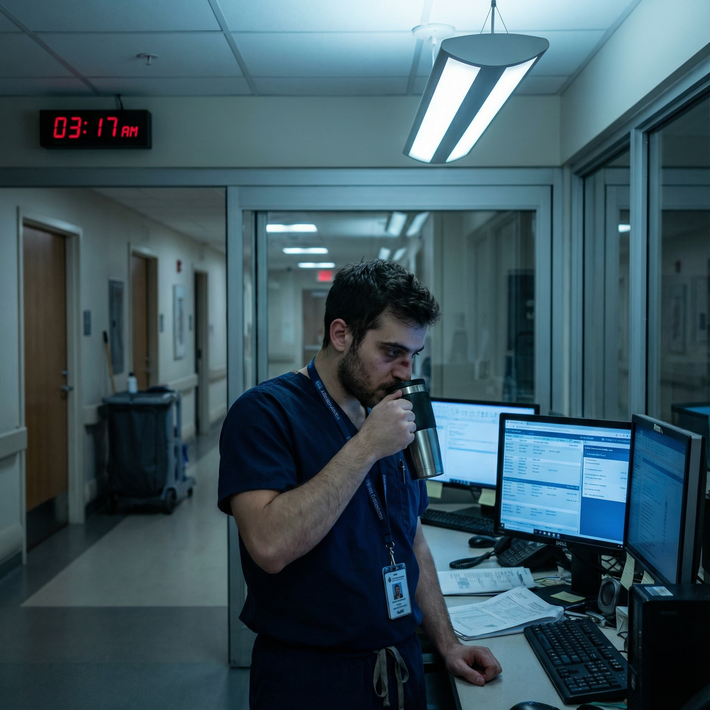
Protected naps on night float beat no naps. The data says so, and the margin is not trivial.
If you measure the outcomes that actually matter on overnight shifts, not the macho folklore residents trade at 4:30 AM, protected sleep windows usually come out ahead. Better vigilance. Faster reaction time. Fewer attention lapses. Lower subjective fatigue. Less next-day sleep debt. That is the core signal.
The real question is not whether sleep helps. That part is obvious. The useful question is narrower and more operational: does a scheduled, protected nap during night float improve performance compared with staying continuously awake? The answer, in most datasets, is yes. But there is a catch. A badly designed nap policy can collapse under pages, poor handoffs, or sleep inertia. So the independent variable worth studying is not “rest” in the abstract. It is actual sleep opportunity: a defined, protected block with a realistic chance of sleeping.
I have seen this play out on real services. The “you can nap if things are quiet” model usually means nobody naps, because things are never fully quiet and because junior residents do not trust that they can disappear for 25 minutes without paying for it later. Meanwhile, a service with a real nap window, cross-cover backup, and clear expectations often looks different by 5 AM. Fewer sloppy orders. Less rereading the same note three times. Fewer almost-mistakes that everyone pretends were nothing.
That is the article’s thesis in plain language: protected naps generally improve measurable overnight performance, but implementation determines whether the benefit is real or imaginary.
Night Float, Protected Naps, and the Numbers That Matter
Let us define the clinical question the right way. Not “Do residents like naps?” Not “Do attendings think naps build weakness?” Those are culture questions, and culture is often wrong. The data question is this: on night float, how does a protected nap opportunity compare with no nap opportunity on safety and performance outcomes?
That makes sleep opportunity the independent variable. Everything else follows from that setup.
The dependent variables should be measurable and clinically relevant:
- Near-miss rates
- Reaction time
- Attention lapses
- Cognitive errors
- Mood and irritability
- Post-shift fatigue
- Next-day sleep debt or recovery burden
This matters because “I felt tired” is not enough. Residents feel tired on nights almost by definition. The signal you care about is whether fatigue degrades function. The better studies use psychomotor vigilance tasks, error detection measures, simulated clinical tasks, and standardized fatigue scales. Not perfect. Still much better than vibes.
The central pattern is consistent: a resident with a true chance to sleep during the circadian trough tends to perform better than a resident forced into continuous wakefulness. Not dramatically superhuman. Just reliably less impaired. And overnight medicine is often won by that margin. Ten percent better vigilance at 3:45 AM can be the difference between catching a potassium of 2.8 and scrolling past it.
What the Evidence Shows: Sleep Opportunity Improves Performance Metrics
The data shows that even short protected naps can improve alertness compared with staying awake straight through the night. Across sleep and shift-work literature, the most reproducible gains show up in vigilance, psychomotor speed, and subjective fatigue. That pattern appears in health care studies, simulation work, and broader operational fatigue research. Different methods. Same direction of effect.
Here is the cleanest summary: brief sleep tends to outperform no sleep.
Quantitatively, protected naps are associated with:
- Shorter reaction times
- Fewer microsleeps and attention lapses
- Lower self-rated fatigue
- Better mood stability
- Modest reductions in near-miss events
The exact magnitude varies by study, but the directional trend is stubbornly consistent. A reasonable summary from the literature trend looks like this: reaction-time performance can improve on the order of the mid-teens percentage-wise after a protected nap opportunity, attention lapses can fall by roughly one-fifth to one-quarter, and subjective fatigue scores often improve even more. Near-miss reductions are usually smaller but still meaningful, because serious overnight errors are relatively infrequent events and harder to capture cleanly.
Read that chart carefully. It does not mean every nap guarantees an 18% faster response or a 12% drop in near-misses on your service next Tuesday. It means the overall signal favors protected sleep, and the biggest gains tend to show up in fatigue-sensitive cognitive tasks.
That distinction matters because a lot of residency arguments are intellectually lazy. People compare a formal nap intervention with “downtime” as if they are the same thing. They are not. Unstructured downtime is often fake rest: shoes still on, pager volume high, one eye on the secure chat, and no confidence that anyone will cover a deteriorating patient. That is not sleep opportunity. That is anticipatory stress in a horizontal position.
The data also shows dose and timing effects. A resident who starts a shift already sleep-deprived usually gains more from a nap than one who came in relatively rested. A nap taken in the early morning circadian trough may produce a stronger alertness payoff than one taken too early in the evening. A short nap that produces light sleep may improve post-nap function more reliably than a longer nap that pushes the resident into deeper stages and leaves them groggy.
So yes, naps help. But the better statement is narrower and more honest: a scheduled, protected, appropriately timed nap often improves overnight performance metrics compared with no nap, especially when baseline fatigue is high.
Where the Data Gets Messier: Tradeoffs, Confounders, and Real-World Constraints
This is where the simplistic “naps are always better” crowd loses the plot. The literature is favorable, but it is not tidy.
Study results vary because night float is not one thing. A 12-hour pediatric night float with steady pages is different from a 28-hour trauma call with nonstop admissions. Shift length, patient acuity, census, intern versus senior role, sign-out quality, and page burden all change the observed effect size. The resident who gets 25 uninterrupted minutes in a quiet room is in a different experiment from the resident who is paged every seven minutes and sleeps in fragments.
Then there is sleep inertia. Real downside. Real physiology. If you wake someone from deeper sleep, especially after a longer nap, performance may briefly worsen before it improves. I have seen residents stumble out of a call room after a 75-minute crash, blinking at the workstation like they have been dropped into another century. For the next 10 to 20 minutes they are not sharp. That is not a moral failing. It is expected neurobiology.
That is why shorter naps, usually around 20 to 30 minutes, often outperform longer naps in operational settings. You get enough sleep pressure relief to improve vigilance without maximizing the groggy rebound that can follow deeper sleep. A 60- to 90-minute nap can be useful in some settings, especially if there is enough buffer after wake-up, but on many busy services it is too clumsy. Too much risk of waking at the wrong stage. Too much interruption risk. Too hard to protect.
Operational variables can erase theoretical benefit fast:
- Frequent pages during the sleep window
- Poorly assigned cross-cover responsibilities
- Inadequate sign-out before the nap
- No quiet, dark sleep space
- A service culture that treats sleep as laziness
- Immediate high-stakes tasks right after wake-up
That last point gets underestimated. If your nap ends and you are instantly expected to evaluate chest pain in a complex ICU patient, that is bad system design. A brief reorientation period matters. Water. Light. Two minutes to review the list. Maybe caffeine if that is your routine. Tiny intervention. Big difference.
How to Read Night Float Naps Like a Data Analyst
If you want to know whether protected naps are worth defending on your service, stop arguing in the abstract and collect basic data.
You do not need a grant, a wearable EEG setup, or a chief resident spreadsheet from hell. You need a simple repeated-measures approach. Compare your service before and after a nap policy, or compare shifts with a real nap opportunity against shifts without one. Then track outcomes that are easy to capture and hard to fake.
Start with these operational metrics:
- Nap attempted: yes or no
- Actual sleep duration: estimated minutes asleep
- Nap timing: clock time
- Interruptions during nap: number of pages/calls
- Caffeine intake: approximate timing and amount
- Self-rated alertness before and after nap: 1 to 10 scale
- Total overnight pages handled
- New admissions or rapid responses
- Perceived near-misses: yes or no, brief category
- Time needed to feel normal after shift ends
That is enough to generate usable local insight.
For example, if you review 20 night shifts and see that on nap-protected nights residents average 24 minutes of sleep, report a 2-point improvement in alertness scores, handle similar page volume, and report fewer attention slips, that is meaningful. Not publishable truth. Still actionable. The data shows a pattern. Patterns matter.
What should you not do? Base your conclusion on one dramatic shift. One “I napped and still felt awful” story proves almost nothing. Maybe the resident came in post-call from a prior service. Maybe there were 14 admissions. Maybe the nap was 87 broken minutes with three pages and no reorientation. Small sample sizes are noisy. Repeated observations are the antidote.
A practical framework looks like this:
Defend protected naps when:
- Workload is heavy enough that fatigue errors are plausible
- Shift length crosses deep circadian vulnerability hours
- The team can realistically cover pages for 20 to 30 minutes
- There is a physical sleep space
- Handoffs are structured enough to allow temporary coverage
Be cautious when:
- The service has immediate, frequent critical events
- There is no buffer after wake-up
- The only feasible sleep block is long and interruption-prone
- Team culture guarantees resentment or sabotage of the nap window
Judge success by outcomes, not ideology:
- Fewer near-misses
- Better alertness scores
- Stable or improved throughput
- Lower post-shift recovery burden
- No rise in delayed response events during coverage
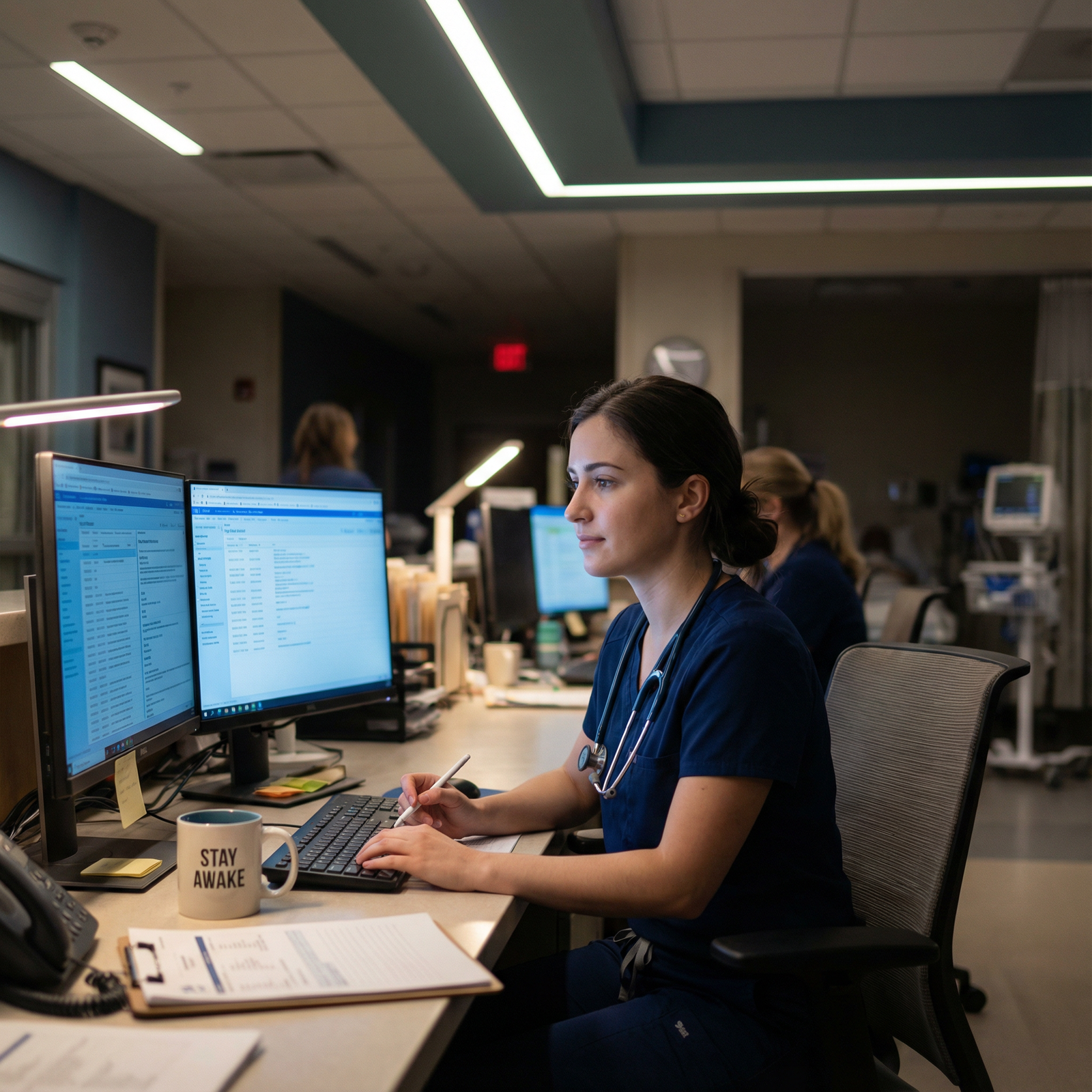
I like simple scorecards because they cut through chest-thumping nonsense. If a rotation says naps are unnecessary but the no-nap nights produce slower work, more forgotten tasks, and wrecked post-shift recovery, that policy is not tough. It is inefficient.
Bottom Line: The Best Schedule Is the One That Reduces Risk Without Creating Sleep Inertia
The evidence points in one direction. Protected naps usually outperform no naps on night float.
Not because naps are luxurious. Because human cognition degrades with sustained wakefulness, especially overnight, and a short scheduled sleep window can blunt that decline. The best-performing nap model is usually brief, predictable, and actually protected. Around 20 to 30 minutes. Low interruption burden. Clear cross-cover. Short reorientation after wake-up.
No-nap culture is rarely a data-backed strategy. It is usually a habit, an identity performance, or a scheduling failure dressed up as professionalism.
So if you are a resident, here are the action steps:
- Track your nights for two to four weeks.
- Record nap duration, timing, caffeine, pages, and alertness.
- Compare protected-nap versus no-nap shifts.
- Note near-misses, attention slips, and post-shift recovery time.
- Bring the pattern, not the complaint, to chiefs or program leadership.
If you are a chief or scheduler:
- Pilot a protected 20- to 30-minute nap window on selected services.
- Assign explicit page coverage during the window.
- Avoid ending the nap directly into high-stakes tasks.
- Build a 5- to 10-minute wake-up reorientation period.
- Audit outcomes after a month.

That is how you make this decision correctly. Not by opinion. Not by tradition. By measuring whether the schedule reduces risk. The data shows that protected naps usually do. The smart move is to design them well enough that the benefit survives contact with real night float.