
How Program Directors Read Your Night Float Evaluations Behind Closed Doors
It’s 2:30 a.m. You just finished admitting your fifth chest pain of the night, your cross-cover pager will not shut up, and your senior casually mentions, “Hey, make sure you don’t piss off nights—those evals go straight to the PD.”
You nod, but you have no idea what that actually means.
Let me pull back the curtain for you.
I’ve sat in those closed-door meetings. I’ve watched program directors scroll through evaluations, stop on a single night float comment, and say: “This is the first real data point I believe about this resident.” Daytime evals are fluff compared to what comes from the night shift. People behave differently at 3 p.m. versus 3 a.m., and program leadership knows it.
You want to know how they really read your night float evaluations? Let’s go there.
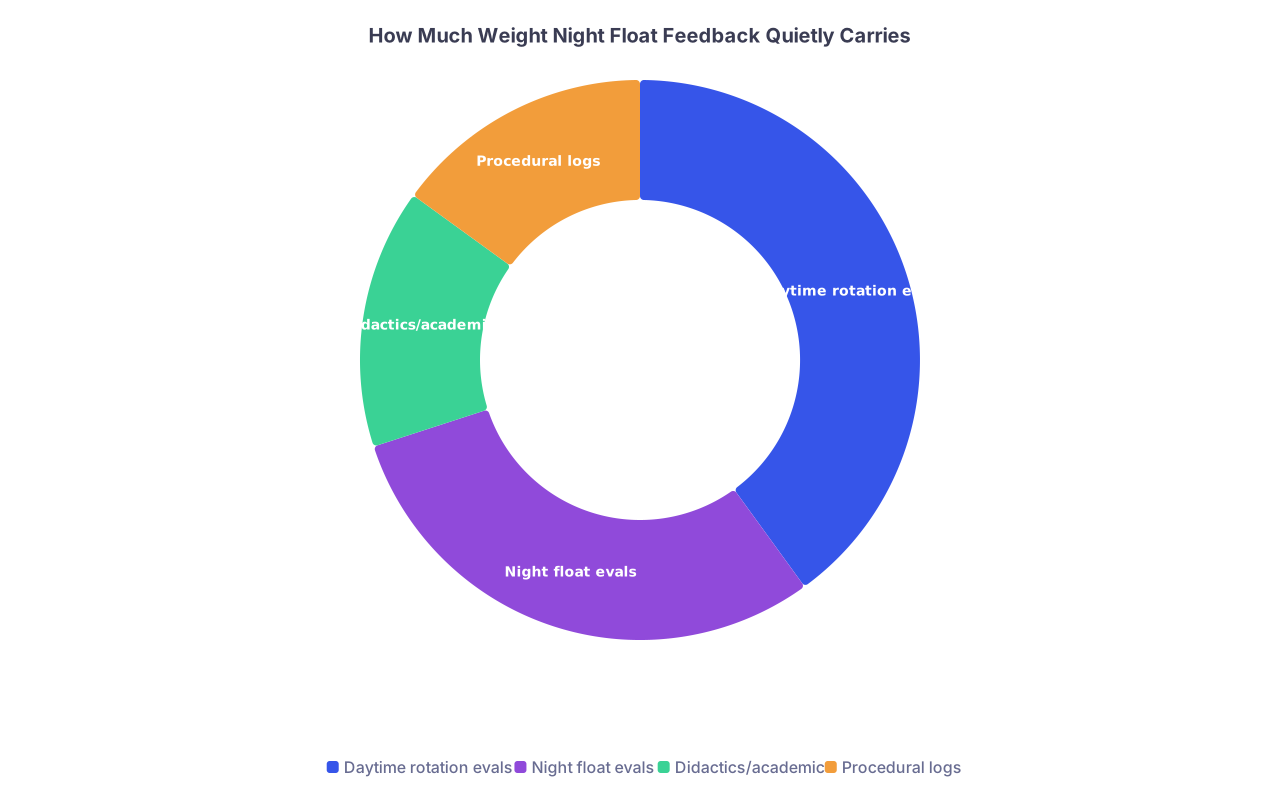
| Category | Value |
|---|---|
| Daytime rotation evals | 40 |
| Night float evals | 30 |
| Didactics/academic | 15 |
| Procedural logs | 15 |
Why Night Float Evaluations Matter Way More Than You Think
On paper, every evaluation is equal. In reality, they’re not even close.
When PDs and associate PDs are actually talking off the record, you’ll hear phrases like:
- “I care more about what the night team says.”
- “If they’re solid at night, I don’t worry.”
- “If there’s smoke on nights, I assume there’s fire.”
Day rotations are performative. You’re surrounded by attendings, students, consultants, social work, families. The resident can “clean up” before rounds. Notes are polished. Stories are rehearsed. Everyone’s on stage.
Nights are surveillance footage. No script. No makeup. Just how you function when:
- You’re tired
- You’re less supervised
- You think “no one important” is watching
Program leadership knows:
- Night nurses are brutally honest when asked privately.
- Night seniors don’t bother sugarcoating if they feel safe with the PD.
- Night float cross-cover exposes pattern problems fast: decision-making, follow-up, reliability.
So when they’re sitting in a Clinical Competency Committee (CCC) or semi-annual review and see a string of bland daytime evals and then:
“Struggled with prioritization and repeatedly delayed evaluating sick cross-cover patients. Required multiple reminders.”
That comment gets read three times. And it sticks.
They do not care that you crushed your outpatient clinic eval. Not when the night float summary suggests they can’t trust you with 40 patients while the hospital is half-asleep.
Who Actually Writes Your Night Float Evaluation (And Who Really Influences It)
You assume your evaluation is from “the attending.” Technically, yes. Practically, not really.
Here’s what happens behind closed doors:
1. The Attending Is Often Guessing
A lot of night attendings are either:
- Not in-house consistently (depending on specialty/hospital)
- Covering huge services and several residents
- On back-up, checking in electronically
Unless they specifically round with you at 2 a.m., their direct observation is limited. So what do they do when the evaluation form shows up?
They ask the people who were actually there with you all night.
And this is where your real evaluation is built.
2. Your Senior Resident’s Voice Is Loud
I’ve watched this happen dozens of times:
Attending opens eval. Stares at fields. Says to the night senior:
“How was she on nights? I didn’t see any disasters. What do you think?”
And the senior will give a one-line summary that becomes your identity for that block:
- “Solid. Independent. Would trust them as a senior tomorrow.”
- “Slow. Needs a lot of hand-holding. Not unsafe, but not ready.”
- “Honestly, a little lazy. Disappears a lot.”
The attending then translates that into evaluation language.
So that short hallway comment at 4 a.m. when your senior asked, “Everything okay?” and you snapped? That memory can color the tone of how they talk about you weeks later.
3. Night Nurses Are the Underrated Powerhouse
A PD or APD who actually knows what they’re doing will, over time, figure out exactly which night nurses to listen to. There are always a few:
- The charge nurse who’s been here 15+ years
- The ICU nurse who trains everyone
- The floor nurse who quietly remembers every unsafe resident
When something feels off about a resident, I’ve watched PDs literally say:
“Let me email nights and see what they say.”
Or more informally: catching the night charge nurse in the hallway:
“How has Dr. X been at night? You feel safe with them?”
If the response is, “They’re great—always come when we call,” that single line can counterbalance a cranky attending comment.
If the response is, “We try not to call them unless we have to,” you now have a reputation problem that’s hard to fix.

How PDs Actually Read Through Your Night Float Comments
Let’s talk about the CCC room. No patients. Coffee. A big screen with your name and every evaluation from the last 6–12 months.
They click on “Night Float – PGY-1, February.”
They do not read everything word-for-word. They scan. And here’s what they zoom in on.
Patterns, Not One-Offs
A single lukewarm comment doesn’t scare anyone. PDs are used to personality clashes. But two or three night blocks, different seniors, different attendings, all echoing similar themes?
You’re on a watchlist, whether they say it out loud or not.
The common patterns that raise eyebrows:
- “Slow to respond to pages” repeated in various ways
- “Needs close supervision for cross-cover decisions”
- “Difficulty recognizing sick patients”
- “Often appeared overwhelmed by volume”
- “Professionalism concerns overnight (late arrivals, missing pages)”
You’ll never see the eyebrow raise. But I’ve watched it. They highlight phrases. They literally say, “We need to keep an eye on this.”
Trigger Words That Make PDs Nervous
Certain words are code. Nobody writes, “Dangerous” unless it’s really bad. But they write around it. Here’s the translation dictionary most residents never see:
- “Needs significant supervision” = We did not feel comfortable letting them run the night alone.
- “Required frequent redirection” = Their judgment was not where it should be.
- “Slow to respond to nursing concerns” = Nurses did not feel safe.
- “Limited situational awareness” = They lost track of what was happening on the unit.
- “Defensive when receiving feedback” = This could become a remediation headache.
The opposite is also true. PDs love words like:
- “Trustworthy”
- “Calm under pressure”
- “Anticipates problems”
- “Advocates for patients and nurses”
- “Functions above level”
When those words show up on night evals, that’s gold. That’s promotion material. That’s who they pick as chiefs, who they nominate for awards, who they let “stretch” into more independence.
What Night Float Really Reveals About You (That Day Rotations Hide)
Program directors use nights as an X-ray for your true clinical self. Night float exposes five things they care about more than your Step score.
1. Your Clinical Judgment Under Pressure
Daytime: you can run every decision by an attending. You can delay hard calls till morning. You can ask “just to be safe” without looking weak.
Nighttime: someone’s satting 82%, and the nurse calls you—now. You:
- Decide whether to go see them immediately or “give it a minute.”
- Decide when to call ICU, when to call rapid, when to just give nebs.
- Decide if you believe the triage note or not.
PDs know this. So when they see “Recognized and escalated care appropriately” in a night eval, that’s not just a checkbox. That’s them thinking:
“I can trust this person on nights next year as a senior.”
2. Whether You Actually Show Up For Nurses
This is the big one you don’t see coming. You can charm attendings all day. If the night nurses don’t like working with you, it will leak into your evals over time.
Nurses don’t write evals directly (at most places), but:
- They complain to seniors.
- They mention names to the PD when asked.
- They remember who answered pages and who vanished.
PDs see indirect text like:
- “Responded promptly to nursing concerns.”
- “Great team player with nursing staff.”
- “Initially hesitant to see patients, but improved with feedback.”
Residents underestimate how fast word spreads upstairs when a resident is labeled “doesn’t come when we call.” I have literally sat in meetings where a PD says:
“Nights does not like working with them. We have to address this.”
That conversation never makes it to you verbatim. But it becomes “We’re concerned about professionalism and responsiveness.”
3. Your Reliability and Stamina
They care less about whether you yawn at 4 a.m. and more about:
- Are your notes done before sign-out?
- Do your sign-outs make sense or are they chaos?
- Do you lose track of tasks from two hours ago?
- Are you always “about to do it” but never actually done?
Night float evals full of phrases like “follows through,” “reliable,” “closes the loop” are more powerful than glowing research letters when it comes to trusting you with high-responsibility roles.
4. Your Growth Curve
PDs don’t expect you to be a machine on your first night float block. They expect day 1 to look different than day 14.
The most reassuring eval looks like this:
“Started the month overwhelmed with cross-cover volume but asked for help appropriately, incorporated feedback quickly, and by the end was managing a heavy list with minimal prompting.”
The scariest:
“Started the month overwhelmed and remained overwhelmed despite coaching.”
One phrase that really sticks is “did not seem to progress.” That is CCC catnip for remediation discussion.
| Source | How Much PDs Actually Trust It (Low/Med/High) |
|---|---|
| Daytime attending evals | Medium |
| Night float attending | High |
| Senior resident feedback | Very High |
| Night nurse informal input | Very High |
| Patient satisfaction | Low-Medium |
The Stuff PDs Quietly Forgive On Night Float (And What They Don’t)
You’re human. PDs know nights are brutal. They don’t expect perfection at 3 a.m. They do, however, draw very clear internal lines that nobody tells you about.
What They’ll Usually Forgive
These rarely sink you long-term if they’re occasional and you improve:
Moving slowly at the start of the block
“Initially slow with admissions but improved” barely registers as a problem. That’s normal.Asking “too many questions”
Behind closed doors, PDs would rather read “asked for help frequently” than “did not recognize when to ask for help.” The latter is how people die.Being nervous on cross-coverage your first time
Everyone is. Comments like “lacked confidence but was safe and thoughtful” are actually fine.A single bad night with documented improvement
If a senior writes, “After feedback, performance improved,” PDs exhale. They see modifiable behavior, not a character flaw.
What They Do Not Forgive Repeatedly
These things, if recurring on night float evals, get remembered:
Ignoring or delaying urgent pages
Any variation of “slow to respond to sick patient calls” is taken seriously. More than anything else.Blaming others repeatedly
Phrases like “frequently blamed system factors or nursing” get translated to: difficult, defensive, not coachable.Being unreachable
Not picking up the phone. Vanishing to “sleep” without telling anyone. This is the stuff that leads to harsh language in closed-door meetings.Lying or shading the truth
PDs take one thing personally: dishonesty. If nights say, “They said they checked on the patient, but hadn’t,” you’ve crossed from “struggling resident” into “untrustworthy resident.” Different category. Much worse.
How to “Read” Your Own Night Evaluations Like a PD Would
When you finally see your evals in MedHub or New Innovations, you probably skim for the overall rating and move on. Wrong approach.
If you want to know how you’re being talked about behind closed doors, you need to read them the way the PD does.
Look for:
Direction of change
Are comments this block better, worse, or identical to your last night float or heavy-call rotation? Same concerns, repeated? That’s a problem.Language around trust and independence
Words like “independent,” “trusted,” “safe to cross-cover” = you’re on track. Words like “needs close supervision,” “limited autonomy appropriate at this stage” = they’re holding you back gently.Any mention of nurses or team dynamics
“Great with nursing staff” is more powerful than you think. “Needs to improve communication with nursing” is code for “they complained.”Speed vs. judgment
“Needs to work on efficiency” is fixable and common. “Struggles with triage and prioritization” hints at judgment gaps—more concerning.
If you see a pattern, do not wait for your semi-annual meeting. Ask a trusted senior or APD directly:
“I saw this theme on my night evals. How worried would you be if you were me, and what would you watch for next?”
That question alone signals insight and coachability. PDs love that. It often softens how they interpret borderline comments.

| Step | Description |
|---|---|
| Step 1 | Your behavior on nights |
| Step 2 | Senior impression |
| Step 3 | Nurse comments |
| Step 4 | Attending evaluation text |
| Step 5 | Program director review |
| Step 6 | CCC discussion |
| Step 7 | Promotion and trust decisions |
How Night Float Comments Shape Your Future In The Program
Here’s the part nobody says explicitly: your night float reputation influences what opportunities you get later.
Who Gets Trusted With High-Stakes Roles
When leadership is choosing:
- Who runs the unit as a senior
- Who gets to be night team leader
- Who gets to moonlight early
- Who they’d call in a disaster
They do not go to your “Professionalism – Meets Expectations” checkbox.
They remember:
“Handled heavy night cross-cover, stayed calm, made safe decisions.”
or
“Struggled on nights, not ready to function independently.”
You’ll never see the email, but I’ve seen decisions like:
“Don’t put them alone on night cross-cover yet; pair them with a stronger co-resident.”
That’s based almost entirely on night float feedback lines.
Who Gets Labeled “Safe” vs “Project”
Every PD has a secret mental spreadsheet:
- Green: Safe, trustworthy, can push responsibility
- Yellow: Needs watching, coachable but inconsistent
- Red: Potentially unsafe, requires structured remediation
Night float evals punch way above their weight in sorting you into those colors. A resident who’s average on days but reliably solid on nights almost always ends up green.
A resident with perfect notes and high test scores but multiple “concerning” night comments? Often yellow, sometimes drifting toward red if they don’t improve.
Chief, Fellowships, and Letters
When writing letters—for fellowship, for jobs—PDs pull phrases directly from your nighttime life:
- “Widely trusted by nursing and colleagues on night shifts.”
- “Frequently chosen to lead the night team given their calm judgment.”
- Or the absence of anything about nights. Which is its own kind of statement.
If your night evals are strong, PDs lean on them as evidence of maturity and reliability. If they’re weak, PDs will avoid mentioning nights at all and focus on safer territory. Fellowship directors notice what’s missing.
Final Reality Check: What You Should Actually Care About On Nights
No, this is not about sucking up to attendings or pretending to be hyper-energetic at 4 a.m. PDs are not that easily fooled.
They’re looking for three simple things from your night float story:
- Are you safe and responsive when no one is watching?
- Do you grow over the course of a tough block?
- Do the people who work nights—seniors, nurses, attendings—trust you?
If your behavior matches those three, your night float evaluations will quietly work for you while you sleep post-call.
If they don’t, you become a recurring agenda item in rooms you’ll never sit in.
FAQ (Exactly 5 Questions)
1. Can one bad night float eval ruin my career in the program?
Not by itself. PDs look for patterns, not one-off complaints. A single rough block, especially early in PGY-1, is survivable if later nights show improvement. The real problem is when the same concern shows up across multiple blocks or years.
2. Do PDs actually talk to nurses about specific residents, or is that just rumor?
They do. The smarter ones are subtle about it, but they absolutely ask charge nurses and trusted night staff, “How has it been working with Dr. X?” That feedback shapes how they interpret your formal evals, especially if comments mention responsiveness or communication.
3. Is it better to ask for help “too often” on nights, or try to be independent?
From a PD’s chair, “asks for help appropriately” is 10 times safer than “overconfident and missed deterioration.” Independence matters later. Early on, they’d rather you wake someone up than gamble with a patient. Repeated unsafe independence is far more damaging than being a bit needy at first.
4. If I see something concerning in my night float eval, should I confront the evaluator?
Confront, no. Seek clarification, yes. A better move is to approach your senior, chief, or APD and say, “I saw these comments, I want to understand what behavior led to this and how to fix it.” That reads as mature and is much safer politically than going straight back to the attending with anger.
5. How can I tell if my night float reputation is actually a problem?
Look for three clues: repeated similar phrases on evaluations (especially around responsiveness or judgment), a noticeably cautious tone from PD/APD in your semi-annual meeting, and subtle decisions like avoiding assigning you to high-autonomy night roles. If you see two of those three, take it seriously and actively seek feedback and mentorship.