
You are on hour seven of a 14‑hour night. It’s 3:10 a.m. The ED just triaged two new admits, your pager is having a seizure, and you realize your co‑resident hasn’t put in a single order on the last patient they went to see. Their notes are half‑finished, their face looks hollow, and the nurse just quietly tells you, “I’m a little worried about Dr. X tonight.”
You feel it immediately: that mix of concern, irritation, and dread. Because if they’re sinking, part of you knows you’re going down with them. Coverage. Safety. Morale. All on the line.
This is where you’re actually living right now. Let’s deal with this reality, not some generic “be a good team player” poster.
Step 1: Quickly Figure Out What Kind of Struggle This Is
You cannot help effectively until you know what you’re dealing with. And you do not have three hours for a feelings circle. You have maybe three minutes between pages.
There are four common flavors of “struggling on nights” I see:
- Overwhelmed but safe
- Slow and behind, but thoughtful
- Disorganized and dropping balls
- Potentially unsafe / impaired
You’re going to do a fast bedside assessment, whether they notice or not.
Do a 2–minute “temperature check”
Find a moment when you’re both at the workroom or computer.
You: “How are you holding up?”
Them: (Watch the response, not just the words.)
You’re looking for:
- Are they tracking what’s on their list?
- Do they know their patients’ basic issues?
- Are their orders and notes coherent?
- Are they missing obvious tasks (stat labs, antibiotics, ICU calls)?
- Do they look acutely unwell (shaking, pale, confused, tearful, intoxicated)?
If you’re getting short, coherent answers and they know roughly what’s going on but are just “so behind,” that’s an overwhelmed but basically safe resident.
If they can’t tell you which patients are admitted, what services they’re on, or what still needs to be done, that’s disorganized. Different problem.
If something feels off—slurred words, bizarre decisions, staring for long periods, can’t follow simple lines of reasoning—you’re now in the “potentially unsafe” zone. Keep that in the back of your mind; we’ll hit that later.
Step 2: Stabilize the Night Before You Fix the Person
Your first obligation is patient safety and not making your own night hellish. That means: triage the work.
Think of it as resuscitating the shift before resuscitating your co‑resident.
Make a shared “must‑do” list
Pull up the list together. If they’re too scattered, you do it and talk out loud.
You: “OK, let’s line this up. What’s actually time‑sensitive in the next hour?”
List it out in three buckets:
Now (0–60 minutes):
- Stat pages (chest pain, hypotension, neuro changes)
- Time‑sensitive meds (antibiotics, anticoagulants)
- New admits needing initial orders
Soon (next 2–3 hours):
- Cross‑cover issues that are stable
- Admit notes that need to exist before sign‑out
Can probably wait:
- Perfecting notes
- Non‑urgent med rec clean‑up
- “Nice to have” labs and consults
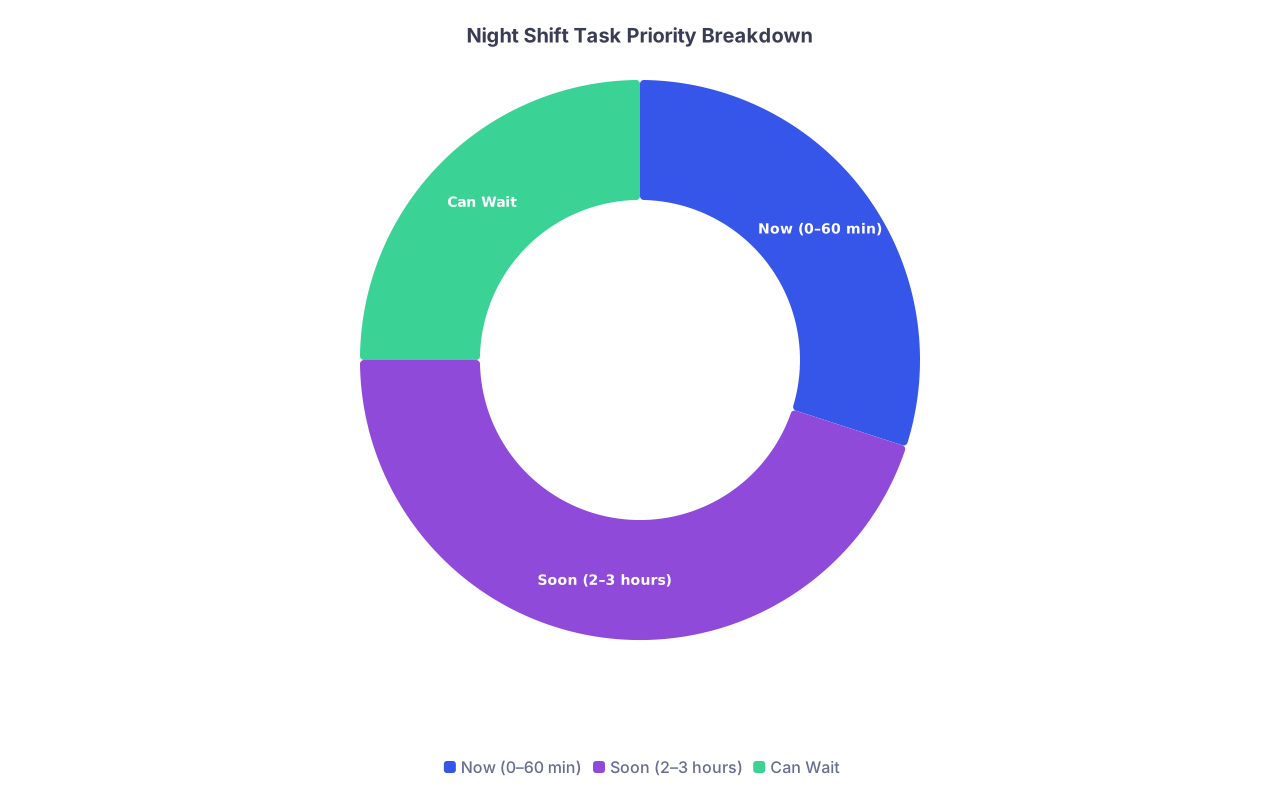
| Category | Value |
|---|---|
| Now (0–60 min) | 30 |
| Soon (2–3 hours) | 45 |
| Can Wait | 25 |
Make this explicit. Out loud. Night brain is foggy; you need clarity.
Divide and conquer intelligently
The dumb move: “I’ll just do everything, you catch up on notes.” That’s how you die at 6 a.m.
Smarter pattern:
- You take: high‑acuity cross‑cover pages + one new admit
- They take: lower‑acuity pages + one new admit with you loosely supervising
- Both: keep chart checking the sickest patients every 1–2 hours
You: “I’ll grab the GI bleed in 12A and the new ER admit. Can you handle the pain control and nausea pages, and start H&P on the COPD admit? I’ll swing by after my patient and we’ll tighten the plan together.”
You’re giving them defined, bounded tasks. Not “just catch up.”
Step 3: How to Help in Real Time Without Becoming Their Personal Scribe
The trick is targeted support, not full rescue.
Use “micro‑supervision” while they still do the legwork
When they’re behind because they think slowly or freeze on decisions, structure it:
Pre‑brief before they see the patient
“This is a new CHF admit, likely volume overloaded. Think: exam, volume status, basic labs, diuretics, telemetry, strict I/Os.”Let them go see the patient alone
You stay available but you don’t stand in the room with them unless things sound scary.Debrief quickly after
“Give me one sentence: why is the patient here, and what’s your plan?”You refine it, not replace it
“Good. Add a BNP, bump the Lasix dose a bit for their weight, and let’s put them on telemetry. Then get that into orders.”
If they’re really slow on the computer, stand behind them for 1–2 admissions and literally say:
“Orders first: fluids, meds, labs, imaging. Then admit note. Then DVT ppx and PRNs.”
Yes, it feels like hand‑holding. But it’s faster than silently watching them drown.
Create templates and shortcuts during the shift
On some services you can:
- Share a basic admit order set you use
- Show them your favorite smart phrases/snippets for H&Ps and cross‑cover notes
- Teach 1–2 keyboard shortcuts that save minutes every task
You’re not “coaching” in a formal sense. You’re in the trench saying: “Click this. Use this phrase. Do it this way, it’s faster.”
Know when to step in and just do it
There are times when “helping them grow” is secondary to “not having a code at 5 a.m.”
You take over completely when:
- A nurse or RT is clearly worried and you agree
- Vital signs are ugly and nothing is happening
- They’re paralyzed on a clearly sick patient
- There’s a time‑critical issue (stroke code, sepsis with hypotension, bleeding)
You: “I’m going to take this one. Can you start the admit note and put in basic labs and vitals goals? We’ll review when I’m back.”
This is not undermining; it’s risk management. If they complain later (they usually don’t), fine. You’d still be right.
Step 4: Protect Yourself from Getting Completely Crushed
If you’re not careful, a struggling co‑resident becomes a black hole that eats your entire capacity. You have to draw some lines.
Set mental “caps” for how much you’ll take on
You’re allowed to think:
- “I will take one extra admit, not four.”
- “I’ll fix urgent orders, but I won’t rewrite every note they half‑ass.”
- “I’ll help structure their work, but I won’t be their personal cross‑cover service.”
This is not selfish; it’s self‑preservation. You exhausted is also dangerous.
Use nurses and overnight staff as allies, not just extra pagers
Nurses know who’s reliable that night. If they’re already bypassing your co‑resident and going to you directly, pay attention.
Say clearly (and calmly):
- “If it’s something urgent and I’m not answering, call the attending or senior directly.”
- “For stable stuff on Dr. X’s patients, please still page them first. If you’re not hearing back in 10 minutes, then loop me in.”
| Situation | Who to Contact First |
|---|---|
| Unstable vitals / rapid change | Senior/Attending STAT |
| No response from struggling resident | Page you, then senior |
| Routine cross-cover issue | Assigned resident |
| You are overwhelmed with pages | Senior to redistribute |
This keeps you from becoming default coverage for the entire floor and your co‑resident.
Involve your senior/attending before you’re underwater
This is where most residents screw up. They wait too long to say something because they don’t want to “throw someone under the bus.”
There is a difference between:
- “They’re a bit slow but we’re okay” and
- “If this continues, we will miss something dangerous.”
If it’s the second one, you say something early.
You (to senior or attending):
“Hey, I want to give you a heads‑up. We’re safe right now, but X is really behind and having trouble keeping up with admits and cross‑cover. I’ve redistributed a bit and I’m supervising some plans, but if our volume jumps or we get another sick admit, we may need some help.”
That’s not betrayal. That’s basic risk communication.
Step 5: If You Think They’re Actually Unsafe
This is a different category. I’ve seen this in a few forms:
- Resident so sleep‑deprived they’re literally nodding off writing orders
- Panic attacks, sobbing, can’t function
- Suspicion of substance use
- Cognitive changes: can’t track conversations, bizarre judgment
You do not “coach” through this. You escalate.
Acute safety problem: act now, apologize later
If you’re seeing:
- Repeated near‑misses
- Orders that make no sense (wrong patient, wrong drug, wild doses)
- Refusal to see obviously sick patients
- Signs of intoxication
You bypass them. You go straight to senior/attending or chief, depending on your system.
You: “I’m seriously concerned about X’s ability to practice safely tonight. We’ve already had [concrete examples]. I need you looped in now.”
Be objective. Use specific examples. Not “they seem off.”
“Two wrong‑patient orders, missed a MAP in the 50s, and when I asked about it they seemed confused.”
Would your co‑resident be upset if they knew? Probably. But if a nurse used the same language about you, you’d want your attending to come look.
Step 6: Decompression and Follow‑Up After the Shift
Most residents skip this and then wonder why they’re burned out and resentful.
Quick debrief with yourself
On your way home or before crashing:
- What did I actually do for them?
- Where did I over‑rescue?
- Where did I tolerate unsafe stuff too long?
- What would I do differently next time?
Write down one or two sentences in your notes app if you need to. This is how you don’t repeat the same mistakes.
Decide what needs to be escalated beyond the night
If it was:
- A one‑off rough night on a heavy call: probably nothing more than a “you good?” text later.
- A pattern: everyone knows they always drown on nights, or they’ve been on a downward trend.
Patterns don’t fix themselves. And the “code of silence” in residency is part of why people end up on remediation late, or worse, hurting patients.
You’ve got a couple of options:
- Quietly tell your senior/chief: “I think X could use some structured support on nights. They struggle with prioritization and speed.”
- Encourage them to ask for help: “You’re not the only one who’s had nights kick their ass. Talk to [PD/APD/chief]; they can actually help with this.”
Talk like someone who wants them to improve, not get fired
If you’re asked for feedback (360 evals, chief checks in, etc.), be honest and specific:
Bad: “They’re terrible on nights.”
Better: “On heavy nights they struggle with prioritizing tasks and fall behind on orders and notes. When I structured their to‑do list and clarified priorities, they did better, but they needed more supervision than expected for their level.”
That’s constructive. It points at skills, not character. And it’s a lot more useful than the fake “they’re great, super nice” comment people write because they’re scared of conflict.
Step 7: What To Say Directly to Your Co‑Resident (Without Being a Jerk)
Day after, you bump into them. You have choices here.
If it was just a rough shift:
You: “Last night was brutal. I saw you were swamped. Next time we’re on together, let’s split early who takes what—not wait until 2 a.m. when we’re already behind.”
You’re normalizing, not shaming.
If it was recurring and you’re genuinely concerned:
You: “Hey, I’m going to say something that might be uncomfortable because I’d want someone to say it to me. Nights have been hitting you hard. I’m worried you’re not getting the support or tools you need. Have you talked with [chief/APD] about it?”
If they get defensive:
“I’m not saying you’re not trying. I’m saying the system expects you to manage a huge load, and if it’s not working, better to get help now than wait until someone’s angry on an eval.”
Let them be a little mad at you if they need to. Better that than watch them circle the drain all year.
A Simple Framework to Keep in Your Head
When you’re too tired to think “strategy,” use this mental flow:

| Step | Description |
|---|---|
| Step 1 | Notice co resident struggling |
| Step 2 | Call senior or attending |
| Step 3 | Create shared task list |
| Step 4 | Prioritize urgent tasks |
| Step 5 | Divide work intelligently |
| Step 6 | Micro supervise plans |
| Step 7 | Monitor and support |
| Step 8 | Discuss with chiefs or leadership |
| Step 9 | Debrief and move on |
| Step 10 | Patient safety at risk? |
| Step 11 | Still falling behind? |
| Step 12 | Pattern or one off? |
Tape that in your mental workroom. It works in every specialty.
Tools You Can Use Tonight
Here’s a quick reference list you can screenshot and keep:

Phrases that work
- “Let’s make a 10‑minute game plan together for the next hour.”
- “What are your top three fires right now?”
- “I’ll take this sick one; can you do X and Y while I’m there?”
- “You’re not alone; nights hit everybody. Let’s structure this.”
- “I’m concerned about how far behind we are. I’m going to loop in senior for backup.”
Simple prioritization rule
If you’re both drowning, ask three questions about each task:
- Could this go horribly wrong in the next hour if we ignore it?
- Does this change management tonight, or is it for morning data‑gathering?
- Can someone else safely do part of this (nurse, RT, phlebotomy, ED doc)?
If:
- Yes to #1 → do now.
- No to #1, yes to #2 → soon.
- No to both → morning or later by whoever is standing.
FAQ (Exactly 3)
1. Am I “throwing my co‑resident under the bus” if I tell my senior or attending they’re struggling?
No. You’re doing your job. There’s a difference between gossip (“They’re useless”) and a concrete safety concern (“We missed a hypotensive episode; they’re behind on admits and not responding to pages reliably”). If you stick to facts and frame it around patient safety and team workload, that’s not betrayal. That’s professionalism. And frankly, your senior would rather know at midnight than discover a mess at 7 a.m. sign‑out.
2. What if I feel resentful because I always end up compensating for the weaker resident?
That resentment is a signal, not a character flaw. It probably means you’ve been over‑functioning and under‑setting boundaries. Next time, consciously limit how much extra you absorb, and loop in leadership earlier when there’s a clear pattern. Also, document heavy nights where you took on out‑of‑proportion work; that’s fair game in your own check‑ins with chiefs or PD when discussing burnout and system issues. You’re not a martyr. You’re a trainee with limits.
3. Should I confront them directly about their performance, or leave that to leadership?
Depends on your relationship and their insight. If you’re peers and you have decent rapport, a direct but respectful conversation can be powerful: “I’ve noticed nights have been rough and I’m worried it might affect how faculty see you. Do you want to game‑plan some strategies?” If they’re defensive, minimizing, or you’re too junior to feel safe doing that, then yes—let leadership handle the formal feedback while you stick to in‑the‑moment support and safety actions. You are not obligated to be their unofficial program director.
Key points:
- Your first job is to stabilize the shift: prioritize ruthlessly, redistribute tasks, and pull in help early if safety is at risk.
- Support your struggling co‑resident with structure and targeted supervision, not total rescue that burns you out and hides real problems.
- Patterns of unsafe or chronically poor performance need escalation beyond a single night—facts, not gossip—so you do not quietly sink with them.