
The night shift doesn’t just test your medicine. It tests your politics. After 2 a.m., people remember how you behaved more than what you knew.
Let me tell you a blunt truth most programs never say out loud: reputations are made on days, but they’re sealed on nights. When attendings, chiefs, and program directors whisper about who’s “solid” and who’s “a liability,” they’re not talking about how you handled pre-rounds. They’re talking about how you handled cross-cover at 3:17 a.m. when everything was falling apart.
You’re not just surviving night float. You’re building (or shredding) your professional identity when far fewer people are watching—but the ones who are, matter.
This is how the politics really work, and how you protect your reputation after 2 a.m.
What Actually Gets Talked About the Next Morning
Here’s the ugly little secret: the details of your differential at 2:30 a.m.? Often forgotten. The way you handled people? That gets passed around.
On a typical morning, right after sign-out, informal debrief starts. Sometimes in the workroom. Sometimes in the hallway. Sometimes during that first cup of coffee when the night float heads out and the day team stays behind.
You think people are saying, “She correctly identified atypical NSTEMI in an elderly diabetic”? Occasionally. Much more often they’re saying things like:
- “He’s calm on nights. Doesn’t freak out.”
- “She calls when she needs help, but not for nonsense.”
- “Nurses trust him. They actually page him instead of trying to bypass him.”
- “He never answers his phone. Good luck getting him after 1 a.m.”
- “She dumps everything at morning sign-out instead of dealing with it.”
That stuff gets remembered. It gets baked into how your name travels in the program.
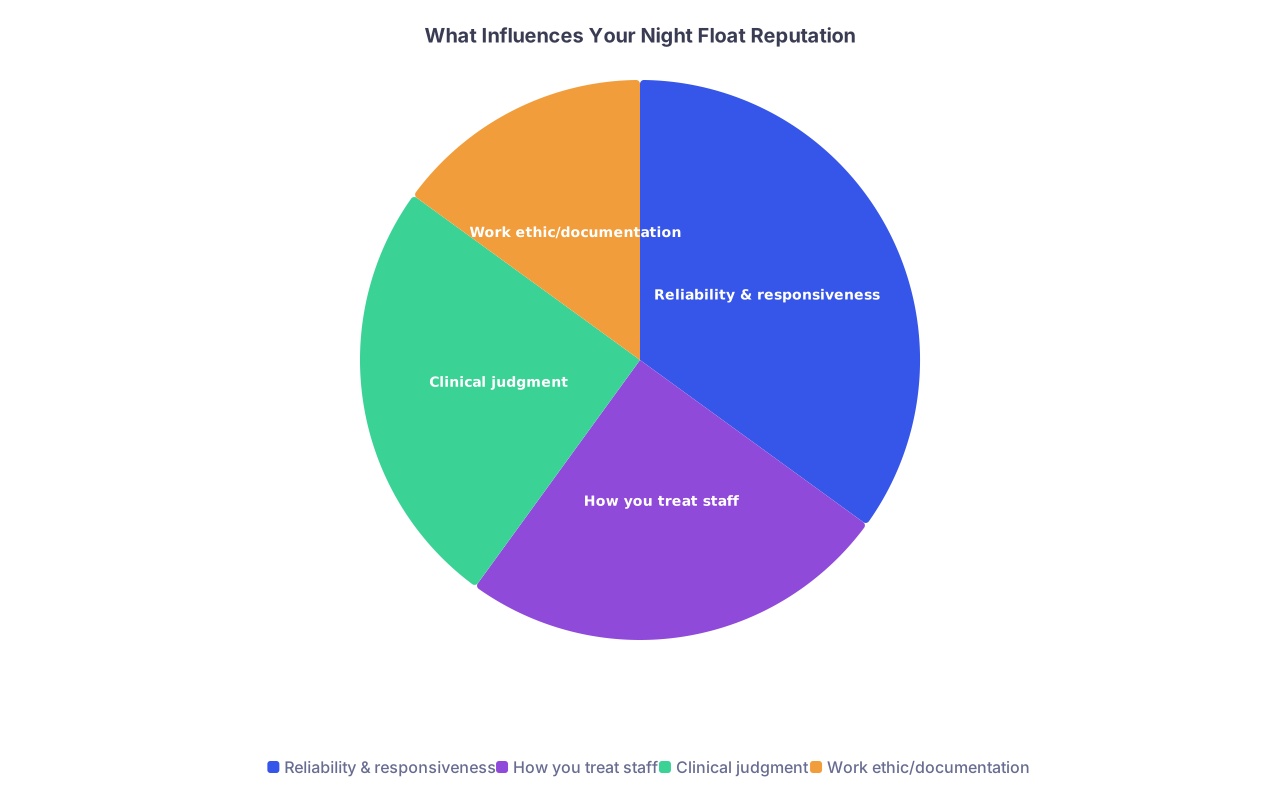
| Category | Value |
|---|---|
| Reliability & responsiveness | 35 |
| How you treat staff | 25 |
| Clinical judgment | 25 |
| Work ethic/documentation | 15 |
Notice what’s on top: reliability and how you treat people. Your night reputation is built more on consistency and respect than brilliance.
Let me break down what people actually track in their heads:
Do you answer pages? Quickly? Nurses know within a night or two who they can count on. If you’re the “ghost” resident, that spreads faster than any Step score.
Do you escalate appropriately? Attendings and seniors are evaluating one thing: Do you wake them up for the right stuff and manage the rest independently?
Do you leave landmines at sign-out? If every morning sign-out includes, “I didn’t get to that,” you will get a label. And you won’t like it.
Do you disrespect or dismiss night staff? Night nurses and RTs absolutely talk. Some programs openly ask them, “Who do you like working with? Who scares you?” I’ve been in those conversations.
Your job after 2 a.m. isn’t just to survive the shift. It’s to consciously control what narrative about you walks into the morning huddle.
The Unwritten Rules of Night Float Politics
Nobody hands you a handbook titled “How Not to Get Destroyed on Nights.” So you learn the hard way. Or you listen to someone who’s already watched others crash.
Let’s go through the codes that actually matter.
1. The Paging Game: How Fast Is “Fast Enough”?
There’s a mental timer every nurse has when they page you. They don’t tell you the number, but they have it.
On most medicine or surgery floors, here’s the rough breakdown of how this plays out:
| Response Time at Night | How Staff Describe You |
|---|---|
| < 2 minutes | Very responsive, reliable |
| 2–5 minutes | Solid, easy to work with |
| 5–10 minutes | Slow, “always busy” |
| > 10 minutes/no answer | Unsafe, “doesn’t respond” |
Nurses won’t always page twice. They might go to the charge nurse. Or skip to the attending. Or log an incident. You often won’t hear about it directly—but your chief might.
Strategy that protects your reputation:
- If you can’t answer right away, acknowledge. A quick, “Got your page about Mr. X, in a code—will come as soon as I’m out” buys enormous goodwill.
- If something’s non-urgent and you’re slammed, negotiate: “I can come now for a quick look or in 30 minutes for a full eval—what do you prefer?” They just want to know they’re not being ignored.
The resident who says, “Don’t page me for vitals” or “Stop bothering me about this” gets remembered. In the worst way.
2. Calling the Attending at 3 a.m.: The Real Threshold
Let me be blunt. Most juniors undercall, not overcall. They’re more afraid of “bothering” the attending than of missing something catastrophic. That’s backwards.
Here’s the quiet standard I’ve seen faculty use when they talk about night residents:
“If you’re thinking about whether to call me, you probably should have already called me 10 minutes ago.”
You are never punished long-term for saying, “I was worried and I called.” You absolutely will be crucified for not calling when you should have.
Clear triggers where calling is expected, even if nobody writes this in a policy:
- Transfer to ICU or near-ICU-level decompensation
- New need for pressors or escalating oxygen (HFNC/BiPAP/NRB in someone who was stable)
- Suspected stroke, MI, or sepsis with hypotension
- Any rapid response or code you personally feel uneasy about even after the dust settles
- Anything that makes you think, “If this goes south and I didn’t call, I’m screwed”
You protect your reputation by framing it correctly when you call:
“Sorry to wake you, but I’d rather overcall than miss this. Mr. Jones just dropped his BP to 80 systolic with rising lactate, on 4L. I’ve given fluids, cultures are sent, broad antibiotics are in. I’m worried he’s declaring sepsis. I’m considering transferring to ICU and wanted your input.”
That’s how an attending later describes you: “She was on top of it. Had already done the right early steps and used me appropriately.”
You know who gets shredded? The resident who calls with, “So I have this guy… uh… and his pressures sort of low… I’m not sure what to do.”
The clinical part can be taught. The political damage from sounding lost and unprepared over the phone at 3 a.m.? That lingers.
How Night Shift Behavior Follows You to Daytime Evaluations
Here’s the part people don’t warn you about: the comments from nights bleed into your formal evals, rank list, and fellowship letters.
Program leadership listens to a specific group about nights:
- Night float seniors
- Night nurses and charge nurses
- ICU fellows who interact with you during transfers or sick calls
- The occasional nocturnist or cross-cover attending
Those people have disproportionate influence because they see you at your worst hours.

| Category | Value |
|---|---|
| Night seniors | 30 |
| Nursing/charge nurses | 25 |
| ICU fellows | 20 |
| Nocturnist attendings | 15 |
| Daytime attendings | 10 |
A conversation I’ve heard word-for-word in a chiefs’ meeting:
“Look, on paper he’s fine. Mid-pack. But nights? Nurses hate working with him. They say he doesn’t answer pages and is rude when he does. I don’t trust him cross-covering a busy floor.”
That one comment anchored how everyone saw that resident. Every mediocre evaluation afterward was interpreted through that lens.
Contrast that with:
“She’s phenomenal at night. Calm, communicates well, asks for help at exactly the right time. ICU fellow said she was the most prepared resident they’ve had all year.”
That resident gets the benefit of the doubt forever. She can stumble on a presentation and people think, “We know she’s solid. Just a bad day.”
Your night float reputation becomes your default setting in people’s minds. You’re either “solid under pressure” or “questionable at 3 a.m.” Those labels are sticky.
Concrete Night Behaviors That Make You “Solid” (or Not)
Let’s get very specific. These are the behaviors that quietly define you.
The “Solid” Night Resident
You want to be described the way seniors and attendings describe residents they trust. It usually sounds like this:
- “If they’re on nights, I sleep better.”
- “They don’t panic.”
- “They pre-chart what matters and don’t drown in fluff.”
- “They fight for sick patients but don’t escalate nonsense.”
- “They’re fair with cross-cover orders and don’t just say yes to everything to avoid conflict.”
What that looks like on the ground:
You get a 2:40 a.m. page: “Patient says they can’t breathe.”
You don’t roll your eyes and say “Again?” You ask three questions:
- “What are their current vitals compared to baseline?”
- “Any new oxygen requirement or mental status changes?”
- “Known cardiac/pulm history?”
Then you say, “I’ll come see them now,” and you actually do. At the bedside, you lay hands, check the monitor yourself, and then either:
- Manage it yourself and document the event, or
- Decide it’s more than “just anxiety” and loop in backup appropriately.
You also circle back to the nurse: “You were right to call. Thanks for letting me know early.” That one sentence buys you weeks of goodwill.
The Resident Who Quietly Destroys Their Reputation
Now the flip side. The resident everyone’s wary of has patterns:
- Doesn’t answer pages for 15–20 minutes.
- Orders things just to get nurses off their back: STAT CTs, random consults, unnecessary labs.
- Snaps at staff: “Why are you calling me about this?”
- Leaves “pending disasters” for the day team: tenuous patients they didn’t reassess, abnormal labs they ignored, consults they never followed up on.
Morning sign-out from them sounds like: “Uh, I didn’t see them again. They were stable when I checked at like 11.”
Day team walks in, finds the patient crashing or clearly worse, and now the story becomes: “Night float dropped the ball.” Even if you truly were overwhelmed, the narrative is what survives.
Choosing Your Battles: Saying “No” Without Becoming The Jerk
You do have to say no on nights. Often. If you say yes to every ask, you’ll drown, and ironically you’ll look disorganized and unreliable.
The trick is how you refuse.
Scenario: 1:15 a.m. page for “Can we get a sleep aid? They can’t sleep.”
Options:
- You say yes and start quetiapine like candy. Fast way to get a bad name with attendings.
- You say, “No, we’re not doing that” and hang up. Fast way to tank your relationship with nurses.
- Or you do this:
“I get that they’re uncomfortable. I’m trying to prioritize people who are unstable right now. Are they in pain? Any shortness of breath or chest pain? If it’s just insomnia, I’d rather not start new meds overnight, especially if they’re older/frail. Let’s try non-pharmacologic stuff for now; if they’re still really struggling closer to 5, page me again and I’ll reassess.”
You’ve set a boundary, given a reason, and left the door open.
Saying no while staying calm and respectful is a political superpower on nights. Attendings will back you if your judgment is sound and your communication is documented.
Documentation That Actually Protects You After 2 a.m.
Residents underestimate how often charts are reviewed after messy nights. Complications, ICU transfers, codes—leadership goes back and reads your notes and orders.
You’re not just documenting care. You’re documenting judgment.
What protects you:
- A quick event note for anything significant: “Called to bedside for new hypotension, 80s/50s from baseline 120s/70s. Exam: … Interventions: … Attending notified at 03:12, plan discussed: …”
- Timestamps that show you responded in a timely way.
- Clear mention of “discussed with attending/senior/fellow” when you escalate.

| Step | Description |
|---|---|
| Step 1 | 2 a.m. Event |
| Step 2 | Your Bedside Actions |
| Step 3 | Your Documentation |
| Step 4 | Morning Handoff Story |
| Step 5 | Chart Review After Issue |
| Step 6 | Program Leadership Discussion |
| Step 7 | Your Reputation |
When I’ve sat in morbidity and mortality conferences, I’ve seen careers almost saved by a single good note:
“She recognized the change early, escalated appropriately, and documented her thought process. This was disease, not negligence.”
And I’ve seen the opposite:
“No documentation of evaluation, no call to attending, and no reassessment for hours.”
That’s when the words “pattern of poor judgment” start floating around.
On nights, a five-line note at 2:40 a.m. can be the most important thing you write all month.
Protecting Your Sanity Without Poisoning Your Reputation
You’re not a machine. Night float is physically and psychologically brutal. The mistake is thinking your only choices are “be a martyr” or “go dark and protect yourself.”
There’s a middle ground that protects both your reputation and your brain.
A few tactics that seasoned residents use:
Structured mini-breaks that people know about.
Tell the nurses: “Between 3:00–3:20, unless it’s urgent, I’m grabbing food and finishing notes. I will check in on the sickest patients right before and right after.”
That feels predictable, not absent.Preemptive check-ins on known-problem patients.
You know which ones. The anxious COPD-er, the uncontrolled pain, the new post-op. If you see them at 11 p.m. and 1:30 a.m., you prevent half the pages later. And nurses think, “They actually check on people.”Template phrases that de-escalate conflict.
“I hear you,” “You’re right to be concerned,” “I’ll come see them,” before you argue about anything.
You’d be amazed how far those three moves go at 2 a.m. when everyone’s tired and edgy.Setting your own red lines.
For example: no starting new benzos in a delirious 85-year-old just because the family wants them to “sleep.” When you consistently protect patients from bad decisions, attendings notice. Even if families or nurses complain in the moment, the long game favors you.
The Politics of Asking for Help: You’re Not Weak, You’re Smart
Residents get this wrong constantly: they think asking for help at night makes them look incompetent. In reality, refusing to ask for help when drowning is what makes attendings doubt you.
There’s a kind of call that makes program leadership trust you more:
“Hey, it’s 2:20 a.m. I’m covering 36 patients. I’ve handled three cross-cover issues, one rapid response, and I’m about to get an ICU transfer going. Now I have two new pages about chest pain. I’m worried I’m missing something or not prioritizing right. Can you help me think through what’s truly urgent here?”
That call tells me: you know your limits, you’re triaging, and you care about patient safety more than your ego or my sleep.
What destroys trust is when we find out:
- You sat on a deteriorating patient for 4 hours because you “didn’t want to wake anyone.”
- You were so flooded you started ignoring pages for non-ICU patients entirely.
- You made big decisions alone that you weren’t trained to make yet (pressors on the floor, risky medication changes) and didn’t loop anyone in.
Night float is heavy. If you pretend it isn’t, you’ll either burn out or screw up—both of which follow you.
What Happens After You Screw Up on Nights
You will have a bad night. Everyone does. A missed early decompensation. A grumpy exchange with a nurse. A note you forgot to write. You’re human.
What matters politically isn’t perfection. It’s response.
Here’s how residents quietly rehab their reputation after a rough night:
Own it early.
Tell your senior or attending: “Last night was rough. I was slower to respond to a change in X than I should have been. Here’s what I learned, and here’s what I’m going to do differently.”Follow up with the people who were impacted.
A 30-second, “Hey, about last night—I was overwhelmed and didn’t communicate well. I appreciate you advocating for the patient,” to a nurse can reverse weeks of tension.Change your behavior in a way people can see.
You respond faster to pages. You preemptively check on sicker patients. You document major events more clearly. People notice.
The resident who pretends nothing happened and blames the system, the nurse, the “dumb page”? That’s the one who gets labeled “doesn’t learn from mistakes.”
And that label? Brutal. Very hard to shake.
FAQs
1. Should I ever push back if a nurse wants me to call the attending and I don’t think it’s necessary?
You can push back, but pick your moments. If a nurse explicitly says, “I’m really uncomfortable; I think the attending should know,” you’re playing with fire by refusing. The smarter move is often: “I’ll come reassess right now, and if you’re still worried after we both look, I’ll call.” If after reassessment you still think calling is unnecessary, document your evaluation well. But realize that if you override nursing discomfort repeatedly and something goes wrong, leadership will not be on your side.
2. How many pages per night is “normal” before I start asking for help?
That depends on your service and hospital, but there’s a more useful rule than a fixed number: if you’re so buried that you’re starting to delay assessments on potentially unstable patients, you’re already late to ask for help. I’ve seen competent residents manage 40 patients with 40–50 pages in a night when most were trivial issues. I’ve also seen people need backup at 20 pages when 5 of them were critically ill or acutely changed. Don’t count pages. Count how many sick or unstable patients you’re managing at once. When that number feels unmanageable, escalate.
3. Is it better to be extra conservative and admit/transfer more patients at night?
Being “admit-happy” or “ICU-transfer-happy” can protect you in the short term, but it eventually gets noticed. Attendings start saying, “They can’t manage floor-level risk.” The balance you want is this: if someone genuinely might crash and you don’t have the bandwidth or resources to monitor them appropriately, transfer. That’s defensible. But don’t punt every tough problem to ICU or ED because you’re scared. Run your logic by your senior or attending. If your reasoning is solid, even a cautious decision will be respected.
4. What if I just hate nights and it shows—how much does attitude actually matter?
More than you think. Everyone expects you to be tired and a little fried. Nobody expects you to love being awake at 3 a.m. But chronic negativity—constant complaining, snapping at staff, making it clear you resent every page—gets coded as “unprofessional under stress.” That’s not a label you want. You don’t have to fake joy. You do have to maintain basic courtesy and stability. If you’re reaching the point where you can’t even do that, that’s a red flag for burnout—and that’s when you quietly ask for help from your PD, a trusted attending, or wellness resources before your reputation takes the hit.
Night float will end. Your fatigue, your circadian chaos, the way the world feels slightly unreal at 4 a.m.—all temporary. The impression you create at 2:17 a.m. when a nurse calls you scared about a patient? That lasts.
Play the long game. Answer the page. Go to the bedside. Call for help when your gut says you’re in too deep. Document like someone will read it later—because someone will.
Do nights right, and days get easier: stronger evaluations, more trust, better opportunities. That “solid under pressure” label follows you into chief nominations, fellowship letters, and job offers.
You’ve survived the dark hours. Now you know how to turn them into leverage. How you use that on your next rotation, your next block of nights, your next cross-cover shift—that’s the next move in your career. And that’s a story you’re already writing.