
The way chiefs judge you on nights has almost nothing to do with your medical knowledge. They’re judging how safe you are to trust when no one is watching.
You think they’re skimming your note to see if the plan is “correct.” They’re not. They’re scanning three things: pattern recognition, risk awareness, and reliability. And your night shift notes and sign-outs scream the truth about all three—louder than anything you say in morning report.
Let me walk you through what chiefs, attendings, and senior residents actually look for. The stuff they talk about in the workroom after you log off. The stuff that makes them decide whether you’re “solid at night” or “needs tight supervision.”
How Your Night Notes Get Read Behind Closed Doors
Here’s the first reality: most chiefs don’t read every word of your night notes. They don’t have time. They sample.
They pull up your list at 6:30 am, glance over your overnight notes, and in under thirty seconds they’ve formed an opinion. Not just about the shift—about you.
They’re looking at:
- How many notes you wrote
- Which patients you chose to write on
- How quickly and cleanly they can understand what happened
- Whether your documentation matches the overnight page log and nursing concerns
Your reputation lives in that thirty-second scan.
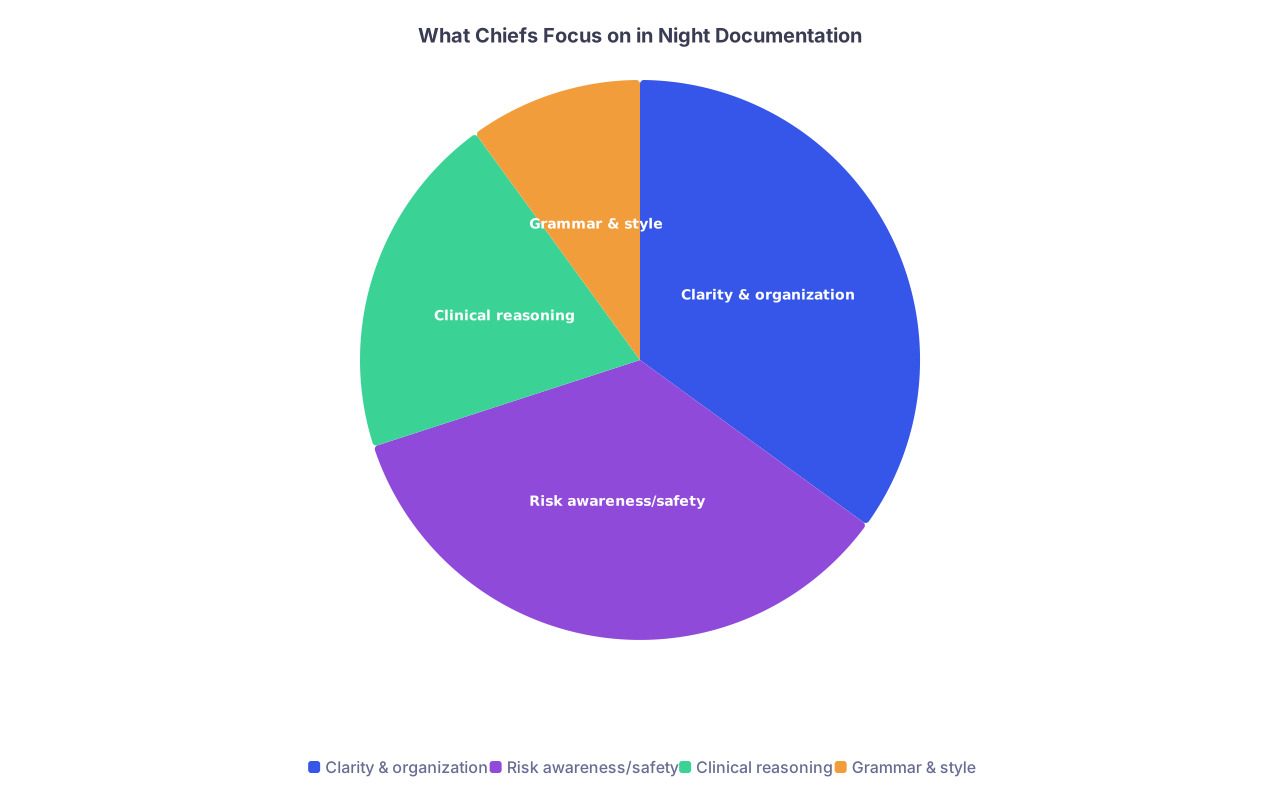
| Category | Value |
|---|---|
| Clarity & organization | 35 |
| Risk awareness/safety | 35 |
| Clinical reasoning | 20 |
| Grammar & style | 10 |
Everyone thinks chiefs care about style and “beautiful notes.” They don’t. They care about whether, at 2 am, you knew what could kill the patient and you made that obvious enough that a zombie attending at 7 am could still follow it.
They notice if:
- Your “cross-cover note” is just: “Paged for pain. Gave oxy 5 mg.”
- There’s no context, no vitals, no thought process, no acknowledgment of risk.
- The same complaining patient got paged on three times and you wrote… nothing.
That’s how you get labeled as someone who “misses stuff on nights.” That label sticks.
The Secret Categories Chiefs Put You In
No one tells you this, but every chief and senior develops their own mental categorization of residents at night. It happens fast. Usually after 2–3 night blocks.
| Category | What Chiefs Say About You |
|---|---|
| The Black Box | "I never know what they did." |
| The Wall of Text | "I can't find the plan." |
| The Checklist | "Solid, nothing missed." |
| The Cowboy | "Orders first, thinking later." |
| The Ghost | "Pages but no documentation." |
Let me translate what each of those actually means.
The Black Box
This is the resident whose night is invisible. Patients clearly had events—RRTs, new O2 needs, nursing notes full of “MD notified”—but the resident’s documentation is minimal or absent.
Morning conversation sounds like this:
“Did anything happen overnight?”
“Uh, a couple of pages, but nothing major.”
“Why is the patient on 4 liters now? Why is there a repeat lactate at 3 am?”
The attending pulls up the chart. No night note. No summary. Maybe a random PRN med administered, nothing else.
This is where trust erodes. Chiefs start asking, “Who was on last night?” before they even read the note. If your name equals “I never know what they did,” you’ve bought yourself a reputation that’s very hard to fix.
The Wall of Text
Opposite problem. This resident writes long, rambling epics at 2 am. Physically impressive. Logically useless.
Pages of review-of-systems, paragraphs of copy-pasted H&P from admission, and buried in the twelfth line of the third paragraph is the actual issue:
“Nurse noted SBP 70s, patient pale and diaphoretic, 1L NS bolus given, repeat BP 110s.”
The chief’s thought process:
“I don’t have time for this. Where is the problem? Where is the plan? Can this person filter what matters?”
If your notes require excavation to find the emergency, you look unsafe—even when you did the right medical thing.
What a “Safe” Night Note Actually Looks Like
Let me show you, concretely, how a typical cross-cover event reads to a chief.
Scenario: At 2:15 am, a floor nurse pages you for a patient on your census with new hypotension and tachycardia. You evaluate at bedside, give fluids, adjust meds, and decide ICU isn’t needed yet.
Here’s how chiefs see different versions of that note.
Weak version (what too many interns write)
“Paged for low BP. Patient asymptomatic. Gave 1L NS. Will monitor.”
You think: Problem identified, action taken. Done.
They think: Did you even see the patient? What was “low”? How do I know you understood the risk? What’s the contingency if they tank again?
Strong version (what builds trust)
“Paged 2:15 am for SBP 78 on floor, HR 118. Pt A&O, c/o mild dizziness on standing, no CP/SOB/abd pain.
Exam: Pale but mentating well, lungs clear, tachy but regular, abdomen soft, no focal neuro deficits.
Data: SBP 80s x2 manual, MAP low 60s, UOP last 3 hrs 15 mL. Labs at midnight: WBC 18 (up from 12), lactate 3.2 (up from 1.8), Cr 1.8 (baseline 1.0). On home metoprolol, IVF @75.
A/P: Suspect early sepsis and hypovolemia in pt with pneumonia on ceftriaxone; no current evidence of shock but concerning trends.
- Bolus 1L LR, hold metoprolol overnight
- Repeat vitals q1h x4, strict I/O
- Repeat CBC, BMP, lactate now
- If SBP <90 or lactate rising, will call ICU for eval.
- Sign-out to day team to reassess need to escalate antibiotics and consider step-up level of care.”
This takes maybe 2–3 minutes longer to write. But the message to chiefs is loud and clear:
You recognized the dangerous physiology. You documented your reasoning. You gave a contingency plan. You handed them a clean thread to pick up in the morning.
That’s what “safe at night” looks like.
How Chiefs Use Your Notes to Judge Judgment
Your note content tells chiefs how you prioritize risk. They read your notes with one question in mind:
“If something bad happened to this patient at 4 am, would I be surprised based on this documentation?”
A few specific things they quietly judge:
1. Your sense of “sick vs not sick”
They look at your exam and vitals. If your note says “patient asymptomatic, looks well” but the nurse document “pt pale, clammy, won’t answer questions,” there’s a disconnect.
I’ve seen chiefs pull the chart of a patient who crashed, then scroll back and say about a night note:
“This reads like they thought it was nothing. That’s what worries me.”
2. Your escalation threshold
Do you ever mention “consider calling ICU,” “discussed with senior,” “notified attending”? Or do you act like you’re operating in your own little silo all night?
Silent cowboys make chiefs nervous. If your notes never show you escalating despite clear instability, you don’t look confident. You look reckless.
3. Your pattern across nights
One decent note doesn’t impress anyone. Patterns do.
Over weeks, chiefs notice:
- You always document bedside exams for concerning pages
- You consistently outline backup plans (“if X happens, then Y”)
- You flag cases for re-evaluation in sign-out notes
Or they notice the opposite:
You give IV hydromorphone at 3 am to an 84-year-old on 3L O2 with no mention of monitoring, no reassessment, no thought about delirium.
That’s not “just pain control.” That’s how you get the “not safe overnight” label.
Sign-Out: The Other Document That Exposes You
Your sign-out is not just a checklist. It’s a psychological profile of how you think.

| Step | Description |
|---|---|
| Step 1 | Day to Night Sign-out |
| Step 2 | Clear problem list |
| Step 3 | Fragmented info |
| Step 4 | Night handles pages safely |
| Step 5 | Missed risks at night |
| Step 6 | Bad outcome |
| Step 7 | Chart review by chiefs |
| Step 8 | Judgment of resident reliability |
Chiefs and attendings see your sign-out in three critical settings:
- Handoffs at 6–7 pm
- Handoffs at 6–7 am
- After something bad happens, when they go back and see what you were told and what you passed on
That third one is the killer.
The “Fake Reassurance” Sign-Out
Maybe the most hated style among chiefs. It sounds like this:
“Room 812 – older guy with PNA. Stable. Nothing to do. Call if any issues.”
Then at 3 am, the nurse calls because he’s on 8 liters, satting 88%, confused, pulling off his NC. You flip through, realize he’s DNR/DNI, chronic CO2 retainer, recent ICU stay, and his daytime lactate was 2.5 “but he looked okay.”
You’re now inheriting a landmine that was sold to you as “stable.”
Chiefs notice who does this. They remember the names that always sign out “stable, nothing to do” on patients who are clearly fragile. They don’t say it to your face right away. But they definitely say it to each other.
The “Constant Crisis” Sign-Out
Equally problematic is the resident who signs out every patient as if they’re about to code:
“Watch everyone. Lot of sick people. Call if anything.”
Translation: “I cannot differentiate risk. I am overwhelmed.”
Your goal isn’t to impress with drama. It’s to make it crystal clear which 2–3 patients the night resident actually needs on their mental radar.
What Smart Sign-Out Actually Sounds Like
Let me show you how chiefs internally grade sign-out.
Say you’re signing out three patients: one low-risk, one medium-risk, one very high-risk.
Weak version
- “812 – PNA, stable, call if fevers.”
- “736 – CHF, needs diuresis, watch I/Os.”
- “905 – septic, came from ICU, still pretty sick.”
You’ve said almost nothing. You’ve pushed all the cognitive work to the night resident.
Strong version
“812 – 78M with PNA, improved, sats 93–95 on 2L, last fever yesterday am. If new O2 need or confusion, I’d be worried about worsening infection or aspiration—please check lactate, blood cultures and call me/ICU if unstable.”
“736 – 60F with acute on chronic CHF, getting IV lasix q6; net -1.2L today, still on 3L NC, sats 92–93%. Very sensitive to fluids. If hypotensive overnight, please be cautious about bolusing—tiny 250 mL and reassess. Vulnerable to AKI, baseline Cr 1.0, now 1.3.”
“905 – 65M came out of ICU yesterday, septic shock from biliary source. Off pressors now but MAP runs low 60s, on 4L NC. This is my ‘watch like a hawk’ patient. If MAP <60 or needs >4L, please call ICU early. Full code. Family very involved—daughter would want update if any significant change.”
What chiefs see in that:
You filtered. You marked the red-flag patients. You gave practical thresholds. You signaled who’s fragile. That’s advanced judgment, not just knowledge.
The Silent Metric: How You Use “Sign-Out to Day Team”
One underappreciated place chiefs judge you is how often and how intelligently you use that little line in your night notes: “Sign-out to day team…”
There’s a huge difference between:
“Sign-out to day team to follow up.”
and
“Sign-out to day team: need reassessment of anticoagulation strategy given new Afib RVR and fall risk, discussion with cardiology pending.”
The first says: “I pushed this to tomorrow because it wasn’t my problem.”
The second says: “I did what was safe for the night, but this needs higher-level deliberation in the day.”
Chiefs love the second kind of note. You’ve understood your job: stabilize and protect, then clearly hand off unfinished business.
How Chiefs React to Bad Outcomes Tied to Night Documentation
Let me be blunt. When something bad happens after a night shift, there’s a predictable sequence.
- Patient deteriorates or codes.
- Attending or chief gets pulled in.
- Once the dust settles, someone opens the chart and walks back through overnight events.
I’ve watched chiefs scroll, in silence, through an intern’s night notes, then say one of three things:
- “Yeah, this was going to happen. They recognized it. Bad disease, not bad care.”
- “They were close, but didn’t quite appreciate how sick this was. We need to teach them.”
- “How did they miss how unstable this was? This is not okay.”
Your documentation decides which bucket you land in. Not your vibe on rounds. Not your Step score.
When your note reads:
“Paged for SBP 80s, pt sleepy but arousable, HR 120. Gave 1L fluids, improved to 90s. Will monitor.”
and that’s it—no exam details, no labs, no suspicion of sepsis, no escalation—then the narrative becomes “they didn’t recognize shock.” Whether or not you sort of had a feeling at the bedside doesn’t matter. If it’s not written, it didn’t happen.
The Small Stuff Chiefs Notice That You Think Doesn’t Matter
Some of this sounds petty. It isn’t. These are pattern detectors honed over years.
They notice:
- Time stamps that make no sense (note at 03:00, but “BP 70s at 04:00” written in past tense)
- Repeated PRN sedatives at night without a single reassessment documented
- Consistent use of “no acute distress” on patients whose vitals are terrible
- Pages about chest pain documented as “pt anxious, reassured” with no EKG, no troponin, no risk frame
None of these single things will “fail” you. But together they build a story: either you think like a doctor who anticipates risk, or you’re sliding by on autopilot, praying no one crashes on your watch.
What Chiefs Quietly Respect (and Rarely Tell You)
Let me give you the other side, because it matters. There are things that make chiefs go, “They’re good at night,” even if they don’t say it to your face.
They respect:
- Short, crisp, problem-focused night notes that name the risk (“worried about evolving GI bleed vs hemodilution”)
- Clear contingency planning (“if Hb drops again or HR >110, would transfuse and call GI/ICU”)
- Honestly worded uncertainty (“Unsure if this is aspiration vs volume overload; obtained CXR and trending O2 needs; will sign out for day team to reassess need for diuresis vs abx change”)
- Residents who document when they ask for help (“Discussed with senior; plan agreed”)—this shows judgment, not weakness
They also pay attention when nurses say, “Night doc actually came to see the patient and explained the plan.” That almost always correlates with good documentation.
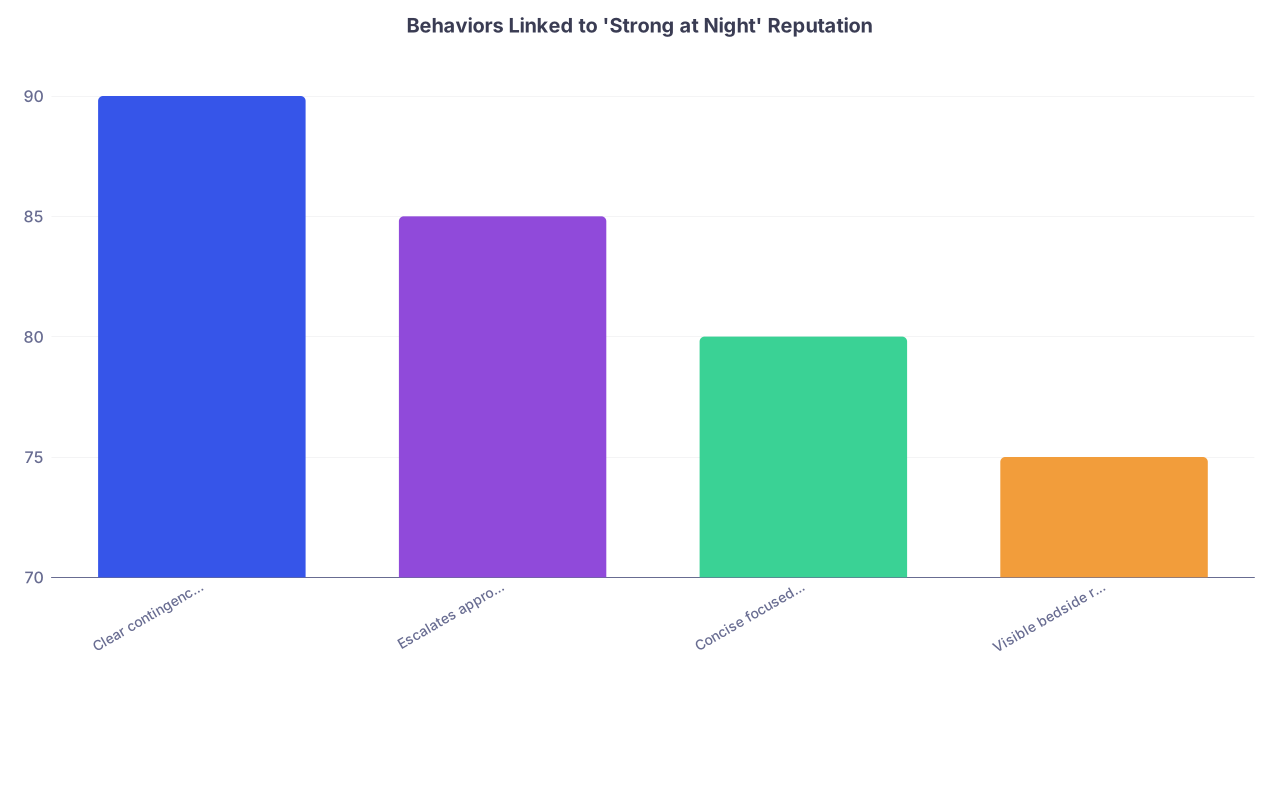
| Category | Value |
|---|---|
| Clear contingency plans | 90 |
| Escalates appropriately | 85 |
| Concise focused notes | 80 |
| Visible bedside reassessment | 75 |
Those residents get more autonomy. More leeway. Better letters. Because chiefs feel like they can sleep when you’re covering their patients.
How to Adjust Your Night Documentation Without Burning Out
You don’t need to write a novel on every Tylenol order. You’d die three nights into a block.
Here’s the real calibration that insiders use:
- If it changes hemodynamics, airway, breathing, neuro status, or level of care → it gets a real note.
- If you ordered labs or imaging because you were actually worried about something bad → you document your worry.
- If you touched the MAR more than once on a fragile patient (opioids, benzos, antihypertensives, insulin) → you show your reassessment at least once.
- If you thought, “If this goes south, I’ll feel bad I didn’t write anything” → write something.
And on the flip side:
- Routine “can I get melatonin” pages don’t need notes if they’re very low-risk and one-off.
- Chronic complainers with identical pain patterns nightly don’t need mini-H&Ps each time—but your first thoughtful note explaining the overall pain strategy should exist somewhere.
You’re aiming for a chart that tells a coherent overnight story without burying day teams in fluff.
The Bottom Line
Your night shift notes and sign-outs are not busywork. They’re the only version of you the chiefs actually see at 3 am.
Three truths to keep in your pocket:
- Chiefs judge whether you’re safe at night from how you document risk, not from how impressive your differential sounds on rounds.
- Concise, problem-focused notes with explicit concern and contingency plans build trust; vague “will monitor” notes destroy it.
- Smart sign-out is about prioritizing risk and handing off unfinished thinking, not dumping tasks or soothing everyone with “stable, nothing to do.”
Write like someone will read your note after something goes wrong. Because sooner or later, they will.