The culture of “just suck it up on nights” is dangerous—and you don’t have to play along.
If your night assignments feel unsafe, you’re not being difficult. You’re doing your job. The trick is pushing back firmly without lighting yourself on fire politically. That’s what we’re going to walk through.
Step 1: Know Exactly What “Unsafe” Looks Like
You can’t push back effectively if your complaint is just “this feels bad.” You need concrete, defensible safety concerns.
Common red flags I see residents ignore (until something goes wrong):
- You’re covering too many patients for your level (e.g., PGY1 cross-covering 80+ complex medicine patients solo).
- You’re assigned tasks beyond your training with no backup (e.g., intern expected to independently manage vent changes).
- No in-house senior or attending for critical services that require immediate decisions (rapid responses, difficult OB cases, SICU).
- You’re routinely post-call beyond ACGME rules because volume is insane.
- You’re being asked to violate written policy (e.g., no supervisor available for central lines that require supervision by policy).
Put it in plain language for yourself:
- “I’m alone, and if two codes hit at once, I literally can’t safely cover them.”
- “I’m being asked to make ICU-level decisions I’m not trained for.”
- “Coverage numbers consistently exceed our program’s usual caps.”
If you can say that in one or two sentences, you’re in good shape to have a productive conversation.
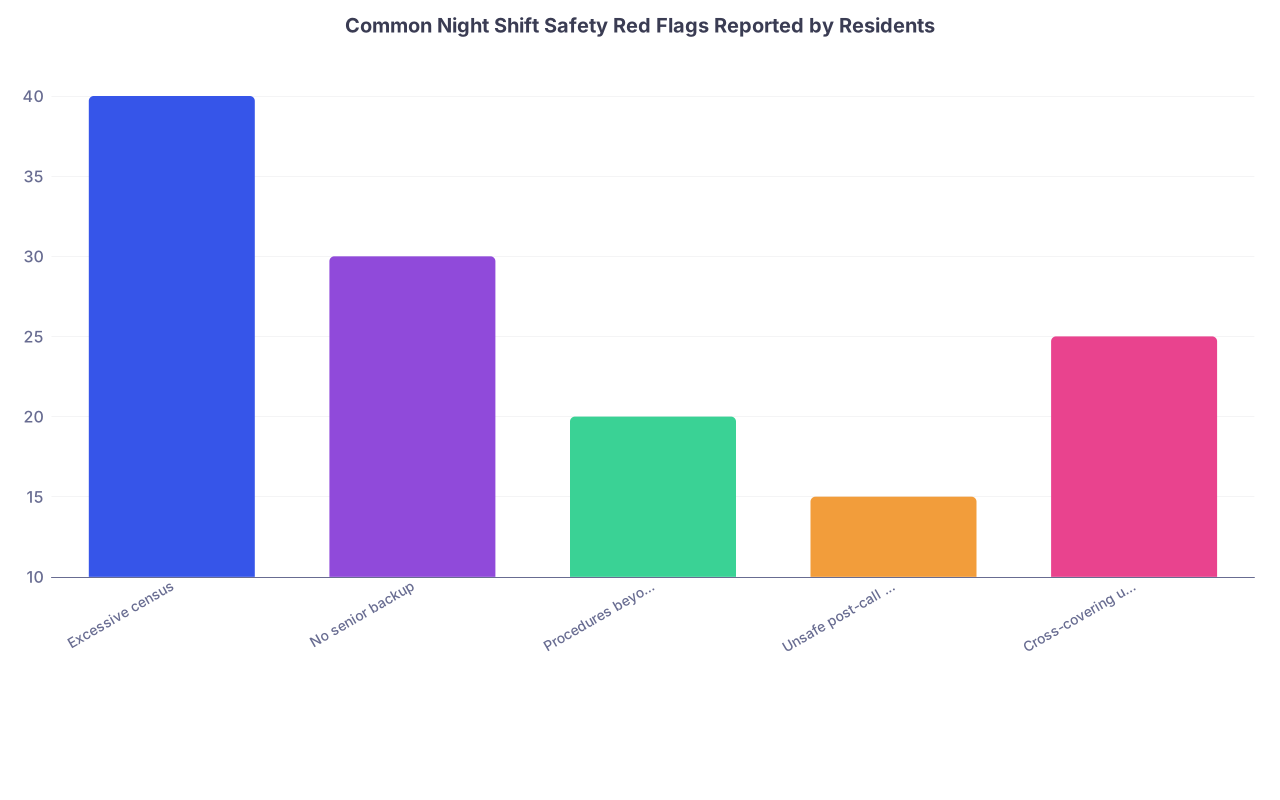
| Category | Value |
|---|---|
| Excessive census | 40 |
| No senior backup | 30 |
| Procedures beyond training | 20 |
| Unsafe post-call hours | 15 |
| Cross-covering unfamiliar services | 25 |
Step 2: Separate “I’m Tired” From “This Is Unsafe”
Your feelings matter, but administrators and attendings respond to risk, not vibes.
Here’s the mental filter:
- Fatigue alone → wellness issue (real, but often deprioritized)
- Fatigue + objective risk → patient safety issue (people listen)
Reframe things away from you and toward patients and the system:
Bad framing:
“I’m exhausted and this is way too much for one person.”
Better framing:
“With this patient load, it’s taking me 45–60 minutes to get to new STAT pages. That delay is unsafe for decompensating patients.”
Ask yourself:
- Can a reasonable third party say, “Yeah, that sounds unsafe”?
- If something went wrong tonight, could I explain why this setup made it more likely?
If yes, it’s time to push back.
Step 3: What To Say In The Moment (On Shift)
You’re on nights. Things are chaotic. You realize the assignment is not safe. Here’s the basic script you want in your back pocket.
Start with calm facts, not emotion
To senior/attending on call (phone or page):
“Hi Dr. Smith, this is [Your Name], night float on [service]. I want to flag that tonight’s coverage feels unsafe from a patient care standpoint.”
Then immediately give numbers and specifics:
- “I’m covering 92 patients across 3 floors, including 8 on high-dose pressors and 4 fresh post-op step-downs.”
- “I’m the only in-house provider for all medical rapid responses, and there’s no in-house senior.”
Then your ask:
- “Given this, I’m concerned I can’t safely respond to emergencies. Can we adjust the assignment or bring in backup?”
You’re not asking permission to feel stressed. You’re stating a safety concern and proposing a solution.
If they blow you off
Common response: “Yeah, nights are rough. We’ve all been there. Just do your best.”
You don’t stop there. You calmly escalate the framing:
“I understand nights are busy, and I’m working hard. I want to be very clear that this isn’t about being uncomfortable—it’s about safety. With this setup, there’s a real risk I can’t get to decompensating patients in a timely way. I need to know what support you want in place if that happens.”
This does three things:
- Removes the “soft” wellness framing.
- Puts some responsibility back on them.
- Signals you’re serious but not dramatic.
If still no movement, you escalate up the chain (more on that next).

| Step | Description |
|---|---|
| Step 1 | Recognize unsafe assignment |
| Step 2 | Notify senior or night attending |
| Step 3 | Document brief note |
| Step 4 | Contact chief or on-call admin |
| Step 5 | Email PD next day |
| Step 6 | Contact GME or risk management |
| Step 7 | Follow up with written report |
| Step 8 | Resolved? |
| Step 9 | Resolved? |
Step 4: Use the Chain of Command Correctly (Without Becoming “That Resident”)
Hierarchies exist for a reason. If you skip straight from “charge nurse” to “hospital CEO,” you lose credibility.
Typical sequence on nights:
- Senior resident / fellow (if on site).
- On-call attending for your service.
- Night house supervisor / nursing supervisor.
- Chief resident (if reachable).
- Program Director (PD) or Associate PD (next day).
- GME office / Patient Safety / Risk Management (if serious and ongoing).
Concrete example:
You: “I’ve paged Dr. Smith (on-call attending), and we talked through it, but we still have one intern covering 70 cross-cover patients and all codes. I remain concerned about safety. Can the house supervisor help with reassigning patients or bringing in another provider?”
You’re not threatening. You’re asking the system to do its job.
And then—and this is vital—you document the interaction for yourself:
- Date/time
- Who you called
- What you said
- Their response
- Any changes made (or not)
Even a quick email to yourself or note in a secure log is enough for now. This matters later if patterns continue.
Step 5: The “Politely Firm” Language You Actually Use
Residents get in trouble when they either sound too vague or too aggressive. You want middle ground: clear, calm, documented.
Here are phrases that work:
To attending/senior:
- “For patient safety, I need to flag that…”
- “I’m concerned we’re setting ourselves up for delayed recognition of deterioration.”
- “I want to make sure you’re aware of the current patient load and acuity.”
- “Can we create a plan now for what to do if we get simultaneous codes?”
To chiefs/PD (post-shift email or meeting):
- “I’m writing because last night’s assignment raised some patient safety concerns.”
- “Given the census and acuity, I wasn’t able to assess new high-risk issues within a safe timeframe.”
- “I’m worried this structure is not sustainable and increases risk of adverse events.”
- “I’m not looking to complain about workload—I’m specifically worried about safety and liability.”
What you avoid:
- “This is ridiculous.”
- “You’re abusing residents.”
- “I refuse to do this” (unless you’re truly at a hard red line and ready to back that up).
You can say no, but make it about the task, not defiance of authority:
“I’m not comfortable performing this procedure independently on nights without supervision given my level of training. I’m worried that would be unsafe for the patient. Can we discuss an alternative?”
Step 6: Involve Nursing Early (They’re Often Your Best Allies)
If nursing is also saying, “This is not safe,” your argument gets stronger instantly.
Loop in the charge nurse:
“Hey, I want to be transparent. I’m covering X patients plus all rapid responses tonight. I’m doing everything I can, but there may be delays getting to pages. If you’re worried a patient is crashing, please call me directly and also consider calling the supervisor or RRT early.”
You’re:
- Protecting patients.
- Protecting yourself (you warned them).
- Making it crystal clear this isn’t about laziness—it’s about triage.
Charge nurses usually know how to escalate to house supervisor/admin, and their complaints often carry significant weight.

Step 7: The Next-Day Follow-Up (Where Real Change Happens)
The night you push back, you’re mostly putting out fires. The next day is when you push for structural change.
Send a concise, factual email. Something like:
Subject: Night Coverage Safety Concern – [Service], [Date]
Dr. [PD/Chief],
I wanted to briefly flag a safety concern from last night’s coverage on [service].
Last night, I was the only in-house physician covering:
- admitted patients across [Y] units
- All medical rapid responses and codes house-wide
- [Any especially high-acuity areas]
Because of this, there were several times where I couldn’t evaluate new acute changes for 45–60 minutes. I’m concerned this structure makes timely recognition of deterioration very difficult and increases risk of adverse events.
I’ve discussed this with [senior/attending/house supervisor] on shift. I’m not raising this as a complaint about workload but specifically as a patient safety issue and to protect the program and hospital.
I’d appreciate the chance to discuss potential adjustments (census caps, backup coverage, or redistribution of patients) so that night coverage is safer.
Best,
[Your Name], PGY[ ]
That’s grown-up, defensible, and hard to dismiss as “whining.”
| Situation | Best First Contact |
|---|---|
| On-shift immediate risk | Senior or on-call attending |
| Systemic pattern over weeks | Chief residents |
| Persistent issue despite chiefs | Program director |
| Clear ACGME duty hour violations | GME office |
| Imminent serious patient harm risk | Risk management / safety hotline |
Step 8: Protect Yourself From Retaliation (Quietly, Not Paranoid)
Most programs won’t retaliate overtly. But you’re not wrong to be cautious.
Basic self-protection:
Keep records
Save factual emails you send. If you have conversations, jot down a few bullets after: “Date, who, what was said.”Stay professional everywhere
Don’t vent in writing in ways that can be screenshotted and used against you. Group chats feel private until they aren’t.Anchor to policy
When possible, connect your concerns to ACGME, hospital policy, or prior safety initiatives:“This seems out of line with our usual cap of X patients for night coverage.”
Share concerns with someone senior you trust
A supportive faculty member who knows your work can be a buffer and a witness.

Step 9: Knowing When to Draw a Hard Line
Sometimes you have to say, “No, I’m not doing that,” and mean it. This should be rare but real.
Examples where a hard line is appropriate:
- You’re explicitly ordered to perform a procedure you have never done or been trained on, with no supervision available, when delay to get proper help will not harm the patient.
- You’re over ACGME duty hours in a way that’s clearly documented and being ignored.
- You’re being asked to falsify documentation, hide events, or misrepresent supervision.
Language you can use:
“I understand this needs to get done. I’m not refusing to help; I’m saying that doing this independently would be unsafe and outside my level of training. I’m asking for an alternative that doesn’t put the patient or my license at risk.”
If they insist, you go up a level immediately and then document the exchange later.

Quick Summary
You’re not weak or “not a team player” for pushing back on unsafe night assignments. You’re doing the exact job medicine pretends it wants residents to do.
Key points:
- Make it a patient safety conversation, not a comfort conversation. Use concrete numbers and risks.
- Use calm, specific, “politely firm” language and follow the chain of command.
- Always follow up in writing the next day. That’s where you create pressure for real change—and protect yourself.
FAQ (Exactly 5 Questions)
1. How do I know if I’m just overwhelmed vs the assignment actually being unsafe?
Ask yourself two questions:
a) “If a reasonable outside physician heard my situation, would they say, ‘That sounds unsafe’?”
b) “Can I point to specific risks—like delays to see unstable patients, no immediate supervision for high-risk decisions, or obvious duty hour violations?”
If the answer to both is yes, it’s not just stress. It’s a safety issue worth raising.
2. Won’t I be labeled as a complainer or troublemaker if I speak up?
You might be labeled that way if you come in hot and vague (“This is ridiculous!”). But if you’re calm, data-driven, clearly focused on patient safety, and you’ve already tried to manage on your own, most reasonable leaders will respect you. And honestly, if a place punishes you for raising legitimate safety concerns, that’s a red flag about them, not you.
3. What if my senior resident is the one insisting the unsafe plan is fine?
You still go up a level. “I spoke with Dr. X and shared my worries about coverage. I’m still concerned about safety, so I wanted to bring this to you directly.” You’re not throwing them under the bus; you’re stating fact. If you feel comfortable, you can also say to your senior, “I’m going to loop in [attending/chief] so we have backup on this.”
4. Should I file a formal incident report or just email my PD?
If there was an actual near-miss or adverse event, yes—use the formal safety/event reporting system. It creates a paper trail the hospital has to take seriously. For pattern problems (like chronic understaffing), emailing your PD/chiefs with specifics is a good start. If nothing changes, then combining both routes (safety report + PD/GME communication) sends a strong signal.
5. What do I do if nothing changes after I’ve raised concerns multiple times?
You escalate strategically. Bring it to the PD and GME office with written examples. Ask directly, “What is the plan to address this?” If your program still does nothing and the risk is significant, quietly start documenting and, if needed, explore external help (like your institution’s ombudsperson or even your specialty’s resident organization). And yes, you should seriously consider whether this is the place you want to stay, because persistent, ignored safety issues usually don’t magically fix themselves.