
It’s 3:47 a.m. You’re on your fourth night of a six‑night stretch. Your pager just went off for the fifteenth time in an hour. You walk past the call room and notice something: the senior who started nights the same week as you is not here. You ask the nurse, “Where’s Dr. X?”
“Oh, they took him off nights. He’s on days now.”
You stop. You both started this block on nights. Same schedule. Same rotation. But he’s home sleeping and you’re about to run a rapid response on a GI bleeder with a hemoglobin of 5.8.
Let me tell you what actually happened.
No, it’s not “random.” No, it’s not just “schedule needs.” And it’s not because someone “volunteered” out of the goodness of their heart. Residents get pulled off nights early all the time. But there are patterns. Criteria. Quiet conversations behind closed doors that you’re not part of yet.
This is the stuff we talk about in the workroom when the door is closed and the students have left.
You want to know the truth? Here it is.
The Real Reasons Residents Get Pulled Off Nights
Program leadership never sends an email saying, “Here are the hidden criteria for who we rescue from nights.” They’ll say things like “service needs,” “schedule adjustments,” “ACGME requirements,” or “continuity of care.” Those are the public words. The cover story.
The real decision tree behind the scenes looks more like this:

| Step | Description |
|---|---|
| Step 1 | Resident on Nights |
| Step 2 | Pull off nights quickly |
| Step 3 | Protect & redistribute nights |
| Step 4 | Remove or cut nights |
| Step 5 | Stay on nights |
| Step 6 | Serious Risk? |
| Step 7 | High Value to Program? |
| Step 8 | Problem on Nights? |
Those three buckets — serious risk, high value, and problems — drive a lot of these changes. Let’s walk through how they actually show up.
Bucket 1: The Residents They’re Afraid Will Break
Nobody will say this in a meeting, but I’ve heard this exact phrase from a PD:
“I’m not losing her over night float. Get her off nights.”
There are residents attendings quietly agree are close to the edge. Burnt out. Depressed. Frail health. Family crisis. Or just clearly decompensating. And nights are gasoline on that fire.
These are the ones who get pulled off nights early “for wellness” or “due to schedule rebalancing” or “to help with daytime coverage.” Translation: we’re afraid this person’s going to crash and we’re not going to be able to justify why we left them on nights when all the warning signs were there.
How do they get identified?
- The attending who pages the PD after call: “He looked horrible. I’m worried about him.”
- The chief who overhears you say, “I’m not sure I can keep doing this,” and actually believes you mean it.
- The nurse who reports you crying in the med room twice in a week.
- The co-resident who sends a quiet text to the chief: “Hey, I’m worried about her. She’s not okay.”
Let me be clear: this is not weakness. It’s pattern recognition. Your behavior during the day, on rounds, in conferences, gets extrapolated to: “How will this person do at 3 a.m. when they’ve been awake for 20 hours?”
Sometimes, someone is removed from nights after a single scary incident:
- Falling asleep writing notes and missing a critical page
- A clear near-miss on a patient because of fatigue
- Showing up visibly impaired: benzos, stimulants, alcohol hangover (yes, that happens more than people admit)
That goes straight upstairs. And then, magically, that person “is moved to days next week.”
If you’re wondering whether people are watching this closely: they are. Chiefs talk to each other. Attendings compare notes. There’s a backchannel Slack / GroupMe you’re not in. Your name comes up with words like “depressed,” “not safe on nights,” “too fragile for night float,” and you’re off nights before the block ends.
Is that fair? Sometimes. Sometimes not. But it’s real.
Bucket 2: The Residents the Program Wants to Protect
Here’s the uncomfortable truth: not all residents are treated equally. Some are “assets” the program is quietly investing in. Those residents get oxygen. Protection. And yes — sometimes, fewer nights.
Who are these residents?
- The one planning on being chief.
- The one doing high-profile research with the Chair.
- The one the program wants to match into a brutal fellowship where letters matter more than their total night shifts worked.
- The one who’s already “carrying the program” — running QI, doing recruitment, covering holes constantly.
When service is overrun and something has to give, program leadership starts calculating opportunity cost:
“Do I want the future GI fellow burning out on night float, or do I want him fresh to give grand rounds next month and keep producing data for our R01?”
No one puts this in writing. But the behavior exposes the priorities.
You’ve probably seen this already without naming it:
- A star PGY-3 on ICU nights suddenly “gets switched to days to help with a quality initiative.”
- A rockstar PGY-2 with 3 publications is “reassigned to a more educational elective” mid-month.
- The chief you barely see on nights because somehow, magically, their schedule is “clinic heavy” during winter.
Are they lazy? Usually not. They’re often working just as hard, just somewhere else — on projects, on leadership tasks, on committee work that the program values more than another week of cross-cover at 2 a.m.
The hidden metric PDs are always calculating: Where does this resident create the most value — and how do we avoid wasting that on scut that a different resident could do?
That’s how some people quietly get removed from night blocks or have their nights cut short. They are “too valuable” to spend another week doing death-by-pager.
Bucket 3: The Residents Who Are a Liability on Nights
Now for the part nobody wants to admit publicly.
There’s a third group: residents who are removed from nights not because they’re fragile, and not because they’re precious. Because they’re dangerous. Or at least, perceived that way.
Here are the kinds of things that trigger that label:
- Calling the attending on every single decision at night, including Tylenol orders and 10 mEq KCl.
- Repeatedly missing pages. RNs document “no response x3, escalated to rapid.”
- Angry nurses: “We hate when he’s on nights. Patients are not safe.”
- Telephone complaints from consult services: “Why is this resident covering at night? They don’t know anything.”
- A pattern of disrespect, short temper, or meltdown behavior at 4 a.m. that ends up in PSNs or incident reports.
When these patterns recur, leadership has a choice: remediate, or minimize exposure. They’ll tell you you’re being “given more support” or “switching your rotation for educational reasons.” Underneath that: “We can’t keep having them on nights; it’s a liability.”
Sometimes it’s explicitly about conflict avoidance. I’ve heard a chief say:
“If we keep him on nights, nursing is going to file a formal complaint. It’s not worth it. Move him to days and pair with a strong senior.”
That resident wonders why they “never get nights” or “got pulled early.” They tell their friends it was “schedule shifts.” The chiefs nod and smile.
That’s not what happened.
Quiet Performance Metrics That Decide Your Fate on Nights
You think what matters at night is surviving the shift and not missing codes. Wrong. That’s the floor, not the ceiling.
Here’s what actually gets tracked informally that later drives decisions about who to keep on nights and who gets spared or removed.
| Hidden Metric | How It Actually Shows Up |
|---|---|
| Reliability | Pages answered, shows up on time, no drama |
| Clinical judgment | Calls at the right time, not helpless, not reckless |
| Emotional stability | No repeated meltdowns, can handle bad nights |
| Team feedback | Nurse and co-resident trust at 3 a.m. |
| Teachable attitude | Learns from feedback, not defensive |
These are not written in your evaluation form, but they drive the hallway conversations.
I’ve watched a program director ask chiefs before night assignments:
“Who do I trust alone in this hospital at 2 a.m.?”
That’s the sentence you should tattoo on your brain. Because that is the bar.
If the answer is “not you,” a few things happen:
- You get fewer nights than your peers, but framed as “we really needed coverage elsewhere.”
- You get pulled early from nights “for wellness” but everyone internally knows it’s performance.
- You get paired with the strongest possible co-resident every time you’re on nights so someone can watch you.
Flip side: If they trust you:
- You end up on nights more. Because you’re safe, efficient, not a headache.
- You may ask to be taken off nights and get denied because “we really need you there.”
There’s a dark irony here: the best residents often get more nights, not fewer. The weakest get pulled “for safety” or shunted to quieter services. The stars get protected from unnecessary nights when something high-yield for the program shows up. Everyone else lives in the middle.
Political Capital: Who Gets Pulled When Someone Needs a Favor
There’s also pure politics. You’re not supposed to say this, but let’s stop pretending residency is a meritocracy.
Sometimes a resident gets pulled off nights because someone with power advocates for them:
- The Chair wants their research fellow on days for an industry meeting.
- The PD wants their “top candidate for chief” rested for an important interview day.
- A faculty member who sits on the Clinical Competency Committee calls the chief: “Can you help me get her off nights so she can finish this grant draft?”
The person most likely to be sacrificed to fill that night slot? The one with the least political capital. The one the program is neutral about. Not bad, not amazing. Replaceable.
So when you see a co-resident suddenly leave nights early “to work on a project,” understand what it means: someone with influence decided their time was more valuable on that project than covering that night. And someone else, usually quieter and less politically connected, slid into that time.
I’ve watched this play out in real time:
- At one program, the rising chief candidate got pulled from a planned 2-week night block halfway through because the PD wanted him at every single interview day and morning huddle. Another PGY-2, who “needed more exposure to cross-cover,” quietly took his remaining nights.
- At another, a resident on a high-profile QI initiative was never on true nights after PGY-1. Every time nights came up, the phrase “we need them protected for QI” appeared. Someone else paid that bill.
You can get angry at that, or you can understand the system and decide how to play inside it.
Safety Incidents and the Quiet Red Flags
The fastest way to get pulled off nights? A safety incident that lands in writing.
Not a minor missed lab or delayed order. I’m talking about:
- Failure to respond to a rapid or code in a timely way.
- Medication error at 3 a.m. that leads to actual harm.
- Gross unprofessional behavior: yelling at nurses, refusing to see a patient.
- Falling asleep in a chair while a crashing patient sits in the next room.
Once that gets documented, everyone moves much faster. The conversation in the chief office is not philosophical. It’s protective.
The question is: can we prove we took reasonable action after the incident?
Often, that “action” is: remove from nights, increase supervision, “provide extra support.” Officially, that’s what goes in the file. Unofficially: this person will not be alone again at night until they’ve gone through remediation.
You might not even be told that’s the reason. It’ll be framed as “more mentorship,” “more time on days,” “more exposure to teaching rounds.” Meanwhile, your name is now in a mental bucket: Does not thrive on nights. Needs oversight.
Does that doom your career? Not necessarily. But it heavily shapes your schedule, especially in the next 6–12 months.
The Quiet Favors: Pregnancy, Disability, and Real-Life Crises
There are also situations where people get pulled off nights early for reasons that are absolutely legitimate — but usually handled quietly.
Pregnancy is a big one. There are programs where pregnant residents, especially in the second and third trimester, get taken off nights or have their total night load reduced.
Nobody will send an email saying, “We pulled Dr. X off nights due to pregnancy.” Instead you’ll hear:
- “We rebalanced schedules for wellness.”
- “She’s needed on the clinic side for continuity.”
- “We had some last-minute service needs on days.”
Same for:
- Residents with poorly controlled diabetes, seizure disorders, or other medical issues that make sleep deprivation genuinely dangerous.
- Residents going through a divorce, a death in the family, or an acute mental health crisis.
- Residents returning from a serious leave who need a softer landing.
Sometimes this is done beautifully, compassionately. Sometimes it’s clumsy and breeds resentment because no one explains anything and others feel they’re “doing extra” for no reason.
But the mechanism is the same: quiet conversation with the PD, maybe Occupational Health, schedule gets reshuffled. Nights disappear or shrink.
If you’re in one of these situations: you should speak up. Programs are very allergic to the optics of ignoring serious health issues. But understand that your peers will not be told the real reason unless you choose to share it. From the outside, it’ll just look like you got pulled off nights “early.”
How Chiefs Actually Decide Who Gets Night Relief
Night coverage is like a tax. Someone pays it. Chiefs are the IRS.
When a schedule hole opens up — someone calls out, goes on leave, crisis hits — the chiefs sit around a computer and have a very real conversation that goes something like this:
“Okay, we need to pull one person off nights. Who can we afford to move?”
Then they go through an unspoken checklist:
- Who’s already drowning? They try not to pick the person already on their third brutal block in a row.
- Who is absolutely essential somewhere else? Those people are mostly protected.
- Who has already “done their time” on nights this year? There’s some vague sense of fairness.
- Who will not create a political problem if we dump more nights on them? That’s the tie-breaker.
Sometimes, frankly, they choose the person they know will not fight them. The resident who always says “sure, whatever you need.” Those people get leaned on the hardest.
If you never say no. If you always absorb the extra nights. If you’re “low maintenance.” You become the path of least resistance. And guess who fills the night gaps?
You.
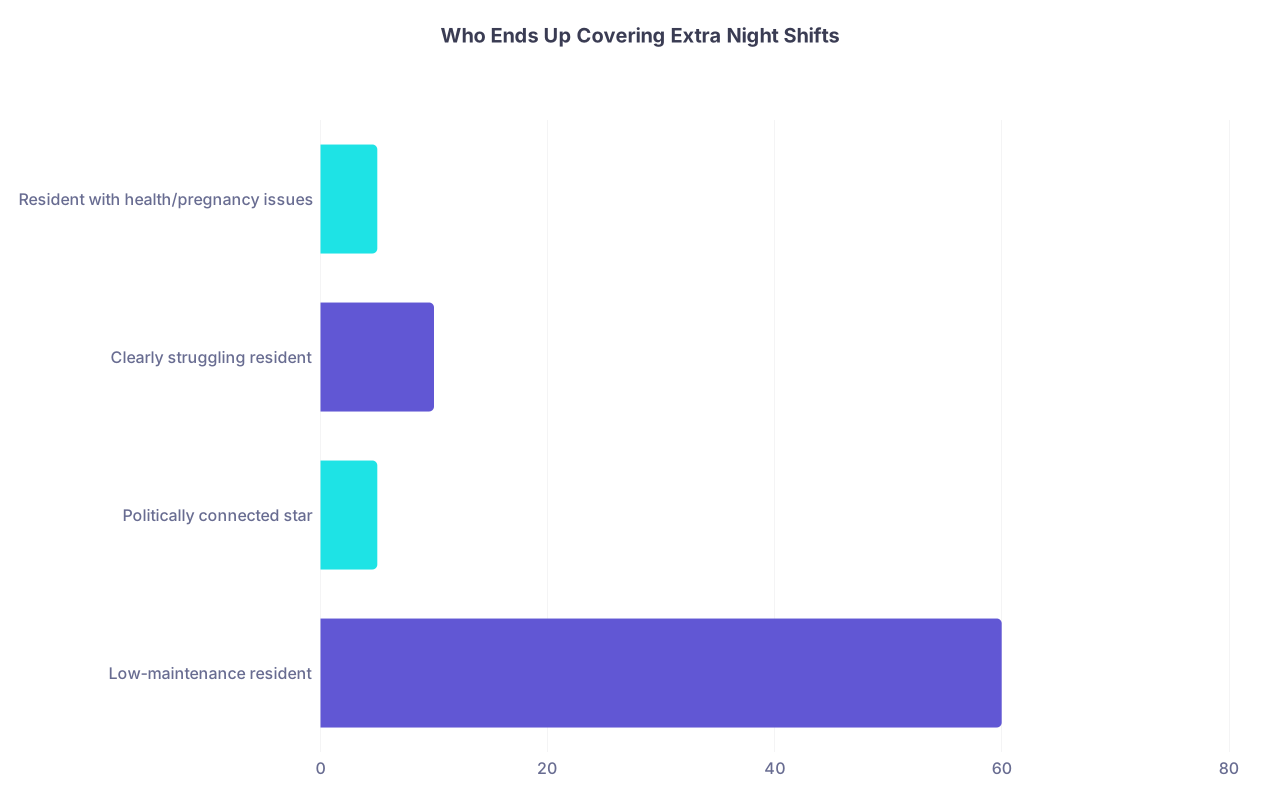
| Category | Value |
|---|---|
| Low-maintenance resident | 60 |
| Politically connected star | 5 |
| Clearly struggling resident | 10 |
| Resident with health/pregnancy issues | 5 |
Is this just? Not really. Is it reality? Yes.
How to Position Yourself: Not Exploited, Not Sheltered, Actually Respected
You cannot control all of this. But you are not powerless.
The residents who end up in the best spot — not being abused with nights, not being sidelined as “too fragile,” actually respected — share a few traits.
They make it obvious they’re safe on nights.
That doesn’t mean being perfect. It means:
- They call for help appropriately, not constantly.
- Nurses trust that when they page at 2 a.m., this resident will come.
- Attendings get concise, accurate sign-outs from them.
- They don’t bring chaos — emotionally or logistically — to the night team.
When chiefs and PDs know you’re safe at night, they stop worrying about you as a risk. That already moves you out of the danger bucket.
They also protect their own boundaries.
They don’t always say yes to every “favor.” They ask, calmly:
- “I’ve done 4 night blocks in 6 months. I’m concerned about burnout. Can we look at spreading this more evenly?”
- “I’m happy to help cover a night, but not an additional 6 in a row. Can we split it?”
The smart ones also quietly accumulate political capital: good relationships with nursing, attendings, chiefs; some involvement in something the program values (recruitment, research, QI). Not because they’re climbing some Machiavellian ladder. Because when push comes to shove and the chiefs are staring at that schedule, residents with visible value are less likely to be the default dumping ground.
And when they really are not okay, they say it clearly.
Not a vague “I’m tired.” Everyone’s tired. But:
- “I am not sleeping between shifts at all; I’m scared I’m going to hurt someone.”
- “I had suicidal thoughts last week after my shift.”
- “My neurologist has told me night shifts trigger my seizures; I need an accommodation.”
You say those things plainly to your PD or chief and watch how fast the conversation changes. No one wants to be the PD who ignored clear risk and then ended up with a tragedy on their desk.
One More Ugly Truth: Sometimes It Really Is Just Luck
There are times when it’s genuinely impersonal: a late maternity leave, a new night admitting service, a last-minute attending absence that changes coverage models. Someone has to move. You were on the wrong block at the wrong time.
But here’s how the “random” chips tend to fall: they fall hardest on the people no one is actively protecting.
If no one in the room is thinking, “We really need to shield X for fellowship / wellness / research / health / politics,” you’re just a name on a spreadsheet. And spreadsheets don’t feel guilt.
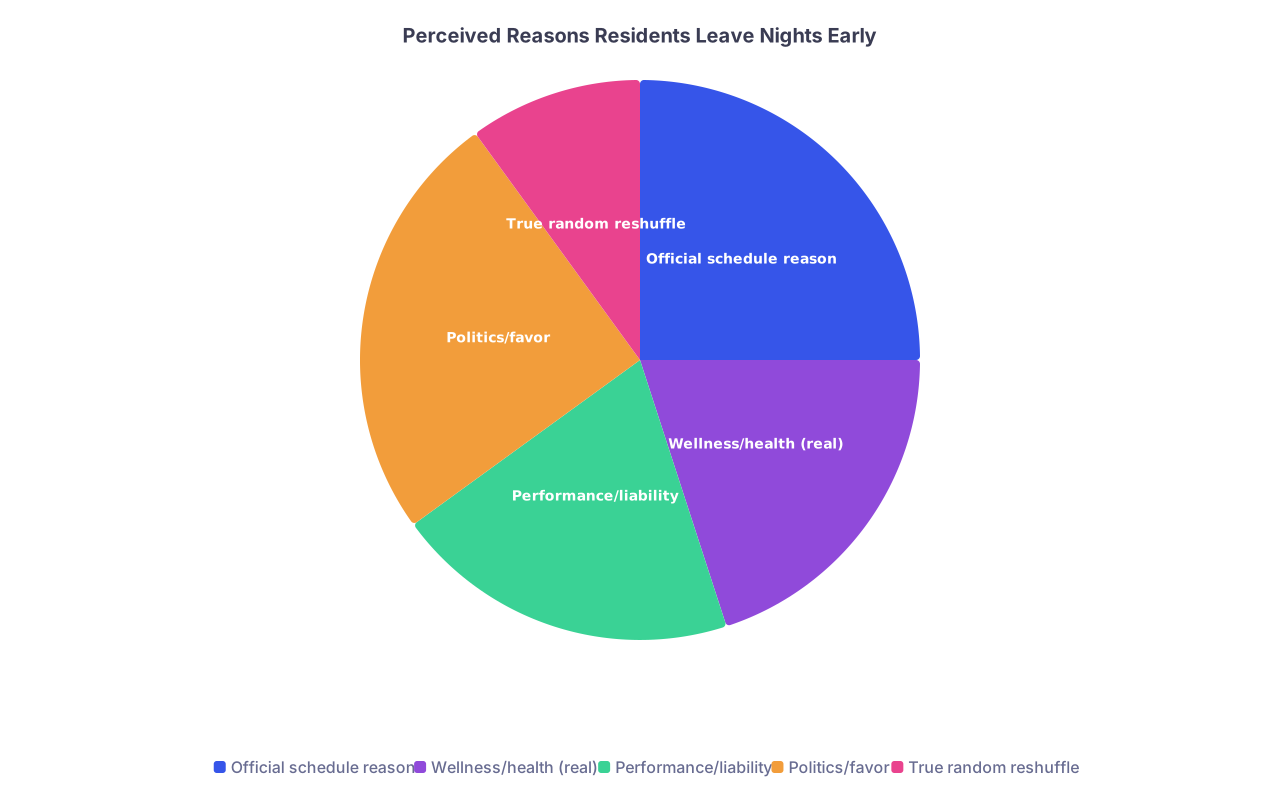
| Category | Value |
|---|---|
| Official schedule reason | 25 |
| Wellness/health (real) | 20 |
| Performance/liability | 20 |
| Politics/favor | 25 |
| True random reshuffle | 10 |
Residents usually believe the first one. The rest is what actually drives most of it.
The Bottom Line: What You Should Take From This
Stop looking at who got pulled off nights early and assuming it’s all luck or blatant favoritism. Sometimes it is. Often it’s a messy cocktail of real risk, perceived value, performance questions, and quiet politics.
Here’s what actually matters for you:
- Make yourself clearly safe and reliable on nights — not a hero, just someone attendings and nurses trust at 3 a.m.
- Build enough visible value and political capital that you’re not the default dumping ground when extra nights appear.
- When you’re truly not okay, say it plainly to someone with power. Do not hint. Do not hope they “notice.”
Those are the levers that decide, more often than anyone will admit to your face, who gets pulled off nights early and who keeps walking that hallway at 3:47 a.m. while someone else is already home, sleeping.