
It is 02:17. You have two open notes, a half-eaten protein bar, and exactly one goal: get through this call without missing something lethal. The phone rings. “Rapid response, 6 West. Patient desatting and hypotensive.”
You are the only in-house resident. The ICU fellow is “available by phone.” The attending is at home. Nursing is looking at you like you are the code team. Because tonight, you are.
Let me walk you through this the way I wish someone had done, with clear mental decision trees you can run in 10–30 seconds when your adrenaline is spiking and the room is chaos.
We are not doing abstract ACLS recitation. You already know “check ABCs.” We are going to turn that into concrete, branching pathways you can actually execute at 3 am, as a solo resident, on a non-ICU floor.
1. The First 60 Seconds: Room Entry Algorithm
Your job in the first minute is not to make a perfect diagnosis. It is to prevent the patient from dying while you figure it out.
Step 0 – As you walk / jog to the room
Call out, either by phone or overhead nurse:
- “Get the crash cart to room X now.”
- “Put patient on full monitor: continuous pulse ox, BP q2–3 min.”
- “Bring an ABG kit / VBG tubes.”
- “Get RT to the bedside.”
You say this before you arrive. Half of your “efficiency” is front-loading the work.
Step 1 – Doorway snapshot: 5-second triage
You step into the room and do not touch anything for 3–5 seconds:
- Is the patient talking in full sentences?
- Color: pink vs gray vs blue vs mottled?
- Work of breathing: gasping, tripoding, using accessory muscles?
- Level of consciousness: awake but anxious vs obtunded vs eyes rolled back?
- Monitors: HR, BP, SpO₂, respiratory rate (if real, not the charted 18).
Then you decide immediately: Is this a crashing patient?
Crashing = any of the following:
- Cannot speak in full sentences or can barely respond.
- Systolic BP < 80 or MAP < 60 with signs of poor perfusion.
- SpO₂ < 85% despite oxygen.
- HR > 140 sustained, with hypotension or altered mental status.
- No pulse / pulseless electrical activity / obvious agonal respirations.
If yes → your mental state switches from “rapid response” to “this is almost a code.”

| Step | Description |
|---|---|
| Step 1 | Enter Room |
| Step 2 | Doorway Snapshot |
| Step 3 | Call Code / ICU Stat |
| Step 4 | Rapid Response Pathway |
| Step 5 | Airway Breathing Circulation |
| Step 6 | Crashing? |
Step 2 – Call type escalation
Do not be precious about labels.
If the patient is:
- Not responsive / pulseless → Call a Code Blue.
- Profoundly unstable but with pulse → Rapid response is fine, but you should:
- Call ICU fellow/attending directly.
- Consider upgrading to Code Blue if trajectory is clearly downward.
You will never be criticized for calling a Code on someone extremely unstable. You will absolutely be criticized (and rightly) for the opposite.
2. Airway and Breathing: A,B Decision Tree for the Floor
Most overnight rapids are respiratory-ish. Desat, increased work of breathing, or just “they don’t look right.” Here is how to run the algorithm.
Step A – Can they protect their airway?
Ask two questions fast:
- Are they following commands and answering questions coherently?
- Do they have a strong cough / gag when suctioned or stimulated?
If no to either, or if they are gurgling, snoring loudly, or repeatedly obstructing:
- Call RT: “Prepare for possible intubation – bring airway cart.”
- Call ICU fellow/attending: “Possible airway compromise, we may need to intubate on the floor or move to ICU stat.”
- In the meantime: head tilt–chin lift, jaw thrust, oral airway if tolerated, suction.
You are not doing solo intubations on the floor as a PGY-1 in most places. Your job is to recognize airway failure early and mobilize the right people.
Step B – Oxygenation decision tree
Think in escalating steps, not random oxygen settings.
Nasal cannula 2–6 L
Use if:- Mild distress.
- SpO₂ 88–92% (in COPD) or <94% (non-COPD).
- They can speak in full sentences.
Non-rebreather mask 10–15 L
Use if:- SpO₂ < 90% on nasal cannula.
- Moderate to severe distress.
- They look scared and are breathing fast but still protecting airway.
High-flow nasal cannula (HFNC) or BiPAP / CPAP
Think of HFNC for hypoxemia with high work of breathing. Think of BiPAP for hypercapnia (COPD, obesity hypoventilation) or cardiogenic pulmonary edema.You must also think: this is ICU-level care.
If they need HFNC/BiPAP → you should be moving them to ICU unless your hospital has a specific intermediate unit that clearly owns this.Intubation
Clear triggers:- Cannot keep SpO₂ > 88–90% despite NRB + HFNC / BiPAP attempt.
- Fatigue: RR dropping, mental status worsening while still hypoxic.
- Recurrent apnea episodes.
- Refractory airway obstruction / anaphylaxis.
As a solo resident, this is your line: if they are on NRB and still <88–90%, and especially if they are tiring, you call ICU and say, “I think we need to intubate. Can you come now.” Not “consider,” not “maybe.”
Step C – Etiology split: hypoxia pattern recognition
Once oxygen is running and the room is calmer, you branch:
- Sudden onset, pleuritic pain, tachycardia, clear CXR → think PE.
- Fever, infiltrates on CXR, productive cough → pneumonia.
- Frothy sputum, crackles, S3, JVD, known CHF → cardiogenic pulmonary edema.
- Wheezes, chest tightness, history asthma/COPD → bronchospasm.
- Unilateral breath sounds ↓, tracheal shift → tension pneumothorax (that is a separate emergency).
You do not make final diagnoses now, but you aim your next tests:
- Stat CXR for basically all respiratory rapids.
- ABG/VBG if you are thinking hypercapnia or metabolic derangement.
- EKG if dyspnea, chest pain, or any hemodynamic instability.
- Troponin/BNP in high-risk cardiac patients (but never delay immediate management while waiting).
3. Blood Pressure Crashing: Hypotension Decision Tree
Overnight hypotension pages are constant. Some are garbage (cuff error). Some are sepsis about to spiral. Your job is to decide which is which in 5 minutes.
Step A – Confirm the number is real
You will see this a lot:
- NIBP says 60/40.
- Patient is talking, warm, mentating perfectly.
- Pulse feels fine.
First: recheck manually or ask: “Get another BP on the other arm, and use a manual cuff if possible.”
If you get:
- SBP < 80 or MAP < 60 repeatedly → treat as real.
- Wide difference between arms → think dissection, subclavian stenosis, or just positional artifact.
Step B – Rapid hemodynamic categorization
Look at:
- Mental status: anxious vs confused vs unresponsive.
- Skin: warm/flushed vs cold/clamy/mottled.
- JVD: up vs flat.
- Lungs: wet vs clear.
- HR: brady, normal, tachy.
This lets you roughly split:
- Warm, flushed, bounding pulses, wide pulse pressure → distributive shock (sepsis, anaphylaxis).
- Cold, clammy, weak pulses → cardiogenic or hypovolemic.
- Bradycardic with hypotension → conduction problem, drug, or neurogenic.
Step C – Immediate actions while you think
Raise the legs (passive leg raise) or lay them flat if not dyspneic.
Check IV access: at least 1–2 large-bore peripheral IVs.
Draw stat labs: CBC, BMP, lactate, blood cultures if suspicious for sepsis.
Give a fluid challenge:
Default: 500–1000 ml crystalloid bolus in adults unless:
- Clear pulmonary edema.
- Known severe systolic heart failure with volume overload.
In those cases, you can still give 250–500 ml cautiously while watching lungs and O₂ sat.
Step D – Sepsis / infection branch
If the patient is:
- Hypotensive.
- Febrile or hypothermic.
- Tachycardic, tachypneic.
- Suspicious source (pneumonia, UTI, intraabdominal, line infection, skin).
Then your algorithm is:
- Draw blood cultures now.
- Broaden antibiotics now (do not wait for rounds).
- Fluids: 30 ml/kg bolus is standard, but on the floor overnight you usually start with 1–2 liters and reassess.
- Call ICU early: “Septic shock, hypotensive requiring boluses, likely going to need pressors.”
If they remain hypotensive after 1–2 L and MAP < 65 → you are in vasopressor territory, which belongs in an ICU setting.
Step E – Cardiogenic / arrhythmic branch
Red flags for cardiogenic shock:
- New chest pain or dyspnea.
- Jugular venous distention.
- Pulmonary edema on exam.
- EKG changes (ST elevation, new LBBB, VT, massive ischemia).
- Cool extremities, narrow pulse pressure.
Your next moves:
- Stat EKG.
- Troponins.
- Consider bedside echo if available and you are trained (or get ICU/cardiology in).
- Avoid drowning them in fluids. Very common mistake.
For unstable arrhythmia (SVT with hypotension, VT with pulse but hypotensive, AF with RVR and hypotension):
- The decision tree is very short: this is synchronized cardioversion.
- As a solo resident, you call the code team or ICU, but you do not waste time with “maybe more fluids” while the BP is 70/40 and HR 180.
4. Tachycardia, Tachypnea, and “Something Is Off”
One of the most dangerous mindsets on nights: “They are just a little tachycardic.” Or “they are always tachypneic.” That is how you miss PE, sepsis, and intracranial catastrophes.
Tachycardia decision tree (non-crashing)
Split it:
HR 100–120, normotensive, asymptomatic
Check:- Pain.
- Anxiety.
- Fever.
- Dehydration.
- Meds (albuterol, withdrawal).
You can often fix the cause and move on.
HR 120–140, with mild symptoms or borderline BP
Now you must ask:- Is this sinus vs SVT vs AF vs something else? Get an EKG.
- Treat underlying (fever, pain, hypovolemia).
- Reassess MAP, mental status, urine output.
HR > 140 sustained or any HR with hypotension/AMS
This is a higher-risk category.
You are considering:- Sepsis.
- Massive PE.
- Unstable arrhythmia.
- Hemorrhage.
This is not “just fluids and walk away.” You at least need further workup and probably ICU involvement.
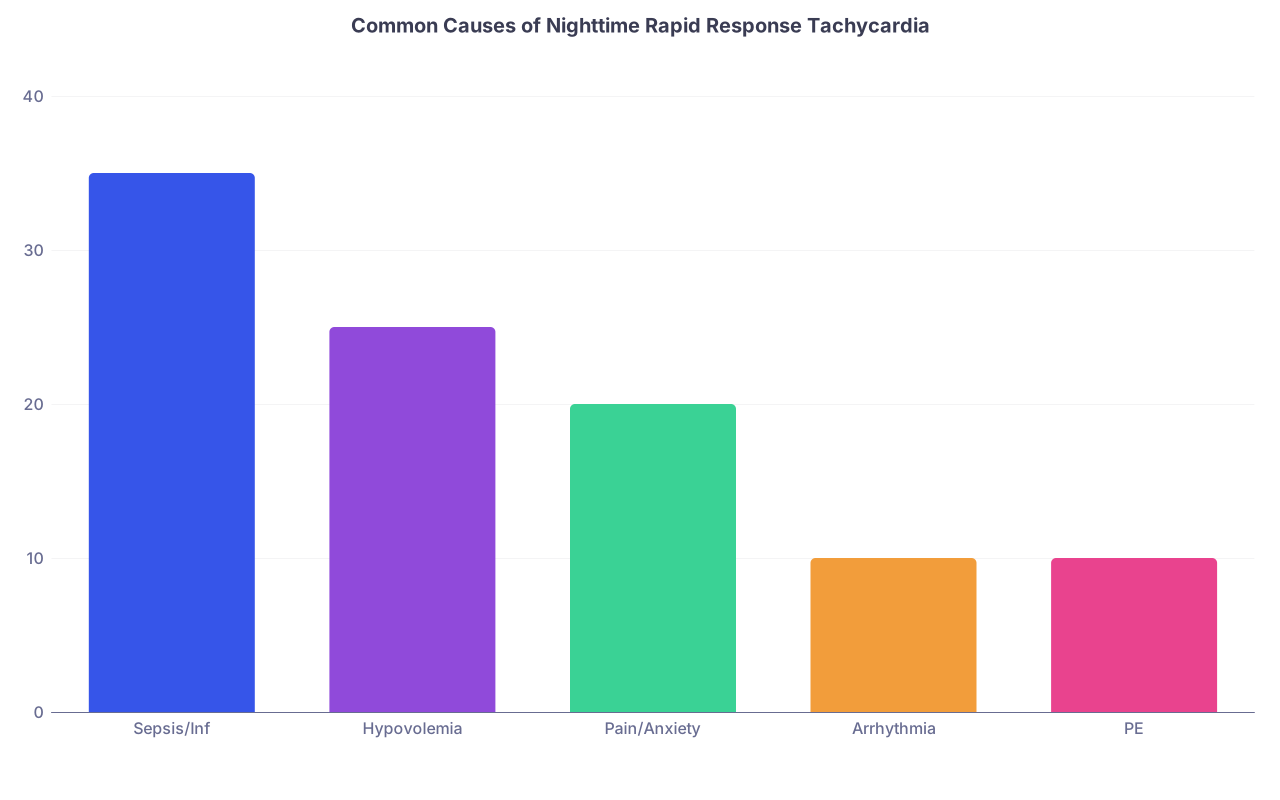
| Category | Value |
|---|---|
| Sepsis/Inf | 35 |
| Hypovolemia | 25 |
| Pain/Anxiety | 20 |
| Arrhythmia | 10 |
| PE | 10 |
Tachypnea decision tree
RR > 24 on a real count, not just the charted magical 18, should prompt actual thought.
Think of four big buckets:
- Hypoxia (pneumonia, PE, pulmonary edema).
- Metabolic acidosis (DKA, sepsis, lactic acidosis, renal failure).
- Pain / anxiety.
- CNS process (acidosis compensation, intracranial event).
Check:
- Pulse oximetry.
- ABG or VBG if you suspect metabolic derangement.
- Fingerstick glucose (DKA).
- Temperature.
- Lung exam.
Red flags:
- Tachypnea with normal or high SpO₂ → think metabolic acidosis or early sepsis / PE.
- Tachypnea with confusion and hypotension → high risk, you should not leave this patient under your casual “watch and wait.”
5. Neuro Changes: Delirium vs Stroke vs “Oh No”
Night float is delirium central. Nursing will call you for “patient is more confused.” You must be able to quickly separate:
- Benign, reversible delirium.
- Acute stroke or bleed.
- Global deterioration from shock or hypoxia.
Step A – Establish baseline
Ask: “What were they like 4–6 hours ago?” Pull the last nursing note. Ask the bedside nurse (they often know more than the chart).
If someone was fully oriented at 20:00 and is obtunded at 02:00, that is a different beast from an 88-year-old with sundowning who is now pulling at lines.
Step B – ABCs and vitals again
A “neuro” change is often the first obvious sign of:
- Sepsis.
- Hypotension.
- Hypoxia.
- Hypoglycemia.
So:
- Check BP, HR, SpO₂.
- Fingerstick glucose.
- Temperature.
You would be shocked how many “neuro” rapids are a blood sugar of 25 or an SpO₂ of 82%.
Step C – Focal vs global
Your internal branching:
- Focal deficit (new unilateral weakness, facial droop, speech disturbance, gaze deviation) → stroke code pathway.
- Non-focal (generalized confusion, disorientation, agitation, obtundation) → delirium/metabolic/toxic.
Stroke-like:
- Time of last known normal.
- Anticoagulation status.
- Call stroke team / neurology immediately if you have them.
- CT head stat. This is not a “let me see how they do in a few hours.”
Non-focal:
- Review meds: new sedatives, opioids, anticholinergics, benzos.
- Check labs: Na, Ca, BUN/Cr, ammonia if cirrhotic, ABG/VBG.
- Check for infection: UA, CXR.
If mental status is declining, airway protection becomes your main concern → loop back to airway tree and ICU involvement.
6. The “Can This Patient Stay on the Floor?” Decision
A question you must answer at the end of every rapid: “Where does this patient belong for the next 6–24 hours?”
You do not want the boomerang rapid – where you “stabilize” them, leave them on the floor, and then they arrest two hours later.
Here is a clean mental model.
| Status After Rapid | Example Scenario | Appropriate Location |
|---|---|---|
| Back to baseline, clear trigger fixed | Hypotension from extra BP meds, resolved with fluids | Floor with closer monitoring |
| Stable but high risk, likely to deteriorate | New sepsis on vasopressor watch, escalating O₂ needs | Step-down / Intermediate care |
| Needs continuous titratable support (pressors, HFNC, BiPAP) | Septic shock needing norepinephrine | ICU |
| Airway at risk or neuromonitoring required | Post-seizure with decreased GCS | ICU |
| Persistently unstable despite interventions | Ongoing hypotension, rising lactate | ICU / Transfer to higher level |
A few hard rules I use:
- Anyone needing HFNC, BiPAP, or vasopressors → not a floor patient.
- Any patient with ongoing MAP < 65 after fluids → belongs in an ICU.
- Any patient with significant, persistent elevation of oxygen needs compared to baseline (like 2L → NRB) → ICU or step-down at minimum.
- Anyone with new, unexplained troponin elevation with hemodynamic compromise → likely ICU.
You will be pressured (subtly or directly) to “watch them on the floor” because there are “no ICU beds.” Your job is to clearly document the objective reasons they require higher level of care and to escalate to the attending if necessary.
7. How to Run the Room: Communication and Control
The hardest part of solo-rapid life is not the medical knowledge. It is controlling a room full of people when you feel underqualified.
Here is the leadership mini-algorithm.
Step A – Declare roles out loud
You walk in and say:
“I am the resident. I will run this rapid response.”
Then:
- “Nurse A, can you stay at the bedside and read out vitals every 2 minutes?”
- “Nurse B, please get 2 large-bore IVs and draw labs I will list.”
- “RT, please manage oxygen; we may escalate to BiPAP or call ICU for intubation.”
You will feel awkward the first few times. Do it anyway. Clear role assignment prevents chaos.
Step B – Closed-loop orders
Do not just say “someone get an ABG.”
Say: “Maria, please draw an ABG now and send it stat. Can you repeat that back to me?”
Step C – Running summary
Every 3–5 minutes, especially once initial chaos subsides, you summarize aloud:
“Summary: this is Mr. X, hypotensive to 70/40, now 90/55 after 1 liter. Probable sepsis from pneumonia. On 10L NRB with SpO₂ 93%. We have blood cultures, labs pending. Plan: one more 500 ml bolus, broad-spectrum antibiotics now, and transfer to ICU. Any concerns from nursing or RT?”
That last question is not pandering. Nurses will warn you of things you are missing if you give them space.
8. Documentation and Debrief: Protecting Yourself and Your Patient
After the adrenaline crash, you will be tempted to write “Rapid response called, patient evaluated, plan discussed” and move on. Do not.
Your rapid response note should answer:
- Why was the rapid called?
- What did you find on arrival (vitals, exam highlights)?
- What did you do (fluids, meds, oxygen, labs, imaging ordered)?
- How did they respond?
- What is the disposition (stay on floor vs transfer) and why?
You do not need poetry, but you need clarity.
Example skeleton:
- “RRT called for hypotension 70/40.”
- “On arrival: patient awake but lightheaded, BP 76/45, HR 120, RR 26, SpO₂ 94% on 2L. Skin warm, lungs clear, no JVD. Suspect distributive shock, likely sepsis (fever 38.9, cough, crackles L base).”
- “Interventions: 1L LR bolus, repeated BP to 95/55; blood cultures x2, CBC, CMP, lactate, troponin ordered; CXR stat; started cefepime + vancomycin.”
- “Disposition: discussed with ICU fellow; transferring to ICU for ongoing hypotension risk and need for possible vasopressors.”
That kind of note protects the patient and makes the morning team’s job much easier.
You should also debrief mentally (or with a co-resident if around): what went well, what you hesitated on, what you want to handle differently next time.
9. A Few Common High-Yield Rapid Scenarios and Their Trees
Let me walk through three very common overnight rapid patterns and the exact branching I use.
Scenario 1 – “SpO₂ 78% on 2L. New SOB.”
- Confirm saturation with different probe / hand.
- Doorway: distress? speech? color?
- Put on NRB at 15 L while you figure things out.
- Exam: lungs (wheezes, crackles, asymmetric), heart, legs (DVT).
- Immediate tests: CXR, EKG, ABG/VBG, labs.
- Decide most likely:
- CHF → IV diuretic, nitrates if hypertensive, ICU if needs BiPAP.
- Pneumonia/ARDS → antibiotics, ICU if needing HFNC/BiPAP.
- Suspected PE with instability → call ICU, consider emergent CT angio if stable enough to move, or bedside echo, and coordinate with attending about lytics vs transfer.
If you cannot maintain SpO₂ > 88–90 on NRB → you call ICU for intubation.
Scenario 2 – “BP 60/40. Patient looks pale.”
- Confirm BP with manual cuff.
- Check HR, mental status, skin, JVD.
- Quick review: recent surgery? GI bleed? On anticoagulation? Diarrhea/vomiting? Infection?
- Two large-bore IVs. 1L crystalloid bolus.
- Send CBC, BMP, lactate, type and screen, coags.
- If GI bleed suspected: call GI and ICU; get PPI bolus, transfuse if indicated.
- If sepsis likely: broad-spectrum antibiotics and call ICU.
If after 1–2 L fluids, MAP still < 65 → you clearly frame this as “shock requiring pressors, this patient must go to ICU.”
Scenario 3 – “Acute confusion and right-sided weakness”
- Check vitals and fingerstick glucose immediately.
- If no obvious metabolic cause and focal deficit present → stroke code now.
- Document last known normal time.
- CT head non-contrast stat.
- In parallel: get NIHSS (if your system uses it), call neurology/stroke team.
This is not the time to hedge. Stroke systems live or die on fast activation, not perfect certainty.
10. A Visual: How Your Night Actually Flows
Just to show you how these things chain together, here is a simplified high-level flow of a typical overnight rapid response process.

| Step | Description |
|---|---|
| Step 1 | Rapid Called |
| Step 2 | Pre-Arrival Orders |
| Step 3 | Room Entry Snapshot |
| Step 4 | Code Blue / ICU Stat |
| Step 5 | ABCs and Vitals |
| Step 6 | Oxygen Escalation Tree |
| Step 7 | Hypotension Tree |
| Step 8 | Neuro Status Tree |
| Step 9 | Tests and Initial Treatment |
| Step 10 | Response Assessment |
| Step 11 | Close Monitoring Plan |
| Step 12 | Transfer |
| Step 13 | Higher Level of Care |
| Step 14 | Documentation |
| Step 15 | Crashing? |
| Step 16 | Primary Problem |
| Step 17 | Disposition |
FAQs (Exactly 5)
1. How do I know when to upgrade a rapid response to a full code?
If the patient loses a pulse, has agonal or absent respirations with no meaningful circulation, or is so unstable that cardiac arrest is imminent (MAP in the 40s with altered mental status despite immediate interventions), you should call a Code Blue. Practically: if you are about to start chest compressions or seriously think you might in the next moments, do not hesitate. Call the code, get full team support, and document your reasoning.
2. What if I am unsure whether a patient really needs ICU after a rapid?
Err on the side of higher level of care when three conditions are present: ongoing hemodynamic instability (MAP < 65 despite fluids), escalating or high oxygen requirements (NRB, HFNC, BiPAP), or any need for continuous titratable infusions (pressors, high-dose insulin, etc.). If you are genuinely torn, call the ICU fellow and present objective data: vitals trends, lactate, oxygen needs, mental status. Ask directly, “Do you think this patient is safe on the floor?” Make it their shared decision, not just your burden.
3. Should I start pressors on the floor if I have a peripheral IV and the ICU is delayed?
This is highly institution-dependent. Some hospitals have protocols for starting low-dose norepinephrine peripherally pending ICU transfer; others prohibit it outside ICU. You must know your local policy. Broad principle: while you can sometimes temporize briefly, persistent shock requiring pressors is an ICU problem, not a floor solution. Your priority should be rapid escalation, not building a makeshift ICU in a random ward room.
4. How aggressive should I be with fluids in hypotensive patients with known heart failure?
Heart failure does not mean “no fluids ever.” In actual hypotension with suspected infection or hypovolemia, you usually start with smaller boluses (250–500 ml) and reassess after each, watching for crackles, rising JVP, or worsening O₂ needs. Bedside ultrasound (if you are trained) helps a lot. The mistake I see more often is undertreating sepsis from fear of edema. You can always back off and diurese later; you cannot undo prolonged hypoperfusion.
5. How do I handle the fear of missing something big on these calls?
You will miss things occasionally. Everyone does. The way you limit harm is by following structured approaches: always reassess ABCs, always check vitals and glucose, always consider sepsis/PE/stroke in the right context, and never ignore your gut when a patient “looks bad” despite seemingly okay numbers. Debrief after tough cases, ask seniors how they would have approached it, and gradually your internal decision trees sharpen. Fear never goes away entirely, but it stops paralyzing you and starts making you systematic.
Key takeaways:
First, think in explicit, rapid decision trees: airway and oxygen first, then hemodynamics, then cause. Second, treat “borderline” instability with respect—escalate early to ICU when patients need advanced support, not after they arrest. Third, run the room with clear roles and closed-loop communication, then document precisely what happened and why you chose the disposition you did.