
The fastest way to lose your senior’s trust on nights is not missing a diagnosis. It is how you handle pages.
Everyone thinks night float is about medical knowledge and stamina. The truth: your reputation is built or destroyed by 2 things—how you respond to nurses and how you manage your pager. Seniors watch this closely. Attendings hear about it. Chiefs absolutely care.
Let me walk you through what people actually say about you when you are not in the room.
What Seniors Really Think About Your Pager
By October of intern year, every senior has you sorted into one of three categories: reliable, chaotic, or dangerous.
Reliable is the resident whose pager patterns are predictable: answers quickly, prioritizes correctly, does not panic-page seniors, and does not make nurses regret calling them. Chaotic is constantly behind, calling back out of order, forgetting to close the loop, missing critical pages because they are drowning in noise they helped create. Dangerous is the one nurses bypass entirely and call the attending directly.
You want to be reliable. Not perfect. Reliable.
Here is the unspoken scoring system seniors use:
| Behavior Pattern | How Seniors Label You |
|---|---|
| Answers within 5–10 minutes, triages | Reliable, safe to trust |
| Slow but closes loops consistently | Teachable, needs polish |
| Fast but disorganized, no triage | Chaotic, risky alone |
| Frequently misses/ignores pages | Dangerous, needs supervision |
| Nurses praise your communication | Leadership potential |
Nobody will tell you this outright on day one. But they will talk about you like this in the work room at 3 a.m.
The Core Rules: What Your Seniors Expect (But Rarely Spell Out)
Rule 1: Respect the page. All of them.
Your senior expects one thing as the floor intern or cross-cover: when the pager goes off, you are accountable for it. Even if the nurse sounds calm. Even if it is the fourth “FYI” in the last 10 minutes.
Here’s what happens behind the scenes. On nights, a bad outcome gets dissected the next morning. The question chain is always the same:
- “Was anyone notified?”
- “What time was the page?”
- “How long until the response?”
- “Who was covering?”
If a rapid is called at 03:40 and there is a record of “Page sent at 03:28, no response,” you are now the center of the story. I have watched chiefs scroll through call logs in front of the PD. It is uncomfortable when your name comes up.
So the baseline:
- Aim to acknowledge pages within 5–10 minutes, sooner if the message sounds even slightly concerning.
- If you are tied up in a rapid or a code, have your senior or another intern cover your pager, or at least let the operator know you are unavailable and who is backup.
The medicine itself can be messy. The response time cannot.
Rule 2: You are judged on triage, not just speed
Answering pages quickly is half the game. The other half is handling them in the right order. Your senior wants to know you can triage without them holding your hand.
Here’s how people who’ve done this a long time sort pages in their head:
- Immediate/STAT – Vitally unstable or could be unstable in minutes
“BP 78/40”, “New O2 requirement”, “Chest pain”, “HR 160s with symptoms”, “Acute mental status change”, “Active bleeding”, “Can’t arouse patient” - Urgent (within 15–30 min) – Not crashing, but could worsen or needs timely orders
“Fever 38.9 on neutropenic patient”, “K is 2.9 / 6.0”, “New afib with RVR but stable”, “No urine output x 8 hours”, “Blood sugar 35” - Routine (within 60–90 min) – Symptom changes without instability, non-critical lab results
“Pain uncontrolled 8/10”, “BP 170s/90s on asymptomatic patient”, “New nausea/vomiting”, “Low mag/phos”, “Wound leaking, but vitals stable” - Low-acuity / Bundle later (as able) – Discharge meds clarifications, diet change, stool softener, sleep meds, “need new tele box”, pharmacy substitution questions.
Your senior expects you to develop this filter fast. They do not want to hear that you went to rewrite a senna order while a hypotensive patient waited.
On a busy night you will have to “stack” lower-acuity pages and address several during one room sweep. That’s normal. Just don’t make the high-acuity patient number 5 on your list because you wanted to be efficient.
Rule 3: Call early for sick, not late for dead
Here’s the secret every PGY-3 wishes interns knew from day one: they’d much rather you overcall on a potentially sick patient than undercall on a crashing one.
You will not get in trouble for:
- Paging your senior at midnight: “Hey, 68-year-old with pneumonia now 85% on 4L, was 94% earlier, RR 28; I’m heading to see her now but wanted to loop you in.”
- Saying: “This guy just doesn’t look right. Vitals borderline but I feel uneasy.”
You will absolutely get a reputation if:
- The patient ends up in the ICU at 06:30 and your senior finds out in sign-out that the nurse had been “worried all night.”
- The note says “MD notified at 02:00 for hypotension” and you did not escalate until 03:15 when the patient was altered.
The truth: seniors remember the nights where they say, “Why didn’t anyone call me?”
So your internal rule on nights should be simple: If you are thinking, “Should I call my senior?” the answer is yes.
Not only for patient safety. For politics. That same senior might be writing your fellowship letter one day.

| Category | Value |
|---|---|
| Immediate/STAT | 10 |
| Urgent | 25 |
| Routine | 40 |
| Low-acuity | 25 |
How to Actually Answer a Page Like You Know What You’re Doing
Most interns answer pages like students asking a question in small group: hesitant, overly polite, scattered. That wastes everyone’s time and makes nurses lose faith quickly.
I’ll walk you through what seniors expect to hear and say in those first 30 seconds.
Step 1: Set the tone in the first sentence
How you pick up the phone matters. It sounds trivial. It isn’t.
Bad:
- “Hello?”
- “Yeah?”
- “This is… um… the doctor?” (I’ve heard this.)
Solid:
- “This is Dr. Lee, night float resident, returning a page for 6 West.”
- “Hi, this is Dr. Patel, cross-cover for medicine. Who’s calling?”
It tells the nurse: you know who you are, you know what role you’re in, and you’re oriented to where they might be calling from.
Step 2: Get the critical info fast
The nurse does not need a full HPI. You do not need the whole admission story before you act. Good residents cut to what matters.
Your priority questions, in some form:
- “What’s going on right now?”
- “What are their vitals?” (If not already stated—often the good nurses lead with this.)
- “Any interventions already tried?” (Pain meds, repositioning, O2 bump, etc.)
- “How different is this from their baseline?”
You’d be shocked how often a “BP 90/50” is a big change from 150s baseline… or the patient’s usual. That difference changes your urgency.
And then you decide: phone order vs. you at bedside.
Step 3: Know when you can safely give phone orders
Not every page is a bedside emergency. Your senior expects you to distinguish pages that need your physical presence from ones that can be handled with clean, clear orders.
- Known chronic pain patient, 8/10 pain, vitals stable, asking for PRN.
- Asymptomatic BP 170/95, on home BP meds, already documented hypertension, no neuro changes.
- Mag 1.3, K 3.2, patient otherwise stable; protocol-based repletion.
- Nausea in a chemo patient with normal vitals, known to team.
Needs your eyes:
- New O2 requirement. Always.
- Chest pain. Always.
- Acute change in mental status, agitation, or “not acting right.”
- Hypotension or tachycardia outside of known baseline.
- “The nurse is just worried.” The good ones are rarely wrong.
Your senior will not be impressed if you order a fluid bolus sight unseen on a borderline hypotensive, tachycardic patient who’s actually bleeding into their belly.
They will be impressed if your default is: “I’m coming to see the patient. I’ll be there in 5 minutes; in the meantime, please put them on the monitor and get a full set of vitals.”

| Step | Description |
|---|---|
| Step 1 | Page Received |
| Step 2 | Read message |
| Step 3 | Go to bedside now |
| Step 4 | Call nurse, assess, see within 15 min |
| Step 5 | Phone orders or bundle with other tasks |
| Step 6 | Consider call senior |
| Step 7 | Document and close loop |
| Step 8 | Unstable signs? |
| Step 9 | Potential to worsen soon? |
The Politics: Nurses, Seniors, and Your Reputation
Here’s what no one tells you on orientation day: your evaluation as a night resident is heavily shaped by how nurses talk about you.
Day team hears:
- “The night doc was great—came quickly, explained everything.”
- Or: “We paged three times before anyone came.”
I have seen faculty change their entire impression of a resident based on a single night where the nurse said, “I didn’t feel safe with them on.” That sentence travels.
What nurses care about (more than your knowledge)
They are not grading your differentials for chest pain. They are tracking:
- Do you answer pages within a reasonable time?
- Do you show up when they are genuinely worried?
- Do you speak to them like colleagues or like they are bothering you?
- Do you close the loop and tell them the plan?
- Do you disappear after giving orders that don’t work and make them re-page?
If your pattern is: slow to respond, dismissive on the phone, reluctant to come to bedside, your nights will get painful. They will escalate around you—charge nurse, supervisor, sometimes straight to the attending.
You do not want to be the intern whose name makes the charge nurse’s face tighten at 7 p.m. handoff.
On the other hand, if you’re the resident who, at 1 a.m., says, “Thanks for calling, let’s go see them together,” they’ll cover you when there’s ambiguity. They’ll prioritize your pages. They’ll warn you early when a patient feels off.
Your senior sees all of this. They hear it. And they file it away.

The Night Flow: How to Stay Ahead of the Pager Instead of Being Ruled by It
The interns who drown on nights are not always the least knowledgeable. Often they just never learned to control the flow. They live purely reactive, sprinting after the pager like it’s a fire alarm.
Seniors expect you to start building systems. Here’s what that actually looks like.
Front-load the shift
The best night residents do a “preemptive strike” in the first 1–2 hours.
They skim:
- Who is on pressors / high O2 requirements / last 24 hours unstable?
- Who had borderline labs that day team was “watching”?
- Who’s on insulin drips, heparin drips, PCA?
Then they physically lay eyes on the highest-risk 3–5 patients before things get crazy. Why? Because when that 2 a.m. page comes—“Mr. Jones is more confused and his BP is 88/40”—you already know his baseline mental status and blood pressure. You know if he looked toxic at 9 p.m. or if this is truly new.
Your senior expects, over time, that you will not be meeting every sick patient for the first time at the rapid response.
Batch the low-acuity noise
You will get nonsense pages. Wrong orders. Typos. “Can you discontinue a med that was already discontinued” types of things. You will get 7 “melatonin and colace” pages in 20 minutes if you let it run you.
The trick seniors use: cluster and batch.
You keep a running list on paper or your phone (whatever your hospital allows) of non-urgent to-dos: constipation, sleep, home dose med reconciliation, “when can patient eat.” When you get a minute between higher-acuity tasks, you clear 3–5 of those at once.
What you do not do is re-open your EMR, dig into a 6-year chart, and spend 15 minutes at 22:30 figuring out a non-critical statin dose while someone’s new O2 requirement sits unanswered.
Communicate delays before they become anger
You will get overloaded. There will be a stretch where you have a rapid, a new admission, and three active pages all at once.
The difference between being perceived as “overwhelmed but solid” versus “unsafe” is how you communicate.
If you know you cannot get to a patient for 20–30 minutes, do not hide.
Call the nurse:
“Hey, this is Dr. Chen. I got the page about Ms. Ramirez’s pain. I’m in a rapid response right now. I’m going to be tied up for another 20 minutes—can you give another dose of her PRN that’s already ordered now, and I’ll come reassess as soon as I’m out?”
Better yet, if it’s potentially serious:
“And if she has any change in vitals or mental status, please call me back immediately or pull the rapid response button if you’re worried.”
You’d be surprised how much good will that buys you. Seniors expect you to learn this kind of time-management communication. It is how you scale from one team’s worth of patients to cross-covering the whole hospital.
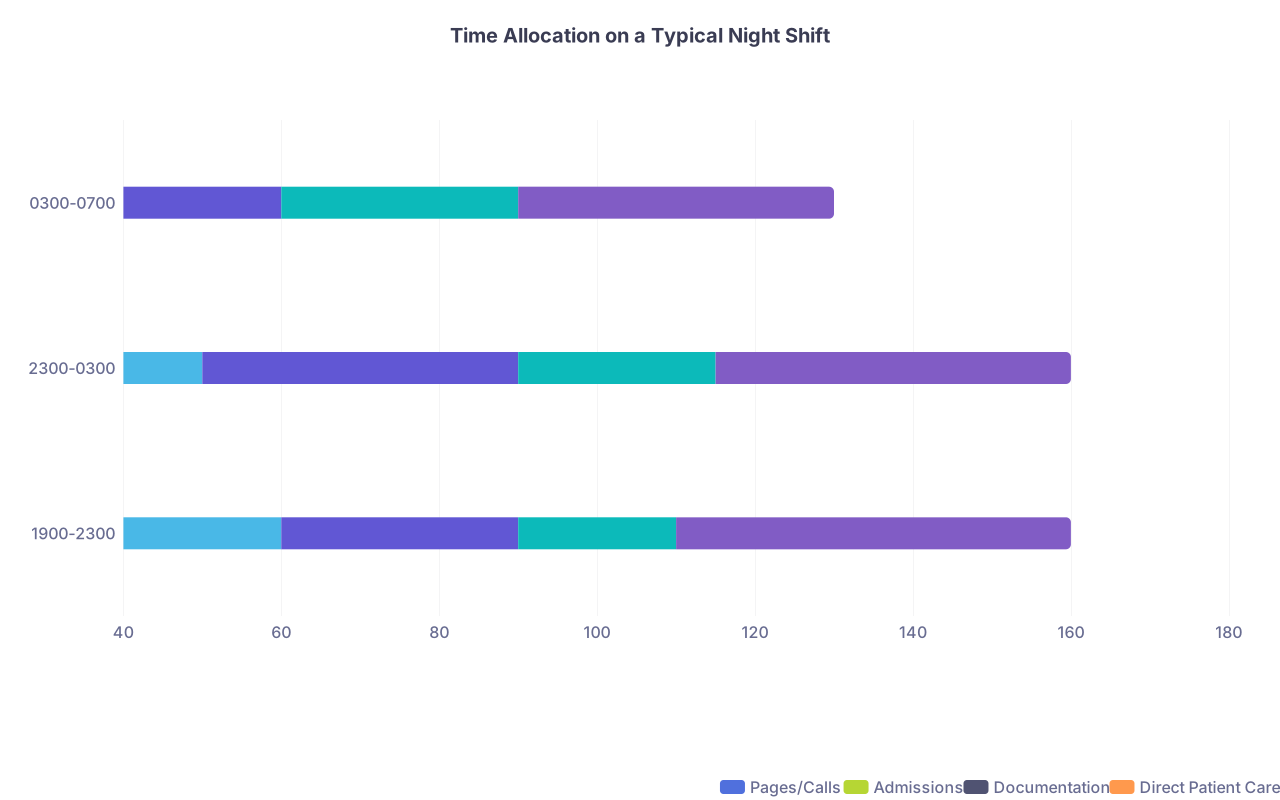
| Category | Pages/Calls | Admissions | Documentation | Direct Patient Care |
|---|---|---|---|---|
| 1900-2300 | 60 | 30 | 20 | 50 |
| 2300-0300 | 50 | 40 | 25 | 45 |
| 0300-0700 | 40 | 20 | 30 | 40 |
The Senior’s Pager: When and How to Use It Without Burning Bridges
You’re not just managing your pager. You’re deciding when to blow up your senior’s.
Residents do not say this out loud, but I will: they keep a mental scorecard of how often you page them on nights and for what. You want to be in the “calls me for the right stuff, not every 10 minutes” category.
Call for these. Every time.
If you remember nothing else, keep this list.
You must call your senior for:
- Any upgrade to ICU or consideration of upgrade
- Any rapid response or code you attend
- New need for pressors, BiPAP, or high-flow O2
- Chest pain that is not obviously benign once you reach bedside
- BP < 90 systolic that does not respond quickly to initial fluids or is associated with mental status change, dizziness, or low urine output
- New focal neuro deficit, suspected stroke, status epilepticus
- GI bleed with ongoing bright red blood or hemodynamic changes
- DKA/HHS you’re managing on the floor, especially if borderline
- Any patient where you think, “If this goes bad and I didn’t call, I’ll regret it.”
Your senior is not annoyed by these pages. They’re annoyed when they don’t get them.
Push yourself to manage these before you call
Then there’s the gray zone—where seniors start separating interns who will grow fast from those who want hand-holding.
Think twice before paging your senior in the middle of the night for:
- Asymptomatic single troponin bump that is tiny and already trended by day team
- A creatinine of 1.6 that was 1.5 this morning, in a chronically CKD patient, otherwise stable
- Mild hypernatremia or hyponatremia that’s not acute, vitals stable, no neuro changes
- Routine pain control adjustments for clearly documented chronic pain plans
- Second call on the same non-critical issue after clear instructions were already given
Does that mean you never call? No. But you should at least formulate a plan before you do.
You will earn huge points if your page sounds like this:
“Hey, this is Dr. Singh. I’m calling about Mr. Alvarez, the 72-year-old on 7 East with sepsis from pneumonia. His BP is now 94/52, HR 110, up from 105/60 an hour ago. He’s a little more lethargic but arousable. I’ve given 1 liter LR, blood cultures are drawn, lactate pending, and I’ve repeated a full set of vitals. I’m concerned he’s trending down. I think we should see him together and consider step-up or ICU. Are you able to meet me at bedside?”
Any senior worth their salt hears that and thinks: this intern is going to be fine.

The Subtle Stuff That Separates the Good from the Forgettable
By now you know the basics. Respond fast, triage well, loop in seniors appropriately. Let me give you the smaller things that no one teaches but everyone notices.
Stop saying “it’s just the nurse”
If you ever let “it’s just the nurse” slip out in front of a senior, watch their face. The good ones will shut that down instantly. The cynical ones will quietly write you off.
The best night residents treat every page as a data point. A charge nurse with 15 years of experience saying “he doesn’t look right” is more valuable than your third year med school neuro exam.
The internal script you want is: “If the nurse is anxious, I should at least be curious.”
Use a consistent structure when you call back
Your brain is going to be tired at 04:00. Structure saves you when your synapses are fried.
When you return a page, quickly:
- Identify yourself and unit
- Confirm patient and room
- Let the nurse speak without interrupting for 10–15 seconds
- Ask for vitals / mental status now
- Repeat back what you heard
- State your immediate plan and time frame
Example:
“Okay, so Mr. Davis in 623 has new chest pain, 7/10, pressure-like, started 10 minutes ago, he’s on 2L now at 94%, BP 138/82, HR 96, and no prior history of this exact pain. You’ve given nitro once. I’m coming to see him right now—should be there in 3–4 minutes. If his pain worsens, BP drops, or he gets short of breath, hit the rapid call.”
That kind of clarity stops repeat pages and builds trust. Your senior will notice that they are getting fewer “we paged but nothing happened” complaints on your nights.
Document like someone will read it at 08:00 (because they will)
Anything significant overnight—rapid response, major med change, new O2, near-transfer to ICU—gets a quick note. Not an epic novel. A clear record.
Morning teams and attendings go looking for: “What happened at 03:00?” If they see a clean, timestamped note, your name gets an asterisk in their head: this person is thorough even when tired.
If they see nothing, they start asking questions.

The Long View: Why Paging Etiquette Actually Matters
Night shifts will blur together. You will forget most of the names, the room numbers, the exact labs.
What sticks—on your side and on theirs—is how you showed up when the pager would not stop screaming. Did you disappear? Did you panic? Or did you slowly become the kind of doctor who can be trusted when there’s only a skeleton crew in the building?
Seniors are not expecting perfection. They remember their own train-wreck nights. What they’re looking for is trajectory: are you getting better at triage, at communication, at not making nurses fight to get your attention?
You will have nights where you miss something, or snap at someone, or get behind on pages. Own it, learn from it, and refine your system. The people you’ll work with for the rest of your career—attendings, fellows, co-residents—are watching that pattern more closely than you think.
Years from now you will barely recall the exact vitals on that 3 a.m. rapid. But you will remember when you shifted from being dragged by the pager to quietly, steadily leading the night. And so will everyone else.