
The mistakes you make charting on night shift will haunt you at 10:15 the next morning. When the attending pulls up your note on rounds and says, “So… explain this.”
You do not want that sentence directed at you.
Night float isn’t just about surviving admissions and cross-cover. It’s about not creating daytime chaos with sloppy, rushed, or defensive documentation that makes everyone’s life harder—especially yours.
Let me walk you through the charting pitfalls I’ve watched residents fall into over and over, and how to stay out of those traps.
1. The “I’ll Finish It Later” Note That Never Gets Finished
This is the most common and the most dangerous.
You’re slammed. You admit three patients in an hour. You tell yourself: “I’ll just put in a skeleton note now and fix it before sign-out.”
Then sign-out becomes a rapid-fire blur. You leave half-finished notes. The day team opens them at 7:10 a.m. and finds:
- “Plan: TBD”
- “Need to review imaging”
- “Will confirm home meds with family”
- Or worse—no note at all, just a bunch of scattered orders
Do not make this mistake. Incomplete documentation at night leads directly to confusion, duplicated work, and angry pages later.
Why this creates daytime headaches
- The day team looks unprepared on rounds because they can’t see your reasoning.
- Nursing and consultants assume nobody has a plan.
- Stuff you “meant to clarify” (home meds, code status, allergy discrepancies) falls through.
- You look disorganized and unreliable, even if you actually did everything clinically right.
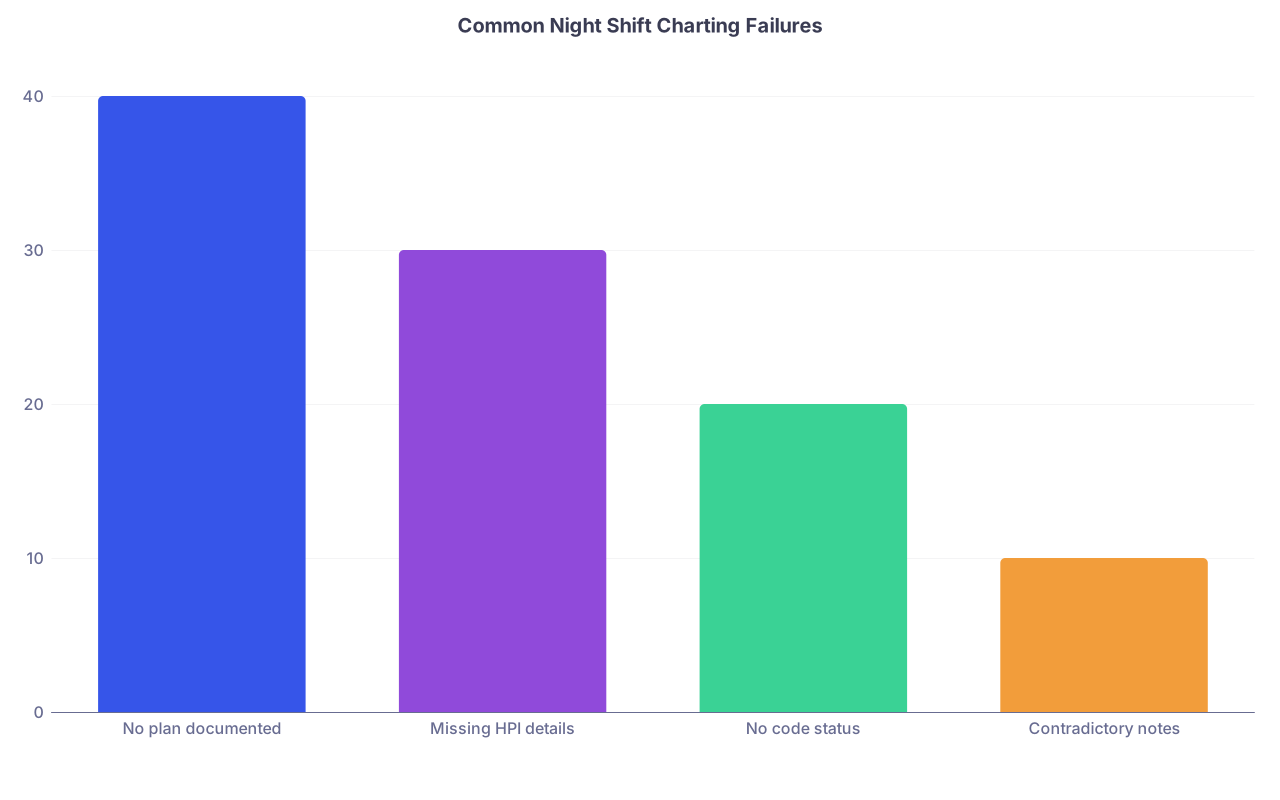
| Category | Value |
|---|---|
| No plan documented | 40 |
| Missing HPI details | 30 |
| No code status | 20 |
| Contradictory notes | 10 |
How to avoid it
Use a strict rule: every new admission gets a minimum viable complete note before you move on.
That means:
- A brief but coherent HPI
- Focused, relevant physical exam
- Problem-based assessment
- At least an initial plan for each active problem
You can be concise. You cannot be vague.
Bad:
“AKI – monitor”
Better:
“AKI on CKD3, likely pre-renal from decreased PO/oral intake x3 days. Plan: 1L LR now, repeat BMP in a.m., strict I/Os, hold lisinopril, avoid NSAIDs, consider renal US if no improvement.”
You can tighten it even more, but the reasoning and next steps are clear. Day team can follow it without guessing what you were thinking.
2. The Copy-Forward Disaster That Becomes a Legal Problem
Copy-forward is the EHR’s most tempting trap on night float.
You’re tired. You open last night’s note. You hit copy. You skim. You tweak the vitals and labs. Done.
Except:
- You just copied “no chest pain” on a patient who had chest pain at 4 a.m.
- You left “no restraints” on a patient who got restrained for agitation overnight.
- You kept “on room air” in a patient now on 4L NC.
This is how people get burned.
Why this is worse on nights
- Staff is thinner; more stuff changes without perfect documentation.
- You’re covering more patients than the day team per resident.
- Things happen quickly: rapid responses, stat imaging, new consults.
Copying forward outdated information makes it look like you weren’t paying attention even if you were.
Concrete example
I’ve seen this exact thing:
Daytime progress note: “No evidence of sepsis; afebrile, WBC 7.”
Night: patient spikes 39.2, becomes hypotensive, gets started on broad-spectrum antibiotics.
Night resident copies day’s note template, adjusts vitals, but leaves: “No evidence of sepsis.”
Guess what the attending and risk management focus on the next day.
Safer way to use templates
- Use templates as structure, not as content.
- Delete any section you’re not actually updating.
- Never copy the assessment and plan wholesale from yesterday. Rewrite each active problem in your own words, even if it’s one line.
If you’re too tired to check every line, you’re too tired to copy-forward. Start from a clean template.
3. The Vague, Defensive, or Blame-Shifting Note
Night notes often get written in the heat of annoyance:
- The cross-cover patient with “10/10 pain” every four hours.
- The frequent fall risk who refuses bed alarm.
- The family demanding “another CT” at 3 a.m.
You’re human. You get frustrated. But if that frustration leaks into your documentation, you create problems for yourself and the day team.
Red flags in night notes
Watch for phrases like:
- “Patient continues to complain of pain despite multiple medications.”
- “Family is very demanding.”
- “Nursing concerned but vitals stable.”
- “Notified day team to address.”
These read as defensive, dismissive, or lazy. Day attendings and risk management love parsing these sentences—against you.
A better approach
Stick to observable facts and your actual clinical reasoning.
Instead of:
“Patient continues to complain of 10/10 pain despite medications. Appears comfortable. Consider psych component.”
Try:
“Patient reports persistent 10/10 abdominal pain despite oxycodone 5 mg PO x2 and APAP. Resting comfortably in bed, normal respiratory pattern, speaking in full sentences, no guarding or rebound, vitals stable. No new focal exam findings. Will continue current regimen tonight, avoid additional opioids; flag for primary team to reassess pain management and consider non-opioid strategies/consult in a.m.”
You’re not minimizing symptoms. You’re documenting what you actually see and what you did. No editorializing. No blame.
4. The Missing “Why”: Orders Without Documentation
On nights, you’ll put in a ton of orders quickly:
- IVF boluses
- Stat lab panels
- CT scans
- Holding home meds
- Starting antibiotics
The mistake: you place the order and never document why. Then the day team walks in, sees new antibiotics, a new CT, and three fluids boluses and has no clue what triggered any of it.
They pull your note. Nothing.
Why this matters
- It looks like you practice by reflex or habit, not judgment.
- It forces the day team to reconstruct the night from nursing notes and the MAR.
- It’s a medico-legal risk: there’s no record you recognized or addressed the actual problem.

| Step | Description |
|---|---|
| Step 1 | Overnight Change |
| Step 2 | Document assessment only |
| Step 3 | Place orders |
| Step 4 | Write brief event note |
| Step 5 | Sign out to day team |
| Step 6 | Did you act? |
Simple fix: event mini-note
Every significant overnight change gets a short “event note” (or a clearly labeled section in your progress note if you’re re-charting):
- Trigger: what happened
- Assessment: what you thought it was
- Action: what you did
- Follow-up: what still needs to happen during the day
Example:
“2:30 a.m., called for SBP 82/50, HR 112. Pt appeared pale, mildly diaphoretic, mentating appropriately. Abdomen soft, non-tender. Concern for possible sepsis vs intravascular depletion. Ordered 1L LR bolus, blood cultures x2, lactate, CBC, CMP. BP improved to 104/62 after fluids, HR 96, lactate 2.1. Will need day team to reassess for infectious source and need for ongoing fluids vs pressors if hypotension recurs.”
That’s 4–5 sentences. Day team knows exactly what happened and why.
5. Ignoring Code Status and Goals of Care in Night Notes
Night float is when the ugly truths surface:
- Patient clearly failing despite “full code” documented three admissions ago.
- Family finally asking, “Is all this really helping?”
- Patient saying at 2 a.m., “I don’t want to go through that again.”
The mistake is pretending none of those conversations happened because you “don’t want to rock the boat” for the day team.
Or worse, you change the code status but don’t document the discussion clearly.
Why this burns people
- Day team walks in with one understanding of goals; patient/family was told something else overnight.
- You look like you either overstepped or avoided responsibility.
- Charts end up full of contradictions about what the patient actually wants.
| Mistake | Consequence |
|---|---|
| No note after code change | Confusion, ethics consults |
| Vague “discussed with family” | Conflicting recollections |
| No mention of patient input | Questioned capacity/consent |
| Multiple conflicting notes | Legal and risk exposure |
How to chart this without creating chaos
If you do not change the code status but discuss it:
“Overnight discussion with patient about prognosis and resuscitation preferences. Patient currently documented as full code, expresses uncertainty about wanting chest compressions/intubation if condition worsens. Provided initial information, recommended further discussion with primary team and possibly palliative care in a.m. No change made to current code status.”
If you do change code status:
- Document who was present (patient vs surrogate, relationship).
- Document what was explained (big picture, not transcript).
- Document patient’s explicit preference.
- Document that you updated the order in the chart and notified nursing.
Example:
“Called to bedside at 1:15 a.m. for family request to discuss code status. Present: patient, daughter (health care proxy), son. Reviewed patient current condition including metastatic pancreatic cancer with progressive decline despite treatment. Explained what CPR, intubation, and ICU-level care typically involve and likelihood of meaningful recovery in this context. Patient clearly stated he would not want chest compressions, shocks, or intubation if his heart or breathing stopped and prefers comfort-focused care. Daughter, as HCP, agrees this aligns with his longstanding wishes. Code status updated to DNR/DNI in chart. Primary RN notified. Sign-out to day team for further goals-of-care conversation and palliative involvement.”
No drama. Just clarity.
6. The “Resident vs Resident” Chart War
Do not fight with colleagues through the chart. Ever.
On nights you’ll inherit plans you don’t fully agree with:
- Surgeries “optimizing” for procedures that may never happen
- Wildly aggressive BP or glucose targets
- Unnecessary q4 labs or neuro checks
The wrong move is to undermine your co-resident in writing:
- “Unclear why day team ordered q4 BMPs; will discontinue.”
- “Primary team plan appears excessive; will adjust.”
- “Do not agree with previous decision.”
This is how you create political problems and—worse—an ugly, permanent record.
How to correct without attacking
Focus on current data and your current plan. Skip the commentary.
Instead of:
“Unclear why patient remained NPO per day team; now allowing diet.”
Try:
“Pt NPO overnight pending imaging, now completed with no evidence of obstruction. Abdomen soft, non-tender; no N/V. Will start clear liquid diet and advance as tolerated.”
You changed the plan. Everyone can see it. You didn’t throw anyone under the bus.
If something looks truly harmful or irrational, that’s a conversation first (call the chief, attending, or primary resident), not a passive-aggressive note.
7. Over- or Under-Documenting Critical Events
Nights bring codes, rapid responses, falls, and near-misses.
Two dangerous extremes:
- A three-page manifesto that drowns the key points in narrative.
- A one-line note: “Code blue at 3 a.m., ROSC achieved, see flowsheets.”
Both create headaches.
- Endless rambling: nobody can quickly figure out what happened.
- One-liners: it looks like you didn’t understand or own your role.
A clean structure for critical event notes
Aim for something like this:
- What triggered the event
- Key exam/vitals on your arrival
- What interventions occurred and your role
- Outcome/status at end
- Pending needs/next steps
Example for a rapid response (not the full code sheet, just your doc note):
“Rapid response called at 2:40 a.m. for acute hypoxia (SpO2 78% on RA). On arrival, pt tachypneic to 32, using accessory muscles, BP 148/86, HR 116, SpO2 82% on RA. Lung exam with diffuse crackles bilaterally, JVD present, 2+ LE edema. Concern for acute pulmonary edema vs pneumonia. Placed on 15L NRB then BiPAP 12/6, FiO2 60%, sats improved to 94%. Ordered stat CXR, ABG, BNP; gave IV furosemide 40 mg x1. Discussed with ICU fellow; decision to transfer to stepdown with BiPAP and close monitoring. Handoff given to accepting team.”
Not a novel. Not a shrug. Just enough to reconstruct the night.
8. Forgetting That Nurses and RTs Read Your Notes Too
A lot of residents act like only attendings read their documentation.
No. Nursing, RT, case management, PT/OT, consultants—all of them look at what you write.
When your note says:
- “Patient refuses to ambulate”
- “Non-compliant with fluid restriction”
- “Difficult family”
…without context, you’re basically lighting a fuse for team conflict the next morning.
How to write in a way that supports the team
Instead of:
“Pt refused ambulation despite multiple attempts.”
Try:
“Attempted to ambulate pt with RN this evening; pt declined due to feeling too fatigued and dizzy on standing. Vitals stable, no focal deficits. Encouraged at least sitting in chair, but pt preferred bed rest. Flag for day team and PT/OT to reassess barriers to mobility and provide further support.”
You still documented reality. You didn’t throw anyone under the bus. You gave the day team a useful starting point.
9. Not Leaving a Roadmap in Your Sign-Out + Chart
The worst combo: vague charting and vague sign-out.
You can’t assume the day team will have time to dissect your note. If they have 3 new admits and 10 follow-ups, they’re skimming.
Your night documentation should match your sign-out like puzzle pieces:
- Chart = the receipts (what happened, what you did).
- Sign-out = the handoff (what still needs to happen and why).
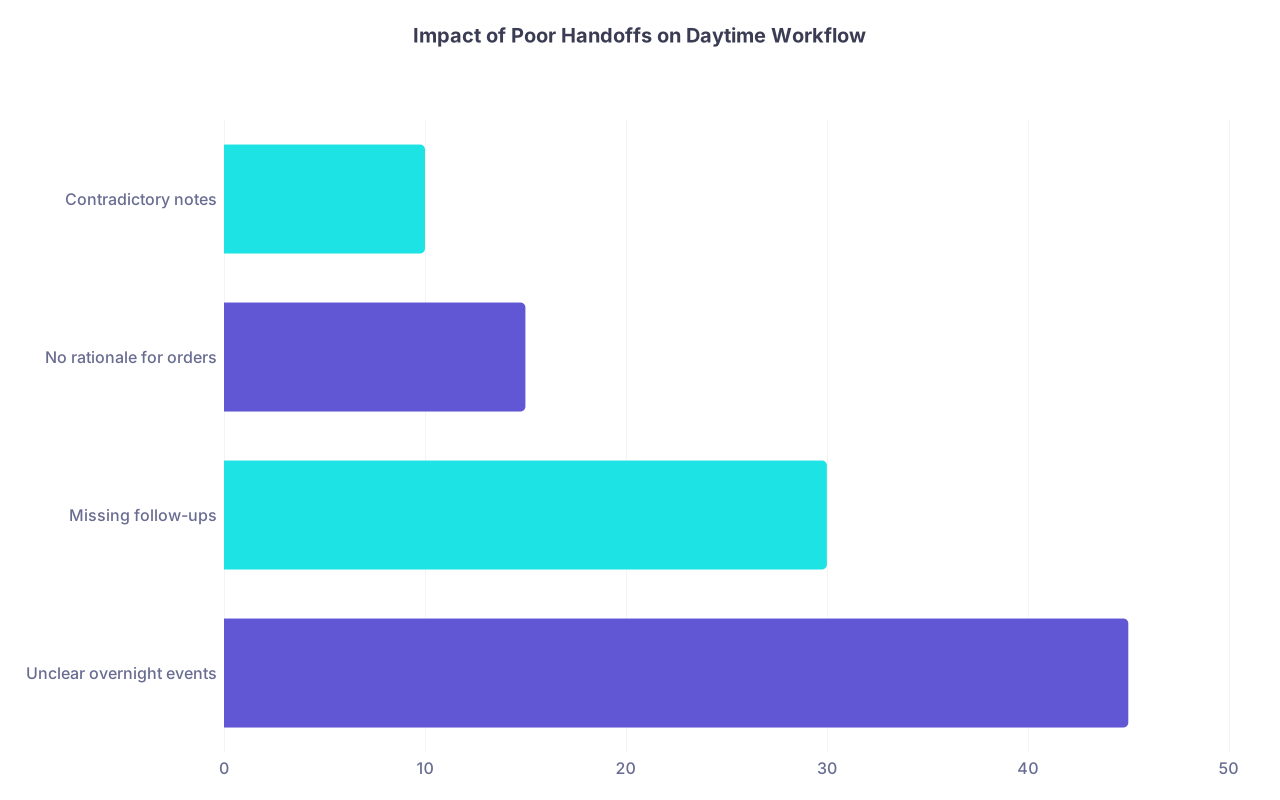
| Category | Value |
|---|---|
| Unclear overnight events | 45 |
| Missing follow-ups | 30 |
| No rationale for orders | 15 |
| Contradictory notes | 10 |
If your chart says “plan for CT in a.m.” and your sign-out doesn’t mention it, it’s going to be missed.
If your sign-out is detailed but your notes are skeletal, the attending will still question your judgment because they only see the chart, not your spoken handoff.
Simple alignment rule
For every admission or major overnight event, ask yourself:
- Is there somewhere in the chart where my reasoning lives?
- Does my sign-out explicitly reference what still needs to be done?
If either answer is “no,” you’re setting up the day team to fail.
10. Letting Exhaustion Write the Note
By 4 a.m., your brain is done. That’s when the worst charting happens:
- Incoherent sentences
- Wrong laterality (right vs left)
- Wrong patient problems pasted into the wrong chart
- Writing “labs WNL” when they’re absolutely not
This is how you create genuine safety issues.

Hard truth
You will be tired. You will make small mistakes. The trick is reducing the damage.
A few protective habits
- Double-check patient name/MRN before signing any big note or order set.
- If you feel your brain fuzzing, read your note out loud quietly before signing. You’ll catch the worst nonsense.
- Avoid free-typing long assessments when you’re barely awake—use short, clear sentences instead of complex ones with multiple clauses.
Example:
Bad 4 a.m. sentence:
“Given the current status of the patient who seems relatively stable but may be at risk for further deterioration, will consider maybe repeating labs and seeing what happens and if there is any change may discuss with ICU.”
Better:
“Currently hemodynamically stable but at risk for deterioration. Will repeat labs at 6 a.m. If hypotension or rising lactate, will call ICU for reassessment.”
Quick Visual: Safer vs Risky Night Documentation Habits
| Safer Habit | Risky Habit |
|---|---|
| Brief but complete notes | “TBD” plans and placeholders |
| Fresh assessment each night | Blind copy-forward |
| Fact-based event notes | Emotional or blaming language |
| Clear code/goals-of-care notes | Unrecorded conversations |
| Collaborative tone about teams | Throwing nurses/colleagues under bus |


| Step | Description |
|---|---|
| Step 1 | Night shift actions |
| Step 2 | Orders placed |
| Step 3 | Notes written |
| Step 4 | Day team interpretation |
| Step 5 | Day plan quality |
| Step 6 | Patient outcomes |
| Step 7 | Perception of your competence |
FAQs
1. How detailed do my night notes really need to be?
You don’t need to write daytime-level essays. You do need: a coherent HPI for new admits, a focused exam, and a problem-based assessment with at least an initial plan. For overnight events, 3–6 clear sentences that explain the trigger, your assessment, what you did, and what needs follow-up are usually enough. If a lawyer or attending read only your note, they should be able to reconstruct what happened and why.
2. What if I disagree strongly with the day team’s plan?
Document the current situation and your current plan without attacking prior decisions. If you believe something is unsafe—like a clearly harmful order—call the senior, chief, or attending. Charting is not the place to wage war with your colleagues. Quietly adjust what’s reasonable, explain your reasoning in neutral terms, and escalate serious concerns through conversations, not passive-aggressive documentation.
3. How do I balance speed and accuracy when I’m drowning in pages?
Use structured, repeatable patterns: a “minimum viable note” template for admissions and a short “event note” format for overnight changes. Prioritize charting for sickest patients and for any action that changed management (new antibiotics, fluids for hypotension, rapid responses). When you’re slammed, it’s better to write a short, clear note right away than aim for a perfect note you never finish. Speed comes from repetition and structure, not cutting corners on clarity.
Open your last night shift note right now and read just the assessment and plan. Ask yourself: if you were the day resident seeing that fresh, would you know exactly what happened overnight and what you were thinking—or would you be guessing? Adjust tonight’s charting accordingly.