
The fastest way to lose an attending’s trust is not a bad note. It is a bad 3 a.m. page.
Night shift exposes you. There is nowhere to hide. The nurses know when you are out of your depth. The attendings know when you are paging without thinking. And people absolutely remember who is “solid at night” and who is unsafe after midnight.
You want to be in the first group.
This is not about being perfect. It is about avoiding the predictable, repeated paging mistakes that signal one thing to every attending: “I cannot trust this resident in an emergency.”
Let’s go through the landmines.
1. Paging Without Owning the Situation
The worst page at 3 a.m. is not “Patient is crashing.” The worst page is, “Um… can you come see this patient?”
That sentence says:
- You have not assessed the patient.
- You have no working differential.
- You want the attending to be the resident.
You must never sound like that.
Classic bad page:
“Hey, sorry to wake you, Mrs. X is hypotensive, I think? The nurse is concerned and wanted me to call.”
What the attending hears: I did not lay eyes on the patient. I did not review anything. I am calling because someone else told me to.
Better structure (and what they are expecting):
- “Hi Dr. Smith, this is Dr. Lee, night float on 6W.”
- “I am calling about Mrs. X in 612. She is a 68-year-old with septic shock from pneumonia, admitted today.”
- “Current issue: Her MAP dropped to 55 despite 2 L fluids; norepi just started.”
- “I have: Examined her, checked labs, looked at the I&O and meds, confirmed line access, bolused additional fluids, titrated pressors per protocol, and repeated vitals.”
- “I am concerned she is failing floor-level care and may need ICU transfer. My plan is: call the rapid response/ICU triage, draw lactate, blood cultures, ABG, and place a Foley for strict I&O. I want to confirm that plan and ask if you want any changes to pressor targets or additional workup.”
What this tells your attending:
- You saw the patient.
- You synthesized.
- You tried to manage within your scope.
- You are calling with a specific question and plan.
Do not make this mistake: paging before you know what is actually happening at the bedside. Unless the patient is literally coding, you go see them first. Then call.
2. Calling Too Late – The “Silent Sinker”
There is a specific kind of night resident that attendings do not trust: the one who waits until things are already catastrophic.
You know the pattern:
- Nurse calls you at 1:30 a.m. – BP 88/50, tachy to 120, patient looks worse.
- You order a 500 mL bolus.
- 2:15 a.m. – BP 82/48 now. Another bolus.
- 3:10 a.m. – BP 76/40, decreased urine, altered.
- Now you call the attending.
You just turned an early intervention problem into a near-code.
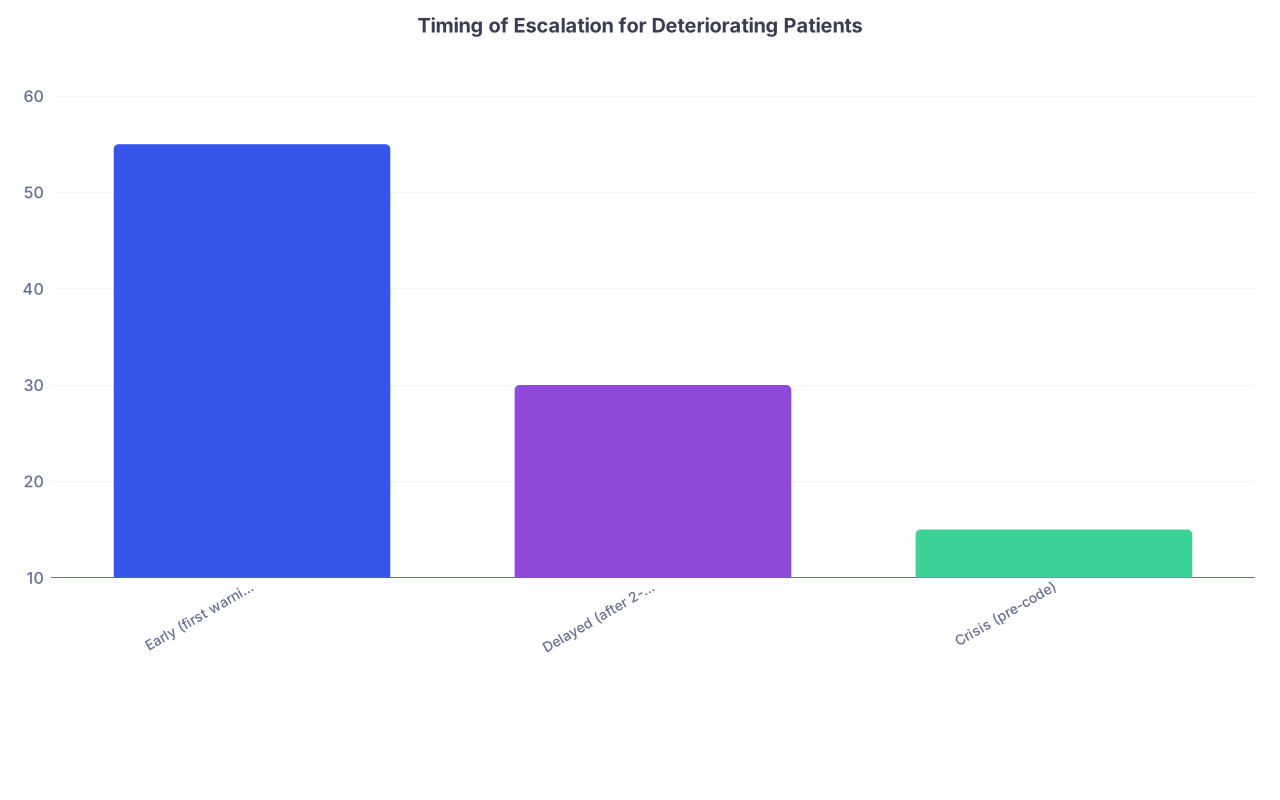
| Category | Value |
|---|---|
| Early (first warning) | 55 |
| Delayed (after 2-3 calls) | 30 |
| Crisis (pre-code) | 15 |
I have watched attendings re-read the overnight events at 7 a.m., then quietly say, “Why did no one call me at 1:30?”
Their trust is gone. Not because of one bad call, but because you showed them you do not recognize when to escalate.
Warning signs you should never “watch a bit longer” without at least considering a call:
- New O2 requirement jump (room air → 4 L or 2 L → 8–10 L).
- MAP persistently < 65 after an initial resuscitation attempt.
- Recurrent chest pain, especially with dynamic vitals or ECG changes.
- New focal neurologic deficit.
- Recurrent or ongoing hematemesis, melena with hemodynamic shift, or Hb drop > 2 overnight.
- Post-op patient with disproportionate pain, tachycardia, or a rigid abdomen.
- Any “I have a bad feeling about this” + objective vitals trending the wrong way.
You do not always need to call at the first soft BP. But you must not wait until the patient is crashing to loop in your attending.
Do not make this mistake: pretending “let me recheck in an hour” is a plan when things are clearly trending in the wrong direction.
3. Calling Way Too Early – Paging for Every Molehill
On the flip side, there is another resident attendings learn to distrust: the 2 a.m. speed-dialer.
Examples I have seen:
- Calling the attending at 2:30 a.m. because a stable patient’s K is 3.2 and you ask, “What should I do?”
- Waking a surgeon because the patient is NPO for a 9 a.m. OR case and wants water.
- Paging at 1 a.m. to clarify which bowel regimen the attending prefers.
This is how you advertise that you cannot handle basic decisions.
Red flags that your page is probably unnecessary:
- The problem is not urgent and could clearly wait for sign-out.
- The solution is something a second-year med student could figure out with UpToDate or your own brain.
- The nurse has not tried a basic nursing intervention yet (eg, non-pharmacologic sleep strategies, repositioning, antiemetic already ordered).

You must learn the difference between:
- “I need to wake my attending now”
- “I will handle this and update them in the morning sign-out”
- “I will text / non-urgent page to ask for teaching, but not at 3 a.m.”
Ask senior residents what they would call about. Watch what they handle independently. That is your bar.
Do not make this mistake: outsourcing basic clinical thinking to your attending at ridiculous hours.
4. Paging Without a Clear Question or Ask
If your attending has to ask, “What are you actually asking me to do?” you already lost points.
Common bad pattern:
- Long ramble.
- Lots of data vomiting.
- No endpoint.
Example:
“So this is Mr. Y, he is on 7W, has CHF, CKD, COPD, he came in three days ago for shortness of breath, he was on 2 L, then had some diuresis, and his creatinine bumped yesterday from 1.7 to 2.1, and now the nurse called me because his urine output seems lower and his BP is like 98 over 60, and he has some crackles but is kind of dry and I am not sure…”
And then you stop. Because you do not know what you want.
What your attending needs is:
- Headline.
- Your impression.
- Your ask.
Example of a better page:
“Dr. Jones, calling about Mr. Y on 7W, 76-year-old with CHF and CKD, 3 days post-admission for volume overload.
Right now he is:
- BP 98/60 (baseline 110s), HR 95, sat 94% on 2 L.
- UOP down to 0.3 mL/kg/hr over 6 hours.
- Creatinine rising from 2.1 to 2.6 today.
- Lungs with mild basilar crackles, JVP borderline, not clearly wet or dry.
I think he is getting into cardiorenal trouble and I am struggling to decide whether to give a cautious fluid trial, hold diuretics, or increase diuresis. My leaning is to hold tonight’s diuretic dose, give a small 250 mL trial, and reassess vitals and JVP. I want your input on that plan and whether you want to see him tonight or wait until morning rounds.”
Specific. Framed. Answerable.
Do not make this mistake: calling before you have formed any plan. You can be wrong. You cannot be blank.
5. Paging Without the Basic Data in Front of You
Nothing erodes confidence faster than this exchange:
Attending: “What is the blood pressure trend?”
You: “Uh… I am not sure, let me check.”
or
Attending: “What is her creatinine and baseline?”
You: “I don’t know, I think like 1-point-something?”
If you are going to wake someone up, you bring the data.
At a minimum, before dialing:
- Vitals (with trends, not just the last number).
- Relevant labs and scans.
- Current meds and recent changes.
- Code status.
- Allergies if meds might change.
- Lines/tubes/oxygen devices for sick patients.
| Situation | Must Have Ready |
|---|---|
| Hypotension / Sepsis | Full vitals trend, I&O, recent labs, fluids/pressors given |
| Respiratory distress | O2 device and settings, ABG/VBG, CXR status |
| Arrhythmia / chest pain | Tele strip rhythm, ECG (done or not), troponins status |
| Neuro change | Last-known normal, neuro exam, CT done/ordered |
| Bleeding / Hgb drop | Vitals, baseline Hgb, current Hgb, anticoag status |
If your call starts with “I’m not sure” to three consecutive basic questions, your attending will question every judgment you make after that.
Do not make this mistake: paging while your computer is closed, chart unread, and you have not stepped into the room.
6. Ignoring Nurse Concerns – or Blindly Obeying Them
Night nursing staff will save you. Or they will expose you. Depending on how you respond.
The two opposite but equally dangerous errors:
Blowing off the nurse
- “He was just 88/50 once, he looks fine, we’ll see.”
- “She always complains of pain.”
- “He is probably just anxious.”
Paging your attending as a courier for the nurse’s request
- “The nurse wants to transfuse.”
- “The nurse wants more pain meds.”
- “The nurse wants you to change the code status.”
Here is the move: you listen, you assess, you think, then you escalate if needed.
When the nurse calls you, your script in your own head should be:
- “What is this nurse worried about?” (serious? mild? pattern for this patient?)
- “What is my independent assessment after I go see the patient?”
- “Do I agree with the nurse’s concern and proposed plan?”
- “Is this within my scope, or does this truly need attending input?”
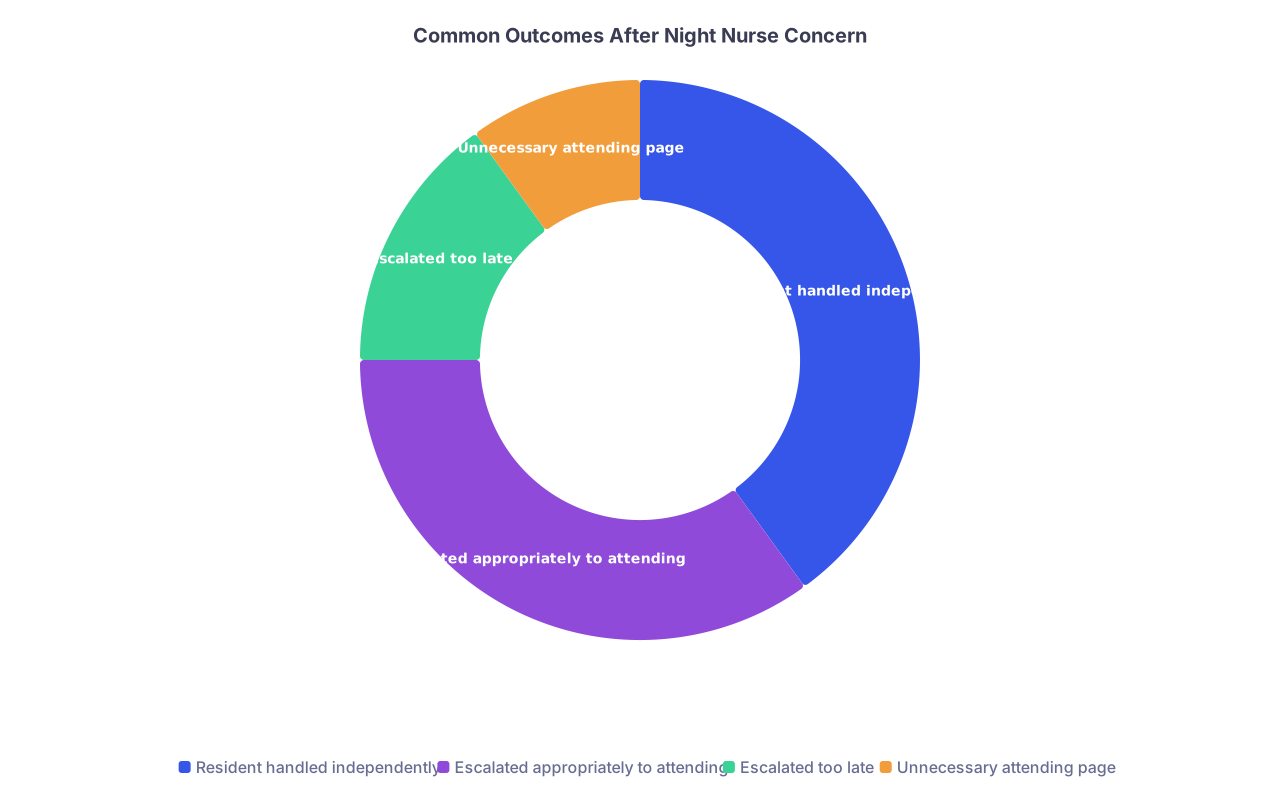
| Category | Value |
|---|---|
| Resident handled independently | 40 |
| Escalated appropriately to attending | 35 |
| Escalated too late | 15 |
| Unnecessary attending page | 10 |
Do not be the intermediary who calls the attending with, “The nurse wants…” That makes you look like a messenger, not a physician.
Reframe it:
- “I evaluated the patient after the nurse expressed concern about X. I agree / disagree with the concern because Y. My plan is Z, and I am calling to confirm / escalate.”
Do not make this mistake: using your attending to resolve every disagreement or uncertainty with nursing.
7. Dumping All Problems at Once with No Prioritization
Some residents think they are being efficient by “batch calling.”
They are not.
You know the call:
- “Hi, sorry to wake you, I have a few updates. First, Mrs. A’s K is 3.3 and I ordered oral K. Also, Mr. B’s blood sugar is 62 but we gave D50. Also, Mr. C is a little tachycardic in the 110s but otherwise okay. Oh and Mr. D had some chest pain but the troponin is pending and the nurse is a little worried.”
You just buried a potentially serious chest pain case inside three non-urgent trivialities.
Attending brains at 3 a.m. function on triage:
- What is physiologically dangerous?
- What could I miss that will be on the M&M slide next month?
- What decision actually requires my involvement?
Always lead with the most urgent or uncertain issue. If you must mention minor updates, they go at the end and they are quick.
Better:
- “I have one potentially serious issue and two very minor updates. Serious first: Mr. D, 64, admitted for pneumonia, now with new chest pain…”
If you are not sure whether to batch or separate, default to:
- Urgent/sick → call immediately, single focus.
- Administrative/minor → group or leave for sign-out.
Do not make this mistake: hiding the needle in a haystack of nonsense.
8. Paging in a Disorganized, Anxious Ramble
Your tone signals more than you think.
If your attending hears:
- Rapid speech.
- Ping-ponging details.
- No structure.
- Apologizing every other sentence.
They assume you are flailing.
You need a mental template. Something like a stripped-down SBAR, but faster.
Night-call micro-structure:
- Who you are and where you are.
- Who the patient is (age + key diagnosis).
- What is happening right now (the problem in one sentence).
- What you have already done.
- What you think is going on.
- What you want from them.
Example:
“Dr. Patel, this is Dr. Nguyen, night float on 8E.
Calling about Ms. L, 54, admitted for necrotizing pancreatitis.
Problem: She has acute worsening abdominal pain, tachy to 130, BP 90/55 from baseline 120s, and is febrile to 39.2.
I have: Examined her, repeated vitals, started a 1 L LR bolus, drawn labs (CBC, CMP, lactate, cultures), and ordered a stat CT abdomen and pelvis.
I am concerned about evolving sepsis or abdominal catastrophe. I think she needs higher-level care. I am planning to activate rapid response/ICU triage and am calling you to confirm that plan and ask whether you want to come see her now or review imaging first.”
Calm. Linear. Contained.

| Step | Description |
|---|---|
| Step 1 | Recognize issue |
| Step 2 | Assess patient |
| Step 3 | Gather vitals and data |
| Step 4 | Form working diagnosis |
| Step 5 | Initiate reasonable interventions |
| Step 6 | Define clear question |
| Step 7 | Call attending with structured summary |
Do not make this mistake: letting your own anxiety control the shape of the call.
9. Hiding Mistakes or Omissions
At 3 a.m., your instinct will be to cover yourself. To quietly “fix” something and not mention it. Or to leave out that you forgot to follow up a lab from four hours ago.
This is how careers get wrecked.
Attendings do not lose trust because you made a mistake. They lose trust because you:
- Hid it.
- Minimized it.
- Refused to own it in real time.
If you:
- Missed an abnormal critical lab for hours.
- Forgot to resume anticoagulation.
- Ordered the wrong dose of a medication.
- Delayed evaluating a nurse concern.
Then say so. Directly. With a follow-up of what you are doing now.
“I want to be upfront: his K of 6.1 came back at 00:30 and I did not see it until 02:00. Since seeing it I have ordered calcium, insulin+dextrose, and repeat labs. I am calling now to update you and confirm if you want him transferred to higher level care tonight.”
You will feel exposed. But the alternative is worse.
Because the attending will eventually read the chart. Talk to the nurse. Look at timestamps. If they learn about the problem from the EMR instead of you, that trust is gone and it does not come back easily.
Do not make this mistake: believing the problem is smaller if you do not say it out loud. It is not.
10. Forgetting to Close the Loop
The last quiet trust-killer: never updating your attending after a serious overnight issue.
Scenario:
- You call at 2 a.m. about acute hypoxia, chest pain, or concerning arrhythmia.
- You agree on a plan.
- Things improve.
- You go on with your night.
- You never send a brief update or mention it clearly in morning sign-out.
From the attending’s perspective:
- They wake up at 6 a.m. wondering what happened.
- Or worse, they learn from someone else on rounds.
Quick fixes:
- For significant overnight events, send a brief update through the agreed channel (secure message, page, or mention during 6–7 a.m. check-in if they do that).
- At minimum: “Ms. L’s BP and pain improved after fluids; CT did not show perforation, and ICU accepted her. Will present details on rounds.”
You are not trying to create more communication. You are closing the loop so they see you as someone who follows things through.
Do not make this mistake: treating the attending like an order set you use once and forget about.
Final Takeaways: How to Be Trusted at 3 a.m.
Boil this down to three moves:
See, think, then call.
Lay eyes on the patient, gather key data, and form a working plan before you hit the pager. You can be wrong. You cannot be unprepared.Escalate early for real problems, and stop waking people for trivia.
Do not sit on deteriorating vitals. Do not call for things you can safely manage yourself. Learn the difference fast.Communicate like a physician, not a messenger.
Give a concise story, your impression, and a clear ask. Own your mistakes. Close the loop.
You will not be perfect. Nobody is. But if you avoid these paging mistakes, your attendings will trust you at 3 a.m.—and that reputation will follow you for years.