
Paging chaos at 2 a.m. is not a rite of passage. It is a systems failure you can fix with a protocol.
You are not “bad at nights.” You are being buried under unprioritized information with no framework. And most programs throw you in with vague advice like “triage and prioritize” and then walk away.
Let us fix that.
Below is a concrete, field-tested way to handle night pages that:
- Protects sick patients from being missed
- Cuts your cognitive load in half
- Makes nurses trust you more
- Keeps you from getting shredded on sign-out the next morning
You will still be busy. You will still be tired. But you will not be drowning.
Step 1: Impose a Paging Structure on the Chaos
Unstructured paging is the enemy. You cannot control how often the pager goes off, but you can control how you process it.
From the moment you start your night:
Decide your triage categories
Use a 4-level system. No more, no less:- Level 1 – STAT / Life-threatening
Immediate response. Drop everything. - Level 2 – Urgent / Time-sensitive
Needs action within 15–30 minutes. - Level 3 – Routine but Necessary
Needs response, but can be batched within 1–2 hours. - Level 4 – Non-urgent / Can wait or be declined
Education issues, clarification, truly non-urgent.
- Level 1 – STAT / Life-threatening
Write this down at the top of your work sheet
Literally. Pen and paper. Something like:- L1: Code / hypotension / respiratory distress / chest pain / neuro change
- L2: Pain uncontrolled / fever / new abnormal lab / acute agitation / bleed
- L3: Routine meds / nausea / insomnia / minor pain / urinary retention
- L4: Order clarifications / non-critical scheduling / nonurgent updates
Use one running list for the night
Divide the page into 3 columns:- Time & source (e.g., 01:32, 6W RN)
- Patient & issue
- Level & plan (done / pending / re-eval)
This sounds simple. It is. That is why it works at 2 a.m. when you are half awake.
Step 2: The 15-Second Triage Script for Every Page
Your first 15 seconds after any page determines the next 15 minutes.
When you call back (you always call back), use a fixed script. Do not wing it. Your script should answer one question: “How fast do I need to deal with this?”
Here is a script I like:
Identify and orient (2–3 seconds)
- “Hi, this is Dr. [Name], night float. Who is paging and which patient?”
Get: patient name, location, MRN if needed.
- “Hi, this is Dr. [Name], night float. Who is paging and which patient?”
Ask for the headline first (5 seconds)
- “Tell me the main concern in one sentence.”
Force clarity: “He is more short of breath,” “She is more confused,” “He is in a lot of pain,” “We need an order for…”
- “Tell me the main concern in one sentence.”
Ask 3 rapid “sick/not sick” questions (5–7 seconds)
Tailor to the complaint, but generally:- “What are the vitals right now?”
- “Does the patient look different or more ill than earlier?”
- “Is there any concern for airway, breathing, or circulation?”
Assign a level in your head and say your next step aloud
- “OK, I am coming right now.” → Level 1
- “I will be there in about 10 minutes. If they get worse, call me STAT.” → Level 2
- “I will enter some orders and come see them in the next hour.” → Level 3
- “I will place that order now / let us address this during the day; I will document.” → Level 4
You are doing three things here:
- Protecting yourself medico-legally (you asked for vitals, you documented the plan)
- Reassuring the nurse with a concrete time frame
- Explicitly prioritizing in a way you can replicate all night
Make this script muscle memory. After a week or two, you won’t even think about it.
Step 3: Use a Simple Objective Priority System
Do not rely only on vibes for “sick/not sick.” People overestimate their gut when they are exhausted.
You want a fast mental checklist. I use what I call the 2-3-4 Rule:
2 – Two vital sign red flags → Level 1
Any two of the following should trigger immediate bedside evaluation:
- SBP < 90 or MAP < 65
- HR > 130 or HR < 40
- RR > 28 or RR < 8
- SpO₂ < 90% on baseline oxygen or requiring new >4L
- New confusion / unresponsiveness / focal neuro deficit
- New chest pain, especially with diaphoresis or hypotension
If two or more of these are present, you go. Now.
Even if the nurse says, “They always run like this,” go look.
3 – Three “worry questions” → Level 2 or 1
Ask yourself three quick questions after hearing the story:
- Can this kill them in the next 30–60 minutes if I am wrong?
- Has there been a sudden change from baseline?
- Is there incomplete information that cannot be fixed without seeing them?
If the answer to any of those is “yes,” that is at least Level 2. If also combined with vitals issues, it becomes Level 1.
Example:
- 70-year-old with pneumonia, nurse calls for “more work of breathing.” RR 26 (higher than baseline 18), O2 from 2L to 4L, SpO₂ 91%. No chest pain. Awake, oriented.
- One vital sign borderline, some change, could worsen. That is Level 2.
4 – Four default Level-3/4 buckets
Everything else falls into these, and you can batch them:
- Symptom relief – stable vitals (pain, nausea, insomnia, mild dyspnea with stable SpO₂) → Level 3
- Convenience / process issues (timing of meds, diet questions, transport issues) → Level 4
- Clarifications (dose route, “can we switch to PO,” “may we remove Foley tomorrow”) → Level 4
- Routine labs / mild abnormalities (Na 132, K 3.3, Hgb 9.3 in a stable patient) → Level 3
You are not ignoring these. You are saying: “Yes, this is important, and it will not bump the GI bleed I have not seen yet.”
Step 4: Build a Decision Tree for Common Pages
Common night pages are boringly predictable: pain, fevers, hypertension, hypotension, confusion, low urine output, labs. You should not be reinventing the wheel at 3 a.m.
Create mini-algorithms you follow every time. Here are a few.
A. “The patient is more short of breath.”
Ask:
- Current vitals and trend?
- SpO₂ now vs baseline?
- On how many liters O₂ now?
- Any chest pain, confusion, or sudden onset?
Triage:
- SpO₂ < 90% OR ↑ O₂ requirement by ≥2L OR RR > 28 → Level 1
- SpO₂ 90–93%, mild RR increase, no distress → Level 2
Immediate orders (before you get there, if Level 1 or 2):
- STAT vitals and pulse ox (if not already done)
- Consider CXR, ABG/VBG, EKG, labs depending on scenario
- Ask nurse to sit patient up, apply O₂ as per RN protocol
Go see them. Listen. Decide: pneumonia worsening? Fluid overload? PE risk? Aspiration?
B. “The patient is hypotensive.”
Ask:
- Numbers and trend: “What is SBP/MAP now, and what was it an hour ago?”
- Any tachycardia, decreased urine output, confusion, chest pain, SOB?
- Any recent meds (opioids, antihypertensives, diuretics, sedation)?
Triage:
- SBP < 90 or MAP < 65 + symptoms → Level 1
- Mild drop (SBP 90–100 but previously 140s), asymptomatic → often Level 2, but I still go quickly
Immediate steps:
- STAT vitals with manual BP
- Ask RN to check for bleeding (dressings, drains, stool, emesis)
- Consider fluid bolus order if clear hypovolemia and not in florid heart failure
Go see them. Decide: sepsis? hemorrhage? cardiogenic?
C. “The patient’s blood pressure is high.”
This is where residents burn time and sanity.
Ask:
- BP now and trend?
- Symptoms: headache, chest pain, SOB, vision changes, neuro deficits?
- Baseline: is this their usual?
- Any PRN or scheduled antihypertensives on MAR?
Triage:
- Hypertensive emergency signs (neuro change, chest pain, pulmonary edema) → Level 1
- SBP > 180 or DBP > 110 but asymptomatic, no end-organ signs → Level 3
Action:
- If symptomatic → bedside now, treat as emergency (EKG, labs, maybe IV meds, talk to senior/ICU).
- If asymptomatic:
- Use existing PRN if ordered
- If they missed their dose, give it
- Avoid knee-jerk IV pushes for “numbers on the monitor” alone
Huge time-saver. You stop treating benign numbers at 3 a.m. like codes.
Step 5: Control Your Workflow with Batching and “Rounds”
You cannot sprint for 12 hours. You need a system for throughput.
Use this structure:
1. Maintain a live “queue” list
On your paper or in a notes app, list:
- Now – Level 1–2 issues you are walking to
- Next 30–60 min – Level 2 and high-priority Level 3
- Batch in 60–90 min – Level 3 and Level 4
Rewrite the list every 2–3 hours. It will keep your head clear.
2. Do “micro-rounds” on clustered units
When you have non-critical pages from the same floor:
- Group 2–3 Level-3 issues on that unit
- Go there once and clear them in one pass
- Before leaving, quickly ask charge RN: “Anyone else you are worried about that you have not called me on yet?”
You look proactive. You catch problems earlier. And you save trips.
3. Protect deep work intervals (yes, even at night)
You will have notes, sign-outs, admissions. When there is a lull in Level 1/2 issues:
- Commit 20–30 minutes to focused work
- During that block, respond only to Level 1/2 pages immediately
- Let Level 3/4 pile up for batch processing right after
You are not blowing them off. You are working intelligently.
Step 6: Use a Standard Night Shift Documentation Template
You need a quick way to document critical night events without spending 15 minutes per note.
Set up a template (in your EHR or a text expander) something like this:
Night Cross-Cover Note – [Time]
Called by [RN name, unit] for [brief issue].Vitals at time of call: [BP, HR, RR, SpO₂, temp].
Subjective: [1–2 lines – symptoms, onset, context.]
Objective: Exam focused on [system].Assessment: [Problem + likely cause].
Plan:
- [Orders placed – labs, imaging, meds, monitoring]
- [Disposition – floor vs higher level of care]
- [Communications – RN aware, notify day team, etc.]
You can fill that in under 2 minutes.
Why this matters:
- If the patient crashes later, your thought process is clear.
- The day team can see what changed at night in one glance.
- It protects you when someone says, “What even happened overnight?”
Step 7: Make Nurses Your Allies, Not Your Adversaries
Most night paging misery is relational, not just logistical. If nurses trust you, they will page smarter. If they think you are evasive or slow, they will escalate everything.
There are a few behaviors that change the whole tone:
1. Set expectations early in the shift
When you first walk onto a major unit:
- “I am covering [list of services]. I will always respond to pages. If something seems emergent – hypotension, chest pain, breathing changes – please call that out as STAT right away. For routine things, I may batch them, but I will not ignore you.”
You have now invited them to label urgency, which directly supports your triage system.
2. Use the “thank + clarify + direct” approach
When you get a page you think is low priority:
- “Thanks for calling me about this.”
- “Just to clarify, are there any changes in vitals, mental status, or breathing?”
- “If not, I am going to finish at the bedside with a sicker patient, then I will put in orders and come by within the hour. If anything changes in the meantime, page me again right away.”
You are not dismissing. You are triaging aloud.
3. Give feedback on helpful vs unhelpful paging – nicely
Bad: “Stop paging me for high BPs.”
Better:
- “Those pages about BPs of 180 with no symptoms – those are fine to send, but what really helps me is if you tell me whether they have headache, chest pain, or neuro changes. If they are asymptomatic, we can often handle with PO meds when I am not in a room with an unstable patient.”
Most nurses will appreciate the clarity. They do not like chaos either.
Step 8: Use a Simple Mental Model to Avoid Cognitive Overload
Decision fatigue is real. At 3 a.m. you will be tempted to say “yes” to everything just to quiet the pager.
You need one or two hard rules that protect your brain.
Here are a few that work:
Never treat numbers in isolation at night.
Do not chase every lab or vital sign without a clinical context.- High BP + no symptoms? Not an emergency.
- Mild tachycardia in a known septic patient who just got up to the commode? Not an emergency alone.
Always see the patient in person for:
- Any new altered mental status
- Any new focal neuro deficit
- Any chest pain
- Any true respiratory distress
- Any significant hypotension
Decide once per night, not 20 times, how you will handle a type of page.
Example: you decide, “Asymptomatic isolated high BPs will be Level 3 unless new end-organ concern.”
Stick to it. You stop re-litigating this decision every time your pager beeps.
Step 9: Track Your Own Data for 3 Shifts
You can refine this system dramatically in one week if you stop guessing and start tracking.
For your next three night shifts, keep a simple tally:
| Category | Shift 1 | Shift 2 | Shift 3 |
|---|---|---|---|
| Total pages | |||
| Level 1 (STAT) | |||
| Level 2 (Urgent) | |||
| Level 3 (Routine) | |||
| Level 4 (Non-urgent) |
Then ask:
- Where am I spending the most time?
- Which pages were actually dangerous, and did I respond fast enough?
- Where am I over-responding?
- Are there patterns by unit, RN, or type of patient?
You will probably find:
- 10–20% of pages are truly urgent.
- 50–60% could be batched or driven by better day-time orders.
- A few repeat offenders (patients and systems) are burning you out.
Address those patterns with your day team: better prn orders, better consult notes, improved handoff notes.
Step 10: Build a Pre-Shift and Post-Shift Routine
If you want to survive night float long term, you cannot brute force every shift.
Pre-shift: 10-minute review
Before the pager starts:
- Quickly scan your sickest patients from sign-out: ICU-level borderline patients, new GI bleeds, fresh postop, sepsis, DKA.
- For each, jot down on your sheet:
- Baseline vitals
- Main active problem
- What would make you worried tonight?
You have just done preventive triage.
Post-shift: 5-minute debrief with yourself
When you finally hand off and sit down:
Ask yourself 3 questions:
- Which page made me feel rushed or unsafe?
- Which page did I overreact to and lose 30 minutes for no gain?
- What can I change tomorrow in my categories, scripts, or thresholds?
Write down one tweak. Implement it next night.
Visualizing the Night Flow
Here is what a structured triage night actually looks like as a process:

| Step | Description |
|---|---|
| Step 1 | Page received |
| Step 2 | Call back within 5 min |
| Step 3 | Headline and vitals |
| Step 4 | Level 1 - Go now |
| Step 5 | Level 2 - See within 15-30 min |
| Step 6 | Level 3 - Batch in 1-2 hr |
| Step 7 | Level 4 - Low priority |
| Step 8 | Document brief note |
| Step 9 | Batch rounds by unit |
| Step 10 | Address between urgent calls |
| Step 11 | Life threat or 2+ red flags |
| Step 12 | Time sensitive change? |
| Step 13 | Symptom or process issue |
A Real-World Snapshot: Time Distribution Across Pages
Here is how time usually ends up distributed for residents who adopt a structured system over a few weeks:
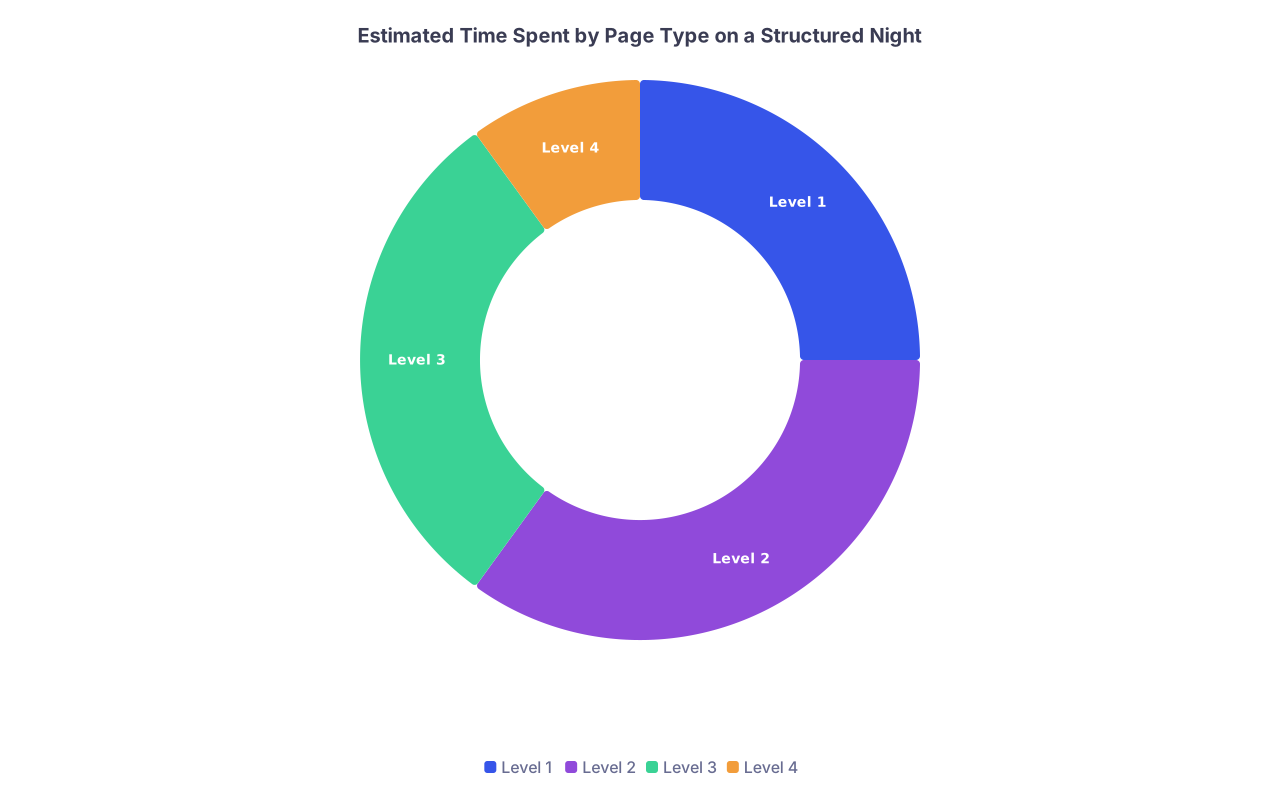
| Category | Value |
|---|---|
| Level 1 | 25 |
| Level 2 | 35 |
| Level 3 | 30 |
| Level 4 | 10 |
Notice something: once you stop over-attending to Level 4 nonsense, you have more time and mental bandwidth for truly sick patients and for getting your admissions and notes done without staying two hours post-call.
The Quiet Win: Day Team Trust
You will know this system is working when your daytime colleagues start saying things like:
- “Your night notes are actually useful.”
- “You caught that decompensating patient early.”
- “Nursing says you are responsive and calm at night.”
Ironically, the more structured and “cold” your triage system, the more warm and reliable you appear to everyone else. Because you are consistent. You do not panic. You do not disappear.
And that matters. A lot.
Your Next Step – Implement Tonight
Do not treat this as theory. You need to operationalize it.
Before your next night shift:
Grab a blank sheet and divide it into:
- Top: your 4-level triage categories
- Middle: your running page list (time / patient / issue / level / plan)
- Bottom: mini-algorithms for 3 common issues in your hospital (e.g., SOB, fever, pain)
Write out your 15-second call-back script on that sheet. Word for word.
On your commute in, make one decision:
“Tonight, I will stop treating [choose one: isolated high BPs, mild lab abnormalities, or routine comfort issues] as emergencies unless they meet my red-flag criteria.”
Then use it. On page #1.
Do not wait a month to “settle in.” Paging overload at 2 a.m. is a problem you can solve this week—if you bring a system to the chaos instead of just more effort.