
7 Night Shift Handover Errors That Lead to Near Misses
What do you tell the family when the patient almost gets intubated twice in 12 hours because the night team never heard he’d just been extubated?
I’ve seen that exact scenario. ICU. New PGY-2 on nights. Vent wean successful at 1600, crazy sign-out at 1900, the key line “he was just extubated, do NOT reintubate unless X, Y, Z” never makes it across. At 03:00 the patient decompensates, RT and night resident rush in, airway tray opened, meds drawn… and the day attending walks by, horrified: “What are you doing? He’s DNR for reintubation.”
You don’t forget that kind of “near miss” once you’ve watched it unfold. And I’ll be blunt: most of these are not freak events. They’re predictable handover failures that repeat every single night in hospitals everywhere.
Let’s walk through the seven big ones I see residents make on night shift. Over and over. You avoid these, your nights get safer immediately.
1. “Everything’s Fine” Handover: The Hidden Landmines
The first, and ugliest, mistake: giving or receiving a sign-out that sounds like a lullaby when it should sound like an alarm.
You know this handover: “4302 – septic shock, but stable now. On pressors. Nothing much to do overnight.”
Translation: You’re about to get wrecked, and nobody warned you.
The problem isn’t that the patient is sick. That’s expected. The problem is pretending they’re simple.
Red flag phrases you should not accept at face value:
- “Nothing to do”
- “Just watch”
- “Pretty stable now”
- “They’ve been like this all day”
Those phrases hide work. And risk.
The landmine version of sign-out:
- No clear “sickest first” order
- No stated trajectory (“getting better vs hanging on vs sliding”)
- No “if X happens, I’m worried about Y”
If you’re the one giving sign-out, don’t make this mistake:
- Don’t lump everyone as “stable” because you’re tired
- Don’t avoid calling someone “very sick” because you’re scared your day wasn’t “successful”
- Don’t assume “night team will see the vitals anyway”
If you’re the one receiving:
- Force a risk stratification. Ask: “Who are you most worried about tonight?”
- If the answer is “no one really,” push back. “If someone is going to crump, who is it?”
- Write a mini “watch list” for yourself with 3 columns:
| Patient | Risk Level | Why |
|---|---|---|
| 4302 | High | Refractory septic shock, rising pressor dose |
| 5110 | Medium | New GI bleed, Hgb drop 2 points today |
| 6201 | Medium | COPD on BiPAP, borderline gas exchange |
Landmine prevention is boring and unsexy: you explicitly rank who is sickest. But skipping this is how you get blindsided at 02:00 by “the stable septic shock patient” who was actually on 3 pressors and max HFNC.
2. Vague Plans and “Call Me If” Without Criteria
Second big error: mushy plans. The “if worse, then call” nonsense.
What does “worse” mean? To a PGY-1 at 3 AM with three pages going off simultaneously?
This is how near misses happen:
- Day team: “He’s borderline. If he gets worse, transfer to ICU.”
- Night team: “Ok.”
- 01:30: BP drifting from 100s to low 80s over three hours, nurse mildly worried, resident juggling cross-cover. No one pulls the trigger because no one knows what “worse” was supposed to look like. At 04:00, code blue.
You need operational plans, not vibes.
Instead of:
- “If he desats, increase O2 and see how he does.”
- “If pain persists, maybe consider CT.”
- “If BP drops, give fluids.”
You want:
- Numbers
- Time frame
- Concrete actions
For example:
- “If sats < 90% on 4L nasal cannula for 10 minutes, switch to non-rebreather and page me / ICU.”
- “If SBP < 90 twice 15 minutes apart or MAP < 65, give 500 cc LR and call me before a second bolus.”
- “If pain uncontrolled after 2 doses of IV morphine 2 mg spaced 30 minutes, don’t keep escalating; call for re-evaluation and consider CT.”
When you give sign-out, do this:
- For every “borderline” patient, write a trigger plan
- Say it out loud to night team, not just “it’s in the note”
- Make nurses aware when possible: “For 4302, here’s the plan when X happens”
When you receive sign-out and hear hand-wavy instructions:
- Ask: “Specifically, at what threshold do you want them transferred / escalated?”
- And: “What’s your upper limit for fluid/pressors/opiates before you want another call?”
If they shrug, decide your own thresholds and document in your personal notes. Don’t be the resident who freezes because “day team didn’t say.”
3. Ignoring Code Status and Goals-of-Care Nuances
This one is brutal, and I’ve watched it almost turn into lawsuits.
The mistake: treating “Full Code,” “DNR,” or “comfort care” as binary labels instead of nuanced instructions. Or worse—skipping it entirely in sign-out.
Near misses born from this:
- Patient is DNR but still full treatment short of chest compressions; night team withholds BiPAP or pressors because “they’re DNR”
- Patient is “comfort care only” but no one clarifies “no labs / no vitals / no transfers”; a terrified intern calls a rapid response at 2 AM and the room fills with a team trying to “fix” unfixable
- Patient is DNR for reintubation post-extubation, but this detail is never said out loud; airway is almost re-established before someone checks the chart
Your danger signs:
- Handovers that say “code status: DNR” and nothing else
- No mention of family meetings that happened that day
- No description of what actually matters to the patient and family (“she wants time to see her granddaughter tomorrow,” etc.)
What you should demand in every sign-out for complex or end-of-life patients:
- Exact code status: “Full code, DNR, DNI, comfort-focused only”
- What the last big conversation included: “Family understands risks of arrest, wants everything short of chest compressions and shocks”
- Any do not do specifics: “Do not reintubate,” “No escalation beyond current pressor level,” “No transfer to ICU per family”
And never rely on the EMR banner alone. I’ve seen it wrong. I’ve seen it not updated after a family meeting. I’ve seen “Full Code” on the screen and a signed DNR in the scanned documents.
At night, before something goes sideways with a fragile patient:
- Double-check the orders
- Check recent notes for “family meeting” or “goals-of-care” language
- Clarify with the day team before they leave if anything doesn’t fit
If you’re the one signing out:
- Do not say “DNR” and move on. Say what that means in practice:
- “DNR/DNI, ok with pressors, ok with BiPAP, no intubation, no chest compressions.”
- Or: “Comfort measures only—no labs, no vitals, no transfers, no rapid response unless for symptom control.”
Skipping this is how you end up doing chest compressions on someone who explicitly refused them. That’s not just a near miss. That’s violating a core trust.
4. Incomplete “Active Issues” – Buried in the History
This one slips under the radar because everyone loves data dumps.
The bad sign-out pattern:
- You hear a fully recited admission H&P from 3 days ago
- Labs, imaging, past medical history, social history, old echo results
- Then a rushed “…and yeah, watching their kidneys and troponins, I guess. Ok next patient.”
What actually matters at night are the live wires:
- What changed in the last 24 hours
- What’s not yet explained
- What’s actively in progress (pending labs, consults, imaging, cultures)
A very common near miss:
- Troponin was borderline and up-trending, cardiology thinking “type II vs type I MI,” stress test ordered for the morning
- Night team hears only “admitted for pneumonia, on ceftriaxone”
- At 02:00, patient develops chest pain, gets morphine, vitals “ok-ish,” everyone assumes it’s infection-related discomfort
- EKG changes recognized late, team didn’t connect tonight’s pain to yesterday’s troponin discussion
Or:
- Creatinine is drifting up, nephrology worried about contrast exposure tomorrow
- Night team never hears “kidneys are fragile and we’re actively watching,” so they order contrast CT at midnight for mild abdominal pain. Next morning? AKI crater.
When you give sign-out, avoid this mistake:
- Limit the “backstory” to 1–2 lines:
- “Admitted with pneumonia and NSTEMI.”
- “New CHF diagnosis, decompensated.”
- Then focus on active problems today, like:
- “Today’s issue: rising troponin, cardiology concerned, watch for chest pain. If any, repeat EKG and call them.”
- “Today’s issue: creatinine up from 1.2 to 2.1 in 24 hours, nephrology involved, strictly avoid contrast tonight unless emergent.”
When you receive sign-out and it’s a firehose of irrelevant data:
- Interrupt (politely but firmly): “What are the 2–3 active concerns for tonight for this patient?”
- Write those down. That’s your priority list.
If you walk into night shift only knowing why they were admitted and not what’s brewing today, you’re flying blind.
5. Non-Standard, Memory-Only Handover (No Written Backup)
You know the worst phrase to say after a near miss?
“I thought you knew that.”
Verbal-only handover is a trap. The human brain at 6:45 PM after 12 hours of rounding is garbage. The human brain at 02:30, six pages deep and hypoglycemic, is even worse.
Near-miss pattern:
- Day resident: “We increased the heparin drip at 17:00 after new DVT, goal PTT 60–80, next PTT at midnight, adjust per protocol.”
- Night resident: hears “heparin drip,” writes nothing. Seven admissions later, it’s gone.
- PTT never drawn. Or drawn but never acted on. The next morning, PTT is 120 and the patient has a big flank hematoma.
You need a structure that doesn’t rely on the most tired person in the hospital remembering every detail.
This is where you should be using some version of a standardized tool (I know, cliché, but the alternative is error):
- I-PASS, SIGNOUT, or your institution’s equivalent
- A simple personal template with: ID / Diagnosis / Active problems / Overnight plan / If-then statements / Code status
And crucially: you keep a written or digital “night list” that you actually refer to.
Typical errors:
- Crossing out or erasing critical notes during the night, leaving confusion
- Trying to keep track of handoff updates mentally
- Not updating the night handover after major changes (new pressors, rapid response, new scans)
Create and stick to a simple rule:
If it can get someone hurt when forgotten, it gets written down.
Labs to check, drips to titrate, imaging to follow, cultures to chase, consult recs that must be implemented—these live on your night list, not just your frontal lobe.
6. Bad Communication with Nursing: Silent Plans and Assumptions
You are not just handing over to another resident. You’re handing over to the nurses and RTs who will actually see the patient decompensate before you do.
Near misses often look like this:
- Day team: “If the BP drifts down, they can get two 500 cc boluses, then call me.”
- That was said only between day and night residents.
- At 01:00, BP is 85/50. Nurse pages night resident: “BP low.” Resident is in a code, doesn’t see the page for 12 minutes. Nurse, not knowing there’s a pre-approved bolus plan, just keeps re-checking vitals.
- BP now 70 systolic when the resident finally arrives.
Or:
- Day team: “We’re worried about alcohol withdrawal, CIWA scores are creeping up, we’ll probably need to escalate benzo dosing tonight.”
- No one explicitly tells the night nurse that they’re allowed to give more frequent or higher doses per new protocol. CIWA is 18 at midnight, nurse nervously under-medicates because “I don’t want to oversedate,” and the patient starts hallucinating and pulling lines before the resident even knows.
If you’re giving sign-out:
- For high-risk patients, explicitly loop in nursing before you leave:
- “Here’s our overnight plan if his BP drifts.”
- “Here’s the seizure or withdrawal plan and max dosing.”
- “If you see X, I want to be paged immediately—even if it looks small.”
- Actually say: “We discussed this in sign-out, I’m documenting it, but I want you to hear it directly.”
If you’re on nights and something sounds high stakes in sign-out:
- Ask: “Have you already told the nurse this plan?”
- If not: you go tell them. Right then. Face to face whenever possible.
Nurses are your early warning system. If they don’t know your thresholds and “if-then” plan, they will either over-call (“they coughed once”) or under-call (“their BP has been a little low for hours”). Both can lead to near misses.
7. No “Closing the Loop” in Morning Handover After Near Misses
The last mistake is subtle but deadly for your learning curve: treating near misses as “bullet dodged, move on” instead of “this was a giant blinking warning light.”
What happens commonly:
- Overnight, you almost miss a DKA, or nearly reintubate a DNR patient, or delay a sepsis escalation.
- You somehow catch it in time, fix it, adrenaline drops, and you’re embarrassed.
- Morning handover: “Pretty busy, but nothing huge overnight,” you say. You hide the scary moment.
Result?
You and the day team lose the chance to tighten the handover process that allowed that near miss to happen.
And another result? The same pattern repeats next week. With someone less lucky.
Here’s what should happen instead after a near miss:
- You describe exactly how your information failed you:
- “I didn’t know they were DNR for reintubation; that was only documented in an attending note, not the sign-out.”
- “The active troponin issue wasn’t on the sign-out; I only saw the trend when I dug into labs hours later.”
- “There was a plan for fluid boluses, but it wasn’t communicated to nursing, so nothing happened for 45 minutes.”
- You describe the “fix” that worked:
- “Nurse pulled me in, I checked X, we changed Y.”
- You propose one change to handover going forward:
- “From now on, anyone with limited code status gets a specific line in sign-out about what’s allowed and what’s not.”
- “Any active MI risk will be its own bullet, separate from pneumonia or sepsis.”
This isn’t about blame. It’s about tightening the net so next time the miss doesn’t even get that close.
And if your program never pauses to dissect these? Start the conversation yourself. “Can we quickly talk through why we almost reintubated a DNR patient last night?” is not overreacting. It’s what prevents the next one from turning into a real harm event.
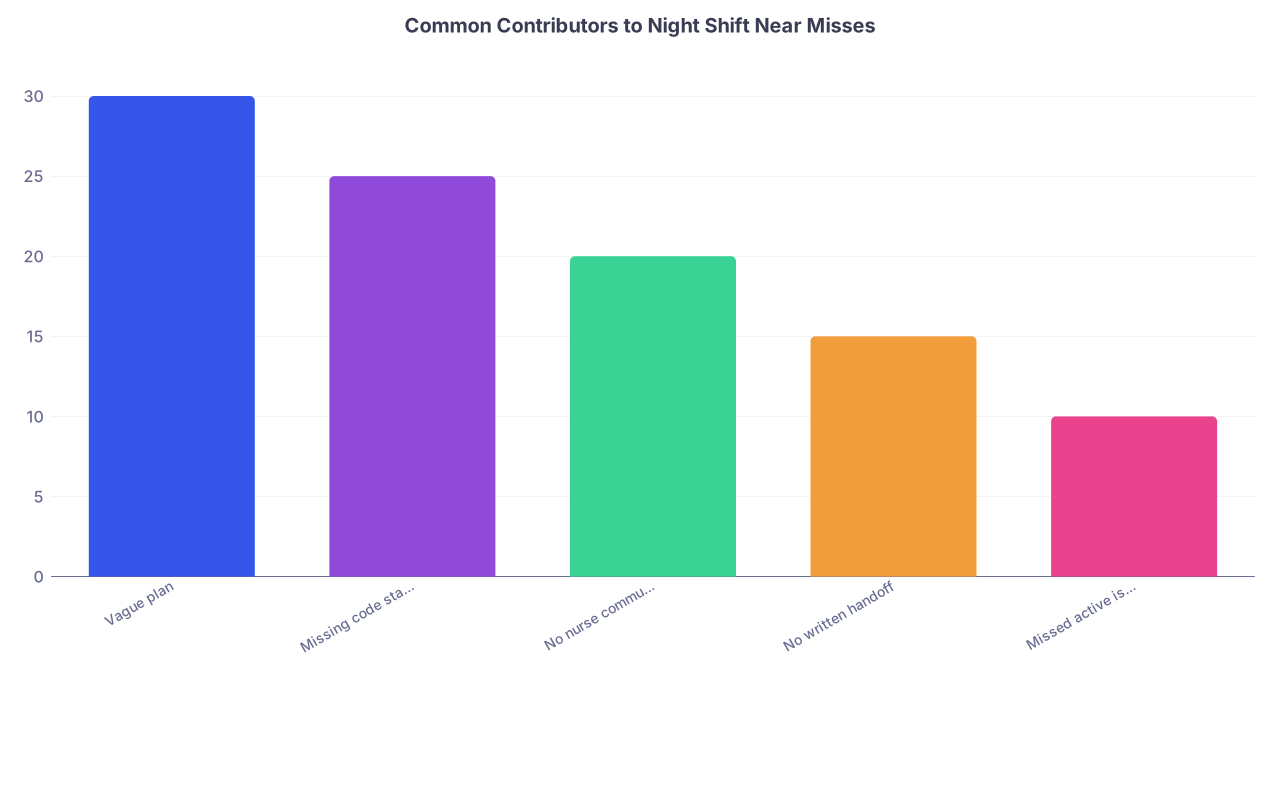
| Category | Value |
|---|---|
| Vague plan | 30 |
| Missing code status detail | 25 |
| No nurse communication | 20 |
| No written handoff | 15 |
| Missed active issues | 10 |

| Step | Description |
|---|---|
| Step 1 | Day Rounds End |
| Step 2 | Identify Sickest Patients |
| Step 3 | Clarify Code Status and Goals |
| Step 4 | Create Written Handoff |
| Step 5 | Discuss If Then Plans |
| Step 6 | Update Nurses on High Risk |
| Step 7 | Night Resident Reviews List |
| Step 8 | Night Monitoring and Actions |
| Step 9 | Morning Debrief on Near Misses |
The 3 Things You Can’t Afford to Get Wrong
Cut through all the stories and detail, and your job around night handover boils down to this:
Name the danger clearly.
No more “seems ok.” Explicitly state who is sick, what’s trending the wrong way, and what could kill them tonight.Turn vague wishes into concrete plans.
“If worse, call” isn’t a plan. Thresholds, time frames, exact steps, and who to involve—that’s a plan.Stop treating near misses as secrets.
When you almost hurt someone, that’s the system flashing red. Bring it into the open, fix the handover that allowed it, and do not let it repeat.
You’ll make mistakes during residency. Everyone does. But if you refuse to make these seven handover mistakes, your nights will be a lot less dangerous—for your patients and for you.