
The most dangerous thing many residents do is not placing central lines or running codes. It is driving home after call.
The data are blunt: a post-call resident behind the wheel often looks, statistically, a lot like a drunk driver. Yet hospitals still push the “just be careful” narrative instead of showing you the numbers. So let’s fix that and actually run the risk calculations for driving after call versus using a rideshare.
1. What fatigue does to your brain: the hard numbers
Start with the physiological reality. This is not about willpower or “I’m used to nights.” Your reaction time and decision-making degrade in measurable, predictable ways.
Several controlled studies have quantified this:
- Being awake for 17 hours produces psychomotor impairment similar to a blood alcohol concentration (BAC) of about 0.05%.
- Being awake for 24 hours ≈ BAC 0.10% (over the legal limit in all U.S. states).
Most residents on a bad call night are in the 22–28 hour awake range by the time they get into their car. Even on a “light” call, you might have:
- 05:30 — wake up
- 06:30 — in hospital
- All-day clinical work
- 19:00–07:00 — in-house call with multiple pages and interruptions
- 07:30–09:00 — prerounds, rounds, notes, sign-out
You are now 24–27 hours from your last full sleep cycle.
Reaction time is not a subtle change. Experimental data show:
- ~20–50% slower response times after 18–24 hours awake
- Lapse rates (micro-sleeps >0.5 seconds) spike exponentially after ~16–18 hours
You do not feel this linearly. Subjective sleepiness ratings plateau, while objective performance continues to fall. That “second wind” you think you get at 07:00 is often just your circadian wake drive briefly masking the fatigue debt.
From a risk standpoint, the key translation is this:
Fatigued driving at 24 hours awake behaves closer to 0.08–0.10 BAC than to “tired but fine.”
2. How dangerous is post-call driving, statistically?
Let’s line this up with the broader traffic data.
General population crash risk scales with both fatigue and hours of sleep:
- Sleeping <5 hours in the last 24 hours: ~3× crash risk vs. 7 hours
- Sleeping <4 hours: ~8–11× crash risk
Residents often get:
- Effectively 0–2 hours of real sleep on heavy call
- Fragmented 1–3 hour blocks with multiple awakenings on “OK” call
Now combine that with actual resident data. One well-known survey study of interns found:
- 41% reported at least one episode of falling asleep while driving post-call during internship.
- 16–20% reported at least one motor vehicle crash or near-crash (depending on study) in a single year, often tied to post-call driving.
If you zoom out to population-level numbers, drowsy driving is implicated in roughly:
- 1–2% of all police-reported crashes
- Closer to 7–10% of all fatal crashes when using in-depth NHTSA model estimates
That is the baseline for everyone. Residents are not baseline. They are systematically pushed into the highest-risk sleep categories multiple times per month.
A reasonable conservative estimate, extrapolating from existing data:
- Relative crash risk post-call for a resident vs. a well-rested driver: 3–7× higher
- Relative risk of falling asleep at the wheel: easily >5× higher
That means every post-call commute is not just “a bit dicey.” Statistically, you are operating in a risk band that society would never tolerate for alcohol, but we quietly accept for fatigue.
3. Building a simple risk model: drive vs. rideshare
Let’s put actual numbers to the decision: Drive myself home vs. take a rideshare.
We need three pillars:
- Baseline crash probability per trip
- Fatigue multiplier for a post-call resident
- Cost comparison for rideshare vs. expected loss from driving
This will be a simple, back-of-the-envelope model. Not perfect. Good enough to make rational choices.
3.1 Baseline crash probability per trip
Annual U.S. numbers (approximate, rounded):
- ~6 million police-reported crashes per year
- ~230 million licensed drivers
- ~1 trillion vehicle miles traveled
Average:
- Crash probability per 10,000 miles ≈ 0.06
(6,000,000 / 1,000,000 * 10,000)
For a 10-mile commute:
- Baseline crash probability per trip ≈ 0.00006
= 6 in 100,000 trips
= 0.006%
This includes all drivers, all states, all levels of fatigue, etc. We are going to adjust this for resident fatigue.
3.2 Fatigue multiplier
From drowsy driving and sleep-deprivation literature:
- 3× risk with <5 hours sleep
- 8–11× risk with <4 hours sleep
- Residents often have sleep fragmentation + long awake time, which amplifies impairment beyond a simple “hours slept” measure.
Take a conservative middle ground:
Use a 4× multiplier for “moderate-fatigue call” and 7× for “severe-fatigue call”.
So for a 10-mile commute:
- Moderate fatigue: 0.006% × 4 = 0.024% (24 in 100,000 trips)
- Severe fatigue: 0.006% × 7 = 0.042% (42 in 100,000 trips)
That sounds small in percentage form. But residents drive post-call a lot. At, say, 6 call shifts per month = 72 per year.
Annual risk of at least one crash = 1 − (1 − p)^n, where p is per-trip crash probability, n is number of trips.
Moderate fatigue case:
- p = 0.00024, n = 72
- Annual risk ≈ 1 − (1 − 0.00024)^72
≈ 1 − e^(−0.00024×72) ≈ 1 − e^(−0.01728) ≈ 1 − 0.9829 ≈ 0.0171
≈ 1.7% annual risk
Severe fatigue case:
- p = 0.00042, n = 72
- Annual risk ≈ 1 − (1 − 0.00042)^72
≈ 1 − e^(−0.03024) ≈ 1 − 0.9702 ≈ 0.0298
≈ 3.0% annual risk
So a resident with multiple heavy call shifts might be staring at a 2–3% annual chance of some crash linked to a post-call commute. Not a fender-bender certainty, but far from trivial.
3.3 Rideshare crash risk
A rideshare trip is not risk-free; you are still in a car. However:
- The big difference: you are not the impaired driver.
- You reduce the probability of your fatigue driving the crash. Rideshare drivers may be tired too, but on average they are not at 24+ hours awake after a night in the ICU.
Let’s make a conservative assumption:
- Rideshare trip has similar baseline risk to any 10-mile trip (0.006% crash probability).
- You avoid the 4–7× fatigue multiplier because the driver is not you.
If 50% of rideshare drivers are somewhat fatigued and that doubles their risk a bit, you might inflate that 0.006% to, say, 0.01%. For a quick model, that is fine.
Annual rideshare crash risk for 72 post-call trips:
- p = 0.0001, n = 72
- Annual risk ≈ 1 − (1 − 0.0001)^72
≈ 1 − e^(−0.0072) ≈ 1 − 0.9928 ≈ 0.0072
≈ 0.7% annual risk
So under conservative assumptions:
- Drive yourself post-call: ~1.7–3.0% annual crash risk
- Use rideshare post-call: ~0.7% annual crash risk
That is roughly a 2–4× difference in annual crash risk attributable to the choice you control.
4. Cost vs. risk: is the rideshare “worth it”?
This is where most residents flinch. “But rideshares are expensive, and I’m on a resident salary.” Fine. Put a number to it.
Assumptions:
- Average rideshare cost for a 10-mile commute (city-dependent): $15 one way
- Call shifts: 6 per month
- You use rideshare only post-call (one-way), drive in pre-call.
Monthly rideshare cost:
- 6 rides × $15 = $90
- Annual = $90 × 12 = $1080
You are essentially paying $1080 per year to divide your crash risk by ~2–4 for this particular set of trips.
Now compare this to the expected cost of a crash. You have both:
- Economic costs: car damage, medical bills, lost work days, deductibles, increased premiums
- Non-economic: injury, disability, or killing someone on the way home
Let us at least quantify the economic side with lowball estimates.
Typical minor crash out-of-pocket cost:
- Deductible: $500–$1000
- Premium increase spread over 3–5 years: valued at, say, another $500–$1500
- Time, hassle, lost days: easily another $200–$500 in opportunity cost
So even a “minor” crash can cost you $1200–$3000 over a few years.
Serious injury crash:
- Medical bills (even with insurance): copays, coinsurance, rehab: $5,000–$50,000+
- Potential long-term disability, missed training, delayed graduation: hard to price but massive.
In health economics, “value of a statistical life” estimates hover around $10 million. Even a 1 in 10,000 reduction in fatal crash risk is often considered meaningful in policy terms.
Let’s do a crude expected-value comparison for one year:
Scenario A: You drive yourself post-call
- Additional risk above rideshare: say +1.5% absolute (e.g., 2.2% vs. 0.7%)
- Assume that 90% of crashes are minor, 10% moderate/major
Expected extra minor crash cost (per year):
- Extra minor crash probability: 1.5% × 0.9 = 1.35%
- Cost per minor crash: assume $2,000
- Expected minor loss = 0.0135 × 2000 ≈ $27
Expected extra serious crash cost (purely financial, ignoring life value):
- Extra serious crash probability: 1.5% × 0.1 = 0.15%
- Cost per serious crash: wildly variable, but be conservative at $25,000
- Expected serious loss = 0.0015 × 25,000 = $37.50
Total extra economic expected loss ≈ $27 + $37.50 ≈ $64.50 per year.
On pure dollars, that $64.50 expected cost is below the $1080 rideshare cost. So if you only care about narrow financial expectation, you might say: the rideshare is not “worth it.”
But this math quietly treats:
- A 0.1–0.3% annual risk of serious injury or death as “acceptable noise”.
- The possibility of killing a pedestrian while you microsleep at a light as just another term in an expected value.
That is not how rational humans judge catastrophic risk. We are (correctly) risk-averse to low-probability, high-severity events. Especially when the activity is discretionary.
If you add even a tiny weight for:
- The moral cost of injuring someone else
- The career cost of losing your license, having a felony vehicular manslaughter charge, or being disabled
The risk-adjusted “utility cost” explodes well past $1080.
The data do not say you must always use rideshare. They do say this: if you would never drive at 0.10 BAC, your post-call drive after a brutal night is in the same statistical neighborhood. Yet you are balking at $15.
5. Breaking it down by call type and commute distance
The risk ratio is not the same for everyone. Let us stratify by two key variables:
- Commute distance
- Call intensity (sleep obtained)
5.1 Commute distance
Crash risk is roughly proportional to exposure (miles driven), so a 2-mile commute is a different problem than 25 miles on a highway.
Illustrative relative risk per post-call trip (using baseline crash risk proportional to miles):
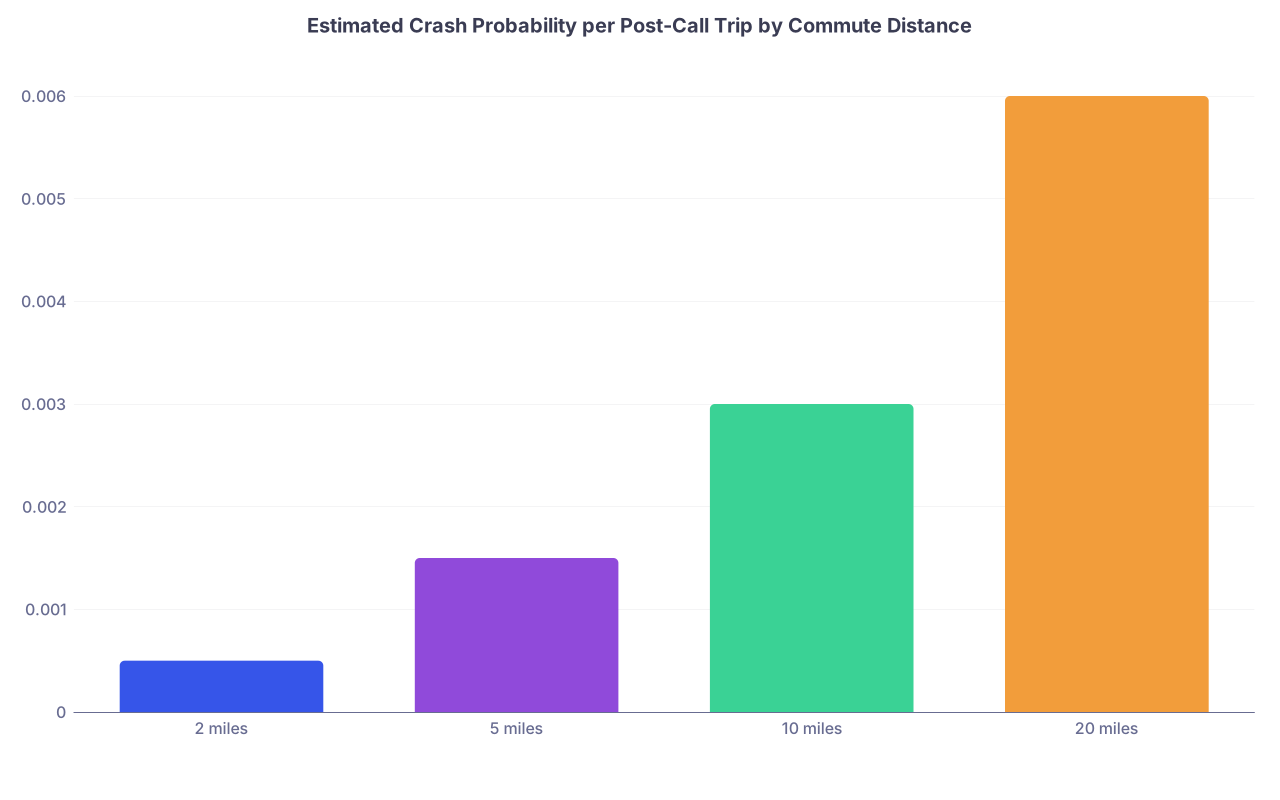
| Category | Value |
|---|---|
| 2 miles | 0.0005 |
| 5 miles | 0.0015 |
| 10 miles | 0.003 |
| 20 miles | 0.006 |
Those values are stylized (as percentages): 0.05%, 0.15%, 0.3%, 0.6% for severe fatigue. The actual scale is less important than the ratios.
Key point: once you are above ~10–15 miles, your cumulative annual risk from repeated post-call drives starts to add up very quickly.
If your commute is 2 miles on quiet side streets, the absolute crash risk may remain relatively low, even with a 5× fatigue multiplier. It is still non-zero, but the cost-benefit threshold for rideshare might shift.
If your commute is 30 miles on a dark interstate at 08:00 with traffic, I would argue the rational, data-driven decision is: never drive yourself post-call on heavy call. The numbers are simply ugly at that scale.
5.2 Call intensity (actual sleep)
We can break call nights into three buckets:
- Green: 4+ hours of consolidated sleep, wake time <20 hours
- Yellow: 2–4 hours, fragmented; wake time 20–24 hours
- Red: <2 hours real sleep; wake time ≥24 hours
Approximate risk multipliers compared with a rested driver:
| Call Type | Sleep Obtained | Wake Time | Relative Crash Risk vs Rested |
|---|---|---|---|
| Green | 4–6 hours | <20 h | 1.5–2× |
| Yellow | 2–4 hours | 20–24 h | 3–5× |
| Red | <2 hours | ≥24 h | 6–11× |
On “green” nights with decent sleep, driving may still be somewhat elevated risk, but within a range that most of society accepts. On “yellow” nights, it becomes debatable. On “red” nights, the data support treating yourself much more like a drunk driver than a “tired” one.
If you want a simple operational rule:
- Green: drive if you feel alert and commute is short.
- Yellow: strong consideration for rideshare if commute >5–10 miles.
- Red: default to rideshare or sleep-in-place, regardless of commute distance.
Not based on vibes. Based on multipliers that match known performance degradation.
6. Hospital culture vs. personal risk management
Most programs are still pretending this is an individual resilience problem. “Drink some coffee.” “Roll the windows down.” This is not strategy. This is wishful thinking.
From a systems standpoint, hospitals and residencies should:
- Subsidize post-call transportation for residents, at least for in-house overnight call.
- Provide safe sleep spaces where residents can actually nap for 2–3 hours pre-commute.
- Explicitly discourage driving after heavy call, in the same way they discourage drug or alcohol impairment.
Some institutions already offer taxi vouchers or rideshare credits. Not enough.
From your personal standpoint, you cannot fix GME policy overnight. But you can create a simple rule set that reflects the data.
Example for a PGY-1 with a 12-mile commute:
- If I get <2 hours of sleep on call or feel “foggy” during sign-out → automatic rideshare home.
- If I catch 2–4 hours, but kept being paged, and feel like I am zoning out on rounds → rideshare if more than light traffic or bad weather.
- If I genuinely sleep 4+ hours, and feel alert walking to the car → can drive, but monitor for micro-sleep signs (blinking slow, forgetting last minute of the walk, etc.).
Is this binary? No. It is probabilistic. But that is the point. You are updating your risk estimate based on your current state, not your ego.
To make this explicit, here is how the decision process actually looks when you put it on a flowchart instead of hand-waving:

| Step | Description |
|---|---|
| Step 1 | End of Call Shift |
| Step 2 | High Risk |
| Step 3 | Moderate Risk |
| Step 4 | Lower Risk |
| Step 5 | Use Rideshare |
| Step 6 | Assess Alertness |
| Step 7 | Drive Home |
| Step 8 | Sleep on Call |
| Step 9 | Commute over 5 miles |
| Step 10 | Commute over 10 miles |
| Step 11 | Feel Alert and No Micro Sleep Signs |
Is this perfect? Of course not. But it is a more rational filter than “I am a tough resident, I am fine.”
7. Side-by-side: when the numbers are most lopsided
To crystallize this, look at a simple comparison across a few common resident scenarios.
| Scenario | Commute | Sleep on Call | Relative Crash Risk if Driving | Rideshare Advantage |
|---|---|---|---|---|
| Night float, mostly quiet | 5 miles | 4–5 hours | ~2× baseline | Modest |
| ICU 24h call, 1 hour broken sleep | 10 miles | <2 hours | ~7–10× baseline | Large |
| Trauma night, no sleep, post-rounds | 20 miles | 0 hours | ~10× baseline | Very large |
| Ward call, 3 hours fragmented sleep | 8 miles | 2–3 hours | ~4–5× baseline | Moderate–large |
| Step-down unit call, 2 hours plus naps | 3 miles | ~3–4 hours | ~3× baseline | Small–moderate |
Overlay cost:
- If you are in that ICU 24h call with a 10–20 mile commute scenario 4–6 times per month, you are paying maybe $50–$100 each month to avoid what is essentially “drunk-level” driving.
- That is less than many residents spend monthly on coffee.
From an analyst standpoint, the highest ROI for rideshare spending is extremely clear:
- Long commute + red call nights = do not drive.
The edge cases (short commutes, green nights) are where you can rationally decide based on your tolerance for small risks and your actual financial stress.
8. What this means for you, practically
The data point one way:
- Post-call self-driving, especially after severe nights, multiplies your crash risk by several fold.
- The absolute annual risk is non-trivial—on the order of a few percent for some residents.
- Rideshare does not remove risk, but it shifts you out of the highest-risk category and cuts your risk down by roughly half to three-quarters.
If you think like a clinician but live like a gambler, you are going to ignore this. If you think like a clinician and an analyst, you start structuring your life around the highest-risk events, not the average day.
The next step is obvious. You build your own simple policy:
- Decide your personal cutoffs (distance, sleep, subjective alertness).
- Communicate with co-residents: share codes or vouchers, split rides if possible.
- Document near-misses. If you catch yourself nodding off while driving, that is not a “one-time thing.” That is a near-miss that should trigger a rule change.
And you push your program, gently or not, toward evidence-based policies: subsidized rides, protected sleep time, actual fatigue training that treats this like impairment, not character weakness.
For now, your job is more basic: get through residency alive and intact. With the numbers on the table, you can see which part of that risk you control directly every time you stand in the hospital lobby at 09:00, badge in one hand, car keys in the other.
That daily decision—the short walk to the parking lot or the tap to request a ride—is where the statistics stop being abstract and start shaping the rest of your career. Getting that choice right consistently is one of the most underrated survival skills on night shift. The rest of the night shift playbook comes after you make it home.