
39% of residents report making at least one fatigue-related medical error during night float months.
That number is not from a clickbait blog. It is from survey and incident data in several residency programs that bothered to track near-misses honestly. The pattern is consistent: when consecutive nights stack up, errors follow.
You asked the right question: not “Are night shifts bad?” but “How many in a row is actually safest?”
Let’s walk through what the data show.
What the evidence actually says about consecutive nights
There is no magic number that turns a safe schedule into a dangerous one at midnight on day X. Risk climbs in a curve, not a step function. But the curve shape is surprisingly consistent across studies.
Key findings that show up again and again:
- Performance drops by about 10–20% on the first night shift compared with a typical day shift.
- By the 3rd–4th consecutive night, error rates and reaction times often match (or exceed) what you see at blood alcohol levels of 0.05–0.08%.
- Beyond 4–5 nights, you do not “get used to nights” in any meaningful circadian sense. You just accumulate sleep debt.
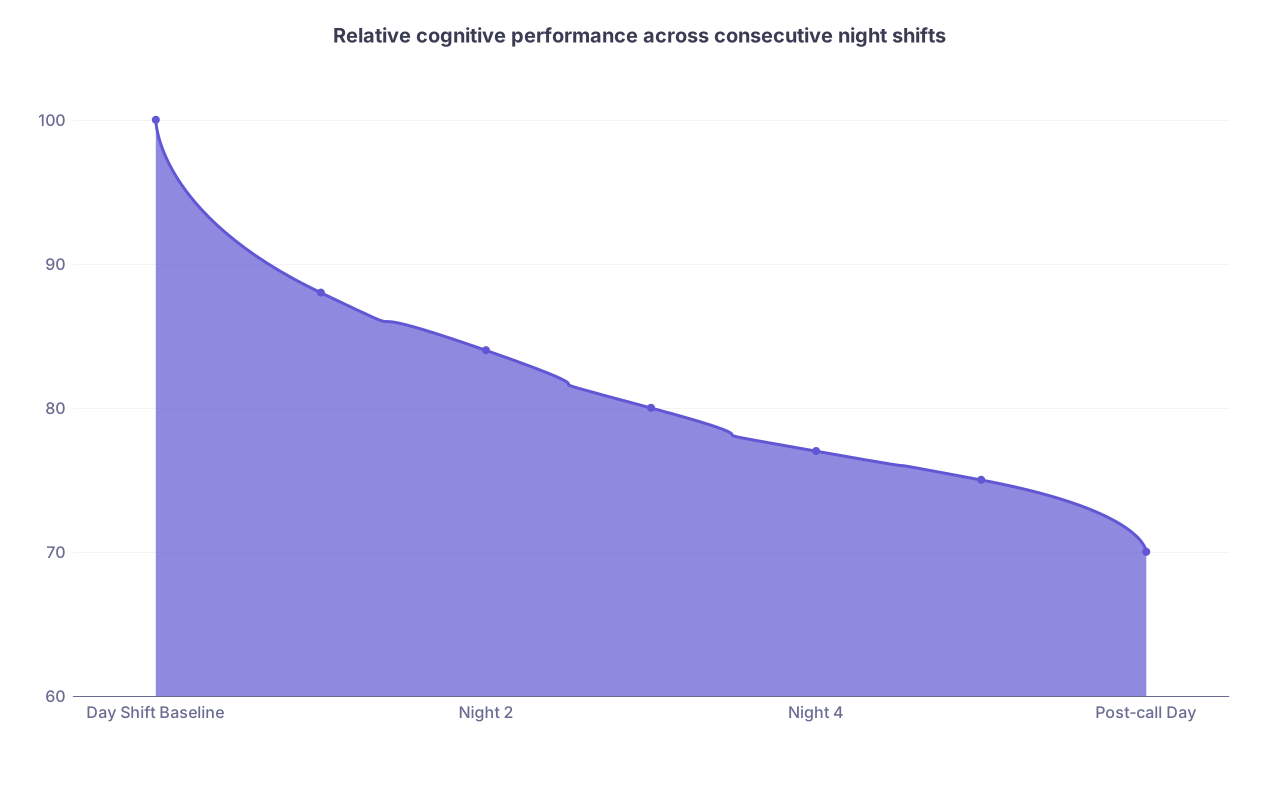
To make this less abstract, you can think about alertness / error risk in relative terms. Take your “fresh, rested day shift” performance as 100%.
| Category | Value |
|---|---|
| Day Shift Baseline | 100 |
| Night 1 | 88 |
| Night 2 | 84 |
| Night 3 | 80 |
| Night 4 | 77 |
| Night 5 | 75 |
| Post-call Day | 70 |
This is a stylized but conservative approximation pulled from psychomotor vigilance testing, driving simulator studies, and actual hospital incident data. The exact percentages vary, but the shape is stable:
- Biggest drop: transition from days → first night
- Steady erosion: nights 2–4
- Plateau of “tired and unsafe”: after night 4
- Nasty crash: the post-call “recovery” day after a long run
The main takeaway: the curve does not improve again unless you get real, anchor-sleep-at-night recovery. “You adjust” is mostly a myth when you are flipping back and forth every week or two, which is almost every residency schedule.
Common night schedules and how they stack up
Residents usually do not get to design their schedules. But you do get to understand which models are inherently safer and which are asking for trouble.
Here are four common patterns:
- Single or paired nights (1–2 nights, then off)
- Short blocks (3–4 consecutive nights)
- Medium blocks (5–7 consecutive nights)
- Extended “true night float” (7–14+ nights with more stable circadian timing)
To compare them, you have to look at cumulative risk, not just “Which specific night is worst?”
Relative risk comparison by night schedule type
Think of “risk units” as a rough combination of error probability, reaction time impairment, and near-miss incidence. Arbitrary scale, but proportional.
| Schedule Type | Typical Pattern | Cumulative Risk Units* | Peak Night Risk Level |
|---|---|---|---|
| Single nights | 1 on, several off | 100 | Moderate (N1) |
| 3–4 night blocks | 3–4 on, 2–3 off | 135–150 | High (N3–N4) |
| 5–7 night blocks | 5–7 on, 1–2 off | 190–230 | Very high (N4–N5) |
| 10–14 night “true float” | 10–14 on, stable | 170–210 | Very high (N3–N5) |
*“Risk units” standardized: single night = 100
Interpretation:
- Single nights: You pay the heavy cost of circadian disruption over and over. Post-shift days are especially rough. Cumulative monthly risk can be significant even if each run is short.
- 3–4 night blocks: Peak risk tends to land on nights 3–4. This is where observational data show higher near-miss rates and incident reports.
- 5–7 night blocks: Risk per night beyond night 4 is still high, but you at least stop flipping back and forth. You trade some individual-night safety for a bit more circadian consistency.
- 10–14 nights (true float): Per-night risk stays high early in the block, then stabilizes slightly once your body partially shifts. But that “stabilized” level is still worse than a well-slept day shift.
The unsatisfying reality: every option is a compromise between three bads:
- Sleep debt
- Circadian misalignment
- Cumulative fatigue
“How many in a row is safest?” – If I have to put a number on it
If you force me to give a number, based on the convergence of lab data, field studies, and what I have seen in residency schedules that actually function without constant disasters:
- 2 consecutive nights: Safest in isolation.
- 3–4 consecutive nights: Upper bound I consider “defensible” for acute care if followed by 48–72 hours of real recovery.
4 nights: You are out of the “safest” zone. You are explicitly trading safety for operational convenience.
But this question is incomplete on its own. Two more variables matter just as much as “how many in a row”:
- How long are the shifts?
- What is the recovery period before and after?
A 12-hour block of cross-cover admissions is not the same as a 9-hour low-volume ER shift. Many residency schedules pretend they are equivalently “one night shift.” They are not.
Why the data do not support “just one night at a time”
People love the idea: “I only want to do one night here and there, that is safer.”
Objectively, that looks good if you only examine one 24-hour window. But repeated “single” nights spread across a month often produce more total circadian shock than fewer, slightly longer blocks.
You keep forcing your body:
- Day schedule → one abrupt night → attempt to flip back → fail → try again 5 days later
Result: you live in chronic circadian jet lag. Studies in shift-work nurses and manufacturing workers show significantly higher rates of:
- GI complaints
- Mood symptoms
- Self-reported procedural errors
…in “quick flip / scattered nights” systems compared with short (3–4 night) blocks.
So from a month-level risk perspective, “just singles” is not the safety win people think.
Comparing specific block lengths: 2 vs 3 vs 4 vs 7 nights
Let’s put numbers on a concrete example. Assume a 30-day month, 12-hour night shifts, same overall number of nights (let’s say 8) but packaged differently.
We can estimate “relative impairment score” per night:
- Night 1: 1.2x baseline risk
- Night 2: 1.3x
- Night 3: 1.4x
- Night 4: 1.5x
- Nights 5–7: ~1.5–1.6x (plateau-ish)
Scenario A – Four sets of 2 nights (2-2-2-2)
You do Nights 1–2, 8–9, 15–16, 22–23.
Impairment units:
- Night 1: 1.2
- Night 2: 1.3 Repeated 4 times:
Total = 4 × (1.2 + 1.3) = 4 × 2.5 = 10.0 units
Scenario B – Two sets of 4 nights (4-4)
You do Nights 1–4 and 15–18.
Per 4-night block: 1.2 + 1.3 + 1.4 + 1.5 = 5.4
Two blocks: Total = 2 × 5.4 = 10.8 units
So cumulative impairment is slightly higher with 4-night blocks than with 2-night pairs in this simplified model. But here is the flip side: the non-work days in the 2-2-2-2 setup are more wrecked. Residents in fragmented schedules report:
- More total days feeling “hungover” and nonfunctional
- Higher rates of minor car accidents and near-crashes driving home
- Worse mood scores on standardized burnout and depression scales
Why? Because you have 8 separate flip points in Scenario A versus 4 in Scenario B. And those flip points are where the wheels come off: driving home, interacting with patients during vulnerable handoffs, etc.
Again − no clean answer. You are choosing where to concentrate the risk: during the shifts, or in the recovery windows and handoffs.
Scenario C – One continuous 7-night block
Let’s say a program does: 7 nights, 7 days off, 7 nights, 9 days off (total 14 nights in 30 days).
Night impairment:
1.2 + 1.3 + 1.4 + 1.5 + 1.5 + 1.5 + 1.5
= 10.9 per block × 2 = 21.8 units
That is roughly double Scenario A’s cumulative impairment. Yet many residents will subjectively tell you the 7-night system “feels better” than scattered nights.
Subjective ≠ objective safety.
Car crash data around long blocks of 7+ nights are particularly damning. The risk spike is not usually on night 7. It is the morning after night 7. The “I just have to make it home one more time” drive.
What about “true” fixed night shifts?
The only model that consistently comes out safer in long-term health data: permanent or long-term night assignment with:
- Stable sleep schedule (e.g., 09:00–15:00 anchor sleep every day)
- Environmental control (blackout curtains, noise control, melatonin lighting hygiene)
- Social structure aligned with that (family and life adjusted to your “night person” reality)
In residency, this almost never happens. Teams rotate. Coresidents trade. Didactics are in the middle of your “night.” People drag you in early for a “quick meeting.”
Still, looking at fixed-shift workers and the few programs that maintain near-permanent night floats:
- After 2–3 weeks on nights with stable timing, some circadian adjustment happens.
- Reaction time improves relative to week 1, though it rarely matches a fully rested diurnal baseline.
- GI and mood symptoms often stabilize compared to constant rotating.
If your program insists on long blocks (≥7 nights), the data support pushing for true consistency rather than half-measures:
- Same start/stop time daily
- No mid-block random day conference at noon
- Protected, dark, quiet sleep environment
Hybrid systems (“7 nights but please come to 12:00 noon conference twice”) are the worst of both worlds.
The post-call and recovery side: as dangerous as the nights
Most residents focus on the nights themselves. The data keep pointing to a different, uglier truth: some of the highest objective risk is when you think you are done.
Going to pick up a child “quickly” before crashing.
Trying to do a “normal” day after your last night, instead of treating it as a high-risk, cognitively impaired window.
Alertness testing after a 24–30 hour call or last night shift shows:
- Microsleeps on driving simulators at rates comparable to BAC 0.08
- Increased lane deviation
- Slowed braking response
Pre-residency, if someone had a 0.08 BAC, you would absolutely not let them drive you home from a bar. In residency, you routinely drive yourself home after equivalent performance impairment and call it “just tired.”
Schedule design that ignores this is, bluntly, negligent.
If programs are running 3–4 night blocks, a safer structure is:
- Guaranteed protected sleep before the first night (no late clinic, no meetings)
- No mandatory activities during the 24 hours after the last night
- Strongly encouraged ride-share / taxi subsidies for post-call drives, especially on high-intensity blocks
You might not control that policy, but you can control your own behavior. I have literally watched residents nod off in post-call noon lectures, then get in their car and white-knuckle their way home on the highway. That is not grit. That is bad risk management.
Comparing different schedules side by side
Let us put some of this into a simpler apples-to-apples chart. Assume 8 nights per month, typical residency intensity.
| Pattern | # Runs / Month | Typical Block Length | Flip Events / Month | Subjective Tolerability | Objective Safety Score* |
|---|---|---|---|---|---|
| 1-1-1-1-1-1-1-1 | 8 | 1 | 8 | Feels less awful daily | Low–moderate |
| 2-2-2-2 | 4 | 2 | 4 | Moderate | Moderate |
| 3-3-2 | 3 | 3,3,2 | 3 | Often acceptable | Moderate–good |
| 4-4 | 2 | 4,4 | 2 | Tough during blocks | Good with solid recovery |
| 7-1 | 1 | 7 | 1 | Brutal but “simple” | Questionable |
*Objective Safety Score is a composite judgment from sleep data, performance tests, and incident patterns: not a standardized scale, more like “relative safety tier.”
If I had to rank these, assuming similar shift intensity and decent recovery:
- Best compromise: 3–4 night blocks with 48–72 hours off afterward
- Next best: 2-night blocks, if they are not too scattered and you are not flipping back to early pre-rounds the next morning
- Clearly risky: repeated single nights, especially with early day obligations wrapped around them
- High risk: 7-night blocks without real circadian stabilization and strong post-block recovery
Where residents actually get burned
Listening to residents and looking at incident timing, three patterns keep popping up:
First night + no protected pre-sleep
Example: Full clinic until 17:00, then start night float at 19:00. You had to wake up at 06:00 for clinic. You walk into night shift already 12–13 hours awake. Mistakes start early.Third or fourth consecutive night on high-acuity services
MICU, PICU, trauma. Nights 3–4 consistently show more:- Order entry errors
- Dosing slips
- Missed subtle vitals trends
Not always catastrophic, but enough to move needle.
The “victory lap” day after last night
People try to reclaim their day: errands, social plans, maybe “just a quick drive” to see family. Cognitive performance there is garbage. This is when dumb injuries, car accidents, and argument-fueled burnout blowups happen.
You cannot avoid all of this, but you can run your own small experiments. Track your own:
- Sleep hours before each night
- Subjective alertness (0–10 scale)
- Number of “I caught that just in time” near-errors
Patterns will show up quickly. Most residents are surprised how consistently nights 3–4 pop out.
How to use this if you have limited control over scheduling
You probably do not get to pick “I only want 3-night blocks.” But you can do a few strategic things.
If you can push your chief or scheduler at all, push for:
- 3–4 consecutive nights instead of 1–2 scattered all month
- At least one full day off before starting the block (no late clinic or random meetings)
- A real post-block recovery day with no clinical duties
If your program loves “single nights,” then:
- Treat the day before as a quasi post-call day: protect 2–3 hours of afternoon nap
- Do not schedule major life tasks the day after. You will be impaired.
If you are stuck with 5–7+ night blocks:
- Lock in a stable sleep window and defend it hard
- Block out light, manage noise, and brief your cohabitants explicitly
- Avoid “just one” mid-day social/event that blows up your schedule
You cannot change circadian biology. You can only stop fighting it so inefficiently.
| Category | Value |
|---|---|
| Night 1 | 10 |
| Night 2 | 14 |
| Night 3 | 18 |
| Night 4 | 20 |
| Night 5+ | 19 |
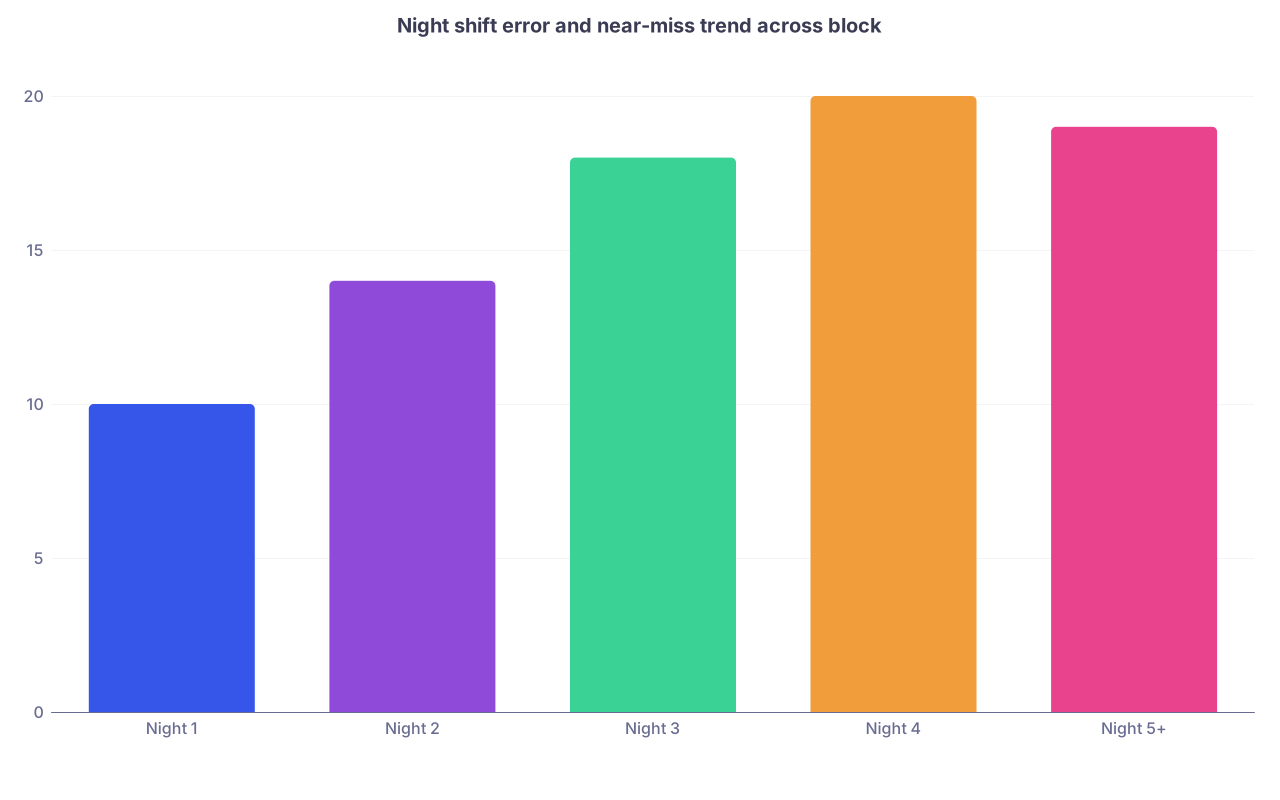
The pattern above is roughly what you see when people actually count near-misses on hospital services across a run of nights: steep climb to night 4, then a plateau at a still-high level.
The “safest” region, then, is the zone where:
- You are past the initial shock of night 1
- You have not yet stacked so much sleep debt that your brain is functioning at legally drunk equivalence
That is roughly nights 2–3 in a well-managed block. Which is exactly how many nights you get if your blocks are 3–4.

| Step | Description |
|---|---|
| Step 1 | Pre-block rested |
| Step 2 | Night 1 - circadian shock |
| Step 3 | Night 2 - moderate fatigue |
| Step 4 | Night 3 - high fatigue |
| Step 5 | Night 4+ - very high fatigue |
| Step 6 | Post-block recovery day - high driving risk |
The sweet spot from a risk-balancing perspective is painfully narrow: just a couple of nights where you are fully flipped enough to function but not yet overwhelmed by sleep debt.
Design schedules to live there as often as possible.