

The fastest way to burn out on nights is not the hours, or the patients, or even the pager. It is your boundary mistakes.
You do not get extra points for being boundary‑less. You just get more consults, more resentment, and eventually, more damage to your brain and your body than you can walk back in a single golden weekend.
Let me walk you through the specific ways residents blow up their own longevity on night shift—often while trying to “be a team player”—and what to do instead.
1. Saying Yes To Everything: The “Helpful Martyr” Trap
The most common night‑shift boundary mistake is pretending you are an infinite resource.
You are not.
On nights, there is always more to do:
- Extra admits that “technically” belong to another service
- Cross‑cover tasks that could wait
- Nurses, consultants, and sometimes attendings who realize you are the only person awake and reachable
The typical pattern: A second‑year on nights trying to prove they can “handle it” says yes to every admit, accepts every “while you’re at it” request, and never pushes back on inappropriate tasks. They get praised for being “amazing on nights.” Six months later they hate medicine.
Here is the boundary mistake: confusing being helpful with being endlessly available.
On nights, you must discriminate between:
- Legitimately urgent issues
- Things that need to be done before morning
- Things someone wants done now simply because you are awake and answer your pager quickly
The resident who burns out says yes to all three.
The resident who survives learns to say, calmly:
- “I can do that, but it will be in about an hour. I need to stabilize two new patients first.”
- “That change is non‑urgent; I will document it and hand it to the day team.”
- “That is primary team decision territory. I will leave them a detailed sign‑out message to address in the morning.”
You do not need to be rude. But you do need to be explicit.
On nights, if you do not protect your bandwidth, someone else will fill it for you. And not necessarily with what matters most for patient care.
2. Treating Sleep Like an Optional Hobby
Residents love to claim they “can function on 4 hours.” They cannot. You certainly cannot on nights, reliably, for months.
The boundary mistake here is simple: failing to defend sleep like it is a clinical duty.
You would not say, “I just did not have time to check that potassium.” But residents treat sleep that way all the time. Then wonder why they are snapping at nurses, forgetting orders, or crying in stairwells at 4 a.m.
On a run of nights, your actual sequence of priorities is:
- Safety (yours and your patients’)
- Sleep
- Food / hydration
- Everything else
When you treat sleep as item #7—after email, doomscrolling, debriefing with co‑residents, and “just one more episode”—you are making a conscious boundary error.
Typical sabotaging behaviors:
- Agreeing to 8 a.m. meetings or teaching sessions after a 12‑hour night
- Sleeping “whenever” instead of blocking protected sleep time
- Letting family / partner schedules override what your body needs on nights
- Going straight from night shift to errands because “daytime is when things are open”
The fix is not glamorous:
- Blackout curtains or an eye mask.
- Phone in another room or on Do Not Disturb with only true emergencies allowed through.
- A set, defended sleep window (for example: 9 a.m.–2 p.m. minimum, no exceptions unless a literal emergency).
If someone demands that you regularly show up to daytime commitments on a week of nights, that is not “being a team player.” That is you allowing your boundaries to be trampled.
Your brain on chronic night‑shift sleep debt is slower, less empathetic, and more error‑prone. That is a patient safety issue, not a personal weakness.
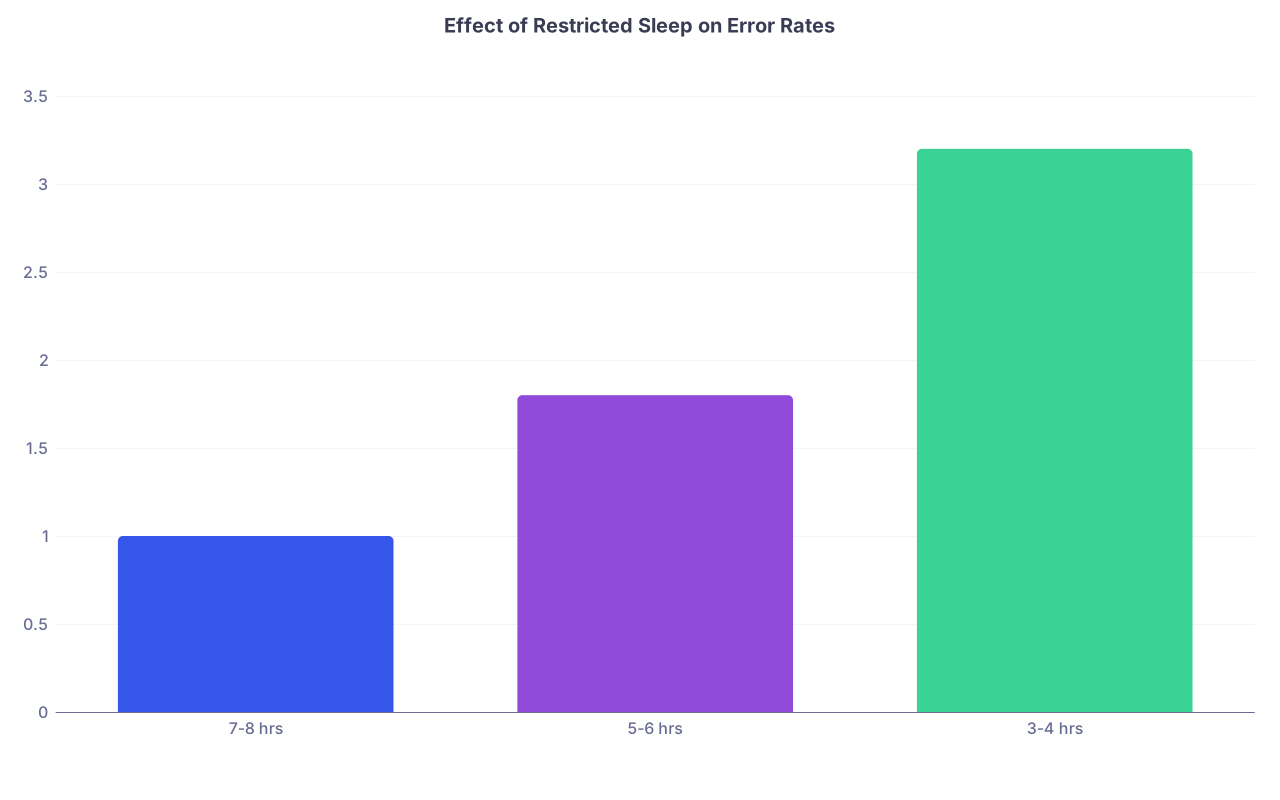
| Category | Value |
|---|---|
| 7-8 hrs | 1 |
| 5-6 hrs | 1.8 |
| 3-4 hrs | 3.2 |
You do not get a badge for operating in the red zone.
3. Letting the Pager Dictate Your Brain
Another subtle boundary mistake: you surrender your attention to the pager.
All night.
Every time it beeps, you drop what you are doing, mentally and physically, and run. You never finish a thought, a note, or a medication reconciliation. You ping‑pong across the hospital in a daze.
That constant cognitive fragmentation is brutal.
I have watched interns finish a night shift with 12 incomplete notes, 5 half‑implemented plans, and this vague feeling of crisis because they let every single interruption reset their priorities.
Boundary problem, not just systems problem.
You cannot stop the pager. You can control your response pattern.
Boundary‑protecting strategies:
- Batch cognitive work: When you sit to write notes, tell the unit secretary or charge nurse, “I am working through notes for 30 minutes; page me for urgent only. Non‑urgent can wait.” Most will respect that if you are dependable with real issues.
- Use explicit triage questions when called: “Is the patient stable? Vitals okay? Any acute change? Can this safely wait 20–30 minutes?”
- Physically finish one micro‑task before sprinting off unless it is a real emergency. “Hang on, let me sign this order so it does not vanish. Then I am on my way.”
If you let every beep hijack your brain, you are doing the cognitive equivalent of sprint intervals for 12 hours. You will feel wrecked, even on a low‑census night.
The myth is that “good” night residents are instantly available. The truth: good residents are responsive to acuity, not every noise.
4. Over‑Owning Problems That Are Not Yours
Night shift is where boundaries between teams get fuzzy. That is necessary—for patient safety. But many residents slide into full‑blown boundary collapse.
Examples I have seen repeatedly:
- The night float intern trying to completely re‑do the day team’s admission workup because “I wouldn’t have done it that way.” At 3 a.m. With 4 other active admits.
- Cross‑cover resident rewriting medication lists on stable patients who have been here for days because “this list is messy and bothering me.”
- Night OB resident chasing down social work issues that absolutely cannot be fixed at 2 a.m. but feel emotionally urgent.
You are there to:
- Keep patients safe
- Manage genuine deterioration
- Admit new patients safely
- Give the day team something they can build from
You are not there to:
- Resolve every systems problem
- Retro‑fix every annoying decision made by days
- Solve daytime communication failures that require families, consultants, and multidisciplinary teams
The boundary mistake is emotional: you let things that are not your responsibility live in your nervous system.
A simple internal script helps:
- “Is this my job tonight?”
- “Will my intervention now change their overnight safety?”
- “Can this be clearly handed off instead?”
If your answer is “No, No, Yes,” you are probably about to burn time and emotional energy on something that can and should wait.
Write a clean sign‑out. Leave a clear message. Then let it go.
5. Allowing Toxic Behavior Because “It’s Just Nights”
Night shift brings out the worst in people sometimes. Exhaustion, reduced supervision, and that weird 3 a.m. moral gravity. I hear versions of this all the time:
“It’s just nights, the nurses are always like that.”
“That attending always screams on the phone after midnight.”
“It’s normal for the ED to dump admits on us at 4:59 a.m.”
No. It is common. It is not normal.
Here is the boundary error: you accept chronic incivility or abuse as part of the deal. You internalize it as “I need to toughen up” instead of “this is a workplace problem that needs naming.”
You are not fragile because you feel sick to your stomach after being yelled at over the phone at 2 a.m. You are human.
Reasonable boundaries on nights mean:
- If a consultant or colleague is verbally abusive, you say, calmly, “I am here to discuss the patient. I will not continue this conversation if you speak to me that way.” Then you document.
- If a pattern of dumping unsafe workloads on nights repeats, you bring specific cases to your chief or program leadership. Not a vague “nights suck,” but, “On three consecutive nights, I was covering 80 patients alone after midnight, which is not safe.”
- If a nurse, RT, or tech is consistently undermining or disrespectful, you address it directly on a calm day shift—do not store months of resentment.
You cannot fix an entire hospital’s culture. But you can stop normalizing abuse because “this is what residency is.”
The line between “tough but fair” and “toxic” is crossed often at 3 a.m. Your job is to notice and refuse to quietly absorb it as your personal failing.
6. Letting Nights Erase Your Non‑Work Identity
Another slow, slippery boundary mistake: on nights, life outside the hospital starts to look optional. So you cut it.
At first, it is practical. You are tired. Your friends are on day schedules. Your partner is annoyed you are absent anyway. So you stop making plans. Stop scheduling anything that matters to you.
Six months in, you become “that resident who is always on nights” as if that is your entire personality.
This is not dramatic. It is how long‑term burnout takes root.
You will not fix this with “self‑care” slogans. You fix it with boring, specific boundaries:
- One protected, recurring activity that is not medicine: lifting twice a week, a standing call with a friend, 30 minutes of guitar, whatever. You schedule it like a consult.
- You warn the people in your life: “On runs of nights, you may not hear from me much, but I still care. Let us plan X on my post‑night stretch.” Communicate, instead of ghosting and then feeling guilty.
- You stop saying yes to every extra shift, moonlighting, or committee role that erases your only off‑nights. Money or “CV building” is not worth obliterating your recovery time if you are already at the edge.
If you treat your relationships and non‑clinical interests as optional add‑ons, residency will consume them.
Nights accelerate that process because isolation feels inevitable. Do not cooperate with it.
7. Blurring the Line Between Empathy and Over‑Identification
This one is quieter but deadly on nights.
At 2 a.m., it is you, a sick patient, minimal backup, and a lot of raw emotion. Families are scared. Patients are unfiltered. You see people at their worst and most vulnerable.
The boundary mistake: you start to absorb everyone’s panic, grief, anger, and despair as if it is yours to carry.
Signs you are over‑identifying:
- You replay one patient interaction in your head for days
- You cannot sleep after nights because you are agitated, not just wired physically
- You feel personally responsible for outcomes that were not preventable
- You feel guilty leaving at shift change if anything is still unresolved
Being a caring physician does not mean being a sponge for unbounded suffering.
You need an internal line:
- “I will show up fully for this patient for the next 30 minutes.”
- “I will do everything in my scope and my resources to help.”
- “After that, I will hand over cleanly and let the system hold them, not just me alone.”
Some residents refuse to use chaplaincy, social work, or psych on nights because “it is faster if I just do it.” Sometimes that is true. Often, it is a control issue mixed with poor boundaries around emotional labor.
You are not weak if you call chaplain at 3 a.m. for a family in meltdown while you handle two actively decompensating patients. You are appropriately delegating.
If you treat every emotional crisis as solely your responsibility, your empathy will turn into exhaustion, then numbness, then cynicism. That is the burnout sequence.
8. Eating, Drinking, and Moving Like a Ghost
This one sounds basic. It is not. It is a boundary issue with your own body.
Residents on nights routinely:
- Go 8–10 hours without water
- Live on cookies from the nurse’s station and cold fries from the cafeteria
- Sit in a dark call room until their back spasms, then sprint to a code with zero warm‑up
You do not need a perfect diet and gym routine on nights. That is fantasy. You do need minimum viable physiology.
Boundary mistake: treating your body as a disposable transport vehicle for your brain.
At a minimum:
- Set a non‑negotiable: finish one full water bottle per 4–5 hours, not negotiable. Refill during every walk back from a unit.
- Bring something with actual protein and fiber. Stop relying on “I will grab something later” as a plan. Later is when the STEMI, the GI bleed, and the agitated delirium hit at once.
- Do 30–60 seconds of actual movement (wall push‑ups, squats, shoulder rolls) every 2–3 hours if you are glued to a chair. Not for fitness. For circulation and back preservation.
This is not wellness fluff. Chronic dehydration and poor fueling make your cognition worse and your mood more volatile. You snap faster. You think slower.
If you are too busy to drink water for 10 hours every shift, that is not your weakness. That is a staffing and workflow problem that needs to be named. But you still have to fight for the minimums in the meantime.
9. Never Drawing the Line on Unsafe Workloads
Some residents will swallow any assignment. Any census. Any combination of services.
They tell themselves, “This is how I learn.” Or, more honestly, “I am scared to be seen as weak.”
This is the most dangerous boundary mistake of all: refusing to ever say, “This is unsafe.”
I am not talking about “this is hard” or “this is unpleasant.” I am talking about:
- 100+ cross‑cover patients solo with no in‑house senior
- Expected to run a unit and the ED at the same time
- Multiple ICU‑level patients on the floor while you are also covering 30 stable admissions
- A run of 7 or more consecutive 12‑hour nights with no real recovery period
| Scenario | Why It Is Dangerous |
|---|---|
| >90 cross-cover patients alone | Too many to track mental status and labs safely |
| No in-house senior or attending | Delays in critical decision-making |
| Covering floor + ED simultaneously | Split attention during emergencies |
| 7+ consecutive 12-hr nights | High risk for cognitive errors and burnout |
I have watched residents cry in bathrooms, then go back out and keep signing orders they are not fully processing. Because “everyone else seems to manage.”
They are not managing. They are white‑knuckling.
You are allowed to say:
- To your senior: “I am at my limit. I am worried about missing something dangerous. What can we offload or postpone?”
- To your chief: “This pattern of assignments is not safe. Here are three specific nights with details. I am documenting this.”
- In extreme situations: “We need backup. Now.”
Will this feel uncomfortable? Yes. Will some people roll their eyes? Probably.
But the alternative is you taking on the moral weight of a system problem alone. And when a serious error happens, trust me, the culture will not say “thank you for being such a trooper and never speaking up.” It will ask why you did not.
10. Treating “I’m Fine” as Your Only Status
Residents become experts at saying, “I’m fine.”
Fine after a pediatric code at 2 a.m.
Fine after a night where nothing went right.
Fine after three months of nights where your sleep is broken and your mood is flat.
No, you are not.
The boundary mistake here is internal: you refuse to monitor your own distress like you would monitor a patient. You ignore all your own red flags.
Real red flags on nights:
- You start fantasizing about car crashes on the way to work, not because you want to die, but because a hospital stay sounds easier than another shift
- You find yourself wishing patients would die because you are too tired to keep treating them (horrifying to admit, surprisingly common in burnout)
- You are drinking heavily or using substances to “knock yourself out” after nights
- You feel numb during emergencies you used to care about
Those are not “normal parts of training.” Those are signs your boundaries have been bulldozed for too long.
You need at least one person—co‑resident, chief, therapist, partner—who knows what your personal warning signs look like and has permission to call you on them.
You are allowed to say to leadership:
- “Nights are amplifying some pretty severe burnout symptoms for me. I need to adjust my schedule or get formal support.”
If your program’s culture treats that as weakness, that is their failure. Not yours.

| Step | Description |
|---|---|
| Step 1 | Boundary Slips |
| Step 2 | Chronic Sleep Debt |
| Step 3 | Emotional Exhaustion |
| Step 4 | Cynicism and Detachment |
| Step 5 | Errors and Near Misses |
| Step 6 | Severe Burnout |
You stop this cascade at the boundary point. Not when you are already at “severe burnout” and wondering if you chose the wrong career.
3 Things To Remember
- Night shift will always be hard. Burnout is not inevitable. The difference is boundaries—what you say yes to, what you protect, and what you refuse to normalize.
- You are not more professional for ignoring your own limits. You are more dangerous. To yourself and to your patients.
- The residents who last are not the ones who martyr themselves on nights. They are the ones who quietly, consistently defend their sleep, their attention, their safety, and their humanity—even at 3 a.m.


