
The most dangerous thing about night shift is not what you do not know; it is what you are too tired to question.
Residents do not get in trouble on nights because they missed a zebrafish disease. They get in trouble because they anchored on “it’s probably nothing,” their brain was running on 40% power, and nobody forced the mental reset. Let me break this down specifically.
You asked about cognitive errors on nights—anchoring, fatigue, and how to counteract them. This is exactly where residents quietly sink or quietly level up.
The Night Shift Environment: A Perfect Storm for Cognitive Errors
Nights are not just “day shift but darker.”
You are dealing with a different cognitive environment:
- Fewer staff, less backup
- Higher noise-to-signal ratio in consults (“rule out badness,” “looks fine but can you check”)
- Circadian low between roughly 2–5 a.m.
- You are expected to make fast, high-impact decisions with incomplete data
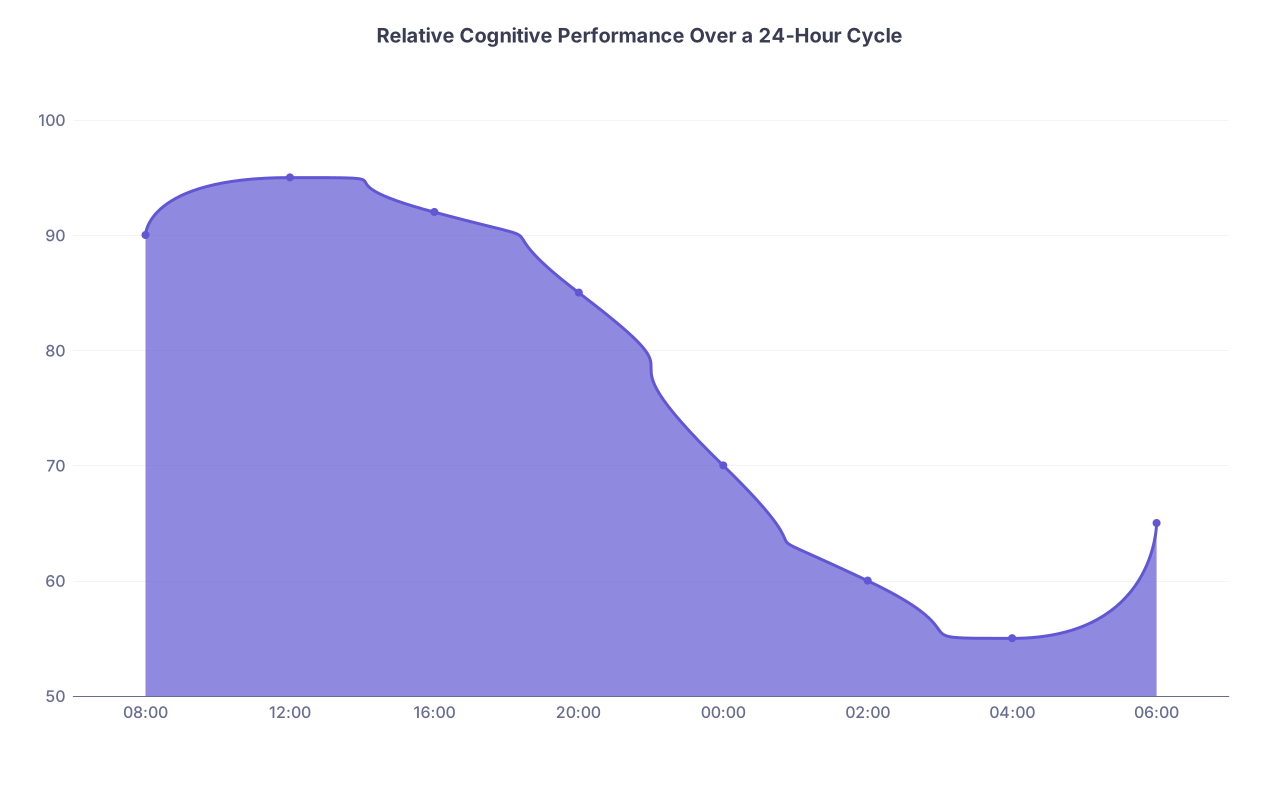
| Category | Value |
|---|---|
| 08:00 | 90 |
| 12:00 | 95 |
| 16:00 | 92 |
| 20:00 | 85 |
| 00:00 | 70 |
| 02:00 | 60 |
| 04:00 | 55 |
| 06:00 | 65 |
That trough between 2–5 a.m. is exactly when you are getting called for “pressure is 80 systolic” or “new chest pain.” Your brain is physiologically worse at:
- Updating prior assumptions
- Holding multiple possibilities simultaneously
- Catching subtle pattern mismatches
That is the perfect breeding ground for anchoring and related errors. The mistake is thinking you can “just be more careful.” You cannot willpower yourself out of physiology. You need systems.
Anchoring: The Classic Night Shift Trap
Anchoring is the tendency to lock onto an initial impression, diagnosis, or piece of information and then under-adjust even when new data arrives.
On night shift, anchoring shows up in very predictable patterns. I will give you actual scripts I have heard on resident workrooms at 3 a.m.
Common Night-Shift Anchors
“They’re just anxious / it’s their baseline.”
The 28-year-old with chest pain who has a history of panic attacks. You hear “she gets this all the time.” You anchor on anxiety. The troponin comes back 0.12 and suddenly you are playing catch-up on a missed NSTEMI.“It’s probably just sepsis / UTI / pneumonia.”
Elderly, febrile, tachycardic, slightly confused. You anchor on “UTI in a demented nursing home patient.” Then the VBG shows a lactate of 6 and the MAP is barely 60. You under-call the shock because it “fits” UTI.“It’s their known X.”
- “It’s his known CHF.” (Actually new PE.)
- “It’s her known COPD.” (Actually pneumothorax.)
- “It’s his chronic back pain.” (Actually cauda equina.)
The prior label from the chart or nurse handoff becomes the anchor.
- “If it were serious, days would have caught it.”
This one is brutal. You inherit a borderline patient from day shift and assume the main problems are already identified. You do not reboot the differential. You miss the smoldering peritonitis, the new neuro deficit, the creeping oxygen requirement.
Why Anchoring Explodes at Night
Fatigue does not just make you slower. It changes how your brain thinks:
- You rely more on pattern recognition and mental shortcuts
- You avoid effortful re-analysis
- You seek “closure” quickly (“I want this to be UTI so I can move on”)
You are also getting anchored by others:
- Nurse: “This is just his usual pain; he gets this every night.”
- ED note: “Low suspicion for PE.”
- Sign-out: “Stable, just follow labs.”
If you do not consciously counter-steer, you will adopt someone else’s anchor as your own.
Other Cognitive Errors That Pair with Anchoring at Night
Anchoring rarely travels alone. Nights select for a whole cluster of errors.

1. Premature Closure
You decide on a diagnosis and stop actively looking for alternatives.
Example:
Admitted for “COPD exacerbation.” You accept the diagnosis, give nebs and steroids. You do not question the pleuritic chest pain or the unilateral leg swelling. You have closed the case in your head. PE walks right past you.
2. Confirmation Bias
You search for data that supports your anchor and discount things that do not fit.
Example:
You think it is sepsis. You focus on the tachycardia and fever. You half-ignore the localized right lower quadrant rebound because “the UA is dirty, so UTI explains it.”
3. Availability Bias
You over-weight diagnoses you have seen recently, especially in that same night.
Example:
You just saw three COVID pneumonias. The next hypoxic patient with bilateral opacities? Your brain is screaming “another COVID,” and you under-explore alternative explanations like acute pulmonary edema or diffuse alveolar hemorrhage.
4. Triage Bias / Severity Bias
On busy nights, you unconsciously give less attention to patients who seem lower acuity or familiar.
- “Chronic pain patient with same complaint again”
- “Frequent flyer with abdominal pain”
- “Behavioral / psych”
Those charts get skimmed, not studied. That is exactly where the occult rupture, the torsion, the bleed hides.
Fatigue: The Physiology Behind Your Bad Decisions
You are not just “tired.” You are cognitively altered.
| Deficit | Mechanism | Night-Shift Consequence |
|---|---|---|
| Slower reaction time | Reduced cortical arousal | Delayed response to deterioration |
| Impaired working memory | Prefrontal cortex fatigue | Forgetting key data / steps |
| Reduced cognitive flexibility | Lowered dopamine, PFC load | Stuck on initial diagnosis |
| Decreased risk perception | Altered limbic-PFC balance | Overconfidence, under-triaging |
| Microsleeps | Thalamocortical instability | Missing alarms, missing details |
Residents love to say, “I function fine on 4 hours.” No, you do not. You have just adjusted your expectations downward.
Specific night-shift fatigue patterns
- Circadian trough: 2–5 a.m. – lowest vigilance, worst decision-making.
- Post-call cognitive fog: 6–10 a.m. – you feel “wired but dumb.”
- Cumulative fatigue: Multiple nights in a row dramatically worsen executive function, even if nightly sleep looks “adequate” on paper.
The result:
Your ability to revise a diagnosis is worse than your ability to generate the first one. Anchoring plus fatigue equals “I picked something at 1 a.m. and never really rethought it at 4 a.m.”
Concrete Countermeasures: How to Actually Think Better on Nights
You do not fix this by “being more vigilant.” You fix it by building small, non-negotiable habits into how you run a night.
1. The “Default Doubt” Rule
Assume your first diagnosis is 80% right at best. You must earn the other 20%.
For any non-trivial decision (admission diagnosis, ICU vs floor, no-CT decision in trauma, sending home chest pain), force yourself to ask three questions:
- What is the most dangerous alternative I have not ruled out?
- What data would prove my current diagnosis wrong?
- Is there any piece of the story or exam that does not fit my diagnosis?
If you cannot answer those in 30 seconds, you are anchoring.
2. The 2-Minute Reboot for Sign-Out Patients
For every cross-cover patient you are called about, do this before giving an order (unless it is a code):
- Re-open the chart. Do not rely solely on sign-out memory.
- Scan: chief problem, last 24 hours, vitals trend, last progress note assessment.
- Ask: “Does the current complaint fit the primary diagnosis, or is this a new problem?”
You will catch a surprising number of “this is not just their usual” cases.
3. Use Time as a Diagnostic Tool, Not a Crutch
Lazy version of “watchful waiting” on nights = “I am tired and I hope this goes away.” That is not observation. That is neglect.
Proper use of time:
- Set explicit re-check times: “Reassess in 60 minutes, measure vitals, document pain, and I will re-examine.”
- Tie time to action thresholds: “If RR > 24, or SBP < 90, or HR > 120, I want a call and we escalate.”
- Recalculate your diagnosis after each interval: “Is the trajectory what I expect for X?”
If nothing has improved and you still have uncertainty, your threshold to expand the workup should drop with each interval.
Tactical Tools Against Anchoring and Fatigue
Let me give you specific, low-friction tools that actually work at 3 a.m.
1. The “Second Diagnosis” Requirement
For any new significant issue (new admission, RRT, possible transfer to ICU), do not stop at one diagnosis. Your job: articulate at least two reasonable possibilities.
Example:
- Don’t write only: “COPD exacerbation.”
- Write: “COPD exacerbation vs early pneumonia vs PE (less likely but considered).”
Say it out loud on the phone:
“I think this is sepsis from pneumonia, but I also considered PE and cardiogenic pulmonary edema.”
That simple habit keeps your brain’s diagnostic “aperture” open.
2. Night-Shift Micro-Checklists
Full-page checklists are useless at 4 a.m. You need brutal, tiny prompts.
Examples:
For chest pain: Always ask yourself:
- ACS?
- PE?
- Dissection?
- Pneumothorax?
If you have not at least considered these four, you are cutting corners.
For hypotension:
- Volume?
- Pump?
- Pipes?
- Rate/rhythm?
Four words, but they force you to look beyond “give fluids.”
-
- Glucose
- O2 / CO2
- Electrolytes
- Infection
- Drug / toxin
- Structural (stroke / bleed)
These are not there to teach you medicine. They are there to protect you from fatigue-simplified thinking.
3. The “Phone-a-Friend” Rule (Used Correctly)
Weak version: “Call attending for everything.” That is not realistic.
Strong version: Have a low threshold for calling when all three are true:
- It is 2–5 a.m. (you are at physiologic low)
- The decision is irreversible or high-stakes (intubation, not getting CT head in new focal neuro deficit, sending borderline home)
- You are aware of anchoring: you keep finding arguments for your initial idea
When you call, lead with uncertainty, not a sales pitch:
“Here is my leading diagnosis, here are the alternatives I am still concerned about, and here is the data I think supports each.”
You are not “bothering” them. You are doing your job.
Running Your Brain Like a System: Pre-, Mid-, and Post-Shift
You cannot separate cognitive performance from how you run the rest of your life on nights. I am not talking about spa-day “self-care.” I am talking about operational reliability.

| Step | Description |
|---|---|
| Step 1 | Pre-shift |
| Step 2 | Shift start |
| Step 3 | Mid-shift 2-5 am |
| Step 4 | Pre-signout |
| Step 5 | Post-shift |
| Step 6 | Bank sleep |
| Step 7 | Caffeine timing |
| Step 8 | Prioritize sickest review |
| Step 9 | Use checklists |
| Step 10 | Second diagnosis rule |
| Step 11 | Reassess borderlines |
| Step 12 | Decompress brief |
| Step 13 | Protect recovery sleep |
Pre-Shift: Setting Up Your Brain
- Bank sleep if you can. Coming into a run of nights with sleep debt is asking for errors.
- Caffeine with intent. Front-load early in the shift; stop it ~4–6 hours before planned post-shift sleep.
- Know your “anchor risk” patients before midnight:
The frequent flyers, chronic pain, baseline altered. These are exactly the ones you will be tempted to dismiss later.
Mid-Shift (2–5 a.m.): High-Risk Window
During this window, adopt a stricter cognitive standard:
- For new significant issues: default to more data, not less (extra set of vitals, quick bedside exam, maybe that lactate or EKG you are “on the fence” about).
- Stand up, walk to the bedside. Do not manage sick-ish patients purely from the phone.
- Use your micro-checklists deliberately. This is when shortcut thinking will try to take over.
Pre-Signout: Clean Up Anchors Before You Hand Them Off
The most demoralizing feedback you will ever get is, “The day team caught X on a patient you had all night.” The way you avoid that:
- Identify any borderline cases: soft hypotension, rising oxygen needs, new but mild chest/abdominal pain, weird neuro complaints.
- Do one final focused re-assessment on the ones that could go wrong after you leave.
- If you are still uncertain, say so in sign-out: “I am not fully happy with X; I would like fresh eyes on them this morning.”
That is not weakness. That is professionalism.
Examples: Real Night-Shift Scenarios and How to Do Them Better
Let’s get very concrete.
Scenario 1: The “Anxiety” Chest Pain at 3 a.m.
You get called: “28-year-old female, known anxiety, now with chest pain. Vitals stable.”
Anchoring temptation: “This is obviously panic. Reassure, maybe hydroxyzine, move on.”
Better approach:
- Quick chart check: risk factors? similar prior visits? any D-dimer/CTs before?
- Bedside: confirm description (pleuritic? exertional? constant?), any dyspnea, syncope, leg swelling, hemoptysis, OCP use.
- Use micro-checklist: ACS / PE / dissection / pneumothorax. Which can I safely exclude with history, exam, EKG, maybe a single troponin?
You still might land on “likely anxiety,” but it will be earned, not assumed.
Scenario 2: Hypotensive Septic Elderly Patient
Handoff from ED: “80-year-old from nursing home, UTI sepsis, on 2 L O2, BP 95/55, HR 115, lactate 3.2, came up 30 minutes ago.”
At 3:30 a.m., nurse calls: “BP 82/48, still on 2 L.”
Anchoring temptation: “He’s septic, give more fluids, it’s expected.”
Better approach:
- Re-open chart: recent echoes? EF? baseline creatinine? any CAD or CHF?
- Go see them. Look at skin perfusion, mental status, JVP, lungs.
- Ask: “Sepsis” is my anchor, but:
- Could this be cardiogenic? (h/o EF 20%?)
- Could there be bleeding? (melena, flank bruising, coagulopathy?)
- Could this be distributive but now fluid-resuscitated and in need of pressors?
Action: maybe you still give fluids—but with eyes open, ultrasound in hand, ICU consult early, not 2 hours later when the gas shows pH 7.1.
Building a Culture That Helps You, Not Hurts You
You are not the only vector for anchoring. The whole system participates.
You will hear from seniors:
- “He is always like that.”
- “She always complains of that.”
- “That service overcalls everything.”
Translate that in your head as: “I am giving you my anchor; use with caution.”
Good seniors and attendings do the opposite. They model language like:
- “I think it is X, but I want you to double-check Y and Z.”
- “If their pain looks even 1 notch worse than I saw earlier, I want to know.”
- “This guy worries me. The numbers are OK, but the gestalt is bad.”
Emulate that. When you are the senior on nights, your words will either free your juniors to think or lock them into your bias.
Key Takeaways: Simple, Ruthless Habits
Let me compress this.
- Your night-shift brain is physiologically worse at updating diagnoses. Assume your first impression is incomplete.
- Anchoring is not subtle. It hides in phrases like “it is probably just X” and “this is their baseline.” Those should trigger doubt, not comfort.
- Countermeasures must be simple and automatic: a second diagnosis rule, micro-checklists, explicit re-check times, and a low-threshold for getting a second brain on high-stakes calls.
You are not trying to be perfect on nights. You are trying to be systematically safer than your fatigue wants you to be. That is the difference between “got through my nights” and “became someone the nurses trust at 3 a.m.”