
Most residents have no idea how brutal a 3 a.m. surge with boarders and hallway beds can get—until it hits them.
Let me be blunt: night flow in a crowded ED is less about “medical knowledge” and more about ruthless logistics, prioritization, and not losing your mind when 14 admit boarders, 6 hallway beds, and a fresh trauma all land on you at once.
You are not just “seeing patients.” You are:
- Running a mini-ICU of boarders.
- Preparing tomorrow’s medicine service before they wake up.
- Protecting the front door from collapsing when surge pages hit.
And you have almost zero margin for sloppy systems thinking.
Let’s break this down like you are actually on shift. Not in theory. In the mess.
1. The Reality of 3 a.m. ED Night Flow
At 3 a.m., the ED is in a different universe than daytime.
Day shift: consultants available, social work everywhere, hospitalists answering pages in 10 seconds, case management present, transport moving people.
Night shift: skeleton crew, inpatient services slow, lab and radiology thinner, tempers shorter, everyone tired.
The three forces that wreck your flow:
- Boarders – admitted patients stuck in ED beds for hours (or half a day).
- Hallway beds – extra “beds” that are not really beds, with real patients and real liability.
- Surge pages – hospital or ED-wide “we are drowning” alerts—meaning more volume, more scrutiny, and less help.
Your job at night is not just “keep up.” Your job is to control the chaos enough to keep the next disaster from killing someone or closing the department.
2. Boarders: Running a Shadow Inpatient Service
You cannot survive nights if you treat boarders like “done” patients.
They are not “done.” They are your patients until they roll out of the ED. If something goes wrong, it is your name in the note and on the chart at the time.
2.1 First Hour on Shift: Boarder Triage
Your first serious move after sign-out: boarder census. Not superficial. You need a quick, systematic scan.
Make yourself a mental checklist and run it every night. Example:
- Any boarder on:
- Pressors?
- HFNC/BiPAP?
- Insulin drip?
- Heparin drip?
- Continuous sedation?
- Any boarder with:
- MAP < 65?
- New fever since admission?
- Escalating O2 requirement?
- New mental status change?
- Any boarder waiting:
6–8 hours with no documented re-exam?
- On critical labs/imaging not followed up?
If your boarders are 15 patients deep, you are not going to sit and chat with each. But you can prioritize which 3–4 you must physically reassess in the next 30 minutes.
| Red Flag | Why It Matters |
|---|---|
| Escalating O2 / new BiPAP | May need ICU, risk of crash |
| New fever after admission | Occult source, missed sepsis |
| MAP < 65 or SBP < 90 | Shock not actually stabilized |
| New confusion or agitation | Delirium, hypoxia, stroke, meds |
| Troponin trending up | Unstable ACS, needs escalation |
If you are inheriting boarders from a shaky sign-out, do not assume anything. “He’s stable” is code for “I have not looked recently.”
2.2 Documentation That Protects You and the Patient
Night residents get burned when a boarded patient deteriorates and there’s no note for 8 hours.
You do not need a novel. You need timestamped re-eval notes.
Example structure (concise, real-world):
03:17 – ED re-eval (boarder): 72M admitted to HF for ADHF. On 2L NC, sat 93–95%. RR 20–22. Lungs w/ bibasilar crackles, no increased WOB. BP 110/65, HR 88, afebrile. UOP adequate per RN (450 mL last 4 hr). No CP, no orthopnea worse than prior. Plan: Continue current diuresis, re-check BMP at 06:00 for K/Cr. Will message HF service re: possible stepdown vs floor bed.
You are showing:
- You laid eyes on them.
- You looked at vitals, outputs, and symptoms.
- You set a concrete short-term plan.
If they crash at 05:30, nobody can say they were ignored for 8+ hours with no physician reassessment.
2.3 Escalations: When a Boarder is Not a Floor Patient Anymore
Classic night mistake: rationalizing a near-ICU boarder as “still fine” to avoid friction.
If any of these are true, you should at least consider ICU / higher level of care and have a real conversation:
- Pressors (even “low dose”)
- Increasing oxygen requirement, especially > 6 L NC or new noninvasive ventilation
- Shocky vitals needing repeated boluses
- Persistent chest pain, neuro changes, or repeated episodes of arrhythmia
Do not just text the medicine intern: “FYI, oxygen went up from 2 to 6 L.” That is you dumping risk on someone with even less power than you. Call the senior or attending if needed and frame it clearly:
“I am in the ED with your admitted patient. Oxygen needs have trended from 2 to 6 L in 2 hours. RR mid-20s, mild increased work of breathing, CXR a bit wetter. I am concerned they’re drifting out of floor territory. I’d recommend ICU or at least intermediate care.”
You are not begging. You are doing your job.
3. Hallway Beds: Unsafe by Default, Manageable With Discipline
Hallway patients are where bad outcomes like to hide.
They have:
- Less visibility.
- Less monitoring.
- More chaos around them.
You cannot change the architecture. You can fix your process.
3.1 Who Belongs in a Hallway Bed?
If your department has no policy, you still need personal rules. Hallways are for relatively stable, lower-acuity, higher-observation-tolerant patients.
Generally OK in hallway:
- Low-risk chest pain pending stress or OBS bed, with normal vitals and normal ECG/troponin so far
- Minor trauma, ambulating, waiting for imaging or dispo
- Simple cellulitis, UTI, stable abdominal pain with reassuring initial workup
- Behavioral health patients already medically cleared and safe with sitter/security
Avoid hallway (unless absolutely forced and you know you are taking a risk):
- Undifferentiated severe abdominal pain with peritoneal signs
- Possible sepsis not yet fully resuscitated
- Active chest pain with dynamic ECG changes
- Stroke alerts, post-tPA patients
- Anyone on high-flow O2, BiPAP, or continuous drips
Your mental question: If this person crashes, will we even notice right away? If the answer is “maybe not,” that patient does not belong against a wall.
3.2 Hallway Workflow: How to Not Lose Them
You will not remember 10 hallway patients unless you create ridiculous-level structure.
Some tricks that actually work:
- Physical list on your brain sheet exclusively for hallway beds. Different color, separate column. You should be annoyed when you see it – that keeps it visible.
- Agree with nursing on who is responsible for vital sign intervals and how abnormal vitals will be communicated. Hallway vitals cannot be every 6 hours.
- Hard rule: any hallway patient who gets new pain, new shortness of breath, or change in mental status gets an immediate bedside eval, not just meds on autopilot.
Do short, frequent micro-checks. Thirty-second encounters:
“Still having chest pain?”
“Any worse shortness of breath?”
“Anyone made you feel worse since I last saw you?”
You are screening for drift. Not doing full histories every time.
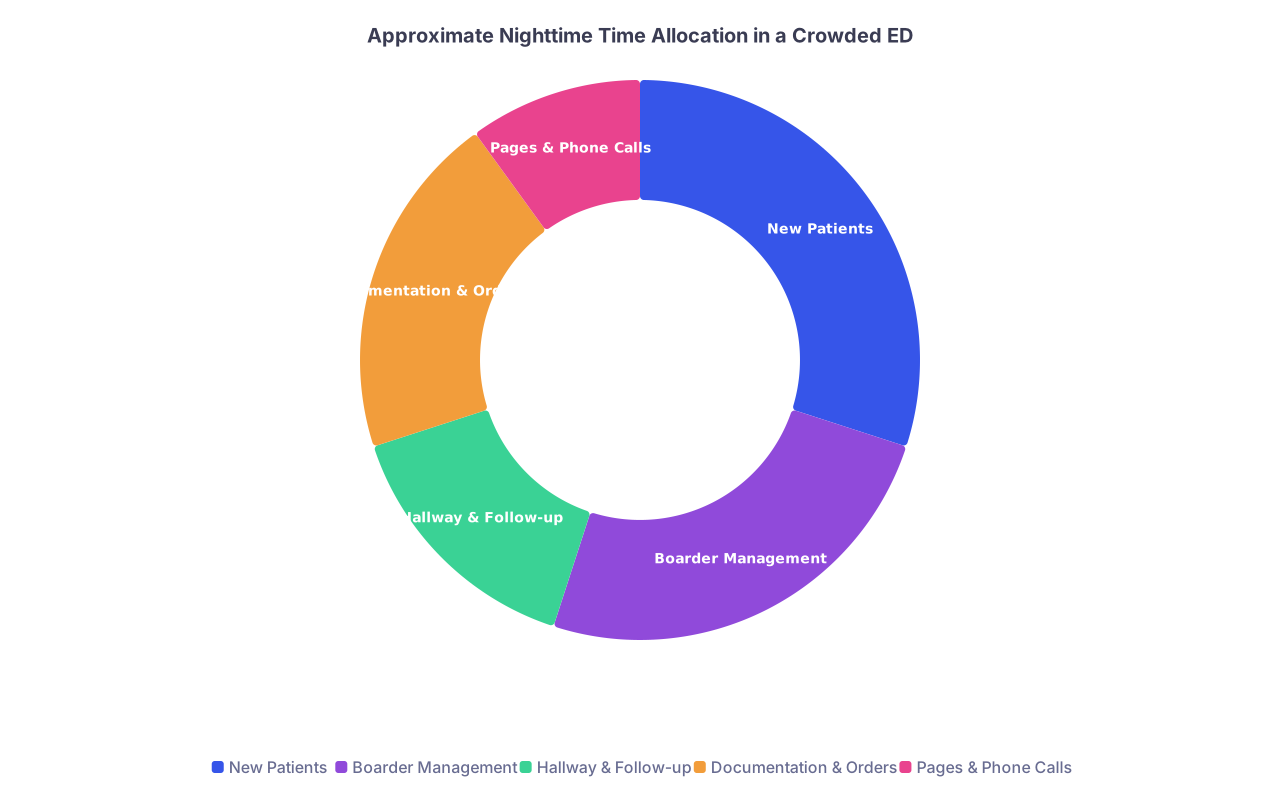
| Category | Value |
|---|---|
| New Patients | 30 |
| Boarder Management | 25 |
| Hallway & Follow-up | 15 |
| Documentation & Orders | 20 |
| Pages & Phone Calls | 10 |
The doughnut is ugly but accurate: hallway care is a real, time-consuming slice. If you do not actively schedule it, it disappears.
3.3 Documentation for Hallway Beds
Short notes, but do them. Especially for any change:
- New pain or worsening pain
- Change in exam (e.g., guarding where there was none)
- Repeat troponin or imaging results
Example:
02:42 – Hallway re-eval: 45F with RUQ pain, waiting US. Vitals stable. Pain similar, not worse. Abd soft, mild RUQ tenderness, no rebound/guarding. No new nausea/vomiting. Will keep NPO. Pending RUQ US.
If you move someone from a room to hallway, document the reason:
Moved to hallway 3 for bed availability; patient stable, vitals WNL, low-risk chest pain with reassuring workup so far.
That one line is the difference between “they abandoned me in hallway” and “this was a measured decision.”
4. Surge Pages at 3 a.m.: Controlled Damage, Not Heroics
Surge pages are when the system admits it is underwater.
“Code Help,” “ED Saturation,” “Capacity Alert,” “Full Code Surge.” Different hospitals, same reality: more patients are coming, and you were already in trouble.
You cannot fix hospital capacity. You can prevent critical errors and keep your own practice safe.
4.1 What a Surge Page Actually Means for You
When a surge page fires:
- You may be forced to open more hallway beds.
- Triage may start “streaming” patients directly to internal waiting, holding areas, or fast track despite limited staff.
- Inpatient teams may get even slower to see or accept admits.
Your priorities shift:
- Identify and stabilize the truly sick or time-sensitive.
- Avoid missing silent disasters parked in corners.
- Disposition anyone you safely can. Fast.
This is where residents implode because they keep working at “pre-surge” depth. You cannot see every patient like you have 6 beds and no hallway.

| Step | Description |
|---|---|
| Step 1 | Surge Page Activated |
| Step 2 | Quick Census Scan |
| Step 3 | Go to bedside now |
| Step 4 | Group disposition candidates |
| Step 5 | Escalate to attending/ICU as needed |
| Step 6 | Rapid dispo - admit, discharge, OBS |
| Step 7 | Reassess waiting room and hallway |
| Step 8 | Repeat brief census every 60 min |
| Step 9 | Any unstable or high-risk patients? |
4.2 The 5–10 Minute “Census Scan”
When surge hits, take 5–10 minutes for a true global view:
- Boarder list: any unstable trends?
- Hallway list: any red flags or long waits with no re-eval?
- Waiting room board (if you can see it): any high-acuity triage notes waiting too long?
You are looking for:
- Sepsis potentials with long door times
- Chest pain sitting too long without ECG/troponin
- Time-sensitive neuro complaints waiting for imaging
- Elderly falls on blood thinners who have not been scanned
You will not fully evaluate all of them immediately. But you can decide who must move to the front of the line, even if “the line” is a hallway stretcher.
4.3 Surge Triage at the Physician Level
At 3 a.m. during a surge, the resident’s job is brutal triage:
- Who needs full workup now?
- Who can be safely “parked” with partial workup and close follow-up?
- Who can you discharge straight from triage / initial bed with tight follow-up?
Some concrete categories:
Immediate full attention
- STEMI / NSTEMI with changes
- Stroke alerts, obvious neuro deficit
- Hypotension, septic shock, severe sepsis
- Respiratory distress, high O2 needs
Time-sensitive but can wait 20–40 minutes with monitoring
- Abdominal pain but stable vitals, non-peritoneal
- Mild to moderate CHF exacerbation on low-flow O2
- Uncomplicated syncope with reassuring initial vitals
Lower risk, rapid dispo candidates
- Minor lacerations, simple fractures post-splint
- Isolated ankle or wrist sprains with imaging done
- Known diagnosis with simple intervention (e.g., migraine with classic pattern and good response to treatment)
You will feel guilty not going room-to-room doing full, leisurely histories. Accept that this is disaster medicine inside a “normal” hospital. You are practicing safe minimalism, not neglect.
5. Practical Night-Flow Systems That Actually Work
You need systems that run even when your brain is half-asleep.
5.1 The “Every Hour” Habit
On bad nights, set a timer or anchor to something (e.g., whenever you sign a note, glance at the clock): every 60–90 minutes, do a rapid mental census:
- Any new boarders?
- Any boarders upgraded/downgraded without you noticing?
- Any hallway bed changes?
- Any waiting room patients flagged by triage RN?
You are not doing full reassessments. You are not writing long notes. You are scanning for “this could kill someone if ignored.”
5.2 Use the Status Board Aggressively
Most ED systems (Epic, Cerner, etc.) have tools you are probably under-using at 3 a.m.
Examples:
- Filter for admissions > 6 hours. Those are prime for drift.
- Flag patients “Watch closely” or “Needs re-eval” and unflag when done.
- Use an internal column (even just a dot or color) to denote hallway vs room vs resus.
If your board does not differentiate hallway from rooms, you will forget someone. Write them out separately if you must.
5.3 Communication with Nursing: Night Variant
Night nurses are often veterans. They know when things are spiraling. Use that.
At the start of a bad shift, say explicitly:
“We are going to be slammed. If you see any boarder or hallway patient with changing vitals, mental status, or new pain, I want to know early. Even if it feels minor.”
Then back that up. Do not snap when they call you for “small stuff.” If you punish them for paging, they will stop—and that is how missed sepsis sits in hallway 10 for 4 hours.
On the flip side, set expectations:
“If I am tied up with an airway or an arrest, and it is something like mild pain not relieved by first-line meds, text me and I will hit it right after the critical situation. If it is vitals or breathing, page me overhead.”
Speaks at their language: clear, actionable rules.
6. Protecting Yourself from Burnout and Blame
This is not just about throughput. This is about not being destroyed by a system that pressures you and then happily blames you when something slips.
6.1 Boundaries: Attendings and Consultants
Night residents often act like they are not allowed to bother anyone. That is how serious misses happen.
Reasonable threshold to involve your attending:
- Any potential ICU-level status change
- Any unclear high-risk dispo you feel queasy about
- Any consultant refusing an obviously appropriate admission/transfer/escalation
Do not be the martyr who “did not want to bother” the attending. If they truly did not want calls, they would not be billing to supervise you.
Similarly, with consultants:
“We are in surge. I have a concern about X. I need you to weigh in so we share this risk.”
Not rude. Just factual.
6.2 Short, Honest Handoffs
Your sign-out in the morning is your last chance to protect patients and yourself.
For each boarder and each hallway patient with any complexity, hand off three things:
- The real problem list (not just “admitted for pneumonia”).
- Latest concerning trends (even if “mild but watching”).
- What you are actually worried about.
For example:
“Bed 18: admitted DKA, now closed anion gap, transitioning to subQ insulin. Last glucose 190, VBG near normal, still mildly tachycardic 100–110 but down from 130. I rechecked lytes at 05:30—K 4.0. I am not worried about recurrent DKA, but if tachycardia persists or increases, consider PE or infection. No current signs, just something I was watching.”
That is honest. And it tells the day team exactly where to look.
7. Simple Mental Models to Use at 3 a.m.
You do not have time for complexity at that hour. Use simple questions.
For any patient (boarded, hallway, or fresh):
- “Could they die or crash in the next 2–4 hours from something I have not yet addressed?”
- “If they stayed exactly like this until 7 a.m., would that be acceptable?”
- “If this ends up in M&M, can I clearly explain my thought process and what I did to mitigate risk?”
If the answer to #1 is yes → prioritize now.
If answer to #2 is no → adjust something (more monitoring, labs, imaging, or disposition).
If answer to #3 is no → document better and/or get help.

8. Example Night Sequence: What This Looks Like in Real Life
Let me walk you through a typical 3 a.m. pattern when a surge hits with boarders and hallway patients.
03:00 – Surge Page Fires
You:
- Stop what you are doing (unless you are actively resuscitating someone).
- Glance through your board: identify:
- Sickest boarders.
- Longest-waiting hallway patients.
- Triage notes for anything dangerous in the waiting room.
03:05 – Micro-Team Huddle (30–60 seconds)
Grab your attending and charge nurse:
“We just got surge. Boarders: 3 high-risk, rest stable. Hallway: 6 patients, 2 I am uneasy about. Waiting room: 2 chest pains waiting > 90 minutes, 1 abd pain > 2 hours. Plan—
I will immediately see chest pain #1, briefly examine chest pain #2 to risk stratify, then reassess the two hallway patients I am worried about. Please prioritize vitals on hallway. If new sick patients come in, pull me ASAP.”
Short. Clear. No one is guessing.
03:15–04:00 – Controlled Sprints
You alternate:
- Rapid high-yield evals (focused histories, focused exams).
- Key orders only—labs, ECGs, imaging, early analgesia/antibiotics as indicated.
- Quick re-evals on hallway and high-risk boarders, with micro-documentation.
You are not entering full novels into the chart. You are writing accurate snapshots to show ongoing care.
04:00–05:00 – Disposition Push
Now that the surge has “landed” and critical patients are identified and stabilized:
- Discharge whoever is clearly safe to go home with good instructions.
- Convert “soft admits” into actual admits; call the necessary teams.
- Re-evaluate any borderline admits vs discharge with the attending—especially older adults and vague abdomens.
This is where you claw beds back.
05:00–06:30 – Clean-Up and Reassurance
Before sign-out:
- Last sweep of boarders: any status drift? Last labs pending?
- Last sweep of hallway beds: either resolve dispo or have a clear plan.
- Chart clean-up focused on highest risk patients first.
This is how you avoid miserable 07:00 “by the way, bed 22 spiked a fever at 04:30 and nobody did anything” conversations.
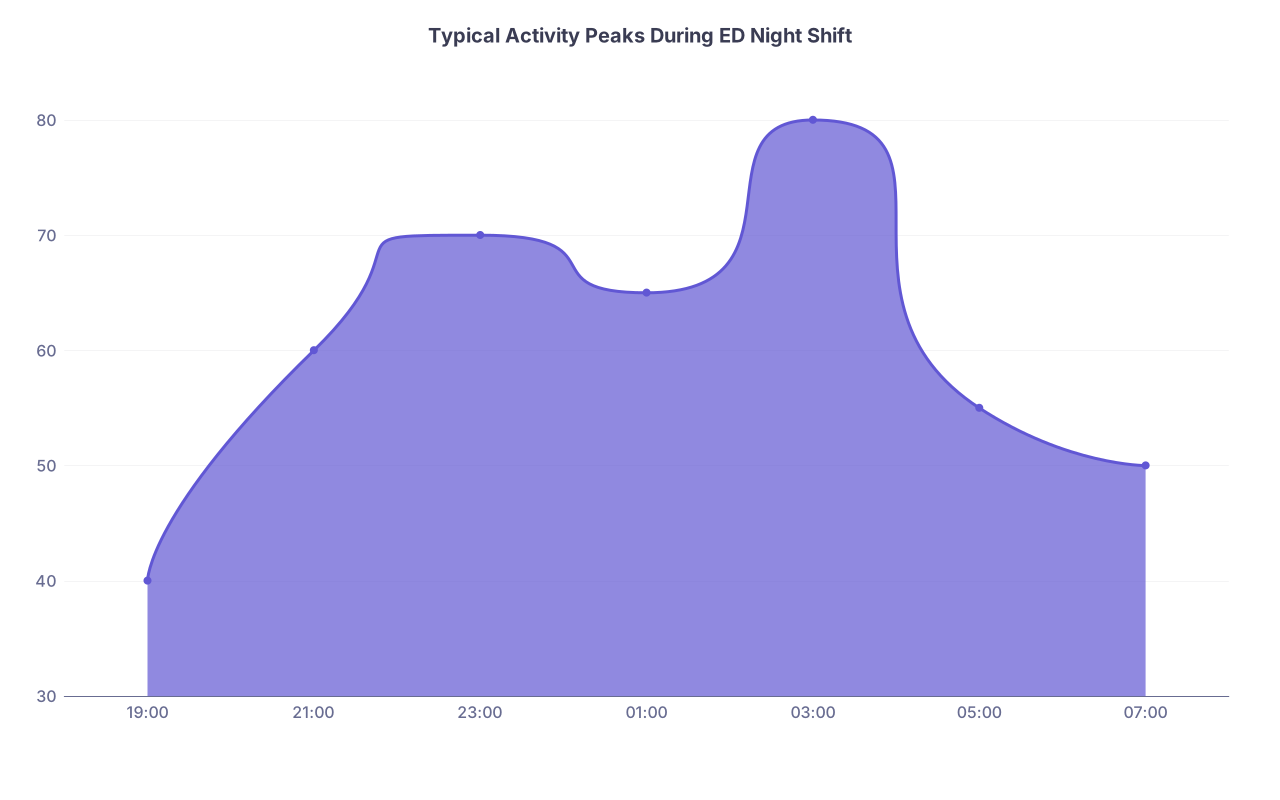
| Category | Value |
|---|---|
| 19:00 | 40 |
| 21:00 | 60 |
| 23:00 | 70 |
| 01:00 | 65 |
| 03:00 | 80 |
| 05:00 | 55 |
| 07:00 | 50 |
You see the spike. That 03:00 block is where deliberate systems keep you from breaking.
FAQ (Exactly 4 Questions)
1. How often should I reassess boarders on a busy night?
There is no universal rule, but a reasonable target in a crowded ED is:
- High-risk or unstable boarders: at least every 1–2 hours, more often if trending badly.
- Moderate-risk but stable boarders: every 2–4 hours with a quick re-eval and brief note.
- Low-risk, very stable boarders: at least once per shift with a documented update.
If vitals, labs, or nursing concerns change, that schedule resets. Do not let a boarded patient go 8 hours with no ED physician reassessment.
2. What do I do if inpatient teams refuse to accept that a boarder needs ICU instead of floor?
Escalate early and clearly. State concise facts: vitals trends, oxygen changes, lactate, mental status. Call the admitting senior or attending, not just the intern. Involve your ED attending and frame it as shared patient safety, not a turf war. Document your concern and the response. You are not being “difficult”; you are refusing to let a crashing patient rot in an ED bed.
3. How do I keep from forgetting about hallway patients when I am stuck in a resuscitation?
Pre-plan for that exact scenario. Before you enter a resus, tell the charge nurse and another provider: “I am tied up in this room. Please watch hallway patients for any change in vitals or condition and pull me if needed.” Keep a physical hallway list on your brain sheet and do a mini-round on them whenever you emerge from a critical room. And when in doubt, ask nurses, “Anyone in hallway worrying you?” They often know before the monitor does.
4. What is an acceptable level of care for a surge situation—am I allowed to cut corners?
You are never allowed to skip essential safety steps, but you are absolutely allowed to simplify. That means focused histories, targeted exams, necessary tests only, and tight follow-up instructions. You do not need exhaustive workups for clearly low-risk problems during a surge. The standard is: did you reasonably identify and manage dangerous conditions, given the constraints? If you can defend your decisions and your documentation reflects your thought process, you are practicing real-world emergency medicine, not cutting corners.
Key points, so you remember this at 3 a.m.:
- Boarders and hallway patients are not “done”; they are your responsibility until they leave the ED.
- Surge pages mean change your mode: prioritize the sick, simplify safely, and push dispo.
- Systems—hourly mental census, clear hallway rules, concise reassessments—will save more lives (and your sanity) than any single piece of textbook knowledge.