
Most night float misery is self‑inflicted through bad sign‑out.
Not laziness. Not malice. Just weak anticipatory planning and zero explicit “if‑then” structure.
Let me walk you through how the good residents fix that.
Why Advanced Sign‑Out Matters More Than You Think
Day teams lie to themselves in three ways:
- “They’ll call if there’s a problem.”
- “It’s probably fine.”
- “Night float can just figure it out.”
All three are wrong. Here is the actual reality of nights:
- The cross‑cover is juggling 40–90 patients, most of whom they have never seen.
- Nurses are triaging which calls are even worth making.
- Everyone is tired. Cognitive bandwidth is low. Even for strong residents.
In that environment, vague sign‑out is dangerous. The night resident will default to defensive medicine (unnecessary labs, transfers to higher level of care, over‑treating) or, much worse, under‑reacting because they do not realize the clinical trajectory.
Good daytime teams make three things brutally clear:
- What might happen tonight.
- What to do first if that thing happens.
- When to escalate and to whom.
That is all “anticipatory guidance” is. And when you embed it as structured if‑then plans, your night float:
- Pages you less.
- Pages you with better, more focused questions.
- Keeps your patients safer with less chaos.
So I am going to break this into concrete pieces:
- Core principles of high‑quality night sign‑out.
- Standard structure you can use on every patient.
- System‑specific anticipatory guidance with examples.
- Common failure patterns I see all the time.
- How to practice and teach this without adding an hour to your day.
Core Principles: What “Advanced” Actually Means
Advanced sign‑out is not just more talking. It is more signal, less noise.
The best sign‑outs I have seen share a few traits:
- Concise but high‑yield history – no re‑dictating the H&P.
- Clear statement of trajectory – improving / stable / tenuous / circling the drain.
- Explicit if‑then plans for the 2–3 most likely overnight problems.
- Default thresholds – when to call rapid, ICU, attending, or day team.
- A short list of “do not do” items that would be tempting but wrong.
You are not trying to cover every hypothetical disaster. You are putting bumpers on the 80% of issues that reliably appear at 02:00.
Before we go system by system, you need an overall template.
A Reproducible Structure for Every Patient
Use the same mental checklist. Every. Time. Your sign‑out should sound almost boringly structured.
I like this:
- ID + reason for admission (1 line).
- Current status / big picture trajectory.
- Active problems with key data.
- Overnight to‑dos (time‑sensitive).
- Anticipatory guidance – “You might see X. If so, do Y. Call for Z.”
Let me make that less abstract.
Example: 72‑year‑old with pneumonia + heart failure.
“Mr Smith, 72, admitted with CAP and acute on chronic HFrEF exacerbation. Day 2 of ceftriaxone / azithro, net negative 1.5 L on IV furosemide.
He is overall improving but still tenuous from a respiratory standpoint. On 2 L nasal cannula, satting 93–95%, RR 18–22. Creatinine creeping up from 1.0 → 1.3 today; SBP 95–105 but asymptomatic.
Overnight tasks:
- Strict I/Os, daily weight already done, no routine labs.
- Continue 2 L NC, goal sat ≥92%.
Anticipatory:
- If his O2 need goes from 2 → 4 L but he is otherwise comfortable and speaking full sentences, get a stat CXR and VBG, page me if concern for worsening pulmonary edema versus pneumonia.
- If he requires >4 L or is tachypneic >28, call rapid response and likely ICU to evaluate for BiPAP.
- If SBP drops <90 with MAP <65 and he is symptomatic (dizzy, altered), hold further lasix, give 250–500 mL LR bolus and call the MICU fellow early.”
That is advanced sign‑out: the night resident has rails to run on.
Now let us get more granular by category.
Anticipatory Guidance by Clinical Domain
1. Respiratory: O2, COPD, Asthma, Pneumonia
Respiratory deterioration is the classic “I wish I had said something” domain.
Think in tiers:
- Tier 1: Minor drift – more O2, a little tachypnea, still comfortable.
- Tier 2: Worsening work of breathing but protecting airway.
- Tier 3: Impending crash – mental status change, exhaustion, refractory hypoxia.
For each patient with any respiratory issue at all, leave explicit thresholds.
Example phrases you actually want to say:
- “If O2 from 2 → 4 L but RR <24 and speaking full sentences, you can go up to 4 L, get a VBG and CXR, and reassess.”
- “If they need >6 L NC or HFNC and are working to breathe (RR >28, using accessory muscles), call rapid and the MICU fellow. This is not a ‘watch and wait’ situation.”
- “If they become more somnolent and CO2 is rising on VBG, page MICU before they are obtunded. He is a full code and appropriate for intubation.”
Asthma/COPD example:
“COPD GOLD 3, on 3 L baseline. Now on 4 L, sat 90–92%, wheezy but talking.
If wheezing increases or he feels tighter, give additional DuoNebs q2h PRN up to 3 extra doses and one 40 mg IV solumedrol early rather than late. If after 2 hours he still needs >2 L above baseline, get a VBG and call MICU to discuss BiPAP. If he becomes drowsy or pH <7.25, that is an airway problem – rapid response and MICU.”
Notice: very concrete steps. Meds allowed. Labs to obtain. Trigger for escalation.
2. Hemodynamics: Hypotension, Tachycardia, Bleeding
You cannot just say “soft BPs.” That is worthless.
Spell out:
- What is “soft but acceptable” for this patient?
- What volume status you think they are in.
- Whether pressors / ICU are within goals of care.
Example: 60‑year‑old septic shock, now on the floor.
“Now off pressors for 24 hours, SBP 90–100, MAP 65–70. Lactate normalized. We think she is approaching euvolemia; stopped fluids this afternoon.
If SBP drops to 85–90 but MAP ≥60 and she is asymptomatic, repeat BP manually and recheck in 15–20 minutes. Do not immediately bolus. If SBP <85 or MAP <60 on repeat, get a stat lactate and 500 mL LR bolus while you are paging MICU and the nocturnist. She is full code and appropriate for pressors / ICU if she re‑declines.”
Post‑op bleeding risk example (even on medicine, you will own these sometimes):
“Post‑TKA, POD1. Hgb 10.2 from 11. No obvious bleeding.
If Hgb drops to 8–9 overnight but vitals stable and no overt bleeding, no transfusion; page ortho in the morning. If Hgb <7 or HR >110 with SBP <90, call ortho immediately and consider 1 unit PRBC; if hemodynamically unstable, call rapid and likely CT‑surgery or ortho chief depending on findings.”
Again, the “if this, then that” is spelled out.
3. Neuro: Delirium, Seizures, Stroke‑like Symptoms
Neuro issues are where vague sign‑out gets you sued.
Delirium patient example:
“86‑year‑old with baseline mild dementia, now with superimposed delirium from UTI. Waxing and waning, pulls at lines, sundowns.
If she becomes more agitated but not dangerous, try non‑pharmacologic first – lights down, reorientation, family video call, sitter if available. If she is a danger to self or staff (pulling lines, trying to get out of bed), you are allowed to use 0.5–1 mg IV haldol q6h PRN, max 3 doses overnight. Avoid benzos. If new focal deficits, slurred speech, or cannot arouse her – this is not ‘just delirium’; call a stroke code.”
Seizure disorder:
“Known epilepsy, on levetiracetam, had subtherapeutic level yesterday. Got a 2 g load this afternoon.
If she has a brief typical seizure lasting <2 minutes and returns to baseline, check vitals, give IV Ativan 1–2 mg if seizure >2 minutes, and page neurology after. If she has 2 or more seizures in 30 minutes or does not return to baseline, that is status – Ativan 2 mg IV, load with 1.5–2 g Keppra if not already done, call rapid response and neurology stat.”
You are giving the night intern permission structure and a basic algorithm.
4. Cardiac: Chest Pain, Arrhythmias, CHF
Do not hand wave chest pain. Ever.
Chest pain example (low‑risk but not zero):
“Middle‑aged woman with atypical chest pain, ruled out x2 with negative troponins, normal ECGs, HEART score low. Pain improved with GI cocktail.
If she has recurrent chest pain similar to prior but vitals stable and ECG unchanged from the last one, you can give SL nitro x1 if SBP >100 and GI cocktail again. Get troponin and repeat ECG. If troponin uptrends or ECG changes (new ST depression or elevation, T‑wave inversions) or pain is more severe / classic, call cardiology fellow and nocturnist. She is full code; going to cath is on the table.”
Arrhythmia example:
“History of paroxysmal AF, currently in sinus, on metoprolol tartrate 25 mg BID and apixaban.
If she flips into AF with RVR up to 130–150 but SBP ≥100 and asymptomatic, give 5 mg IV metoprolol x1, can repeat once. Goal <110. If still >130 after 2 doses or SBP <90, call rapid response and cardiology / ICU. She is not a candidate for immediate cardioversion tonight unless unstable.”
CHF volume status we already touched above.
5. Endocrine: DKA, HHS, Hypoglycemia, Steroids
Endocrine issues at night usually become emergencies through neglect.
DKA example (stepdown/floor, late phase):
“DKA resolving, anion gap down from 20 to 12, on insulin drip ~1 U/hr, now on D5 ½NS with K. K 4.2, creatinine 0.9. Goal is to close gap, transition to SQ insulin in morning.
If fingersticks drift below 100 while gap still open, increase the dextrose rate, not the insulin. We do not stop the drip until the gap is closed. If K drops <3.5, call me / MICU to adjust fluids and add more K. If he becomes more lethargic or vomiting resumes, check BMP and VBG – think recurrence of acidosis.”
Hypoglycemia‑prone patient:
“Brittle diabetic, had a 40 today after poor PO intake. We reduced basal by 30%.
If fingerstick <70 and alert, give 15 g oral glucose and recheck in 15 minutes. If <50 or altered, give 25 g D50 IV push, then start D5 ½NS at 75–100 mL/hr if NPO. If 2 episodes of BG <60 overnight, hold further prandial insulin and page the on‑call endocrine / primary team to adjust regimen.”
Steroid‑dependent example:
“Chronic prednisone 10 mg daily for adrenal insufficiency equivalent (yes, that is not ideal, but you will see it).
If he becomes hypotensive, febrile, and looks septic, stress dose him early – hydrocortisone 100 mg IV once then 50 mg q6h, in addition to sepsis workup. Do not wait for someone to tell you steroids are ok. He is steroid‑dependent.”
6. Renal/Electrolytes: AKI, HyperK, Hyponatremia
Electrolytes are classic “if‑then” territory.
Hyperkalemia risk patient:
“CKD4, baseline K 5.0–5.5, today 5.6, EKG without peaked T waves. Lokelma given. No ACEi tonight.
If K returns at 6.0–6.4 overnight and ECG still without significant changes, you can repeat Lokelma and hold all RAAS agents. Recheck K in 4 hours. If K ≥6.5 or any ECG changes – peaked T waves, widened QRS – give calcium gluconate 1 g IV, insulin 10 units IV with D50, and call nephrology / MICU. He is on the transplant list; we are aggressive.”
Hyponatremia example:
“SIADH, Na 122 this morning, on fluid restriction and salt tabs. Slow correction is the goal.
If Na rises >8 points in 24 hours (check CMP scheduled at 04:00), call me / nephrology; we may actually need D5W to slow it. Do not start normal saline for mild hypotension without talking to someone; you may worsen the sodium.”
7. GI/Infectious: GI Bleed, Sepsis, Post‑op Abdomen
GI bleed example:
“Upper GI bleed, got 2 units PRBC today, Hgb now 8.4 from 6.2, hemodynamically stable, on IV PPI drip. Endoscopy planned tomorrow.
If melena continues but Hb drop is <1 g and vitals are stable, you do not have to urgently transfuse; recheck CBC in 6 hours. If Hgb <7 or HR >110 with SBP <90, call GI fellow and rapid response; likely needs ICU and urgent scope. He is full code and appropriate for escalation.”
Post‑op abdominal patient (surgical but on your service happens more than you think):
“POD2 sigmoid resection, mild ileus expected. NG to low intermittent suction.
If he has abdominal pain but soft abdomen, no rebound, and passing some flatus, you can give 0.5–1 mg IV hydromorphone q3–4h PRN, mindful of ileus. If new fever >38.5, tachycardia >110, or peritoneal signs (board‑like abdomen, guarding, rigid), call the surgery resident immediately and consider CT abdomen overnight.”
Sepsis watch example:
“Complicated UTI with bacteremia, day 1 of cefepime. Lactate 1.8, HR 90–100, BP 110/60.
If fever to 38.5–39.0 with stable blood pressure and HR <110, draw repeat cultures, give scheduled antibiotics as planned, and give 500 mL LR over 1 hour if he looks dry. If SBP <90 or MAP <65 on two checks, that is sepsis with hypotension – 1–2 L LR bolus, stat lactate, and call rapid / MICU.”
How to Build Efficient If‑Then Plans Without Adding an Hour
The usual complaint: “This is great, but I do not have time.”
That is only true if you wing it every day. Once you standardize, it speeds you up.
Here is what I have seen work:
Build micro‑templates by problem in your head (or actually written down early on).
- Example: “If mild O2 increase, do X. If large increase + distress, rapid + MICU.”
- Same for hypotension, chest pain, delirium, hypoglycemia.
During prerounds, flag which patients actually need advanced anticipatory guidance.
- Not every cellulitis on IV cefazolin needs a novel if‑then plan.
- Your focus: respiratory, hemodynamic, neuro, endocrine brittle, renal/electrolyte, GI bleed, fresh post‑op, sepsis.
Write one‑line if‑then bullets in your sign‑out document as you go.
- Example: “IF O2 >4 L OR RR>28 → CXR/VBG, call rapid+MICU.”
- By sign‑out time, you are not improvising.
Use consistent phrasing so nurses and night residents recognize the pattern.
- “If X… can manage on floor, do Y, no call needed.”
- “If X… page cross‑cover, not attending.”
- “If X… call rapid, then attending / MICU.”
The work is front‑loaded the first few weeks of intern or junior year. By late PGY‑2, you do this without thinking.
Common Failure Patterns (And How to Fix Them)
I see the same bad habits repeat in every program.
“Watch the vitals” without thresholds.
Translation: “I could not be bothered to think about this.” Fix it by forcing yourself to define a number: “If SBP <90 or MAP <65 on two measurements, then…”Dumping management decisions on night float.
“If pain worsens, consider increasing PCA.” No. Either authorize something concrete or say, “Do not escalate opioids; page surgery if pain out of proportion.”Not aligning with goals of care.
Saying “call rapid for any deterioration” in a DNR/DNI patient with comfort‑focused goals is lazy and cruel. For those patients: “If he develops increased work of breathing, ok to give morphine 1–2 mg IV for comfort; no ICU, no BiPAP. Call family if major change, but no rapid.”Information overload.
Reading the entire admission note aloud, then tacking on weak anticipatory planning at the end. Instead, front‑load: “Biggest risk tonight is respiratory. Here is what to do if he worsens.” History details can be trimmed.No documentation of what you actually told night float.
You will not remember by morning. Put a concise version in the sign‑out section of the note or handoff tool. This also matters medico‑legally.
A Quick Visual: What Good vs Bad Sign‑Out Looks Like
| Aspect | Weak Sign-Out | Advanced Sign-Out |
|---|---|---|
| Trajectory | Vague (“seems ok”) | Clear (“improving but still tenuous”) |
| Vital thresholds | None | Explicit MAP/SBP/HR cutoffs |
| Respiratory plan | “Call if SOB” | Stepwise O2 / rapid / ICU triggers |
| Neuro expectations | “He’s confused” | Baseline vs worrisome changes defined |
| Lab guidance | “Follow up labs” | Which labs matter and what to do with them |
| Escalation pathway | “Page if concerned” | Rapid vs MICU vs attending spelled out |
Teaching This to Interns and Students
If you are a senior, this is part of your actual job.
Two quick approaches that work:
Real‑time correction at evening sign‑out.
Let the intern give their version, then you patch it in front of them.“So for Mr Jones, I would add: ‘If his O2 need jumps >2 L or RR >28, call rapid and MICU. He is full code.’ That way night float knows your threshold.”
Mini‑drills on slow afternoons.
Pick one complex patient and say: “Give me three if‑then plans for tonight.”
Force them into explicit structure: “If this… then that… call X.”
You will see a steep learning curve over 2–3 weeks if you do this consistently.
Putting It All Together: An Example “Gold Standard” Sign‑Out
Let me give you one complete, realistic sign‑out for a complex patient so you see how all the pieces integrate.
“Mrs Hernandez, 68, admitted with septic shock from pneumonia, now on the floor day 3. History of COPD on 2 L at home, HFrEF 25%, CKD3.
Today: Off pressors x36 hours, on 3 L NC satting 92–94%, RR 20–22. Net even last 24 hours, creatinine 1.6 from baseline 1.4, K 4.8. On cefepime day 3, lactate 1.4. Still a little confused but better than yesterday; redirectable, no focal deficits.
Overnight: No labs scheduled. Continue cefepime at 22:00. Strict I/Os. She has fragile physiology, so the big risks tonight are respiratory and hemodynamic.
Respiratory:
- If her O2 goes from 3 → 4–5 L but she is comfortable, RR <24, speaking full sentences, you can increase up to 5 L, get a CXR and VBG, and reassess. Page me if concerning findings.
- If she needs >5 L or RR >28 with increased work of breathing, call rapid response and MICU early; she is full code and appropriate for BiPAP or intubation if she declines.
Hemodynamics:
- Her acceptable BP is SBP 95–110, MAP ≥65. If SBP 85–95 with MAP ≥60 and she is asymptomatic, recheck in 20 minutes, make sure the cuff is appropriate, no immediate bolus.
- If SBP <85 or MAP <60 on two readings or lactate >2, give 500–1000 mL LR while calling rapid response and MICU. She is within goals of care for ICU and pressors.
Neuro:
- Delirium is expected to wax and wane. If she is more agitated but non‑threatening, try non‑drug measures first. If she is a danger (pulling lines, trying to climb out of bed), you can use haldol 0.5–1 mg IV q6h PRN, max 2 doses overnight. If she becomes more somnolent and hard to arouse, think sepsis progression or CO2 retention – get VBG and call MICU.”
That is maybe 90 seconds of talking. But it gives the night resident an actual algorithm.
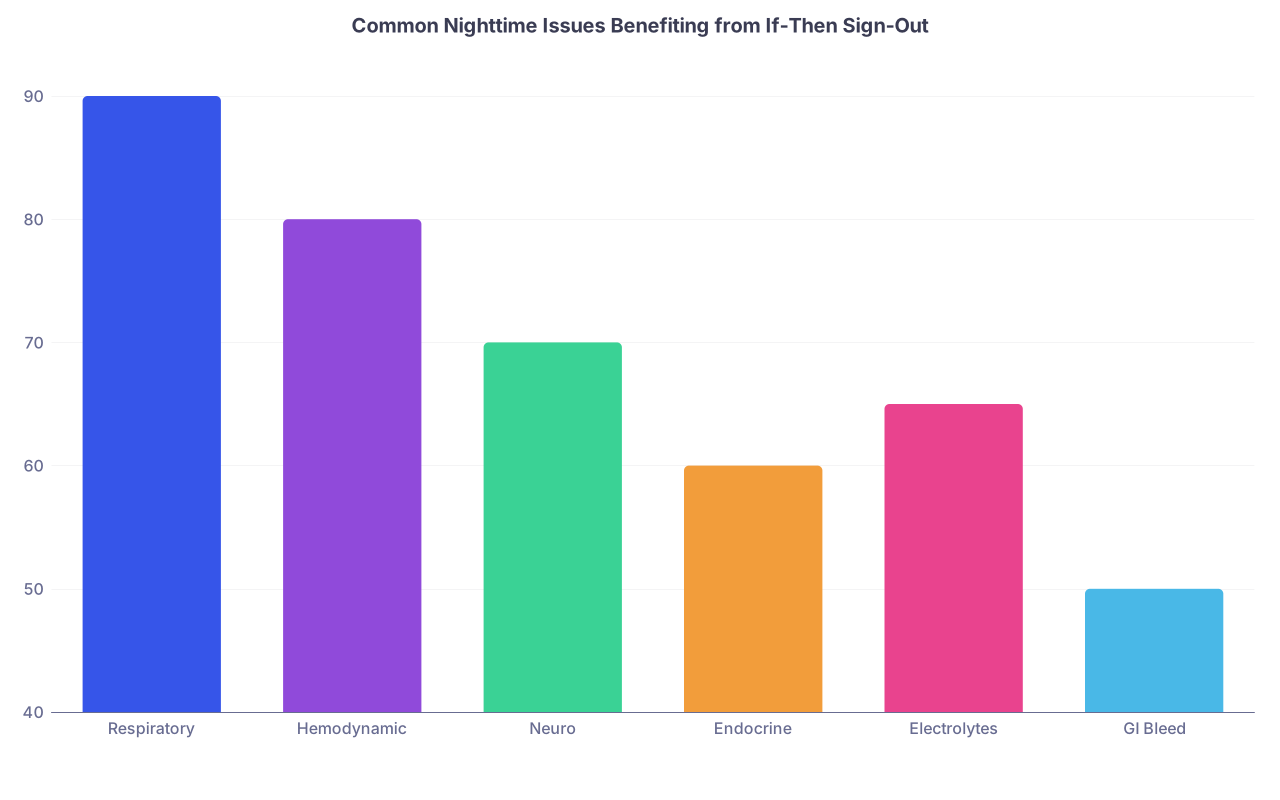
| Category | Value |
|---|---|
| Respiratory | 90 |
| Hemodynamic | 80 |
| Neuro | 70 |
| Endocrine | 60 |
| Electrolytes | 65 |
| GI Bleed | 50 |

| Step | Description |
|---|---|
| Step 1 | Identify High Risk Patient |
| Step 2 | Define Likely Night Events |
| Step 3 | Set Vital and Symptom Thresholds |
| Step 4 | Write If Then Actions |
| Step 5 | Specify Escalation Path |
| Step 6 | Teach to Team at Sign Out |
FAQ: Advanced Night Sign‑Out
How many patients actually need detailed if‑then plans?
Usually 20–30% of your list. Focus on anyone with significant respiratory support, borderline hemodynamics, active infection with sepsis risk, post‑op status, brittle endocrine / renal issues, or acute neuro changes. Your cellulitis and straightforward CHF follow‑ups do not need elaborate algorithms.What if I am the night resident and the day team gave me nothing useful?
You create your own micro if‑then plan during your initial scan of the list. For each high‑risk patient, jot one line: “If X, do Y, then call Z.” You can build this off standard hospital protocols. It is not ideal, but it is safer than improvising at 03:00 with no framework.Do I have to document these if‑then plans in the chart?
Short answer: yes, for the big stuff. Put a concise “Overnight Plan” or “Sign‑Out” section in your daily note for high‑risk patients: “If SBP <90 or MAP <65 on 2 checks, give 500 mL LR and call rapid / MICU; pt full code.” This protects the patient and you, and aligns the whole team.What about patients with limited code status or comfort care?
They absolutely require anticipatory guidance, but the if‑then logic is different. You specify comfort‑focused actions: “If dyspnea worsens, give morphine 1–2 mg IV q1h PRN, no ICU transfer, no rapid; call family if major change.” Being explicit here prevents well‑meaning but unwanted escalation at night.How can I get my co‑residents to buy into this without sounding preachy?
Use cases. After a rough night, debrief: “We got hammered because Mr X’s plan was ‘call if issues.’ If we had just said ‘if O2 >4 L or RR >28, call rapid and MICU,’ half of this chaos disappears.” Suggest a shared template for sign‑out. People adopt what clearly reduces their page volume and disasters.
With robust anticipatory guidance and tight if‑then planning, nights stop feeling like random firefighting and start looking like controlled risk management. Once you master this, the next level is teaching your interns to do it automatically—so your entire team’s nights get quieter. But that is the next step in your evolution as a senior, and a conversation for another call room.