
You walk into your apartment at 7:15 a.m., brain buzzing from sign-out, clothes smelling like hospital air. Your toddler hears the door, yells “Mama!” and sprints toward you. Your partner meets your eyes over the kid’s head, dark circles, coffee in hand. Both of you are exhausted. And you haven’t even tried to sleep yet.
If that feels close to home, you’re not “doing it wrong.” You’re in one of the hardest combinations in residency: night float + young kids + a partner who naturally wakes early. This is survivable, but not if you leave it to “we’ll just see what happens.” You need a system.
Let’s build one.
Step 1: Accept That “Normal” Is Off the Table (For Now)
You cannot do night float like your single co-intern. You also cannot parent like your 9‑to‑5 friends. If you aim for those standards, you’ll just drown in guilt.
So you and your partner need to agree on one simple thing:
For the duration of night float, the goal is survival with minimal damage, not “ideal parenting” or “ideal partner behavior.”
That means:
- Some routines will break.
- Some standards will drop.
- Some balls will be dropped on purpose to keep the important ones in the air.
(See also: If You’re on Nights During a Personal Crisis for triage strategies.)
You’re not failing. You’re running a crisis-mode schedule that’s long enough to require structure, but temporary enough that you shouldn’t rebuild your entire life around it.
Say this out loud with your partner, literally:
- “For these 2/4 weeks, we’re in survival mode.”
- “We’re going to protect sleep and safety first, then everything else.”
Once that expectation is set, we can get tactical.
Step 2: Design an Actual 24-Hour Schedule, Not Vibes
Hand-waving “I’ll sleep when I can” is exactly how you end up getting two 90-minute naps, snapping at your kids, and fighting with your partner.
You need a written 24-hour plan. Down to wake/sleep windows, who handles which kid events, and when you and your partner are allowed to be “off duty.”
Here’s a starting template for a classic 12-hour night float (7 p.m.–7 a.m.), two kids under 5, partner up at 6 a.m.
| Time | You (Resident) | Partner | Kids |
|---|---|---|---|
| 6–7 a.m. | Commuting home / sign-out | Up with kids, breakfast | Wake, breakfast |
| 7–7:30 a.m. | Quick connect, shower, wind-down | Solo parent, morning chaos | Play, get dressed |
| 7:30–1 p.m. | Core sleep (blackout, no noise) | Out of house or quiet activity | Daycare/school / outing |
| 1–2 p.m. | Second sleep or quiet rest | Emails/chores/nap if possible | Nap / school |
| 2–4 p.m. | Awake time with kids | Shared parenting / errands | Play, park, snacks |
| 4–5:30 p.m. | Nap / pre-shift rest | Dinner with kids | Dinner, bath |
| 5:30–6 p.m. | Commute / pre-call transition | Bedtime routine starts | Wind-down |
| 6–7 p.m. | At work / sign-in | Kid bedtime | Sleep |
| 7 p.m.–6 a.m. | Working nights | Own downtime + sleep | Sleep |
This is just a model. The point is: make your own table like this. Physically write it out or type it and print it for the fridge.
Then, hard rule:
- No one “just guesses” who’s responsible at a given hour. You both know.
Step 3: Protect Your Core Sleep Like It’s a Medication
Your core enemy is fragmentation. Kids screaming at 9:30 a.m., Amazon ringing at 10, partner “just checking something” at 11. Suddenly you’ve had “6 hours in bed” but only 3 real hours of sleep.
On night float with young kids, you realistically need one protected 4–6 hour block plus a smaller nap. Non-negotiable.
Make a Core Sleep Block
For most residents on a 7p–7a shift, this looks like:
- In bed: 7:30 or 8 a.m.
- Protected until: 12:30–1 p.m.
- Second sleep/nap: 4–5:30 p.m.
If your kids are loud and your partner is an early riser, this only works if everyone treats your sleep like a night shift in reverse: you are the “away at work” parent from 8 a.m.–1 p.m.
That means:
- You’re not available.
- You’re not “just talking about daycare billing.”
- You’re not “quickly playing” for 10 minutes.
You are out of service.
Turn Your Bedroom Into a Bat Cave
You need to cut light, noise, and interruptions aggressively. Not halfway.
Bare minimum setup:
- Blackout curtains or taped garbage bags over the windows. (Ugly? Yes. Effective? Also yes.)
- White noise machine or loud fan.
- Eye mask and earplugs if possible.
- Phone on Do Not Disturb, with only:
- Partner
- Hospital/emergency line
allowed through.
Position your partner so you don’t hear morning chaos:
- If you have a second room, they do breakfast out there.
- If it’s a small apartment, they take the kids out for breakfast at a park, grandparents, or even a 45-minute “drive and podcast” if that’s the only way to keep them from screaming at the door.
Is that ideal parenting? No. Is hearing “MAMA WAKE UP!” at 9, 10, and 11 a.m. worse for everyone? Absolutely.
Step 4: Negotiate Clear Roles With Your Early-Rising Partner
The early-rising partner is both a blessing and a curse. Great for mornings with kids. Easy for your schedule to annihilate them.
You have to pre-negotiate three things with them before night float starts:
- Morning responsibility
- Late afternoon / evening responsibility
- Their protected rest time
Morning: This Is Their Zone
If they’re naturally up early, mornings with the kids are theirs. Fully. You are a ghost.
Concrete rules:
- They do wakeup, breakfast, daycare/school drop-off.
- You’re already in bed, lights out, before they start that routine.
- If they need something from you, they send a text. You answer when awake. They do not walk in to “ask quickly.”
Late Afternoon: Your Reluctant Zone
You’re exhausted. You don’t want to parent at 2 p.m. You want to die on the couch. But if your partner has been “on” since 6 a.m., this window is where you step in hard.
Plan for:
- 2–4 p.m. = You are the primary parent.
- Your partner gets:
- A nap
- Time to go for a run
- Quiet time alone in the bedroom with headphones
- Errands without kids
Even if you’re a zombie, you must take some of this load or your relationship will implode by week two.
Protected Time for Them
Big mistake I see all the time: resident is barely alive, partner is also barely alive, both feel like martyrs, and resentment builds quietly.
Do this instead:
- Add a non-kid hour for them into the daily schedule, circled.
- Example: 1–2 p.m. every day is sacred “partner off duty” time.
- That might be earlier or later depending on naps, but it must exist.
Make them feel like a person, not your support staff.
Step 5: Handle Kid Sleep and Noise Without Losing Your Mind
Your kids do not care that you worked nights. They only care that you’re home and they can access you. So you need systems that make your unavailability clear without traumatizing anyone.
Physical Barriers Help More Than You Think
- White noise in the kids’ rooms and your room.
- Door closed, sock or sign on the outside of your door that signals “Do not open.”
- For little kids: use a picture (moon = quiet, sun = okay).
- Baby gate or closed hallway door so they physically cannot sprint into your bedroom unsupervised.
Script for Older Toddlers/Preschoolers
You will repeat this a hundred times, and that’s fine.
Simple language:
- “When Mommy is sleeping in the daytime, it’s the same as when you sleep at night. I’m not awake. If you need help, you ask Daddy/grandma/the grown-up who’s awake.”
- “If you see the moon sign on the door, it means I’m asleep and you can’t come in.”
You’re not abandoning them. You’re modeling boundaries. You also like not crashing your car driving home post-call. That matters.
Step 6: Use Outsourcing Aggressively During Night Float Only
This is the time to shamelessly buy time and energy.
If you can manage it financially, temporarily outsource:
- Groceries (delivery or pickup)
- Cleaning (even a once-a-week deep clean)
- Laundry (wash-and-fold for 2–4 weeks)
- Pre-made or freezer meals
Do not try to “do it all” during night float. That’s how people spiral.
If money is tight:
- Ask grandparents or nearby friends to:
- Do 1–2 daycare pickups per week.
- Take the kids to the park once or twice.
- Bring over one dinner a week. (Say: “We’re on nights. One simple meal would help a ton.”)
This is temporary. You are not signing a lifetime contract with Instacart.
Step 7: Decide What You’re Going to Drop (On Purpose)
You will not do everything.
So choose intentionally:
- Social life? Downshift.
Group chats on mute. No brunch. You’re on nights. - House standards? Lower them.
Toys all over the floor? Fine. Laundry in baskets instead of folded? Fine. - Hobbies? Put big, time-consuming ones on pause.
- Extra work stuff? No volunteering for extra QI projects or teaching sessions.
Have a 5-minute “what drops” conversation with your partner:
- “For these 2/4 weeks, we won’t cook from scratch.”
- “We won’t schedule extra playdates.”
- “We won’t tackle house projects.”
You’d be amazed how much stress lifts when you decide not to care about certain things right now.
Step 8: Micro-Connect With Your Partner So You Don’t Turn Into Roommates
Night float is the perfect setup for becoming logistics roommates. Passing like ships. Talking only about daycare bills, coverage, and who’s doing bath.
You need tiny, reliable connection points.
Realistic options:
- 7–10 minutes when you get home:
- Hug.
- One sentence each: “Hardest thing about last night?” “Best thing?”
- One logistics item only (“Who’s doing pickup?”). Then stop.
- A running note on your phone:
- Each of you leaves one line a day: something you appreciated, something hard. Read it when you can.
- Scheduled 20–30-minute “catch-up” once per week on your day off:
- No kids if possible.
- Walk outside, coffee in hand.
- Ask: “What’s working / what’s not working about this schedule?”
You don’t need elaborate date nights. You need a few small threads that keep you on the same team.
(See also: Handling Chronic Illness on Night Float for fatigue management strategies.)
Step 9: Manage Your Body So It Doesn’t Mutiny
You cannot out-willpower physiology. Night work will mess with you. You just want to blunt the damage.
Basic rules that actually work during night float:
- Caffeine window:
- OK from start of shift until ~3–4 a.m.
- Stop after that so you can sleep by 8 a.m.
- Food timing:
- Light meals at night; heavy meal closer to “dinner time” (for you, that might be 11 p.m.–1 a.m.).
- Simple snack before sleep at 7–8 a.m. (banana, toast, yogurt). Not a huge greasy breakfast; that sits in your stomach and wrecks sleep.
- Movement:
- 5–10 minutes of stretching or a short walk after you wake up, not before bed.
- Light:
- Sunglasses on way home if it’s bright; don’t flood your brain with daylight.
- Bright light when you wake up for your “day” (2–3 p.m.), especially if you feel like a mole person.
You’ll still feel off. But less like you’ve been hit by a bus.
Step 10: Special Situations and How to Handle Them
A few common variants I see all the time:
Situation: Partner Also Works Full-Time and Can’t Do Mornings Alone
Then you must recruit a third adult or external structure.
Options:
- Early daycare drop-off (many open at 6–6:30 a.m.).
- Morning sitter 2–3 hours so you can sleep 8–11 a.m. while both of you handle work.
- Grandparent or neighbor who does 2 mornings a week.
Your schedule might look like:
- You sleep 9 a.m.–1 p.m. (after a quick decompression).
- Nap again 5–6:30 p.m.
- Kids in daycare 7 a.m.–4 p.m.
Not perfect. But safer than no block at all.
Situation: Baby Who Still Wakes Frequently at Night
You’re not doing night feeds. Full stop.
Rough rule:
- You handle zero baby wakes on nights. You’re working; that is your “night shift.”
- Make up for it with afternoon/evening baby duty.
- Consider one extra night per week where a grandparent/sitter helps overnight so your partner can get a true block of sleep.
Situation: Very Small Space, No Way to Avoid Noise
Then you shift the battlefield.
- You sleep with:
- Earplugs + white noise + eye mask
- Partner takes kids:
- Out of the house for 2–3 hours in the morning (park, library, drive, indoor playground).
- If weather is awful:
- Rotate: 90 minutes inside with quiet TV/tablet time, then 90 minutes outside no matter what (coats, stroller walk, mall laps).
Visual: How Your Energy and Sleep Really Look
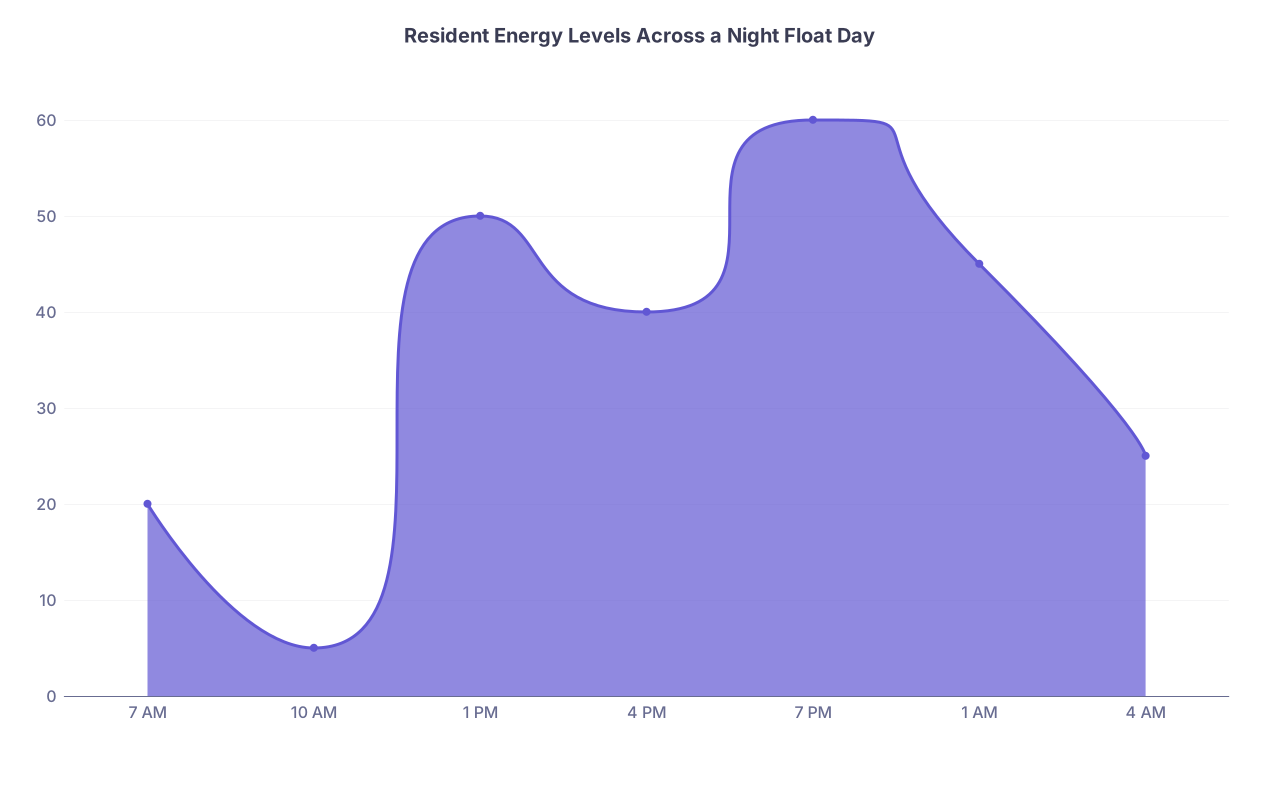
| Category | Value |
|---|---|
| 7 AM | 20 |
| 10 AM | 5 |
| 1 PM | 50 |
| 4 PM | 40 |
| 7 PM | 60 |
| 1 AM | 45 |
| 4 AM | 25 |
You’re not crazy for feeling worst mid-morning and late-night. Build your schedule around those dips.
Step 11: Debrief After the Block and Adjust
When the block ends, do not just sprint back into days and pretend it never happened. Take one hour with your partner and ask:
- What absolutely did not work?
- What surprisingly helped?
- Where did each of us feel most overwhelmed?
Then write a simple “next time” plan:
- “Next time, we’ll start grocery delivery from week 1.”
- “Next time, we’ll get help for two morning daycare runs.”
- “Next time, we’ll cut screen guilt and let the kids watch cartoons while I get my last hour of sleep.”
Night float comes back. Your future selves will thank you for leaving them a playbook instead of vibes.
Quick Reality Check
You will:
- Be tired.
- Snap sometimes.
- Miss some kid moments.
- Fight once or twice with your partner.
That doesn’t mean your system is failing. That means you’re a human family being stress-tested by a system that wasn’t designed for you.
Your job is not to make it pretty. Your job is to make it safe, predictable, and just soft enough around the edges that nobody breaks.
FAQ (Exactly 5 Questions)
1. How many hours of sleep should I realistically aim for on night float with young kids?
Aim for at least 5–6 hours total, ideally in one 4–6 hour core block plus a shorter nap later. If you’re regularly getting under 4 hours of real sleep (not just “in bed”), that’s unsafe. At that point, you need to bring in extra help or change the plan—more daycare, sitter coverage, or family support.
2. Is it selfish to ask my partner to handle almost all mornings alone?
No. It’s survival. During night float, your “morning” is their “middle of the night” equivalent. You’re not skipping out on parenting; you’re trading. You’re taking more late-afternoon/evening kid duty and doing emotional and logistical work around the schedule. The selfish thing would be pretending you can do it all and putting everyone at risk.
3. What if my partner is resentful and says, “This is too much, I can’t do this”?
Take that seriously. Sit down on a day off and map the full 24‑hour schedule together. Then ask: “Where can we remove pressure?” That might mean daycare instead of a parent doing every hour, outsourcing cleaning, cutting non-essential commitments, or pulling in a third adult (family, friend, sitter). Often the resentment is less about the schedule and more about them feeling unseen or like their needs don’t count. So explicitly build protected time for them into the plan.
4. Should I flip my schedule on days off or stay on “night mode”?
With young kids and an early-rising partner, completely staying on night mode is usually impossible. The middle ground that works for most families:
- Sleep a bit later (9–10 a.m.) on your last night,
- Take a 2–3 hour nap in the afternoon,
- Go to bed earlier that night (midnight–1 a.m.).
On multi-week night blocks, many people do a partial flip on days off—stay up later than the family but not all night, then nap mid-day.
5. Is more screen time for my kids during this block going to mess them up?
No, not in a limited, time-bound way. If 30–90 extra minutes of cartoons in the morning or afternoon lets you get another hour of sleep or gives your partner a break, that’s a reasonable trade. You can tighten things back up once nights are over. A temporary relaxation of screen rules for 2–4 weeks won’t undo your entire parenting approach; chronic, years-long patterns are what matter, not a single brutal rotation.
Open your calendar for your next night float block. Block off your core sleep window every day and label it “unavailable – at work (sleep).” Then sit down with your partner tonight and sketch a 24‑hour table for one sample day. That’s your first concrete step out of chaos and into a plan.