
Two hours before your first night shift of a 7-on stretch, your partner tells you they’re leaving. Or your parent ends up in the MICU across town. Or your kid spikes a fever and your childcare just texted: “I can’t do this week.” You look at the clock, look at your badge, and feel that cold, hollow shock: I still have to go in.
Let me be blunt: medicine is not built for your life to fall apart. But your life will fall apart anyway, at least once. If this is that week, you need a triage plan—for your patients, and for yourself.
Step 1: Do a Rapid Assessment – Are You Safe to Work Tonight?
You know how you ask in sign-out: “Sick or not sick?” You’re going to do the same on yourself.
Skip the vague “How am I doing?” nonsense. You need to answer two concrete questions:
- Am I safe to provide care tonight?
- If yes, under what conditions and for how long?
Run through this like an internal ROS:
- Sleep in last 24 hours: Have you slept at all in the last day? If you’ve been awake 24+ hours and you’re emotionally wrecked, that’s equivalent to being legally drunk. That’s not noble. That’s dangerous.
- Acute impairment: Are you shaking, sobbing uncontrollably, dissociating, or having panic attacks every few minutes? If you were your intern, would you trust yourself with insulin drips and stroke pages?
- Self-harm or dark thoughts: If you’re having thoughts like “I don’t care what happens to me tonight” or “I kind of hope something bad happens,” that is a stop sign, not a red flag. You do not go in. You get help.
- Substances: Did you drink, take benzos, double-dose a sleep med, or use anything else to cope in the last several hours? Then you already know the answer: you are not safe to work.
If you are clearly not safe to work tonight, your next step is not “push through” and it’s not up for debate. It’s: contact your chief or attending and occupational health/employee health (or your institution’s emergency coverage plan) and say:
“I’m not safe to work tonight; I need to call out.”
Then we deal with the fallout. Because the fallout is still better than harming a patient or breaking yourself further.
If you might be safe to work but you’re on the edge, move to Step 2.
Step 2: Call Early, Be Direct, and Use the Right Phrases
Residents wait too long to tell anyone. They hope they’ll “stabilize” by sign-out. They do not. They just show up shattered and hope no one notices.
You need to tell someone before the shift, not at 8:15 PM when the ED is paging for admits.
Who to contact, in order:
- Night float chief or administrative chief
- The attending on for the night (or service attending if that’s the system)
- Program director or APD if it’s really big or long-term
What to say. Drop the vague “stuff is going on” line. Use language that triggers professional responsibility in the person hearing it:
“I’m dealing with an acute personal crisis and I’m not confident I can work safely without some adjustments. Here’s what I think I can and cannot handle.”
or
“I just found out [family member] is critically ill / I’m going through a sudden separation. I’m emotionally not stable enough to do full cross-cover alone tonight. Can we talk through options?”
If you are not safe to work:
“I have an acute mental health crisis and I’m not safe to work tonight. I know this puts the team in a bind, but the risk to patients is too high if I go in.”
You are not required to give your whole life story. You are required to be honest about safety.
And no, “But my co-residents will hate me” is not a valid reason to hide a safety issue. They’d hate you more if you missed a major lab or wrote the wrong dose and someone got hurt.
Step 3: Decide Your Level of Function – Then Build a Smaller Job for Yourself
Let’s say you’ve decided you can work, but you’re not at full power. Treat this like a disaster-response schedule. You’re not trying to be the hero; you’re trying to not collapse.
You need to define your functional level. Roughly:
| Level | What You Can Safely Do | What You Should Avoid |
|---|---|---|
| 1 – Barely Holding | Simple, protocolized tasks with supervision | Solo cross-cover, high-acuity decisions |
| 2 – Limited | Admits, routine cross-cover with backup available | Being the only responsible decision-maker |
| 3 – Modified Normal | Most tasks but need mental breaks and support | Extra projects, nonessential work |
Level 1 – Barely Holding It Together
You’re crying in the car, dry-heaving between pages, can’t track a full H&P without your mind sliding back to what happened.
If you must be physically present (no backup staffing), negotiate:
- You cover only low-acuity, protocol-heavy work: order sets, standard admits, routine cross-cover.
- The senior or another resident double-checks all high-risk orders (insulin, pressors, anticoagulation, chemo, tPA, code status changes).
- You do more in-person check-ins and less complex phone triage.
- You are allowed to step away and cry for 5 minutes without shame.
If they cannot build you that protected role, then frankly, they can’t safely use you. That’s the honest take.
Level 2 – Limited But Functional
You’re emotionally raw, but you can think. You’re slower. More distractible. You’re safe with support.
You:
- Still take admits, but ask for thought-partnering on tricky plans.
- Have another resident or attending cosign critical decisions (early in the shift when you’re most flooded).
- Offload anything extraneous: no teaching sessions, no extra notes, no committee work, no research calls.
Level 3 – Modified Normal
You’re hurting but mostly intact. Energy for work is actually a relief. You:
- Work as normal but proactively plan breaks and backup.
- Tell your senior or attending directly you’re in a rough stretch and may need a little more oversight or a quick step-away occasionally.
- Refuse any additional “can you just also…” tasks.
The key: you define your limits out loud. Don’t wait for people to guess. They won’t.
Step 4: Ruthlessly Triage Your Life – What Drops, What Stays
Your life cannot run at 100% while you’re on nights in crisis. Something will drop. Better you choose than random collapse chooses for you.
Run a 3-bucket triage on your non-work world:
Bucket A: Non-negotiables (Truly Must Do)
These are things that, if dropped, create immediate harm or crisis. Limit this list mercilessly.
Typical examples:
- Childcare coverage while you’re on shift
- Pet care if you’re the only one (feeding, basic care)
- Legal/financial deadlines with real penalties (court appearance, deadline to sign housing docs, etc.)
- Communicating key updates to one or two core family members
What you do here:
- Solve the next 72 hours, not the next three months.
- Ask for help you’d normally be “too proud” to ask for. That pride is a luxury you cannot afford this week.
“Hey, can you stay at my place overnight and be there when my kid wakes up?”
“Can you take my dog for 3 days? I’ll pay for boarding or whatever you need.”
“I need someone to call my mom once a day with updates because I’m drowning.”
Bucket B: Important But Can Pause
Things that matter long-term but will not ruin your life if they go quiet for 1–2 weeks.
- Research meetings
- Long response texts
- Wedding planning details
- Exercise perfection (you don’t need a 5-mile run; you need a 10-minute walk and a shower)
- Studying for boards at full intensity
Your move: explicitly press pause. Do not just “ghost and feel guilty.” Send short, honest messages:
“I have an unexpected personal situation and I’m on nights. I need to pause work on X for the next 1–2 weeks. I’ll reconnect when I’m stable.”
Most decent humans will say, “Of course.” The rest are showing you who they are.
Bucket C: Dead Weight Right Now
Anything that is pure guilt-driven, vanity-driven, or “I said I’d do it so I must” but has no immediate consequences:
- Optional social events
- Perfectly curated meals
- Voluntary presentations you could reschedule
- Being on every group chat in real time
Kill these. No apology paragraph, no explanation.
“Can’t make it. Rough week. Rain check.”
End of story.
Step 5: Modify How You Work on Nights – Concrete Hacks That Actually Help
You cannot just tell yourself “I’ll be more careful.” That’s not a plan. You need structure to protect your tired, grieving brain.
1. Externalize Everything
Your working memory is trashed. Stop trusting it.
- Keep a running list of:
- Active admits and one-liner status
- Cross-cover to-dos
- Time-based tasks (recheck labs, repeat exams, redraw labs after transfusion)
- Use the dumbest simple format possible: a folded piece of paper in your pocket with boxes to check. Fancy note systems break under stress.
And say things out loud:
“I’m going to put in these insulin orders now while I’m thinking about it.”
That’s not weird. That’s physics—your brain is offline at random intervals.
2. Slow Down on Anything That Can Kill Someone
When you’re spun up emotionally, you tend to either rush or freeze. You have to deliberately slow for high-risk moves:
- Anticoagulation adjustments
- Insulin regimen changes
- Electrolyte repletion for K, Mg, Na
- Code and rapid response documentation and orders
- Transfusion decisions
Rule: for any high-risk order set, you pause, read, confirm twice, and if possible, ask someone to co-sign eyes:
“Can you just glance at this heparin order real quick and make sure I’m not missing something? I’m a little fried.”
This is not weakness. This is what pilots do when they’ve had a long day: checklists and copilot confirmation.
3. Use Micro-Breaks, Not Fantasy Rest
You are not doing 30-minute meditative breaks on night float in a busy hospital. Stop setting that bar. You need micro-breaks:
- 2 minutes in the stairwell with your phone on silent.
- 5 minutes sitting while you drink water and stare at a wall.
- 90 seconds in the bathroom where you actually breathe slowly.
Every 2–3 hours, force one. Set a quiet alarm if you have to. Night shifts stretch endlessly when you’re in crisis; small scheduled breaks keep you from falling into a black hole at 3:30 AM.
4. Control the Inputs
Crisis plus nights is a sensory overload trap. You can’t process everything.
Decide:
- Who gets through to you during shift: maybe one person (partner, sibling, close friend) who can text “No change” or “Call me if you can.”
- Put everyone else on Do Not Disturb. You can call them post-shift if you have energy.
And do not doom-scroll in the call room. You’re not emotionally stable enough to read about mass disasters or Twitter fights at 4 AM. That stuff will stick to you.
Step 6: Use the Hospital’s Uncomfortable but Real Resources
Residents often forget they have institutional tools because they feel “too dramatic” using them. Get over that.
Here’s what you likely have access to:
- Employee Assistance Program (EAP) or resident mental health services: often 24/7 phone lines. Call from the call room if you have to. They’re used to tears.
- GME office or well-being officer: They can formalize a short leave, shuffle schedules, or document that this is a crisis period.
- Family and Medical Leave Act (FMLA) or medical leave equivalents: If this crisis isn’t a 2-day thing but a 4-week thing (major depression episode, divorce process, critically ill child/parent), you may actually need official time, not heroic coping.
I’ve seen residents quietly vanish into a “personal leave” black box instead of naming what is happening. You’re allowed to say the words: “I need to talk about a short-term leave” or “My parent is in the ICU in another state; I need options.”
Step 7: The Next 24 Hours: A Concrete Plan
Vague coping strategies don’t help when you’re shattered. Here’s what the next 24 hours might actually look like.
Before the Shift (60–90 minutes)
- Eat something boring and real. Toast with peanut butter, rice and chicken, whatever you can get down. Crisis makes you nauseated; eat anyway.
- Text or call one trusted person:
“Tonight is going to be rough. I’m on nights and [brief crisis]. I may text you on a break; I don’t need solutions, just presence.”
- Pack a bag with:
- Extra scrubs or undershirt (sweats + tears + code sweat = you’ll want a change)
- Snacks that don’t upset your stomach
- Any meds you take at home that you can legally and safely take at work (SSRI, beta-blocker, etc.)
- Decide: who gets updates during the night, who waits until morning.
During the Shift
- Tell at least one person in-house (co-resident, senior, or attending):
“I’m in the middle of a rough personal situation. I’m here and working, but I may be slower and I might need an extra set of eyes on some things.”
- Use your lists religiously. No “I’ll remember that later.” You won’t.
- When you feel the panic spike: step away for 2 minutes if patients are stable. Cold water on your wrists, 10 deep breaths, back in. This is battlefield medicine, not a spa.
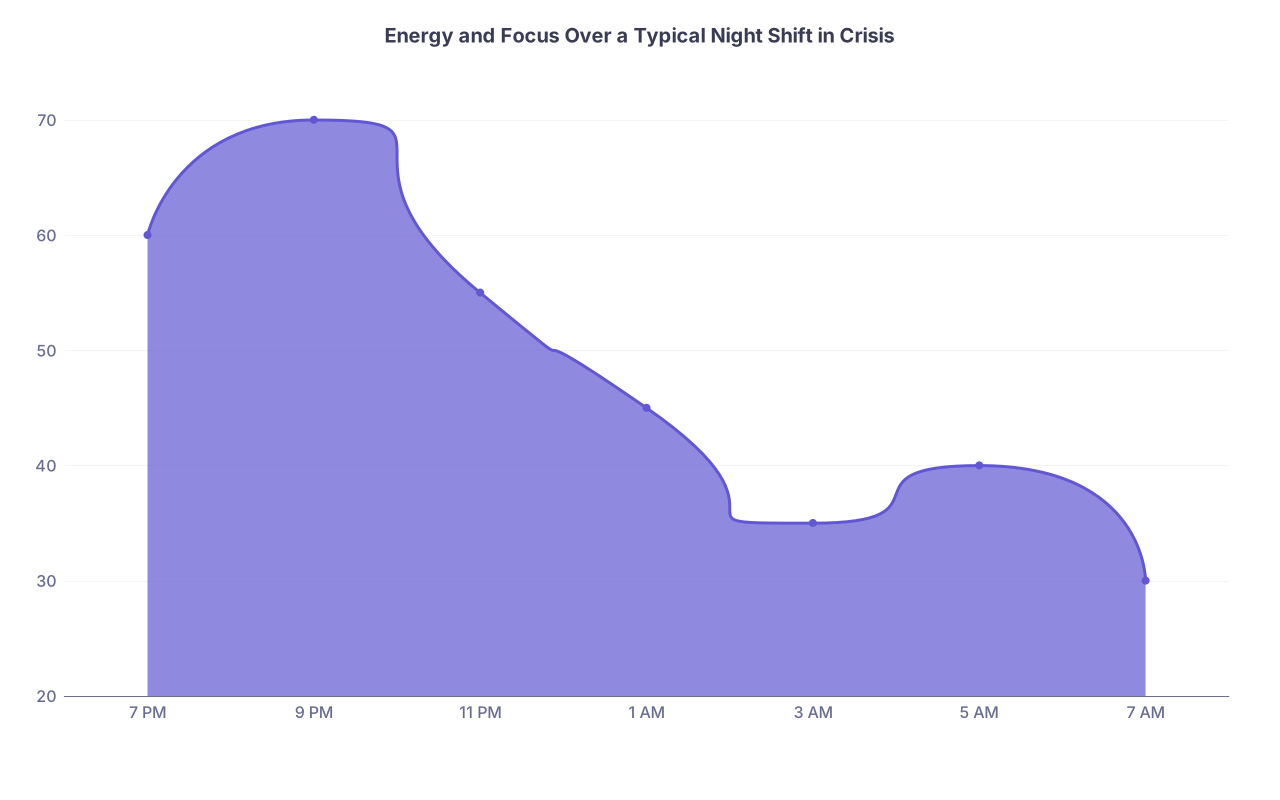
| Category | Value |
|---|---|
| 7 PM | 60 |
| 9 PM | 70 |
| 11 PM | 55 |
| 1 AM | 45 |
| 3 AM | 35 |
| 5 AM | 40 |
| 7 AM | 30 |
That low point around 3–5 AM? Plan around it. Avoid starting the trickiest tasks right there if you can.
After the Shift
- Get home as directly as possible. No errands. No heroic “I’ll just drop this off.”
- Eat something very small if you’re empty.
- Decide: shower, then sleep or sleep, then shower. Don’t add other steps.
- If your brain is racing, write a brain dump on paper:
- What I need to handle today
- What can wait a week
- What I’m scared of
Then circle the one thing you truly must do after you sleep.
Step 8: If This Isn’t Just One Night – Planning for a Longer Crisis
Sometimes the crisis is a hit-and-run: horrible, but quickly crystallized. Other times you’re looking at weeks or months: ongoing custody fight, prolonged family illness, new major depression.
If this is not a 2–3 day storm but a season of life, you cannot live in permanent emergency mode. It will break you.
So:
Loop in leadership early – PD, chief, someone with actual power.
Use words like:- “Sustained personal crisis”
- “I’m concerned about my long-term functioning”
- “I want to plan something sustainable so I stay safe and effective.”
Ask about concrete options, not just “support”:
- Temporary shift to day electives instead of nights
- Spacing out ICU or trauma rotations
- Short-term leave or reduced schedule for a defined period
- Swapping night rotations with future blocks when you’re more stable
Rebuild your external life on the assumption you’re not at 100%:
- Paid help if you can afford it (cleaning, childcare hours, food delivery).
- Clear role shifts in relationships:
“For the next month, I need you to handle X. I truly cannot.”
You are not failing residency by needing structure. Residency is already barely survivable under ideal conditions; add a divorce or dying parent on top and “just push through” is not resilience. It’s denial.
One More Thing People Don’t Say Out Loud
Night shifts in the middle of a personal crisis will show you who your people are.
Some colleagues will quietly pick up scut for you, double-check your orders without making you feel stupid, ask you the next day if you slept. Some attendings will say, “I’ll take that call; you go take 10 minutes.” Those are your people. Remember them.
Others will roll their eyes, gossip, say things like, “We all have problems, she just needs to suck it up.” Those people are telling you something about themselves too. Believe them. But don’t let them be the reason you neglect your safety or your patients’.
What You Can Do Today
If you’re in this situation right now, do this next:
Pick up your phone, open your messaging app, and text your chief or senior:
“I’m in an acute personal crisis and on nights. I need to talk about what I can safely handle tonight.”Then grab a scrap of paper and make three short lists:
- “Must do in next 24h”
- “Can pause 1–2 weeks”
- “Can drop completely”
Circle one item from the “Must do” list. Handle only that after your next block of sleep. Everything else can wait.