
You are staring at the screen at 02:37. Cross-cover pager just went off for the fourth time in ten minutes. Someone is hypotensive on the surgical floor. Another nurse is asking for sleep meds “like the patient gets at home.” The ED wants you to reconcile meds on a direct admit who arrived without a list. You have not eaten since 18:00.
And now you are being asked to place three medication orders that could absolutely hurt someone if you get them wrong.
This is where night shift quietly destroys residents. Not with one spectacular disaster, but with small, predictable medication ordering errors that spike between midnight and 06:00. I have seen the same patterns, over and over, across services, hospitals, and years. The good news: most of them are avoidable if you recognize the traps before you step into them.
Let’s go through the worst offenders and how to protect yourself.
Why Medication Errors Spike at Night (And Why You Are Not Special)
Before we get into specific mistakes, you need to accept one thing: you are not immune.
Fatigue, interruptions, and thin staffing change how your brain works. Full stop.
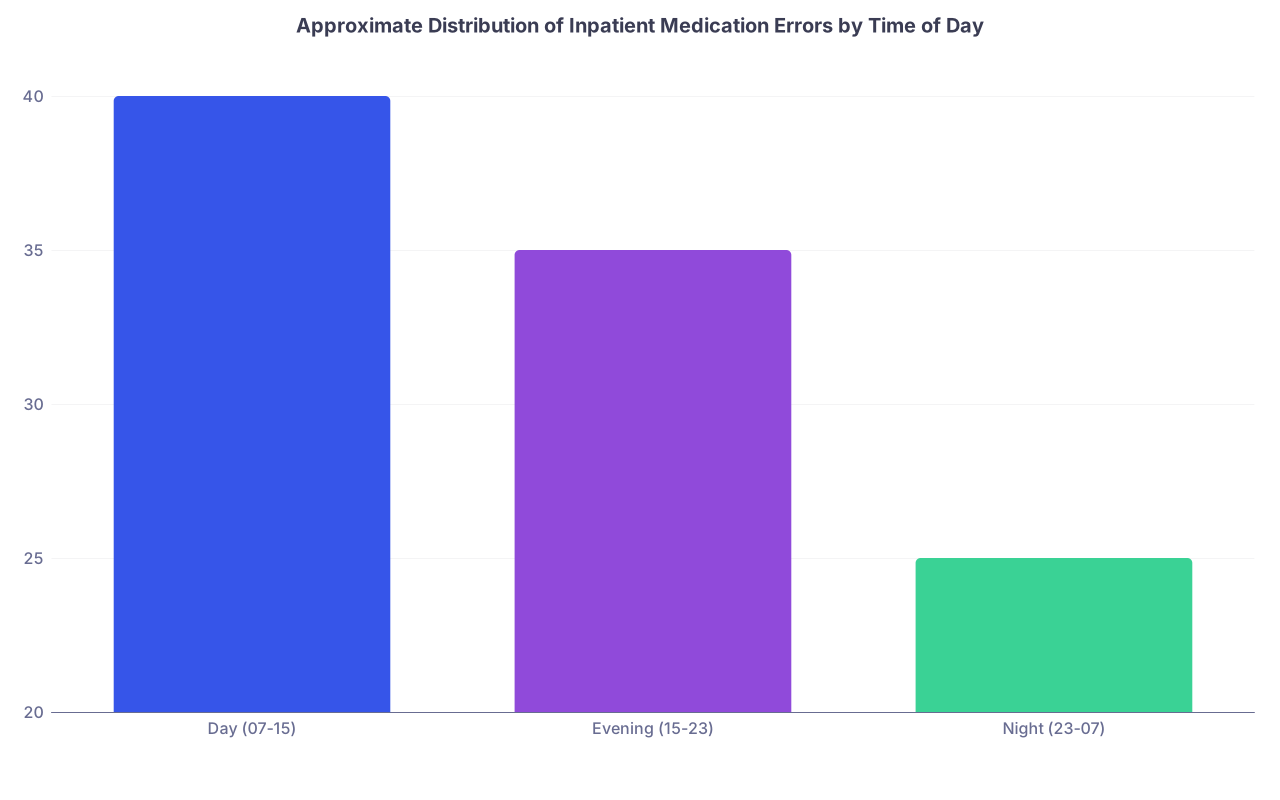
| Category | Value |
|---|---|
| Day (07-15) | 40 |
| Evening (15-23) | 35 |
| Night (23-07) | 25 |
Roughly a quarter of inpatient medication errors happen on nights, even though fewer orders are placed then. So proportionally, nights are worse. Why?
Common nighttime risk factors:
- You are tired and operating on diminished working memory.
- There are fewer pharmacists actively screening orders or they are remote and covering multiple hospitals.
- Nursing ratios are worse. Fewer eyes on every patient.
- The orders you get called about at night are often time‑sensitive and high-risk: pressors, insulin, sedatives, opioids, IV antibiotics.
The mistake I see residents make: believing that “I am careful, so I am safe.” That is delusional. You are safe only if your process is designed for when you are not at 100%.
So let us attack this by category.
1. Wrong Dose / Wrong Route: The Classic Night Shift Landmine
You are half awake. A nurse calls “Can you order hydromorphone for breakthrough? PO is fine.” Your brain hears “hydromorphone” and “dose” and you click the first order sentence that looks reasonable.
That is how you end up giving someone IV‑equivalent doses by mouth that are 2–4× what they need. Or worse, switching routes (IV vs PO vs subQ) without adjusting for bioavailability.
Common dose/route failures at night
- Opioid conversions (morphine ↔ hydromorphone, IV ↔ PO)
- Insulin (mixing up units vs volume, sliding scale vs basal)
- Electrolytes (IV vs PO KCl, mg vs mEq)
- Anticoagulants (heparin infusion vs SQ prophylaxis vs treatment dose)
- Pediatrics (mg vs mg/kg, wrong weight, wrong concentration)

The dangerous part: every EHR tries to “help” you with default doses, order sets, and “favorites.” Those shortcuts are great at 10 AM. At 3 AM, they facilitate autopilot.
How to avoid killing someone with the wrong dose
Force yourself to see the numbers twice.
For anything that can stop someone’s breathing or blood pressure:- Opioids
- Benzos
- Insulin
- Pressors
- Electrolytes (IV potassium, magnesium in arrhythmia patients)
Do this:
- Say the order out loud to yourself:
“Hydromorphone 0.2 mg IV q3h PRN severe pain, max 4 doses in 24 hours.” - Then re-read the order in the “review/sign” screen and confirm:
- Drug
- Route
- Dose + units (mg vs mcg vs mEq vs units)
- Frequency
- PRN indication if relevant
Never trust your memory for conversions at 03:00.
If you are doing:- Morphine ↔ hydromorphone
- Fentanyl patch to equivalent PO opioid
- Pediatric mg/kg dosing Use:
- Your hospital’s opioid conversion chart.
- Clinical calculator in UpToDate / Lexicomp / Micromedex. Do not “ballpark.” The number you are “pretty sure” about at 3 AM is often wrong.
Route check rule: route and indication must match the clinical picture.
Before signing, ask:- “Does IV vs PO make sense for how sick this person is?”
- “Is this meant to be continuous (gtt) or intermittent (IV push or piggyback)?”
Watch for weight-based traps.
Especially in:- Pediatrics
- ICU drips
- Chemo / oncology patients
- Obese patients with adjusted body weight dosing
Confirm:
- The current recorded weight is accurate and recent.
- Units: kg vs lb. If you see 150 as a pediatric weight, you should be alarmed.
2. Sound-Alike / Look-Alike Meds: EHR Autocomplete Is Not Your Friend
Half-awake, you type “hydro…” and click the first option:
- Hydralazine
- Hydroxyzine
- Hydromorphone
- Hydroxyurea
I have seen hydralazine ordered for anxiety and hydroxyzine ordered for blood pressure. Of course the nurse caught it. You can not rely on that.
| Medication 1 | Medication 2 |
|---|---|
| Hydromorphone | Morphine |
| Hydralazine | Hydroxyzine |
| Metoprolol | Metoclopramide |
| Lamotrigine | Labetalol |
| Celexa (citalopram) | Celebrex (celecoxib) |
This gets worse at night because:
- You are more likely to rely on autocomplete.
- You feel rushed and “know what it is supposed to be.”
- Pharmacist coverage may be thinner.
Protective habits against look-alike/sound-alike errors
Type more, not less.
Do not type “hydro” and hit enter. Type “hydromorphone” or “hydralazine” fully. Let your fingers do the work, not your tired visual system.Always read the tiny description line under the drug name.
Check:- Drug class
- Formulation (tablet, injection, extended-release)
- Strength options
Be hyper-suspicious if the indication and drug class do not match.
If you are ordering for:- Anxiety and see an antihypertensive
- Blood pressure and see an antihistamine Stop. You are about to make a mistake.
Confirm with the nurse when the request sounds off.
If a nurse says, “Can you order that hydro thing Dr. X ordered last time?”
Your script:- “I want to make sure I order the exact right thing. What was it for and what dose do you see in the MAR from before?”
3. PRN Sedatives, Sleep Meds, and Opioids: The “Just Something To Help Them Sleep” Trap
This is the night shift classic. Nurse calls: “The patient cannot sleep and is very anxious. Can you order something? Maybe Ativan or something?”
Your pagers are exploding. You reflexively add:
- Zolpidem 10 mg PO QHS PRN
- Or lorazepam 1–2 mg IV q4h PRN agitation
- Or double their opioid “just for tonight”
I have lost count of how many:
- Aspiration pneumonias
- Overnight falls
- Post-op respiratory arrests
started with a lazy nighttime “just give them something” med.
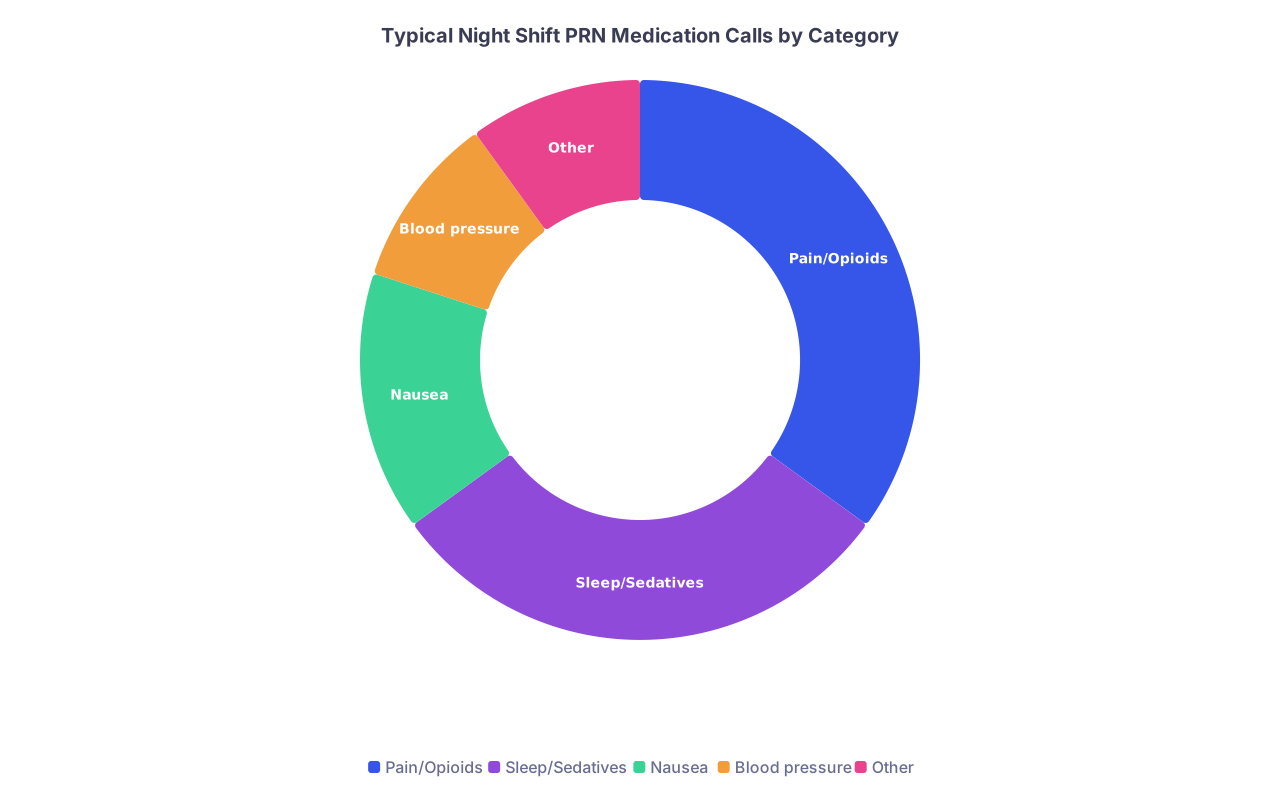
| Category | Value |
|---|---|
| Pain/Opioids | 35 |
| Sleep/Sedatives | 30 |
| Nausea | 15 |
| Blood pressure | 10 |
| Other | 10 |
The predictable problems
- Elderly on benzos → delirium, falls.
- COPD/OSA patients + opioids or benzos → hypoventilation, morning ICU transfer.
- Post-op patients + zolpidem → confusion, pulling lines, getting out of bed alone.
How to not be the resident who caused the fall or code
Refuse to treat a nursing problem with a pharmacy solution.
Ask:- “What non-med things have been tried?” (lights off, noise reduction, repositioning, addressing pain first)
- “Is the patient in pain, anxious, or just awake?”
Check the respiratory red flags before ordering anything sedating:
- Age > 65
- History of OSA, COPD, or chronic opioids
- Already on opioids or benzos
- New post-op or on PCAs
If yes:
- Sedative dose should be minimal, if used at all.
- Avoid IV benzos for “sleep” in almost everyone.
- Strongly consider no sedative and document your reasoning.
Use the mildest agent that actually matches the problem.
- True anxiety: very low-dose PO clonazepam or hydroxyzine, if appropriate and not contraindicated, and only if non-pharmacologic measures are not working.
- Situational insomnia in relatively healthy adult: very low-dose melatonin or trazodone, or simply reassurance and re-orientation.
For pain: treat pain, not insomnia.
If patient “cannot sleep” because of pain:- Start by optimizing analgesia.
- Reevaluate multimodal therapy: acetaminophen, NSAIDs if safe, local measures. Jumping to sedatives on top of undertreated pain is lazy and dangerous.
4. Duplicate Therapy and Continuing Contraindicated Meds
You are cross-covering. You do not know these patients. You are asked to “restart home meds” or “continue yesterday’s plan.” This is where duplicate therapy and dangerous continuations live.
Common night shift screwups:
- Ordering Lisinopril on a patient already ordered for enalapril in house.
- Restarting home metformin on a patient with AKI and hypotension.
- Continuing anticoagulation “per home regimen” in a patient who just had a fall or GI bleed.
- Ordering a second QT‑prolonging med on top of existing ones (e.g., adding haloperidol to escitalopram and ondansetron).

How to not stack meds like Jenga at 2 AM
Always view the full active med list before ordering anything “new.”
Do not rely on the banner or summary. Go into the actual MAR / medications tab:- Look for same classes (two ACE inhibitors, two SSRIs, multiple opioids).
- Look for drugs with overlapping toxicities (QT, nephrotoxicity, CNS depression).
Be especially careful with “resume home meds” orders.
Rules:- Never use a blanket “resume all home meds” order.
- Only restart meds you can justify pathophysiologically tonight.
- Ask: “Has anything changed that would make this med harmful now?”
Examples:- ACEi/ARB in AKI or hypotension
- Metformin in sepsis, contrast, AKI
- DOACs/warfarin in new GI bleed, trauma, hemorrhagic stroke
- Beta-blockers in shock or bradycardia
Double-check for chronic medications that should temporarily stop.
Specifically at night when patients decompensate:- SGLT2 inhibitors in DKA, sepsis, AKI
- Diuretics in hypotension, poor PO intake
- Antiplatelets/anticoagulants post-fall or new anemia
If unsure: de-escalate, document, and hand off.
Safer to:- Hold a questionable chronic med overnight.
- Clearly document in the note and sign-out:
“Held metformin overnight due to AKI and sepsis. Needs re-eval for restart in AM.”
5. High-Risk IV Meds: Potassium, Insulin, Pressors, and Anticoagulants
These are the drugs that turn minor ordering errors into codes. Night is when doses get rushed and verification steps get skipped because “the lab just came back and they need it now.”
Potassium: tiny decimal, huge consequences
Typical mistakes:
- Ordering IV KCl when PO was enough (and safer).
- Wrong concentration: 20 mEq/100 mL vs 10 mEq/50 mL vs 40 mEq/100 mL.
- Stacking infusions without checking the total daily dose.
- Ordering high-concentration KCl through a peripheral line.
Protection rules:
- If the patient has a gut and is not critically ill, default to PO replacement.
- Confirm:
- Current K level.
- Renal function.
- Presence of EKG changes or arrhythmias.
- Line type (central vs peripheral) and hospital policy for max concentration.
Insulin: units, scales, and stacking
Classic problems I see on nights:
- Ordering both a sliding scale and separate correction doses that double-cover the same glucose.
- Not adjusting insulin for NPO status.
- Confusing U-100 syringe units with insulin concentration in an order (less common with EHR, but still happens in documentation).
- Leaving pre-meal doses on a patient who is now on tube feeds or TPN with different nutritional inputs.
Protection rules:
- On any insulin order:
- Include: basal, nutritional, and correction clearly.
- If NPO:
- Hold prandial insulin.
- Reduce basal dose in high‑risk patients (frail, renal failure).
- Avoid “aggressive” overnight corrections. Hypoglycemia at 4 AM is worse than a transient blood sugar of 230.
Pressors / Anticoagulants: do not freelance
Night shift is not the time to invent a custom heparin protocol. Use your institution’s order sets and pathways. Always.
6. Verbal / Telephone Orders and the Pager Pressure Cooker
Another night shift classic: nurse calls from a satellite unit, wants a verbal order because “I am in the room right now, can you just say it and enter later?”
You are tempted. You want to stop the beeping.
Common verbal-order disasters:
- Misheard doses (15 vs 50, “five-zero” vs “one-five”).
- Wrong drug because of poor phone connection.
- Nurse writes one thing, you eventually enter another.
- Delay in order entry so next shift has no documentation of what was actually given.

| Step | Description |
|---|---|
| Step 1 | Pager goes off |
| Step 2 | Phone call from nurse |
| Step 3 | Give verbal dose |
| Step 4 | Chart later when free |
| Step 5 | Discrepancy with what nurse gave |
| Step 6 | Place order directly in EMR |
| Step 7 | Verified documented order |
| Step 8 | Verbal order requested |
How to avoid the verbal-order trap
Default: enter orders yourself in real time.
If the system allows, say:- “I will put it in the computer right now so we both see the same thing.”
If you must give a verbal order (code, true emergency):
- Speak slowly and use closed-loop communication:
- “Order: Morphine two milligrams IV push now, one-time dose.”
- Ask the nurse: “Please read that back to me exactly.”
- Document it in the chart as soon as the situation is stable.
- Speak slowly and use closed-loop communication:
Refuse vague requests.
If you hear:- “Can you order that thing the day team usually does?”
Your response: - “I need the exact medication and dose, and I will verify it in the chart. One second while I pull it up.”
- “Can you order that thing the day team usually does?”
7. Fatigue, Multitasking, and the Illusion of “Fast”
Most nighttime med errors are not because you did not know the pharmacology. They happen because you tried to do three things at once on 3 hours of sleep.
Common cognitive errors:
- Clicking through EHR alerts without reading them.
- Signing orders while you are on the phone.
- Starting an insulin order, getting interrupted, coming back and adding a duplicate.

A few hard rules that protect you from yourself
Never sign orders while talking on the phone.
Hang up or say:- “Give me 30 seconds to enter this safely and I will call you right back.” Multitasking is not efficient when it causes errors you spend hours cleaning up.
Use the “one task at a time” rule after midnight.
After midnight, assume your attention is fragmented. Commit to:- Finish the order you are in.
- Then return the next page.
Do not bounce back and forth mid-order.
Respect EHR warnings that you normally ignore.
Yes, many are dumb. But:- “Potential duplicate therapy”
- “Renal dose adjustment recommended”
- “Significant drug–drug interaction” At 3 AM, treat these as red lights, not yellow. Pause. Check.
Know your personal “danger hours.”
For many residents: 02:00–04:00 is the worst.
During that window:- Double‑check high-risk orders.
- Avoid doing complex med rec if it can safely wait until early morning.
8. Building a Night-Shift Medication Safety Ritual
You will not remember 30 rules at 04:15 in the ICU. You need a short, brutal checklist mentality.
Here is a simple mental checklist I have used and pushed on juniors:
Before signing any high-risk medication order at night, ask:
“Is this the right patient?”
- Check room, name, MRN. Especially when you are cross-covering multiple units.
“Does drug + dose + route + frequency make sense?”
- Say it out loud. If it sounds too strong, too often, or too complex, it probably is.
“What is already on board?”
- Look at the MAR. Find duplicates, interactions, overlapping side effects.
“What is the worst plausible thing this could do? Am I prepared for that?”
- Sedative → respiratory depression / fall
- Insulin → hypoglycemia
- Anticoagulant → bleed
- Potassium → arrhythmia
If that worst thing would be catastrophic in this specific patient, reconsider or reduce dose.
“Can this wait for day team, or is it truly time‑sensitive?”
Not everything called in at 01:30 is an emergency. Sometimes the safest action is to:- Stabilize.
- Do the minimal safe intervention.
- Clearly hand off the decision for bigger changes.
Your Next Step Tonight
Do not just nod and move on. Change how you practice.
Before your next night shift, do one concrete thing:
Open your hospital’s order sets and pick three high-risk medications you commonly use at night (for example: hydromorphone, insulin, IV potassium). For each one, write down on a sticky note or index card:
- The typical safe starting dose and route for:
- A relatively healthy adult.
- A frail/elderly or renally impaired patient.
- One specific red-flag situation where you should either lower the dose or avoid it entirely.
Keep that card in your pocket or taped to your workstation. When your pager explodes at 02:30 and you are about to click “sign,” force yourself to look at that card.
Small, boring safeguards like that are what keep good residents from making the kind of night-shift medication mistake that you remember for the rest of your career.