
You have signed out, grabbed the pager, and the clock says 18:57.
You know, logically, this is “the start” of your night shift.
But emotionally? Your brain is already scattered:
- One patient is boarding in the ED waiting for a bed.
- There is a “FYI” list from day team that is absolutely not just “FYI.”
- You are doing mental math about when you can eat, when you might see a bed, and how many cross-cover calls will hit in the first hour.
You swipe in, sit down, open the EMR—and immediately get pulled into a call about a hypotensive post-op patient. Your “plan” to get organized before chaos hits is gone by 19:05.
That is the exact hole a 10-minute “micro-routine” is designed to fill.
Not a perfect morning routine. Not a 45-minute journaling session with essential oils. A fast, repeatable 10-minute sequence that:
- Stabilizes your brain
- Structures your first moves
- Lowers the “oh shit” factor of nights from 10/10 to something tolerable
Let me walk you through how to build one that actually works on real residency nights, not fantasy wellness-retreat nights.
Step 1: Accept the Constraint and Set a Hard Boundary
You are not building a spa day. You are building a protocol.
The constraint:
- You get 10 minutes. Max.
- You do it at the start of your shift, or as close to that as clinically safe.
- You protect it like it is a procedure.
If a patient is crashing, of course you break it. But “nurse wants an order for melatonin” or “ED wants to discuss a stable admission” can wait 6–8 minutes while you get set.
Make a rule for yourself:
“Unless there is a time-sensitive clinical issue, I get to do my 10-minute micro-routine. First.”
Tell your co-nights if you have them:
“I do a quick 10-minute setup at the start of the shift. If something is crashing, interrupt me. If not, I will be fully available right after.”
You are not being selfish. You are buying safety and cognition for the next 12 hours.
Step 2: Know the 4 Pillars of a Solid Night-Shift Micro-Routine
Almost every effective micro-routine for nights taps the same four domains:
- Body – small physical reset so you are not starting in panic physiology
- Briefing – a fast, standardized mental map of your night
- Tools – making sure your physical and digital tools are set up
- Triage Plan – deciding in advance how you will handle common chaos
You will customize within those four, but do not skip a category. If you only “get organized” in the EMR and ignore your body and triage plan, you will still feel like you are drowning by 23:00.
Step 3: Build the 10-Minute Template (Minute-by-Minute)
Here is a basic 10-minute template that works for most residents. We will tweak it later for specialties.
Minute 0–2: Physical Reset (Body)
You are likely walking in with some level of sympathetic overdrive—traffic, running late, pre-shift dread. You want to drop that down half a notch before you touch a chart.
Find a quiet-ish corner. Stand or sit. Two minutes. That is all.
Protocol:
Unclench scan – 10 seconds
- Jaw, shoulders, hands.
- Literally think: “Jaw loose, shoulders down, hands open.”
3 cycles of 4-6-8 breathing (~90 seconds)
- Inhale 4 seconds through nose
- Hold 6 seconds
- Exhale 8 seconds slowly through mouth
- Repeat 3 times
One physical cue you repeat every night (~20 seconds)
- Could be:
- Touching your badge and thinking: “You have done this before.”
- Putting on your stethoscope as your “armor”
- A quick neck stretch sequence you always do
- Could be:
This is not meditation. It is a reset button.
Minute 2–6: Rapid Briefing (Mental Map)
Now you sit down at a computer. This is where most people either scroll randomly or get sucked into one patient and lose the forest.
You are going to do a fixed briefing sequence every night. Same order, same categories.
Your goal:
In 4 minutes, you know:
- Who is sick
- Who is unstable-ish and worth watching
- Who is likely to blow up your night
Do not write a novel. This is a snapshot, not a full H&P.
I like a simple three-bucket system:
- Red – High risk / unstable / likely calls
- Yellow – Moderate risk / might drift / specific issues to monitor
- Green – Low risk / routine / can mostly ignore unless called
Use a tiny notepad, an index card, or a narrow notes doc. One line per patient. Color-code if you are a visual person or use symbols:
- R = Red
- Y = Yellow
- G = Green
Process:
Scan list(s) once without clicking anything (30–45 seconds)
- Look at: new admits, post-ops, very old, very young, high-acuity teams, step-down beds.
Identify obvious Reds (90 seconds)
- Recent rapid response / ICU transfer candidate
- On pressors earlier / severe sepsis / GI bleed / status asthmaticus
- Post-op within last 24 hours with any flags (tachy, hypotension, increasing O2)
- New admission with unstable vitals or unclear diagnosis
- Quickly scan their last note and vitals trend. Then write:
- “R – Bed 12 – Septic shock on norepi earlier – watch BP/urine – check labs ~22:00”
Identify top Yellows (90 seconds)
- CHF on high-dose diuretics
- DKA resolving
- COPD on BiPAP
- Any “soft” vital issues or complex social situations likely to decompensate
Again, one succinct line:
- “Y – Bed 7 – DKA resolving – anion gap 14 – repeat BMP at 02:00”
Everything else = Green, unless proven otherwise (30–45 seconds)
- No need to list every detail. Just understand the mix.
- You could even write “G – rest of floor; no acute issues flagged by day team”
You now have a live “radar” card for your night. You can refine later. For now, you have a mental map instead of a black box.
Minute 6–8: Tool Check (Set Up Your Environment)
Most residents bleed time and attention because they “just start” and then waste the next three hours fixing their setup over and over.
You will spend two minutes setting your table.
Standard tool check:
-
- Volume on?
- Vibration checked?
- Do you know the key callback numbers (ED, ICU, main floor RN station)?
- Put them on a sticky note if you always forget.
Workstation layout
- Open:
- EMR patient list view
- Orders window in a separate tab
- Notes tab or your template
- Arrange windows so you can see vitals and labs without four clicks.
- Open:
Personal essentials within reach
- Water bottle filled
- Quick calorie source in your bag (nuts, granola bar, whatever you tolerate)
- Pen + small notepad ready, not buried in your white coat
This seems trivial until you get 3 calls in 90 seconds and cannot find a pen, cannot find the right window, and miss key vitals on the wrong patient. This 2-minute setup saves you from that.
Minute 8–10: Pre-Commit Your Triage Rules
This is the piece almost nobody does. And it is the one that actually quiets your brain.
You are going to spend two minutes deciding in advance how you will handle:
- Calls
- Pages
- Admissions
- Distractions
Because “I will handle things as they come” really means “I will let every page hijack my nervous system.”
Write a few if-then rules for the night. For example:
“If I get >2 pages in 2 minutes, I will:
- Write them down in order,
- Answer the sickest issue first,
- Then call back the rest in sequence.”
“If I get a non-urgent cross-cover request while I am evaluating a sick patient, I will say:
- ‘I am evaluating an unstable patient right now. I will call you back in 10–15 minutes unless the patient is acutely decompensating.’”
“If the ED calls for a stable admission while I am behind on cross-cover, I will:
- Ask for 10 minutes, finish my current priority, then do the admission fully.”
You can keep these rules on the back of your radar card or as a tiny note in your pocket.
It sounds silly. It works. Your brain has a playbook instead of treating each interruption as a fresh existential crisis.

| Step | Description |
|---|---|
| Step 1 | Shift Start |
| Step 2 | 2 min Body Reset |
| Step 3 | 4 min Rapid Briefing |
| Step 4 | 2 min Tool Check |
| Step 5 | 2 min Triage Rules |
| Step 6 | Ready for Clinical Work |
Step 4: Customize for Your Specialty and Setting
That template is the skeleton. Now you tailor it.
Inpatient Medicine / Hospitalist-Type Night Float
Your pain points:
- High cross-cover volume
- Frequent “is this urgent?” uncertainty
- Many moderately sick patients instead of a few critically sick ones
Micro-routine upgrades:
In the Briefing step, prioritize:
- Recent rapid responses
- Elderly on high-risk meds (anticoagulants, insulin drips, antiarrhythmics)
- High oxygen needs / increasing FiO2
Add one specific step:
- Identify 2–3 patients you will eyeball early if things stay quiet (e.g., the septic, the GI bleed, the brittle COPD). Write “eyeball” next to their name.
ICU / Step-Down Nights
Your pain points:
- Constant borderline instability
- Procedures and ventilator management
- Less volume, higher acuity
Micro-routine tweaks:
Briefing:
- Focus more deeply on vented patients and those on pressors
- For each vented patient, jot: mode / FiO2 / PEEP / any recent settings change
- Mark “R” next to anyone on multiple pressors or with escalating needs in last 6 hours
Tools:
- Confirm where procedure kits are (central line, art line, intubation carts)
- Make sure you know who your backup is (fellow, attending, anesthesia).
Triage rules:
- Explicit rule: “Any change in pressor requirement, acute sats drop, arrhythmia on monitor > 30 seconds = see now, everything else waits.”
ED Nights
Different beast. The structure still holds.
Your pain points:
- Constant inflow
- Time pressure
- Need for rapid disposition decisions
Micro-routine tweaks:
Body reset becomes non-negotiable. You will be on go-mode for hours.
Briefing:
- Quick look at current board:
- Identify 2–3 sickest waiting (trauma, chest pain with bad story, septic-looking)
- Identify “fast dispo” patients to move early (simple lacs, UTI, med refills if safe)
- Quick look at current board:
Tools:
- Confirm:
- Your “favorite orders” for common ED issues are loaded
- You know which rooms are monitored vs not
- You know where to find the on-call lists fast
- Confirm:
Triage rules:
- Clear rule like: “Always pick up the obviously sick or unstable next. Between stable patients, prefer fast dispositions to keep flow moving.”
Step 5: Add a 60-Second Mid-Shift Reset (Optional but Strong)
Your micro-routine is not only for 19:00. You can add a 60-second “mini-reset” at:
- Midnight
- 03:00
- Or right after a big event (code, intubation, difficult family conversation)
Mini-reset protocol (1 minute):
2 cycles of 4-6-8 breathing (30 seconds)
Quick scan of your radar card:
- Cross off resolved issues
- Promote any Yellow that is feeling more like Red
Ask yourself one question:
- “Who is most likely to crash in the next 3 hours?”
- If you have an answer, go lay eyes on them next.
It seems small. But it gives your night structure: start – mid – end, instead of an endless blur.
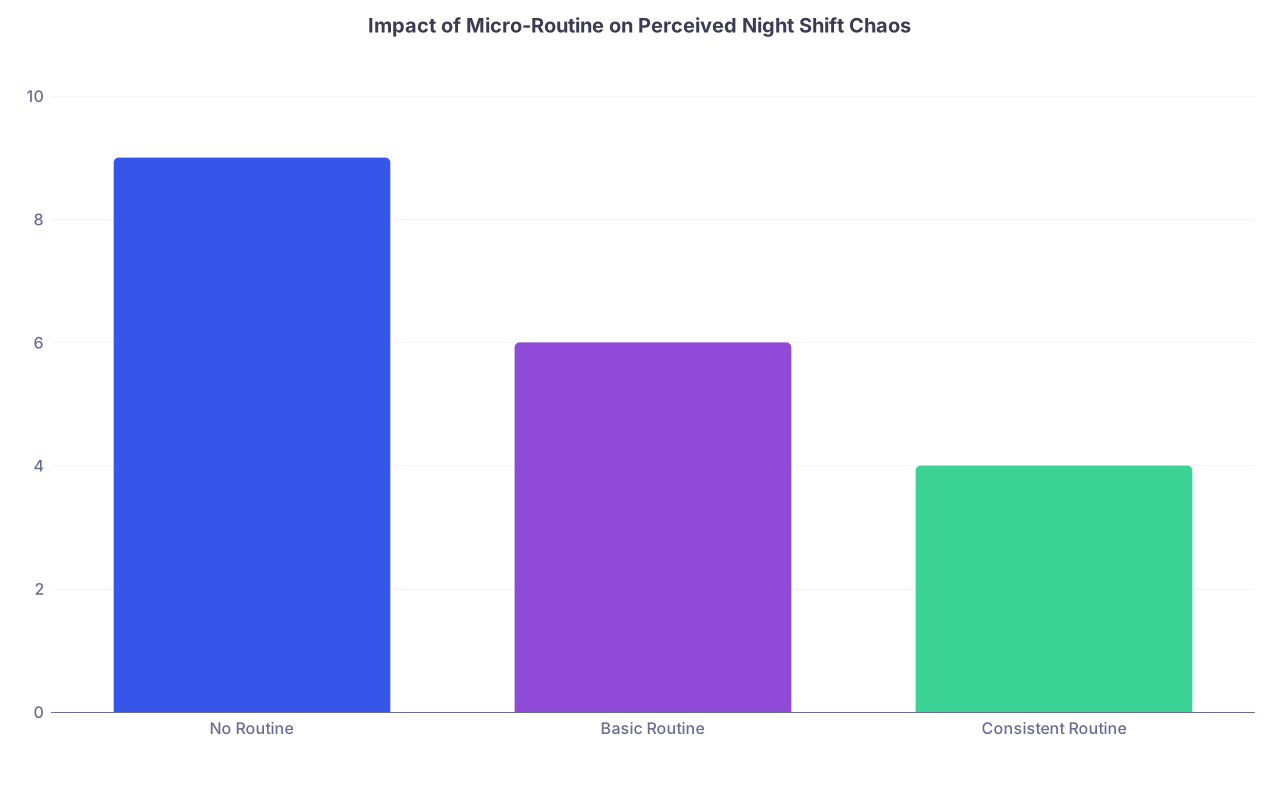
| Category | Value |
|---|---|
| No Routine | 9 |
| Basic Routine | 6 |
| Consistent Routine | 4 |
Step 6: Build Your One-Card Night Shift Template
Let’s turn all of this into something you can literally carry in your pocket.
Take an index card. Split it front and back.
Front: Radar + Briefing
- Top: Date / Shift time
- Left column: R / Y / G
- Right column: Patient bed + 3–5 word problem + 1 action
Example:
- R – 12 – Septic shock – check repeat labs 22:00
- Y – 7 – DKA resolving – BMP 02:00
- Y – 3 – GI bleed – Hgb 01:00
- G – rest of floor stable per signout
Back: Micro-Routine + Triage Rules (tiny)
Back of card:
Micro-Routine Steps (keywords only)
- Body – 3x 4-6-8
- Brief – R/Y/G list
- Tools – pager / windows / snacks
- Triage – call-back script
Your 2–3 triage rules
- “>2 pages in 2 min — list & sort, sickest first”
- “Non-urgent while with sick pt — script”
- “Pressor change / sats drop / rapid HR — see now”
Glance at the back when you are fried and defaulting to chaos.
| Side | Section | Content Type |
|---|---|---|
| Front | Header | Date, shift time |
| Front | Patient list | R/Y/G + bed + 1 action |
| Back | Steps | 4 keywords (Body, Brief, Tools, Triage) |
| Back | Triage rules | 2–3 short if-then rules |
Step 7: Drill It Until It Is Automatic
The first few nights, you will need to think: “Ok, now breathing, now briefing, now tools…” That is fine. You are programming your brain.
Here is how to speed that up:
Practice the breathing once during the day.
- Take 90 seconds before lunch and run 3 cycles. Build the muscle memory.
Dry-run the routine mentally on your commute.
- “When I sit down, I do: 3x 4-6-8, scan list, mark Reds, mark Yellows, open windows, check pager volume, review triage rules.”
- That is a mental rehearsal, which your brain treats as partial practice.
Time it for 3 nights.
- Use your phone clock.
- See how long each step actually takes you.
- Trim anything that bloats the 10 minutes.
The goal is that by your 5th–7th night using this, the micro-routine feels like brushing your teeth. Familiar. Quick. Predictable.

Step 8: Handle the Nights Where You Truly Cannot Get 10 Minutes
Sometimes you walk into a code. Or a rapidly escalating unit. Fine. This is residency, not a lab environment.
On those nights, you use the 90-second micro-micro version as soon as the immediate crisis is under control.
90-Second Emergency Version
20 seconds – One breath + unclench
- One long 4-6-8 breath
- Drop shoulders / unclench jaw
40 seconds – Verbal or mental briefing
- Tell yourself:
- “Top 1–2 sick: X and Y. Most likely next problem: Z.”
- That is it. Even saying it out loud helps anchor your focus.
- Tell yourself:
30 seconds – Tool + one triage rule
- Glance at pager, confirm volume
- Pick 1 triage rule:
- “Sickest first, non-urgent waits, and I tell them that.”
Is it as good as the full 10 minutes? No. But it is way better than nothing. You are still giving your brain a frame.

Step 9: Common Mistakes That Kill Micro-Routines
I have watched residents try this and then abandon it. The patterns repeat.
Mistake 1: Turning It Into a Huge Project
If your “10-minute routine” becomes:
- Full chart review of every patient
- Detailed to-do list for the entire night
- A dozen checklists and templates
You will hate it and stop. Keep it brutally simple:
- 2 minutes body
- 4 minutes rough risk map
- 2 minutes tools
- 2 minutes triage rules
Done.
Mistake 2: Letting Every Page Interrupt It
You must decide: this matters.
If you answer every page instantly during your 10 minutes, you will never finish. Use simple language:
- “I am just sitting down to start the shift and reviewing the list. Unless it is urgent, can I call you back in 5–10 minutes?”
- Most nurses will say yes. They also prefer a calmer, more organized night float.
Mistake 3: Using It Only When You “Have Time”
You will almost never “have time.” The whole point is you make time because it protects the rest of the shift.
Treat it like:
- Hand hygiene.
- Pregnant trauma call.
- Signout.
Not optional. Standard.
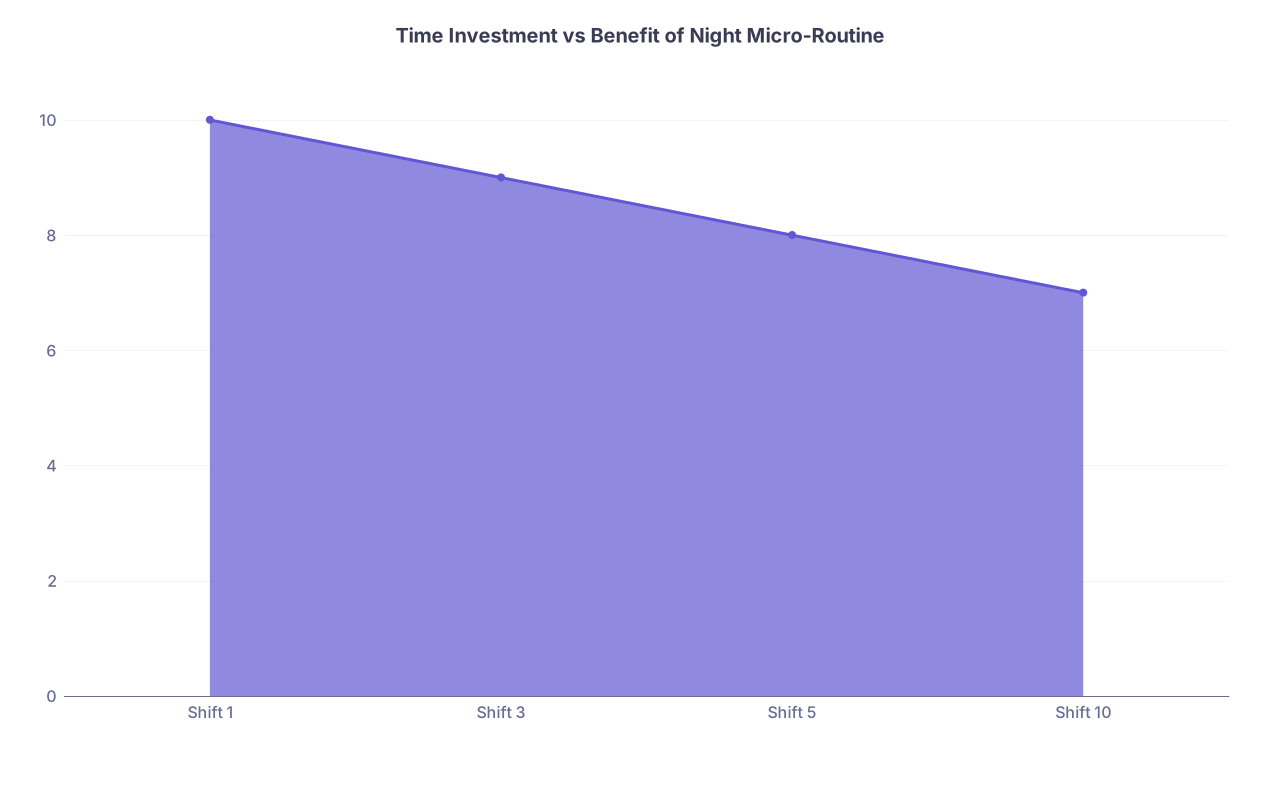
| Category | Value |
|---|---|
| Shift 1 | 10 |
| Shift 3 | 9 |
| Shift 5 | 8 |
| Shift 10 | 7 |
Step 10: Pair It With a 3-Minute Shutdown at the End (Bonus)
Not strictly necessary, but powerful.
At the end of the shift:
- Cross off what is done on your radar card.
- Circle anything that needs explicit mention in signout.
- Flip the card and glance at your triage rules—ask, “Did I follow them?”
You are teaching your brain: nights have a start, middle, and end. They are not one continuous trauma.

Put It All Together
You do not need a perfect life overhaul to make nights survivable. You need a small, reliable anchor.
Here is your move:
- Commit to a 10-minute start-of-shift micro-routine that covers body, briefing, tools, and triage.
- Write it on a single card and use that card to map Reds, Yellows, and Greens within your first 10 minutes.
- Protect it on every shift unless something is actively crashing; on disaster nights, run the 90-second emergency version as soon as you can.
That is how you take a chaotic, unpredictable night and give it a spine. Not perfect. But controlled enough that you are driving the shift, not being dragged behind it.