

You are halfway through a brutal night float block. It is 4:02 a.m. You just finished a septic workup in the ED, put in your fourth admission, and now you are back at the workroom computer staring at a new “STAT” page from the floor. Your eyes are burning. Your brain feels like wet cardboard. You catch yourself rereading the same lab values three times and still not processing them.
You are not just “tired.” You are cognitively impaired. And you still have patients depending on you.
This is where people make real mistakes. Miss that subtle ST elevation. Forget to recheck that potassium. Mix up orders. I have seen it happen. Every resident who has done enough nights has.
So you need a plan for that exact moment. Not a vague “sleep hygiene” lecture. A step‑by‑step tactical protocol for what to do right now at 4 a.m. when your brain is slipping and you still have three hours left.
That is what this is: a practical alertness playbook for the wall.
Step 1: Triage Yourself in 90 Seconds
Before you touch another order, do a 90‑second self‑assessment. You are about to decide how aggressively you need to intervene on your own brain.
Run this checklist, fast:
Micro-sleep check
- In the last 10 minutes, have you:
- Snapped awake not remembering the last sentence you read?
- Blinked and felt like time “skipped”?
- Drifted during a conversation and missed half a sentence?
- If yes, you are in dangerous territory. Treat this like a safety issue, not just discomfort.
- In the last 10 minutes, have you:
Cognitive check
- Can you:
- Repeat a 7‑digit number backward (e.g., 3‑9‑4‑2‑7‑8‑1)?
- Summarize the last patient you saw in one clear sentence without looking at the chart?
- If that feels surprisingly hard, you are more impaired than you think.
- Can you:
Physical state check
- When did you last:
- Drink water?
- Eat something with actual calories?
- Stand up and walk more than 10 steps?
- Rate your current state 1–10:
- 1–3: Barely functioning
- 4–6: Sluggish but workable
- 7–10: Alert enough
- When did you last:
Once you have that quick snapshot, you choose the right intervention tier:
| State Rating | Risk Level | Intervention Tier |
|---|---|---|
| 1–3 | High risk | Emergency reset |
| 4–6 | Moderate risk | Tactical boost |
| 7–10 | Mild risk | Maintenance and pacing |
If you are 1–3, you do not “push through.” You execute a short, controlled reset. If you are 4–6, you use targeted stimulation and structure your tasks carefully. If you are 7–10, you maintain and avoid dumb mistakes.
Step 2: The 10–15 Minute Emergency Reset (When You’re Truly Toast)
This is for the nights when your brain is clearly done. You are rereading orders. You almost placed something on the wrong patient. Your pager feels like a personal attack.
The unsafe move: keep grinding.
The right move: a controlled micro‑reset that buys you 60–120 minutes of improved cognition.
The 4 a.m. Reset Protocol
This should take 10–15 minutes max and you can usually negotiate that with your team or nursing if you say the quiet part out loud: “I need 10 minutes so I do not make a mistake.”
Communicate clearly (1 minute)
- Tell the charge nurse or senior:
“I’m hitting a wall. I’m going to take 10 minutes to reset so I do not screw up an order. Page me only for true emergencies.” - This is not weakness. This is risk management.
- Tell the charge nurse or senior:
Caffeine + water (2 minutes)
- If you will be off shift in ≤4 hours:
- 50–100 mg caffeine is enough (small coffee, half an energy drink).
- If you still have 6–8 hours:
- 100–200 mg max, once. No redosing.
- Chase with at least 250–300 mL water. Dehydration makes fatigue worse.
- If you will be off shift in ≤4 hours:
Quick fuel (2–3 minutes)
- Eat something with:
- 15–30 g carbs + 5–10 g protein. Example:
- Half a sandwich
- Greek yogurt
- Banana + small handful of nuts
- 15–30 g carbs + 5–10 g protein. Example:
- Avoid:
- Huge meals
- Straight sugar (candy, soda alone) – crash is real
- Eat something with:
Nap or pseudo-nap (6–8 minutes)
If your environment/hospital culture allows a micro‑nap, do it. If not, do a “body offline, senses offline” reset.Option A: 7–10 minute chair nap
- Sit or recline where you will definitely wake up if paged:
- Chair in the call room
- Recliner in a quiet corner
- Set two alarms on your phone for 9 and 11 minutes.
- Eye mask or hoodie over eyes, noise as low as feasible.
- The goal is not REM sleep. It is to interrupt the worst of the microsleeps with one controlled bout.
Option B: Pseudo-nap if actual sleep is impossible
- Find a spot where you can safely sit alone.
- Close your eyes.
- Head down, hands loosely in lap.
- Slow breathing:
- In 4 seconds, out 6 seconds, repeat.
- Completely disconnect from screens and charting. Even 6–8 minutes of sensory quiet helps.
- Sit or recline where you will definitely wake up if paged:
Reboot with movement (2 minutes)
- The moment your alarm goes off:
- Stand up, slow stretch: neck, shoulders, hamstrings.
- Walk briskly down the hall and back. At least one flight of stairs if possible.
- Splash cold water on your face in the nearest bathroom.
- This movement transition is what converts the reset from “more groggy” to “more awake.”
- The moment your alarm goes off:
You just bought yourself 1–2 hours of functional brain activity. Do not waste that window on low‑value tasks.
Step 3: Reorder Your Work – Protect High-Risk Tasks
After the reset, you treat your remaining night like triage.
You are not trying to “clear your to‑do list.” You are trying to protect patients from your tired brain.
Create a Rapid Task Triage
Sit down, look at your list, and categorize tasks into three buckets:
High-risk cognition tasks
- Interpreting labs/imaging:
- New troponin trend
- ABGs on a decompensating COPD patient
- Ordering or adjusting:
- Insulin drips
- Pressors
- Anticoagulation
- Writing critical orders:
- Transfer to ICU
- Code status changes
- New unstable consults
- Interpreting labs/imaging:
Medium-risk tasks
- Standard admission orders using templates
- Med reconciliations with pharmacy backup
- Brief progress notes where the plan is already stable
Low-risk tasks
- Scut:
- “Please renew diet order”
- Routine day‑team follow‑ups that are not time‑critical
- Non-urgent dressing changes that can wait
- Scut:
You want to front‑load your best remaining attention on category 1 tasks. Then do medium. Leave low‑value, low‑risk tasks for the last hour or kick them to sign‑out if truly nonurgent.
If nurses call with something that sounds minor (e.g., “can you make melatonin nightly?”) at 4:30 a.m. when you are triaging someone’s sepsis, it is okay to say:
“I’m managing an unstable patient right now. Can this safely wait for the day team?”
Often, the answer is yes.
Step 4: Use Structured Thinking Tools So Your Brain Does Not Have to Wing It
At 4 a.m., relying on “remembering everything” is how you miss things. You need crutches. They are not just for interns. Seniors who think they are above checklists are the ones who order heparin on the wrong patient.
Build (or Steal) Micro‑Checklists
Have a few prebuilt checklists either in your brain, on your phone (within policy), or on a small card in your pocket. Especially for:
Chest pain admission
- Troponins (serial)
- EKG now + repeat if change
- ASA loading if appropriate
- Nitroglycerin precautions
- Anticoagulation if indicated
- Telemetry order
Sepsis workup
- Lactate
- Blood cultures x2
- Broad‑spectrum antibiotics
- Fluid bolus
- Pressor plan if hypotension persists
- ICU contact threshold
Acute mental status change
- Vitals + fingerstick glucose
- Oxygenation and CO2
- Medication review (opioids, benzos, anticholinergics)
- Infection workup
- Neuro exam with NIHSS if stroke concern
Using a checklist when you are exhausted is not overkill. It is survival.
Co-sign Your Own Orders With a “Second Pass”
You will make fewer mistakes if you assume your first pass is flawed. Build this habit:
- Enter orders.
- Stand up, walk 5 steps away.
- Come back, and read every order aloud in your head:
- Correct patient?
- Correct dose?
- Correct route?
- Reasonable frequency?
At 4 a.m. I have watched residents almost place:
- 100 units instead of 10
- BID instead of once
- On the patient in the next room
Your “second pass” is cheaper than a root cause analysis.
Step 5: Use Smart, Not Stupid, Stimulants
Most residents abuse caffeine like it is a fire extinguisher: random, last minute, and messy. The goal is not to avoid caffeine. The goal is to use it like a drug with a dose, timing, and indication.
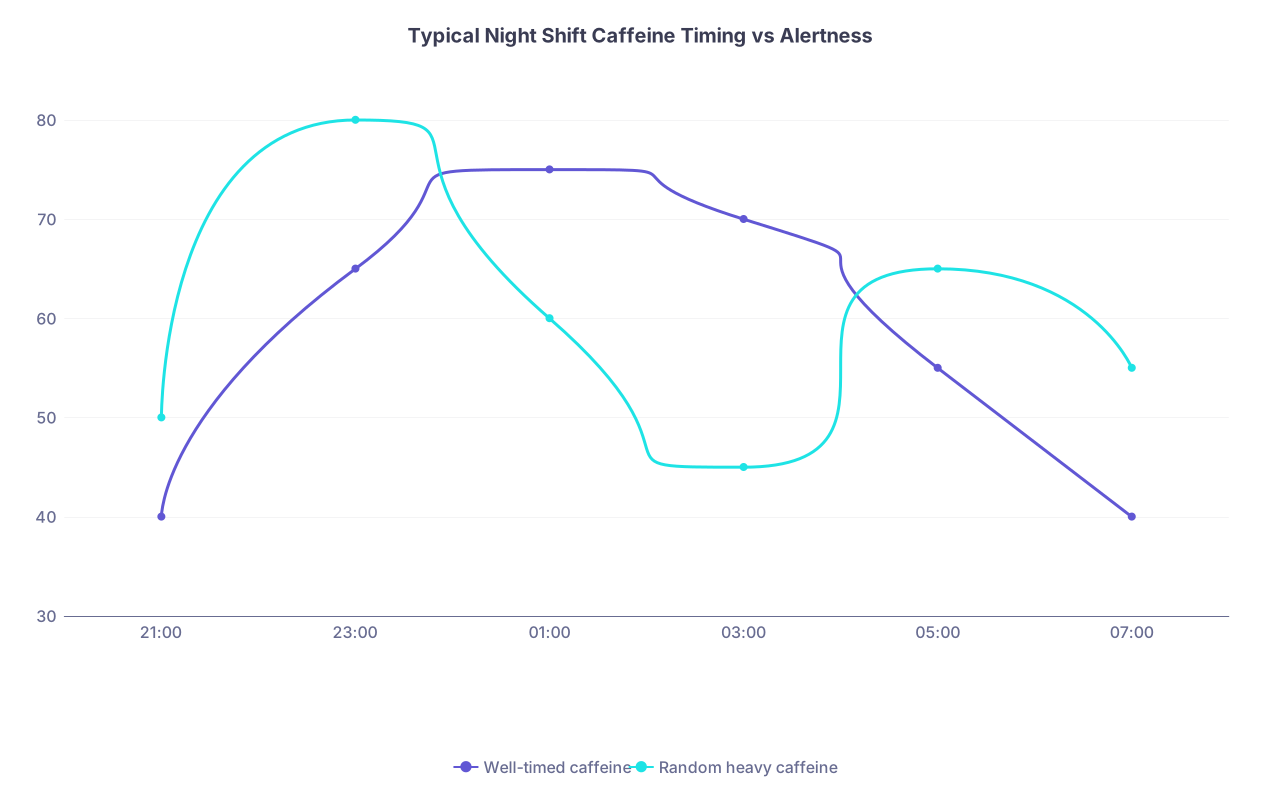
| Category | Well-timed caffeine | Random heavy caffeine |
|---|---|---|
| 21:00 | 40 | 50 |
| 23:00 | 65 | 80 |
| 01:00 | 75 | 60 |
| 03:00 | 70 | 45 |
| 05:00 | 55 | 65 |
| 07:00 | 40 | 55 |
A Simple Night-Shift Caffeine Strategy
Use this on a typical 7 p.m.–7 a.m. or 8 p.m.–8 a.m. shift:
Before shift (1–2 hours before start)
- 50–100 mg if you are already tired.
- Keeps you from starting the shift already behind.
Early shift (first half: 9 p.m.–1 a.m.)
- 100–200 mg total, spread out:
- Example: one normal coffee around 10–11 p.m.
- Do not go above 300–400 mg for the entire night unless you want palpitations and a useless crash.
- 100–200 mg total, spread out:
Late shift (3–5 a.m.)
- If you are dying at 4 a.m. and have ≤4 hours left:
- Small top‑off: 50–100 mg.
Think half a coffee, green tea, not a huge energy drink.
- Small top‑off: 50–100 mg.
- If you go home and need to sleep by 9–10 a.m., be careful. Caffeine after 5 a.m. will haunt you.
- If you are dying at 4 a.m. and have ≤4 hours left:
Last 1–2 hours (5–7 a.m.)
- No more caffeine. You are protecting post‑shift sleep.
And stop pretending energy drinks plus no water is “fine.” They dehydrate you, spike you, and then you crash right when you are signing out.
Step 6: Make Your Physical Environment Fight For You
You cannot change that the hospital is fluorescent and ugly. You can hack it a little.
Light: Your Most Underused Tool
At 4 a.m. your circadian rhythm wants melatonin, not EMR. You counter that.
On shift
- As much bright light as you can tolerate in your workroom:
- Keep overhead lights on.
- If you have a small desk lamp or light therapy box you can bring on nights, use it during the wall hours (2–5 a.m.).
- Avoid charting in dark rooms. Darkness + screen glow = micro‑sleep factory.
- As much bright light as you can tolerate in your workroom:
After shift
- Sunglasses when you walk out of the hospital into daylight.
- Dim lights at home if you are going straight to sleep.
- You are separating “work light” and “sleep light” aggressively.
Temperature and Movement
Cold helps. Stagnation kills.
- If possible, keep the room slightly cool, not warm. Warm + chair + exhaustion = dozing.
- Every time you finish a note: stand up and walk at least 30–60 seconds.
- Use stairs instead of the elevator at least once an hour if physically possible.
Step 7: Use Other Humans as Guardrails
The dumbest thing you can do on nights is try to be a hero in isolation.
You are not just responsible for patients. You are responsible for your impaired self too.
Three Simple Safety Behaviors
Say out loud when you are struggling
- To your co‑resident, senior, or even a nurse you trust:
“I’m fading. I need a second set of eyes on anything high risk.” - You will be surprised how often nurses already noticed.
- To your co‑resident, senior, or even a nurse you trust:
Double‑check big decisions with another brain
- Before you:
- Call ICU for transfer
- Start pressors on the floor
- Change anticoagulation in a complex patient
- Quick script:
“It’s 4 a.m. and I’m tired. Can I run a case by you to make sure I’m not missing something obvious?”
- Before you:
Use nursing as an early warning system
- Explicitly tell them:
- “If something feels off, even if vitals are ‘fine,’ please page me early. I’d rather see the patient twice than once too late.”
- Explicitly tell them:
No one remembers who got through nights without ever asking for help. People remember who missed the tamponade.
Step 8: Micro-Habits That Add Up Over a Night Float Block
You do not fix nights with one heroic 4 a.m. hack. You make them survivable by stacking a bunch of small, boring habits.
During the Shift
Hydration discipline
- Bring a 1‑liter bottle.
- Rule: finish it by 3–4 a.m. Refill once if you are very active.
Food pattern
- One real meal early in the shift (before midnight).
- Then 1–2 small snacks, not a 1,500‑calorie dump at 2 a.m.
Built-in movement triggers
- Every time your pager goes off and you are sitting, stand up before you answer it.
- Use every lab check as an excuse to walk to the unit instead of calling, when time allows. Movement = alertness.
Between Shifts

| Step | Description |
|---|---|
| Step 1 | Post shift |
| Step 2 | Light snack and hydrate |
| Step 3 | Sleep block 4-6 hours |
| Step 4 | Wake - brief sunlight exposure |
| Step 5 | Short walk or light exercise |
| Step 6 | Pre-shift meal |
| Step 7 | Arrive early and plan priorities |
Anchor sleep
- You will not sleep like a normal human. Fine.
- Get one solid core block: 4–6 hours as protected as possible.
- White noise, blackout curtains, phone on do not disturb except for true emergencies.
Micro‑exercise
- Even 10 minutes of brisk walking or light bodyweight stuff (pushups, squats) before shift helps.
- You are not “getting fit.” You are priming your brain.
Limit life chaos
- You cannot be a great resident, a perfect parent, a social butterfly, and a home renovator during a tough night float block. Something has to give temporarily.
- Be explicit with partners/family: “For the next 2 weeks, I will be a zombie. Here is what I can and cannot realistically do.”
Step 9: When You Are Too Impaired – The Red Line
There is a point where coping strategies are not enough. I have seen residents at 4:30 a.m. who should not be writing for Tylenol, let alone managing three pressors.
You need to know where that line is and what to do when you cross it.
Red Line Signs
If any of these are happening repeatedly in a single night:
- You fall asleep standing up or while typing.
- You place or nearly place a dangerous order on the wrong patient or dose.
- You cannot meaningfully follow a nurse’s verbal report.
- You walk into a room and forget entirely why you are there, more than once.
- You feel physically unsafe to drive a car.
That is not “I am a strong resident working hard.” That is unsafe practice.
What To Do
- Tell your senior or attending directly
- “I am not safe right now. I almost ordered X on the wrong patient. I need help or coverage.”
- Document the pattern for your own protection
- Not in the chart. In your own notes:
- When it happened
- How many hours you had worked
- Who you notified
- Not in the chart. In your own notes:
- If this is happening frequently
- This is a systems problem, not a personal toughness problem.
- You may need:
- Schedule adjustment
- Sleep medicine evaluation (OSA, circadian disorders)
- Mental health support (depression, burnout, substance use)
Yes, residency is hard. But “dangerous levels of impairment” is not an acceptable baseline because “this is how it has always been.”
Step 10: A Concrete 4 a.m. Tactical Script
Let me put this into a literal play‑by‑play for the moment you hit the wall.
You look at the clock: 4:07 a.m. You feel destroyed. Here is the script.
- 90‑second self‑check
- Realize you are at a 3/10. Cognitively sluggish, making small errors.
- Communicate
- Tell charge nurse: “I am going to take 10 minutes to reset. Page me only for emergencies.”
- Reset protocol (10–12 minutes)
- Drink 100 mg worth of caffeine + water.
- Eat a small snack (half sandwich or yogurt).
- Sit in a quiet spot, eyes closed for 7–8 minutes with a phone alarm.
- On alarm, stand up, walk one flight of stairs, splash cold water on face.
- Return and reorder tasks (3–5 minutes)
- List open tasks, label H/M/L risk.
- Do high‑risk cognitive items first while your reset is still working.
- Use checklists and a second pass on orders.
- Use help
- For any borderline calls (“Does this patient need ICU?”), call senior/ICU and say:
“It is 4:30 a.m., I am tired, and I want a second set of eyes.”
- For any borderline calls (“Does this patient need ICU?”), call senior/ICU and say:
Do this instead of just doom‑scrolling your EMR and hoping your brain “wakes up.”
Key Takeaways
- The 4 a.m. wall is not just discomfort; it is cognitive impairment that demands a protocol, not willpower.
- A brief, structured reset (caffeine, water, micro‑nap or pseudo‑nap, movement) plus smart task triage will buy you 1–2 hours of safer performance.
- Use tools and people—checklists, second passes on orders, and explicit help from nurses/seniors—to protect patients from your tired brain.


