
It’s 2:37 a.m. in January. Every room on your stepdown unit is full, the ED board is bleeding red, and your cross-cover list looks like someone copy-pasted “sepsis?” fifty times. Your phone vibrates: “Hey, can you call the MICU fellow about 4-12? Not looking good.”
You stare at the number. You know the fellow. Smart. Tired. Blunt. The kind who can make you feel like an intern again with a single, “So… what do you want from me?”
This is exactly the moment I’m talking about.
Let me tell you what the fellows are actually thinking at 2–4 a.m. during a brutal respiratory/flu/COVID/RSV winter. What they expect from you. What secretly impresses them. And what quietly gets you labeled as “that resident we don’t trust on nights.”
Most of this no one ever says out loud. They just write it in your informal reputation file that lives in people’s heads.
The Unspoken Reality: Fellows Are Doing Triage, Not Customer Service
On “sick” winters, your ICU and subspecialty fellows are not sitting in a dark room waiting for teaching cases. They’re running a war zone.
In a typical night at a big academic center in January, a MICU fellow might be:
- Running a unit that’s 110% full
- Handling 3–5 simultaneous transfers
- Fielding consults from the ED, floors, and outside hospitals
- Helping an intern place a central line
- Reassessing three different patients all “soft” but sliding
So when you call, they mentally sort you into one of three categories within about 20 seconds:
- This resident gets it → I can trust their judgment and move fast
- This resident is okay → I’ll verify everything myself and we’ll be fine
- This resident is a liability → I have to redo the entire assessment and basically ignore their opinion
Your goal is very simple: never land in category 3. And, ideally, build a reputation as category 1.
That reputation is built on nights. Especially in sick winters.
What They Expect Before You Ever Call
The biggest complaint fellows have at 3 a.m. is not that residents call them. It’s how you call.
They’re not expecting you to be a mini-fellow. They are expecting you to do some basic work before you hit “dial.”
Here’s what “bare minimum” looks like to most ICU/floor/subspecialty fellows in winter:
You’ve actually seen the patient.
Not “nurse says they’re more short of breath.” Not “telemetry called.” You physically walked into the room, looked at the patient, talked to them if possible, and laid hands on them.
You have real vitals.
Not just “they were 96% an hour ago.” They want now:
- HR, BP (with trend if it’s soft), RR, SpO₂, temp
- O₂ delivery method and settings
- Recent weight if heart failure or fluid-sensitive
You’ve opened the chart and looked at:
- Last H&P or problem list
- Recent imaging (even just the impression)
- Most recent labs and cultures
- Active meds, especially drips, anticoagulation, and pressors/inotropes
You’ve done one cycle of immediate, obvious interventions. That might mean:
- Increased O₂ or escalated from nasal cannula to NRB/HFNC per protocol
- Given a scheduled neb or a PRN that makes sense
- Started a fluid bolus if hypotensive and not in florid pulmonary edema
- Checked a blood sugar on any altered patient
- Asked for a stat EKG and troponin on a chest pain/hypotension combo
- Drawn basic labs: CBC, BMP, lactate, VBG/ABG if respiratory concern
You’ve thought, “What do I think this is?”
They are not grading your accuracy at 3 a.m. They’re grading whether you’re thinking at all. “I’m worried this is progressing sepsis vs. PE vs. COPD exacerbation” is better than, “I don’t know, they just look bad.”
That’s the mental checklist fellows are using. If you call without having done these things when you reasonably could have, their respect for you drops a notch. And it does not bounce back quickly.
How to Present a Sick Patient at 3 A.M. (The Way Fellows Wish You Would)
I’ve heard this exact line from a pulmonary-critical care fellow:
“If they start with the entire hospital course from admission 6 days ago, I already know I’m going to have to dig for the actual problem myself.”
Here’s the structure that makes fellows’ blood pressure drop in a good way. This is the “I trust this resident” presentation.
Lead with the alarm.
They want to know, in one sentence, why you’re calling now and not an hour ago.
“Hi, this is Dr. X, the night resident on 8W. I’m calling about Mr. Jones in 8124 – he’s hypotensive to the 80s now, tachy to 130, and more confused compared to baseline.”
Then give the 10-second ID and key background, not the entire hospitalization:
“He’s a 67-year-old with COPD, HFrEF, and DM2, admitted 3 days ago with influenza pneumonia and sepsis, currently on 4L nasal cannula, on broad-spectrum antibiotics, not in the ICU.”
Now, the last 2–3 hours in tight, clinical language:
- Vitals trend: “Over the last 3 hours his MAPs have fallen from mid-70s to low 60s despite 1L LR, HR increased from 100s to 130s, RR now mid-30s, sats 90–92% on 4L, temp 38.8 from 37.5.”
- Mental status: “He was alert and oriented to person/place this afternoon; now only to person, intermittently somnolent.”
- Objective findings: “On exam he has diffuse crackles, increased work of breathing with accessory muscle use, cool extremities, cap refill about 3–4 seconds, borderline urine output with only 0.3 cc/kg/hr over the last 4 hours.”
Interventions you’ve already done:
“I’ve given 1L LR, started a second large-bore IV, repeated lactate and blood cultures, ordered stat CBC/BMP, and put him on NRB with sats now 93%.”
Then your read:
“I’m concerned he’s in worsening septic shock and may need pressors and higher level of care.”
Then, and only then:
“What I’m asking is if you can come evaluate him for possible MICU transfer, and whether you’d like me to start norepinephrine if his MAP stays under 65 while you’re on your way.”
This is how you sound like a competent resident they want to work with. Even if your assessment is imperfect, you’ve told them exactly what they need to know quickly.
You know what they hate? This:
“So, um, I have Mr. Jones. He came in like three days ago with shortness of breath and cough. I think it was the flu? He has COPD and heart failure and diabetes and, uh, let me scroll… some kidney disease. He’s been kinda more confused tonight…”
You’ve already lost them.
What They Expect From You in the First 5 Minutes at the Bedside
When fellows come see your patient, they’re quietly judging how you behave in the room.
They are not expecting you to auscultate like them or read the ABG like a pulmonologist. They are expecting a certain posture.
Here’s what they want to see:
You look like the team leader, not a bystander.
I don’t care if you’re an intern. You stand at the foot or side of the bed, you know the nurse’s name, and you’re the one summarizing what’s happened. If the nurse asks a question, you try to answer before looking helplessly at the fellow.
You touch the patient.
Sounds stupid, but it’s not. The fellows notice. You put your hand on the chest, feel the work of breathing, feel the pulses, squeeze the legs for edema. It signals that you examine before you panic.
You’re watching the monitor and the patient.
A fellow will sometimes just stand back for thirty seconds and see whether you’re glued to the monitor numbers or actually looking at the person. If you never take your eyes off the SpO₂ and ignore the gasping patient, that’s a red flag.
You know where key info is in the chart.
They say, “What’s his last echo?” and you’re already in imaging. They ask, “How much urine in the last 6 hours?” and you’ve got I/Os open. The worst look is you fumbling around Epic like you just met it yesterday.
You’re not arguing to avoid escalation.
This is a big one in winter. Fellows loathe the resident who minimizes because they don’t want another transfer or upgrade: “Well, his pressures have always been a little soft” or “He looks kind of like this sometimes.”
If the fellow came up at 3 a.m., they already think this is serious. If you keep downplaying, they stop trusting you in the future.
The Difference Between “Help Me Think” vs “Transfer This Now” Calls
Fellows do not mind you calling to think out loud—as long as you’re honest about what type of call this is. The problem is when you blur the line.
There are two categories in their mind:
- I’m worried but not sure how worried
- I think this patient is crashing and needs something I can’t provide
If you can signal which one it is early, they immediately calibrate how fast they move and how much bandwidth to allocate.
For a “help me think” call, you say something like:
“I’m not sure this patient needs ICU, but I’m uneasy and want your help framing next steps.”
For a “this is bad” call:
“I think this patient is acutely decompensating and may need ICU level care or a procedure urgently; I’d like you to come now.”
Fellows hate faux-calm presentations where the resident sounds mellow but the patient is clearly tanking when they arrive. They also hate the reverse: you scream fire on the phone and they arrive to a comfortable patient with stable vitals and no interventions attempted.
Winter-Specific Expectations: Respiratory Nightmares and Fluid Disasters
“Sick winters” are really just code for “everyone’s lungs and kidneys are giving up at the same time.”
The patterns are predictable. Ask any pulm/CC fellow what they see in January:
- COPD + influenza → hypercapnic failure
- CHF + viral trigger → flash pulmonary edema
- Immunosuppressed + RSV → rapid escalation to HFNC/BiPAP/intubation
- Obese/OSA + sedation → hypoventilation and silent desaturations
What do they expect from you in these situations?
For respiratory patients:
- You know the mode and settings of whatever is on their face: “He’s on HFNC 60/60,” not “some high-flow thing.”
- You’ve tried simple things: sit them up, reposition, clear secretions, give nebs if indicated.
- You’ve thought about code status before the fellow arrives. The worst moment is discovering at 3 a.m. that nobody has really talked to the DNR/DNI patient about BiPAP/intubation.
- You at least glanced at the last ABG or VBG, and you know if they’re a CO₂ retainer.
For volume disasters:
- You know their weight trend and last echo EF.
- You know exactly how much fluid they’ve gotten in the last 24 hours, not “a lot.”
- You’ve thought: is this sepsis needing more fluid, or CHF needing diuresis and afterload reduction?
- You’ve checked for the simple killers: EKG, troponin, BNP if unclear.
They do not expect you to manage the nuance. They do expect you to recognize patterns and not be surprised by textbook things.
How Not to Be “That Resident” This Winter
There are some behaviors that get you labeled quickly in sick season. I’ve sat with fellows in workrooms at 4 a.m. while they debrief who they trust and who they groan about.
Here’s the short list of what puts you on the bad side fast:
Chronic undercaller or overcaller.
If you never call and then dump a train-wreck at 6 a.m. sign-out: black mark. If you call for every 2-point HR bump as a crisis: also a black mark. You’re allowed a learning curve. You’re not allowed to ignore feedback.
The “I already did that” liar.
We can tell when you say you listened to lungs but can’t describe anything. Or claim you checked a BP manually but don’t know the number. Once they catch you in lazy dishonesty, they stop believing your entire assessment.
Paging and disappearing.
You call, present, fellow comes to see the patient, and you’re mysteriously “in another room” and never show. That might fly once on a chaotic night. If it’s a pattern, they decide you avoid hard cases.
Blaming nursing or others for everything.
“I don’t know, the nurse was worried.” Or “The ED didn’t give report.” Or “Day team never told me.” Fellows can smell deflection. They want ownership, not excuses.
What Quietly Impresses Fellows (And They Remember)
On the flip side, there are things residents do on winter nights that make fellows say, “I’d work with them any day.” This is how you want people talking about you when you’re not there.
The pre-call text or page with heads-up.
“Hey, just letting you know, 6-18 is soft and on HFNC 50/50, I’m watching him closely; if he worsens, I’ll call you for possible transfer.” That gives them situational awareness. Shows you’re anticipating, not reacting.
You show up with a plan and options, not a blank slate.
“Here’s what I’ve done, here are the two paths I’m considering, and here’s why I’m leaning toward one.” Even if they scrap your plan, they respect the thinking.
You circle back after scary cases.
“I wanted to ask you about last night’s intubation—what should I have done earlier?” This is rare. Fellows remember the residents who actually debrief and try to get better.
You protect their time.
“Two quick questions” that are actually two quick questions. Grouping non-urgent stuff into a single page instead of pinging them five times in an hour for nonsense.
You own your misses.
“I should have called you earlier. I saw the trend and hesitated. I won’t make that mistake again.” That line earns more respect than any fake confidence ever will.
A Simple Mental Model for Winter Nights
When things are chaotic and you’re exhausted, use this 4-step internal script for any “sick” patient before involving a fellow:
Look
Go to the room. Look at the patient. Decide: do they look sick, or do they look like the numbers say they’re sick? Those are very different scenarios.Stabilize
Do the obvious, low-risk interventions you know are indicated: oxygen, fluids, sugar check, nebs, positioning, basic orders.Frame
Ask yourself: What am I most worried about? What level of care do I think they need in the next 2–4 hours? What am I not sure about?Call
Present crisply. Say what you did. Say what you think. Say exactly what you want from the fellow: advice, an evaluation, a transfer, or a procedure.
That’s it. That is 90% of being the resident fellows actually trust during the worst months.
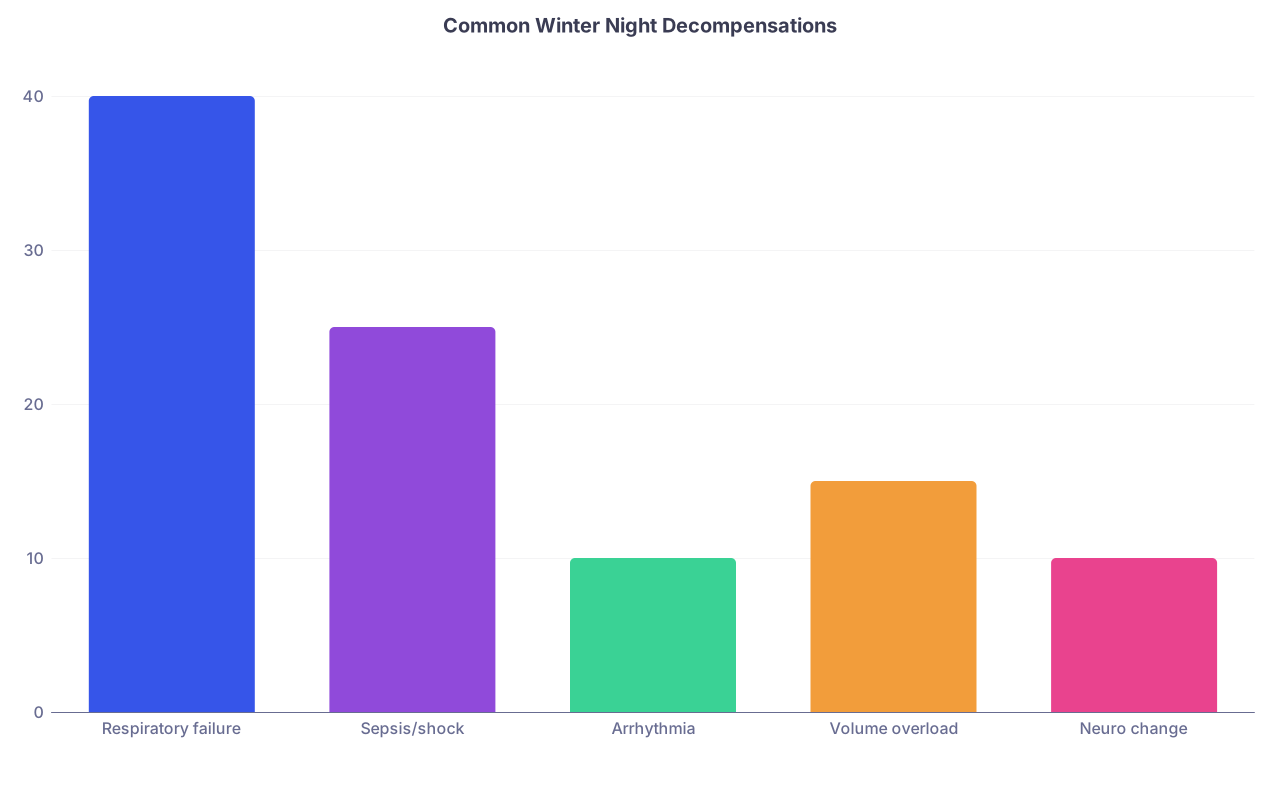
| Category | Value |
|---|---|
| Respiratory failure | 40 |
| Sepsis/shock | 25 |
| Arrhythmia | 10 |
| Volume overload | 15 |
| Neuro change | 10 |


| Step | Description |
|---|---|
| Step 1 | Notified of change |
| Step 2 | See patient |
| Step 3 | Immediate ABCs and vitals |
| Step 4 | Review chart and trends |
| Step 5 | Basic interventions |
| Step 6 | Form assessment and concern level |
| Step 7 | Call fellow with clear ask |
| Step 8 | Looks sick? |
| Resident Type | Fellow's Internal Reaction |
|---|---|
| Prepared and direct | High trust, faster decisions |
| Adequate but scattered | Double-check everything |
| Minimizer/avoider | Low trust, closer supervision |
| Alarmist without data | Frustration, filter future calls |

FAQs
1. How do I know if I’m calling the fellow too often or not enough during winter nights?
Listen to their feedback and your senior’s feedback. If you’re repeatedly hearing, “Call me earlier next time,” you’re undercalling. If you’re hearing, “This could’ve waited” or they sound irritated and you realize the patient is stable and you’ve done nothing yet, you’re overcalling. On a sick winter night, if you feel uneasy and can articulate why, you’re almost never wrong to call—just be explicit whether you want advice versus immediate evaluation.
2. What if I’m truly overwhelmed and can’t do all the pre-call work you described?
Say that out loud. “I’m cross-covering 60 patients, I’ve got two other acute issues, I haven’t been able to get labs yet, but this patient looks sick and I need your help.” Fellows are much more forgiving when you’re transparent about bandwidth than when you pretend you’ve done things you haven’t. They’re living the same chaos; they understand.
3. How do I handle disagreements with fellows about level of care or urgency?
State your concern clearly, once, with data. “I hear you that the numbers look okay, but I’m really worried because his work of breathing and mental status have changed significantly in the last hour.” If they still disagree, document objectively, tighten your monitoring, and escalate through the proper chain (your senior, attending) only if you genuinely believe the patient is at risk. Do not turn it into a power struggle; make it about the patient, not your ego.
4. Can I use nights in sick season to actually learn, or is it just survival mode?
You can learn a ton—but not during the middle of a code. The move that impresses fellows is following up after: “Can we quickly go over that shock patient from last night? How did you interpret the lactate and echo?” Two 5-minute debriefs per week during winter will teach you more real critical care than a month of daytime lectures. Fellows are usually very willing to teach the resident who showed up, did the work, and then came back with thoughtful questions.
Key points: On sick winter nights, fellows expect you to actually see the patient, do the obvious first steps, and call with a clear, concise story and a specific ask. They judge you as much by your approach and honesty as by your medical knowledge. If you own your patients, anticipate problems, and treat fellows as partners rather than a safety net you dump on, you’ll quietly build the reputation that matters most: “the resident we trust when things are falling apart.”