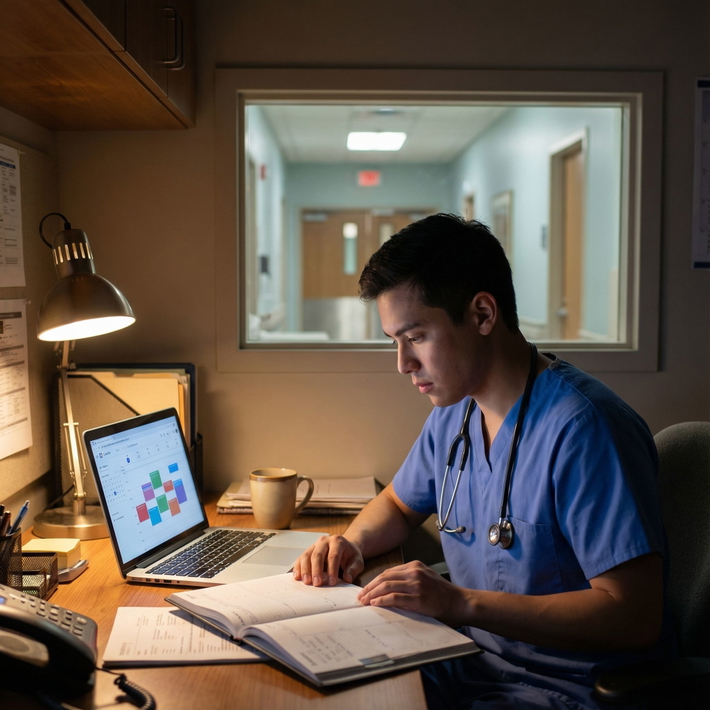
It’s 2:37 a.m. in your apartment. You’re not on nights. You’re not even a resident yet. But you’re wide awake imagining yourself on the cross-cover pager, alone, heart racing, trying to manage ten sick patients, and you can almost feel your hands shaking.
You’re thinking: what if I just can’t handle night shifts?
Not “they’ll be hard.”
More like: “What if I completely fall apart and hurt someone?”
And then the spiral kicks in:
- What if I freeze during a code at 3 a.m.?
- What if I’m so exhausted I miss something obvious and someone crashes?
- What if nights prove I’m not cut out for medicine at all?
You start Googling stuff like “residents who can’t handle nights” and “too anxious to be on call” and, yeah, here we are.
Let me be blunt: you’re not the first person to have this exact 2 a.m. panic. I’ve seen stellar interns, future chiefs, absolute rockstars, all quietly terrified of nights before they start. And I’ve also seen a smaller group where the fear wasn’t just “first-time jitters”—it was a sign something deeper (anxiety disorder, sleep condition, health issue) needed attention.
The question isn’t “Are nights scary?” They are. For almost everyone.
The real question is:
How do you tell what’s normal anxiety vs. a real, practical risk to your safety, your patients, or your health?
Let’s pick that apart without sugarcoating it.
What Night Shifts Actually Feel Like (Not the Instagram Version)
Before you can judge your reactions, you need a halfway honest picture of what nights are.
Nights are not one cinematic code blue after another with dramatic lighting and inspiring music. Most of the time, they’re a weird mix of:
- Boredom
- Random spikes of panic
- Decision fatigue
- And this surreal, half-dreamlike exhaustion at 4–5 a.m.
There’s usually less staff. Fewer seniors physically present. More “call me if you’re worried” energy. Your body is telling you it should be asleep. Your brain is telling you, “Cool, but you’re about to write for pressors.”
A typical night might be:
- 7 p.m.: You sign out, heart pounding but still functioning.
- 10 p.m.: You’re answering pages for Tylenol and bowel regimens. Anxiety drops a notch.
- 1 a.m.: You get a real call—someone hypotensive, someone desatting—and your sympathetic nervous system goes into overdrive.
- 4 a.m.: You’re exhausted enough that even stupid pages feel like personal attacks.
It’s not glamorous. It’s tiring. And it always feels worse before you’ve done a few.
But here’s the key: most residents don’t “feel ready” before nights. They do them anyway, they’re scared, and over a couple weeks they get used to it. Not because they’re superhuman, but because the environment is built with layers of backup.
You know who worries “What if I can’t handle it?” the most?
The ones who will triple-check, call for help early, obsess over patient safety. The exact ones who are usually fine.
Is This Normal Anxiety or a Real Red Flag?
Let’s separate this into two rough buckets: what I’d call “functional fear” vs. “disabling signs.”
1. Signs it’s probably anxiety (and you’re still okay to do nights)
These are the things I see in people who are scared, but ultimately safe and competent:
- You catastrophize before the shift, but during acute situations you can function. Your heart pounds, but you can still follow an ACLS algorithm, call the senior, move your hands.
- The idea of nights makes you dread them for days, but you still show up, you still do the work, and feedback from seniors is: “You’re doing fine” or “You’re appropriately cautious.”
- You second-guess your decisions a lot, but when you actually review them with attendings, they’re generally correct or at least reasonable.
- Your sleep schedule gets weird on nights, but you can eventually fall asleep on off days, and you’re not hallucinating or physically breaking down.
- You feel nausea, racing heart, or shaking before call, but it tapers once you’re actually busy and in the middle of tasks.
The anxiety is loud. It screams worst-case scenarios. But behaviorally, you’re functioning. Your performance might not be perfect (no one’s is), but it’s not dangerously impaired.
2. Signs there may be a real safety or health risk
These are the things where I stop reassuring and start saying: okay, this isn’t just “everyone’s anxious.”
- You literally cannot stay awake even with maximum effort. You’re nodding off standing up, falling asleep while writing notes, forgetting entire chunks of the night. That’s a safety issue.
- You get near-panic attacks that fully block function. Not just anxious. I mean you can’t move, can’t speak clearly, can’t focus, while a patient needs decisions now.
- You have an underlying medical condition that nights absolutely wreck. E.g., severe migraines triggered by sleep reversal, brittle diabetes that destabilizes at night, seizure disorders, bipolar disorder where circadian disruption is a known major trigger.
- You’ve gotten consistent feedback that nights are unsafe for you. Seniors having to step in repeatedly because you’re making big misses directly tied to fatigue or panic (not just “you’re an intern, you’ll learn”).
- Your mental health is tanking only around nights. As in: suicidal thoughts that flare only during/around night shifts, serious depressive spirals, or self-harm urges connected to call.
Those are not “you’re just a wimp.” Those are “this needs professional evaluation and maybe formal accommodation” situations.
Quick Reality Check: How Do Most People Adapt?
You might be telling yourself:
“Everyone else just handles nights. I’m the only one who feels this insane.”
No. You’re not.
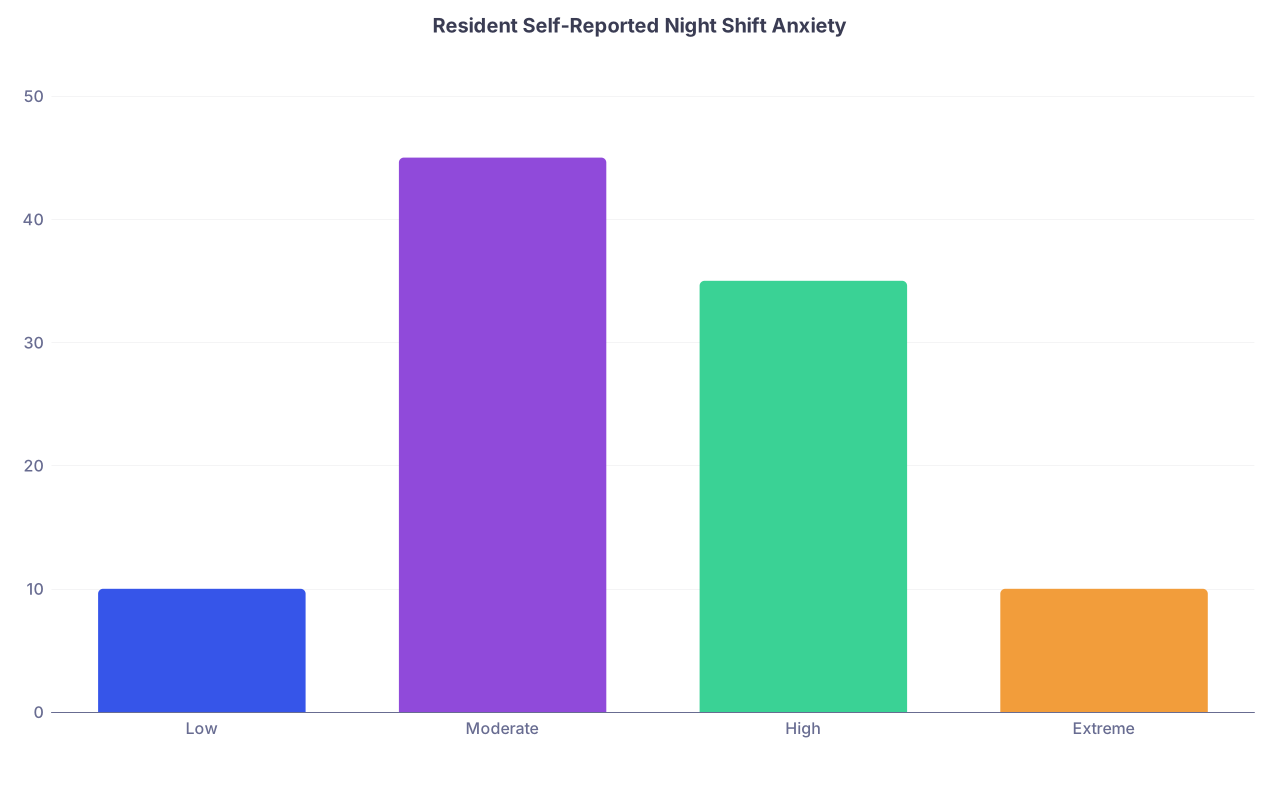
| Category | Value |
|---|---|
| Low | 10 |
| Moderate | 45 |
| High | 35 |
| Extreme | 10 |
Most interns I’ve talked to put themselves in the “moderate to high” fear zone before their first night block. The 10% “extreme” are people like you: spiraling weeks in advance, imagining worst-case disasters.
And you know what? The majority of that 10% still make it through nights safely with:
- Clear backup plans
- Practice asking for help early
- Adjusted sleep habits
- And sometimes, therapy or medication for underlying anxiety
There isn’t a magical “night shift gene” everyone else has and you don’t. There’s just exposure + systems + support + time.
How To Test Yourself Before You Assume You’ll Fail
You don’t actually know yet if you “can’t” handle nights. You only know that your brain is convinced you can’t. Those are different things.
So, how do you get data without waiting to melt down on your first real call?
1. Stress-test your anxiety in controlled ways
No, not by doing some fake-night all-nighter the week before. That mostly proves that everyone feels like trash at 3 a.m.
I mean:
- Notice what happens in real-time clinical stress. During a busy ED shift, a code in the ICU, a chaotic clinic with four sick walk-ins. Are you able to function when stakes feel high? Do you freeze completely, or do you move through fear?
- Pay attention to how you recover once the crisis passes. Do you bounce back to baseline in 30–60 minutes? Or stay in a dissociated fog for hours?
If you can function in fear during day crises, that’s a good sign you’ll probably be okay at night with support.
2. Do a brutally honest self-inventory
This isn’t about beating yourself up. It’s about clarity.
Ask yourself:
- When I’m underslept now, do I become slightly slower, or genuinely unsafe?
- Have I had any near-misses in the past where fatigue played a clear role?
- When I’ve frozen before, was it total paralysis, or a few seconds of “oh shit” before I got moving?
Write it down like you’re assessing someone else. Sometimes when you see it on paper, you realize: “I feel like a disaster, but my behavior isn’t actually catastrophic.”
3. Get an outside read—from someone who’ll tell you the truth
Not your equally anxious classmate. Someone who’s supervised your clinical work.
Ask a trusted resident or attending: “Be honest—how do I perform under stress? Any concerns about my ability to handle nights?”
If more than one supervisor says some version of: “You’re anxious but solid. Just need reps,” believe them more than you believe your 2 a.m. brain.
If someone does say, “You really shut down when overwhelmed; we should talk about that,” that’s gold information. Painful, but useful. That’s when you loop in mental health and maybe GME/Student Affairs early.
Concrete Ways To Lower Risk (Even If You’re Terrified)
You’re not going to make nights 100% safe. Nobody does. But you can make them a lot safer than your brain is imagining.
1. Treat your body like equipment you’re responsible for
You know how you’d never run a code with dead batteries in the defib? That’s you showing up to nights on 3 hours of sleep and nothing but iced coffee.
Before & during nights:
- Protect pre-call sleep like it’s an actual order. Blackout curtains, white noise, phone out of the room. People think this is optional; it’s not.
- Front-load hydration and actual food before the shift. By 3 a.m., you’ll neither want nor remember to eat.
- Caffeine early, taper late. Slamming an energy drink at 4 a.m. is a great way to be vibrating and useless when it’s time to sign out and sleep.
This isn’t “wellness” fluff. It’s non-negotiable cognitive performance maintenance.
2. Script your backup plan in advance
You’ll feel less doomed if you know exactly what to do when your brain says “I can’t do this.”
Before your first night block, literally write:
- Who’s my direct backup (name/role, not just “the senior”)?
- What scenarios will I call them no matter what? (e.g., new chest pain, hypotension, anything I feel uneasy about)
- How will I phrase the call when I feel stupid bothering them?
Something like:
“Hey Dr. X, sorry to bug you, I’m on nights and I have a patient with X, Y, Z, vitals are this, I’m thinking A vs B and leaning toward A, but I’d like you to take a look / confirm.”
If you pre-decide that “feeling overwhelmed” is itself a valid reason to call, you remove half the paralysis.
3. Use checklists when your brain is mush
This isn’t residency exam; it’s patient care. No one gets a medal for doing things from memory at 4 a.m.
Make or borrow simple checklists:
- For chest pain
- For hypotension
- For altered mental status
- For sepsis workup
Then, at night, let the checklist hold the cognitive load your tired, anxious brain can’t. You’re not less of a doctor because you use tools. You’re safer.
When It’s More Than Anxiety: Getting Real Help
Sometimes the bravest thing is not “pushing through.” It’s saying: this isn’t safe, and I need backup beyond a coffee and a pep talk.
If you recognize yourself in the more serious risk signs, this is what I’d do:
1. Get an actual mental health evaluation
Not Reddit. Not your co-intern. A psychiatrist, psychologist, or therapist familiar with medical trainees.
Spell it out:
“I’m about to start nights, and I’m genuinely scared I might not be safe, either to myself or patients. I have (or don’t have) history of anxiety/ADHD/depression/etc.”
Maybe you need:
- Therapy focused on panic, perfectionism, or catastrophic thinking
- Medication for anxiety or sleep
- Documentation for accommodations if you have a medical/psychiatric condition
Is that ideal in a perfect world? No. Is it better than silently melting down at 3 a.m. with a crashing patient and no coping tools? Absolutely.
2. Talk to your program / school before everything explodes
This is uncomfortable. Programs vary in how supportive they are. Some are great, some are frankly trash about this. But most would still rather know earlier than deal with a sentinel event or a broken resident.
You don’t have to walk in saying “I can’t do nights ever.” You can say:
“I live with [condition] and I’m concerned about how night shifts might impact my safety and performance. I want to plan ahead to make this as safe as possible for everyone.”
Sometimes that leads to:
- Modified schedules or fewer consecutive nights
- More supervision for early call blocks
- Or in the more severe cases, formal accommodations or even a leave to stabilize
Is that scary to consider? Yes. But better to know the line before you cross it.
Anxiety vs. Real Risk: A Quick Comparison
| Aspect | Mostly Anxiety | Real Risk Concern |
|---|---|---|
| During crises | Scared but functional | Frozen, unable to act |
| Fatigue effects | Slower, more cautious | Micro-sleeps, blackouts |
| Feedback from seniors | “You’re doing fine” | “This feels unsafe” |
| Mental health impact | Dread, some insomnia | Suicidal thoughts, breakdowns |
| Pattern over time | Improves with exposure | Worsens despite support |
This table isn’t perfect, but if you read the “Real Risk” column and think, “oh, that’s me,” don’t just push through. Take it seriously.
You Don’t Have to Be a Night-Shift Superhero
You’re probably imagining some mythical resident who never gets tired, never makes a mistake, loves nights, and just knows what to do at 3 a.m.
That person doesn’t exist.
What exists are:
- Tired humans who prepare
- Anxious humans who ask for help early
- Flawed humans who use systems to make fewer errors
And a small subset of humans for whom nights are truly dangerous without medical and structural support.
You want to know which one you are because you care about your patients. That alone already puts you ahead of more people than you think.
Years from now, you won’t be replaying every 3 a.m. page. You’ll mostly remember two things: the couple of hard nights that taught you who you are under pressure, and whether you listened to yourself when something felt truly off.