
The fear of calling an attending at 3 a.m. is wildly overblown—and it’s also very real in your head at the same time. Both can be true.
You’re not crazy for dreading that middle-of-the-night page. You’re scared you’ll sound stupid. You’re scared they’ll yell. You’re scared you’ll wake them up for something “dumb” and they’ll remember it forever and blacklist you for fellowship, for letters, for life.
Let’s walk straight into that fear instead of pretending it’s not there.
The 3 a.m. Nightmare You’re Playing in Your Head
You know the script. You’ve run it a hundred times.
It’s 3:07 a.m. The unit is weirdly quiet. The monitor alarm chirps. A nurse comes over: “Hey, can you come see Bed 12? Pressure’s dropping.”
You walk over. It’s a septic patient. They don’t look right. You stare at the vitals, scroll through the notes, pretend you’re “thinking,” but really you’re bargaining: maybe they’ll stabilize, maybe the cuff’s wrong, maybe I can just recheck and not wake up the attending yet.
In your brain:
If I call, I’ll sound dumb. If I don’t call, the patient might crash. If I call and it’s nothing, I’ll be “that” resident. If I don’t call and it’s something, I’ll be the resident everyone whispers about.
So what do you do? Stall. Recheck. Redraw labs. Ask the nurse to repeat the blood pressure. Walk in and out of the room three times pretending you’re “reassessing” when really you’re avoiding the phone like it’s radioactive.
This is how residents get into trouble. Not because they didn’t know everything.
Because they were too scared to call.
The sad thing? Almost every attending would rather you wake them up ten times too often than once too late.
What Attendings Actually Expect From You at 3 a.m.
Forget the polished orientation speeches. Here’s the unglamorous truth of what most attendings want when you call them in the middle of the night.
They don’t expect you to have the perfect plan. They expect you to:
- Recognize when something isn’t safe.
- Call before it becomes a disaster.
- Give a coherent, basic summary.
- Tell them what you’ve already done.
- Be willing to say, “I’m worried and I need help.”
That’s it. Not boards-level pathophysiology at 3:12 a.m. Not a 12-point differential diagnosis with citations. Just: is this okay or not okay, what’s going on, what have you tried, and what do you need.
Here’s the part your brain keeps rejecting: They already expect you to need help. You are an intern or junior. They were you. They know what 3 a.m. brain feels like. They’ve heard a hundred shaky, half-whispered calls over the years.
If an attending gets angry that you called because you were legitimately worried about a patient, that’s not a “you” problem. That’s them being a bad educator and, honestly, a liability.
You’re allowed to be inexperienced. You are not allowed to let fear of looking inexperienced harm a patient.
The Line Between “Appropriate Call” and “Why Did You Wake Me Up”
You’re terrified of being the resident who pages for “dumb stuff.” So let’s make this less abstract.
Here’s how most attendings mentally categorize pages at night:
| Type of Page | How Most Attendings See It |
|---|---|
| True instability | MUST call, no question |
| Early warning signs | Should call, they’re glad you did |
| New concerning symptom | Reasonable to call |
| Non-urgent housekeeping | Can wait, mildly annoying |
| Truly trivial / lazy | Annoying, but rare |
And here’s the trap: as a terrified new resident, you put “early warning signs” in the “non-urgent” category, and that’s backwards.
If you’re wondering “Should I call?” at 3 a.m., the answer is almost always yes.
They’d rather you call when:
- The patient is trending the wrong way (pressures, oxygen, mental status) even if they’re not “crashing.”
- Your gut says, “Something’s off” and you can’t explain it.
- You’re about to start something with serious consequences: pressors, tPA, BiPAP, code status conversations.
- A nurse is clearly concerned and doesn’t look reassured by your plan, even after you’ve addressed their immediate issues.
On the other hand, it usually can wait if it’s:
- A non-urgent med reconciliation question.
- A discharge planning detail for tomorrow.
- A lab that came back slightly off but doesn’t change management overnight.
- Something you can safely write down and clarify during morning rounds.
And yes, at some point someone will snap and say, “Don’t wake me up for this again.” It will feel like the world ended. It didn’t. You adjust your threshold for that specific thing, with that specific attending. You move on.
What to Actually Say on the Phone (So You Don’t Sound Lost)
Let me take some air out of this: attendings are not grading your 3 a.m. call like an oral boards exam. They mostly want speed, clarity, and to sense that you’re not completely underwater.
You’re anxious you’ll freeze. So script it.
When you call, you need four things, and you can literally scribble this on a sticky note at the call room desk:
- Who the patient is and why they’re admitted.
- What changed.
- What you’ve already done.
- What you’re worried about and what you want.
You don’t need a TED Talk. Try something like:
“Hi Dr. Smith, sorry to wake you, this is Dr. Lee, the night resident. I’m calling about Mr. Jones in 12B. He’s our 68-year-old with pneumonia and sepsis admitted this afternoon.
He was stable on 2L earlier, but over the last hour his blood pressure has dropped from 110s/70s to 80s/50s, HR is 120s, and his urine output has been low. I repeated a manual BP which confirmed it. I gave a liter of LR, no real improvement, and I’ve just ordered stat labs and a lactate.
I’m worried he’s becoming more septic and I’m not sure if I should start pressors here or get him to the ICU now. Can you help me with next steps?”
That’s gold for an attending. Even at 3 a.m. That tells them: you know the patient, you recognized the change, you acted, and you know your own limits.
You’re scared they’ll ask a question you don’t know. They will. So you plan your line:
“I don’t have that in front of me, but I can pull it up”
or
“I’m not sure, let me check and call you right back.”
That doesn’t make you incompetent. It makes you honest.
The Thing They Care About More Than Your Medical Brilliance
Here’s the unsaid rule: attendings don’t remember who nailed the obscure diagnosis at 2:45 a.m. They remember who was safe.
Safe looks like:
- You call before the patient spirals, not after.
- You own your discomfort: “I’m not comfortable leaving them like this overnight.”
- You don’t hide stuff that went wrong. You tell them, even when it makes you look bad.
- You follow through on the plan and circle back if it’s not working.
Unsafe looks like:
- You’re paralyzed by fear of bothering them, so you delay.
- You sugarcoat the situation: “They’re kind of hypotensive but… it’s probably okay.”
- You leave out crucial details because you’re scared it’ll trigger more questions.
- You think, “I’ll just watch them a little longer” when your gut is screaming.
I’ve watched this play out. The resident who calls “too much” but keeps patients out of the ICU? Attendings secretly love them. They might tease. They might sigh. But they trust them.
The resident who never calls? The one everyone describes as “chill” on nights? Attendings get nervous. Because that’s how you miss the patient who’s silently bleeding out, slowly decompensating, or about to arrest.
At 3 a.m., “annoying but safe” beats “independent but dangerous” every single time.
Why Your Fear Feels So Loud (And What’s Actually Behind It)
This isn’t just about the phone. It’s about all the junk riding on top of it.
You’re not actually just scared of waking someone up. You’re scared of what that means about you:
- “If I call for help, it proves I’m incompetent.”
- “If they get mad, it means I shouldn’t be a doctor.”
- “If I sound unsure, they’ll never respect me.”
- “If I mess up this call, I’ll ruin my career.”
Residency is engineered—almost perfectly—to trigger that kind of thinking. You’re evaluated constantly, watched, graded, summarized in a few vague words on an attending’s evaluation form. You know that three lines of text can influence fellowships, jobs, recommendations.
So you start performing. Even for the phone.
But look closely at what experienced residents actually say about their attendings:
- “She gets mad if you don’t call her for sick patients.”
- “He wants to know about any rapid response, no matter what.”
- “She told me, ‘If you’re wondering whether to call, call.’”
I’ve literally heard an ICU attending say to a new intern on day one: “If you ever hesitate about calling me, I want you to err on waking me up. You won’t get in trouble for that.”
You will absolutely encounter a few who are short, or condescending, or exhausted and snappy. That sucks. It will sting. But they’re not the standard. And they don’t get to decide whether you do the safe thing for your patient.
A Simple Night-Shift Call Game Plan (So You’re Not Freewheeling at 3 a.m.)
Let’s make this practical. You’re already catastrophizing—in vivid, high-def detail—so give your brain an actual script and system. Otherwise it just loops.
Before your shift, do three things:
Ask explicitly: “For what things do you want to be called overnight?”
Force the attending to tell you their preferences. You’ll get stuff like: “Any chest pain, any acute mental status change, any rapid, any transfer to ICU, any lactate above X, any concern from the nurse you can’t resolve.” That becomes your personal “no hesitation” list.Write your call template on a sticky note or on your sign-out sheet:
- One-liner (who is this, why here)
- What changed
- What I did
- What I’m worried about / what I’m asking for
Decide your personal safety rule:
“If I think about calling more than twice, I call.”
No more mental tug-of-war for 40 minutes while the patient deteriorates.
Then when something actually happens:
- Go see the patient yourself.
- Fix the obvious things you can fix right away.
- Pull up their chart and vitals before you dial.
- Take 20 seconds to write 3 bullet points you’ll say.
You are not supposed to improvise your way through residency. People who claim they do are either lying or dangerous.
The Ugly Scenarios You’re Afraid Of—And How They Usually End
Let’s walk through your worst-case thoughts. Drag them into the light.
“What if I call and it turns out to be nothing?”
Then it’s nothing. Seriously. You’ll feel stupid for five minutes. The attending might say, “Okay, just keep an eye on it,” in that tired voice that sounds like judgment. Then they go back to sleep. You go back to the floor. Patient is fine.
Next day at rounds? No one even remembers.
What you don’t see is the hundred times they were called for “nothing” and it actually turned into something. They don’t want to miss that one because you were trying to look cool.
“What if they yell at me?”
Some will snap. “Why are you calling me for this?” “Did you even examine the patient?” “You should know this.” It will feel like you just got punched.
Two things:
First, you’re allowed to protect yourself without being dramatic. After the storm passes, you can say, calmly: “I’m calling because I was worried and I wasn’t comfortable managing this alone.” That sentence is unassailable.
Second, your priority is the patient, not the attending’s mood. If they’re rude but the patient is safer because you called, that’s a trade you make every single time.
If it becomes a pattern, you’re not obligated to silently suffer. You can talk to your chief, program leadership, a trusted senior. People have been fired for being toxic in exactly this way. You’re not powerless.
“What if I don’t know the answer to something they ask?”
You won’t. They know that. Normal answers:
- “I haven’t checked that yet; I can look it up right now.”
- “I don’t remember; let me pull it up while we’re on the phone.”
- “I’m not sure. Can you walk me through how you think about that?”
You do not have to fake knowing. They’d rather you ask and learn than guess and hurt someone.
“What if something bad happens anyway?”
It will. Despite your best effort. Patients will code. People will die. Consultants will second-guess you. You’ll replay every moment, every almost-call, every sentence.
But “I was scared to wake my attending” is not a reason you want in that replay.
The Uncomfortable Truth: Being Scared Doesn’t Mean You’re Not Cut Out for This
You’re looking around at the seniors who seem unbothered. They eat cold pizza at 2 a.m., crack jokes with nurses, call their attendings without flinching. You assume they were born that way.
They weren’t. They just survived their terrified phase.
They made the awkward calls. Got snapped at. Got corrected. Stayed up the rest of the night obsessing over a comment. Then woke up, did it again, slightly less scared.
Courage in residency isn’t the absence of fear. It’s doing the safe thing while your stomach is in knots.
The attendings who are actually good at this job? They’re not looking for fearlessness. They’re looking for residents whose fear doesn’t stop them from picking up the phone.
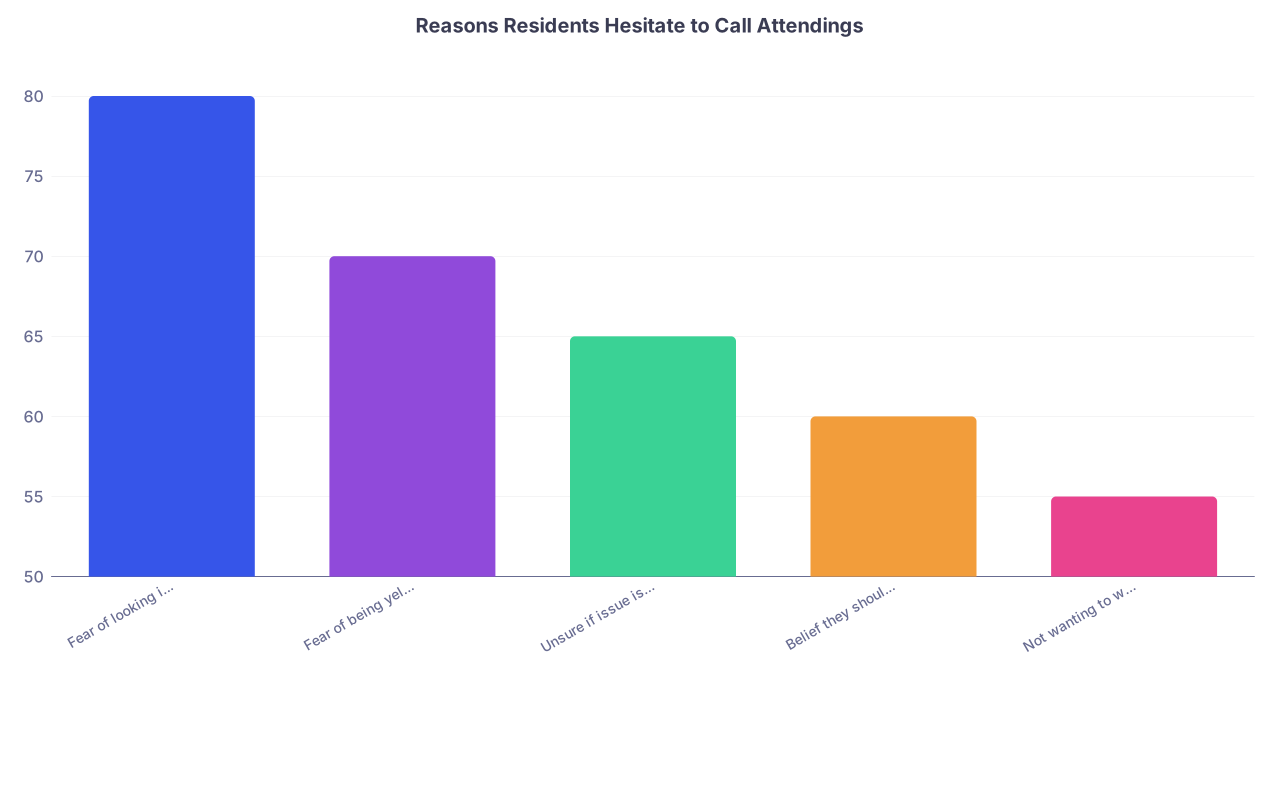
| Category | Value |
|---|---|
| Fear of looking incompetent | 80 |
| Fear of being yelled at | 70 |
| Unsure if issue is serious | 65 |
| Belief they should handle it alone | 60 |
| Not wanting to wake attending | 55 |

| Step | Description |
|---|---|
| Step 1 | Notice change in patient |
| Step 2 | Go assess in person |
| Step 3 | Document and monitor |
| Step 4 | Stabilize what you can |
| Step 5 | Call attending |
| Step 6 | Reassess in short interval |
| Step 7 | Still worried? |
| Step 8 | Thought about calling twice? |

Concrete Step You Can Take Tonight
Print this if you have to. On your next night shift, before things get busy:
- Ask your attending: “What do you definitely want to be called for tonight?”
- Write your four-part call script on your sign-out sheet.
- Decide your rule: “If I think about calling more than twice, I call.”
Then when the clock hits 3 a.m. and your stomach drops at a bad vital, don’t re-run your anxiety movie for the hundredth time.
Pick up the phone.
FAQ (Exactly the Stuff You’re Too Embarrassed to Ask Out Loud)
1. What if my senior tells me not to call the attending, but I’m still worried?
This is awful when it happens, but it does. First, be explicit with your senior: “I’m actually pretty uncomfortable with this; I think we should loop in Dr. X.” If they still shut it down and you truly think the patient isn’t safe, you are allowed to escalate. That might mean calling the attending yourself and saying, “I know you weren’t paged yet, but I’m worried about this patient.” Or involving the charge nurse. Is it socially awkward? Yes. Is it better than being the one who stayed quiet when you knew something was wrong? Also yes.
2. How much info should I have before calling, especially when it’s chaotic?
Enough to not sound like you haven’t seen the patient. At minimum: you’ve looked at them, checked their vitals yourself (or verified them), know the reason they’re admitted, and have done obvious immediate things (fluids for hypotension, oxygen for hypoxia, etc.). You don’t need the entire chart memorized. You can literally say, “I haven’t reviewed all their imaging yet, but acutely I’m seeing X, Y, Z.” Chaos is not an excuse to hide; it’s a reason to call sooner.
3. What if I accidentally forget to call and realize it later? Am I doomed?
No, but you should not bury it. When you realize, call and be straightforward: “I should have called you earlier about this and I didn’t. Here’s what happened.” Most attendings respect that more than the resident who pretends everything went perfectly. You may get feedback. It might sting. But that conversation is exactly how you make sure you don’t repeat the same mistake.
4. How do I stop replaying bad calls in my head for days afterward?
You probably won’t totally stop—residency and rumination are a pair. But you can box it in. After a rough call, take five minutes to jot down: what happened, what you did well, what you’d change next time, and one sentence of “good enough” reality (“I called because I was worried; that was the right thing.”). Then you close the note and move on. If you need to debrief, grab a trusted senior or co-resident and say, “Can I sanity-check how I handled this?” Don’t let vague self-loathing be the only voice you hear.
Open the Notes app on your phone right now and type out your 4-part night-call script in your own words. The very first time you use it at 3 a.m., you’ll be terrified—but you won’t be lost.