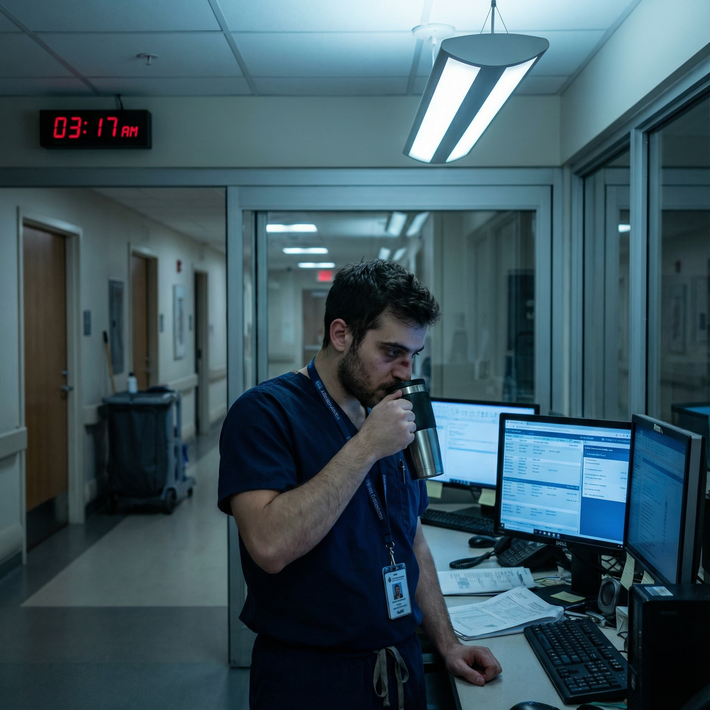
You do not need perfect notes right now. You need safe notes. Defensible notes. Notes that let the next team understand what happened and what still matters.
That distinction saves people.
I’ve seen residents waste an hour polishing one elegant progress note while six higher-risk patients had nothing useful documented. That’s backwards. If you’re behind on night float notes, the job is not to become a novelist at 3:40 a.m. The job is to reduce risk fast, document the essentials, and build a system that stops this from happening again.
Here’s the standard I want you to use:
- Patient safety first
- Legal defensibility second
- Efficiency always
- Perfection never
At this point you should stop thinking, “How do I catch up on everything beautifully?” and start asking, “Which notes matter most, and what is the minimum safe version of each?” That’s the whole game.
Step 1 (Day 0–1): Triage the backlog in 15 minutes
Your first move is not writing. It’s sorting.
At this point you should make a notes triage list. One sheet of paper. One note in your phone. One sticky in the workroom. I don’t care. But it must be visible and ordered by risk and deadline, not by guilt.
Use four buckets:
- STAT – safety-critical documentation needed now
- Same-day – needed for continuity before handoff or rounds
- 24–72h – important documentation, but not immediately dangerous
- Defer – only if truly low risk and no operational deadline
A simple triage pass looks like this:
- List every missing note.
- Put each patient into one of the four buckets.
- Mark charting deadlines or service expectations.
- Circle anything involving instability, escalation, procedures, goals-of-care change, or major plan revision.
STAT notes usually include:
- Rapid response or decompensation
- New oxygen requirement, pressors, chest pain, neuro change
- Admission with unclear plan
- Procedure/event note that explains a major intervention
- Cross-cover event that changed management
Same-day notes usually include:
- New admissions needing a basic anchor note
- Significant overnight updates before sign-out
- Consult follow-up with actionable recommendations
- Patients likely to be discussed on rounds
24–72h notes are often:
- Lower-acuity progress updates
- Routine continuity notes
- Documentation that matters, but won’t immediately jeopardize care
Defer is the smallest pile. Be honest. Most people overuse it because they’re tired.
Also identify your blockers immediately:
- No template ready
- Missing labs or imaging
- Unclear assessment/plan
- Gaps from several admissions in a row
- Sign-out was weak and now you’re reconstructing the night from crumbs
That last one is common. Brutal, but common.

Once the list exists, your brain calms down. Chaos hates being named.
Step 2 (Day 1–2): Write the ‘minimum safe note’ template first (then expand)
Now you write. But only the minimum safe version first.
At this point you should use a category-based template where risk determines detail. This is faster and smarter than reinventing every note from scratch. If you are opening with the HPI and trying to sound polished, you’re already wasting time.
Your minimum safe note needs four core pieces:
- Interval events – what changed
- Objective data reviewed – key vitals, labs, imaging, exam findings
- Assessment – what you think is going on
- Plan – what is being done next, by whom, and when
That’s enough to make a note useful.
A practical skeleton:
- Overnight/interval events: “Admitted overnight for hypoxemia; required escalation from 2L NC to HFNC.”
- Objective: “Reviewed vitals, CBC/BMP, CXR, RT documentation.”
- Assessment: “Acute hypoxemic respiratory failure likely multifactorial, concern for pneumonia vs volume overload.”
- Plan: “Continue HFNC, repeat VBG at 0600, broad-spectrum antibiotics already started, follow cultures, reassess after diuresis, sign out to day team for pulmonary review.”
That works. It’s not pretty. It’s good enough to protect the patient and explain your thinking.
What wastes time?
- Rewriting the whole HPI from the ED note
- Listing every negative review-of-systems item no one needs
- Over-polishing phrases
- Building a differential with ten zebras when the plan is unchanged
- Copy-forward junk that makes the note longer and less true
That stuff is dumb. Skip it.
For higher-risk cases, add explicit safety language:
- “Patient re-evaluated at bedside”
- “Nursing updated on call parameters”
- “Escalation to senior/attending discussed”
- “Return assessment planned after intervention”
That sentence or two matters far more than elegant prose.
At this point you should be finishing notes in passes. First safe. Then fuller later if needed.
Step 3 (Week 1): Backfill efficiently—use a ‘priority sprint’ and a reusable structure
By week 1, the immediate fire should be shrinking. Now you need a repeatable clean-up method.
At this point you should do one priority sprint per day, ideally 60–90 minutes, focused only on the highest-risk leftover backlog. Not inbox. Not random chart browsing. Not helping three people troubleshoot printers. Just notes.
Structure the sprint like this:
- Open your triage list.
- Finish all remaining STAT or same-day carryovers first.
- Use one consistent problem-based format for every patient.
- Stop when the sprint ends.
The reusable structure I like is simple:
- Problem
- Current status
- New data
- Plan
- Follow-up needed
That reduces cognitive load. You’re no longer deciding how to write each note from scratch. That’s where people burn out.
Also build yourself a macro list for common recurring note elements:
- Admission problems
- Consult follow-up
- Lines/airway/tubes
- Pain control
- DVT prophylaxis
- Bowel regimen
- Antibiotic course
- Discharge readiness
- Pending imaging/labs
- Code status / goals of care
Good macros save time. Bad macros create bloated fiction. If the macro adds garbage you don’t verify, kill it.
The goal of the sprint is not heroics. It’s consistency. One clean bite every day beats one giant guilt-fueled binge charting session.
Step 4 (Day 3–14): Quality control—make notes defensible without rewriting everything
Now you tighten quality. Not by rewriting. By checking the right things.
At this point you should run a 5-point defensibility checklist before signing a catch-up note:
- Does the note explain why the patient mattered tonight?
- Did I review and document the key objective data?
- Is the assessment medically coherent?
- Is the plan specific about next steps and timing?
- Does the note match what actually happened?
That last one is where documentation drifts into nonsense.
Common drift errors:
- Saying meds were given when they were actually held
- Referring to labs as “pending” when they already resulted
- Carrying forward yesterday’s oxygen support
- Copying an exam that no longer fits
- Implying reassessment happened when it didn’t
This is how notes become legally ugly. And clinically useless.
Plan specificity matters more than people think. “Continue to monitor” is weak. “Repeat BMP at 0600, reassess potassium after replacement, notify covering team if K remains <3.2” is defensible.
You do not need to make every note beautiful. You do need it to be accurate.
Step 5 (Week 2–4): Prevent recurrence with an after-round ‘note rhythm’ (night-shift friendly)
If you only catch up and never change your rhythm, you’ll be right back here next month. I’ve watched that loop too many times.
At this point you should build a night-shift note rhythm that happens in small bursts. End-of-shift mega-charting is a trap. You’re tired, details blur, and your sign-out gets worse.
Use this rhythm:
- Start of shift: review carryovers, preload note shells, identify likely event-heavy patients
- After each major event/admission: enter 2–4 lines immediately
- Midnight check: update objective data and pending tasks
- Pre-signout: close the loop on interval events and active plans
- Post-signout if time remains: expand lower-risk notes
Your rule is simple: close the loop before you leave.
That means:
- If you changed the plan, the note reflects it
- If a result mattered, you document how it changed management
- If you gave sign-out on an issue, the problem list matches that issue
Also keep a lightweight missing-pieces system:
- Lab/imaging pull list
- Consult follow-up queue
- Pending tasks log
Not a masterpiece. Just something you’ll actually use at 2:17 a.m.
This rhythm is boring. Good. Boring systems save you.
Step 6 (1–2 Months): Team-level alignment and escalation plan if you’re consistently behind
If you’re still chronically behind after several weeks, stop making it a morality play. Sometimes it’s you. Sometimes it’s the system. Often it’s both.
At this point you should review:
- Number of admissions per shift
- Frequency of unstable cross-cover events
- Whether templates are helping or slowing you down
- Whether your sign-out process is weak
- Whether you’re getting interrupted every ten minutes for nonessential nonsense
If the backlog is persistent, ask for help early:
- Template review with a senior
- Protected note time
- Workflow redesign
- Redistribution of admissions or cross-cover burden
- Better handoff structure
- Direct feedback on whether your notes are too long
That is not weakness. That is adult behavior.
Also document your risk mitigation if you had a serious backlog:
- What you addressed immediately
- How you prioritized
- What remains completed vs pending
- When supervising physicians were updated if appropriate
That way the record reflects responsible action, not neglect.
If your system is broken, fix the system. White-knuckling it is overrated.
Summary: Your 6-step fix—triage, minimum safe, sprint, QA, rhythm, and escalate if needed
Here’s the timeline, stripped down to what matters:
- Day 0–1: Triage the backlog by risk and deadline.
- Day 1–2: Write the minimum safe note first.
- Week 1: Use a daily priority sprint to clear high-risk leftovers.
- Day 3–14: Run a defensibility check before signing.
- Week 2–4: Build a night-friendly note rhythm in small bursts.
- Month 1–2: If you’re still behind, escalate early and fix the workflow.
At this point you should decide what the next 60 minutes are for. My recommendation:
- Spend 15 minutes making the triage list
- Spend the next block clearing STAT notes
- Then write same-day minimum safe notes
- Leave polish for later, if later exists
That’s the win condition: safety, defensibility, and a repeatable process.
Not perfect writing. Not pretty writing. Useful writing. That’s what good night float documentation actually is.